
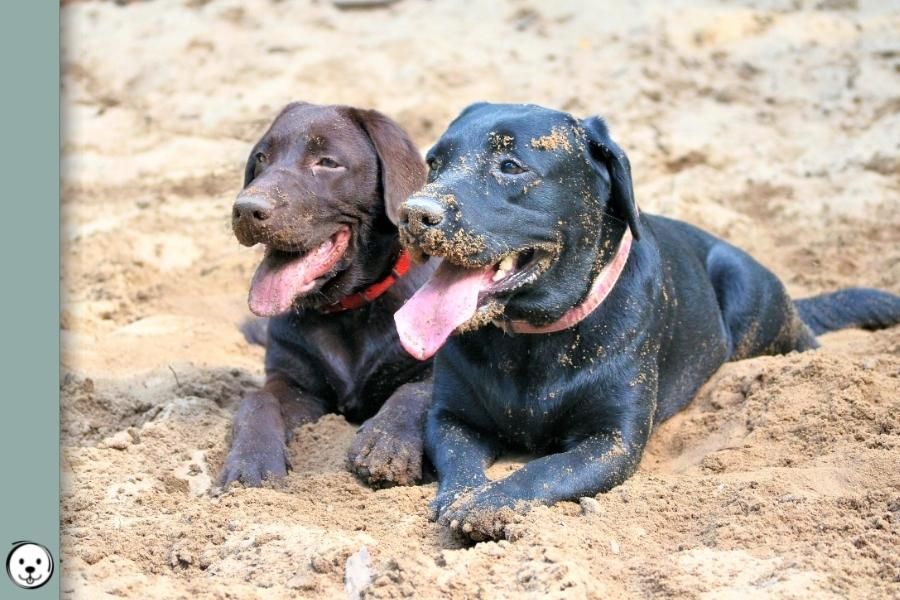
Want to know what to expect in your whelping box?
A Punnett Square is an easy tool to Mendelian traits such as puppy coat colors. This small table helps us estimate the probability with which each puppy will inherit certain traits.
Getting Started
If you are familiar with the genetics basics, you already know about genes and alleles. But let’s repeat some of the basics before we talk about the actual inheritance of coat color:
The different versions (wild-type and mutants) of the same gene are called alleles.
In diploid body cells (also called somatic cells), you find two copies of each gene, so there will be two alleles per gene. These alleles can be identical (homozygous) or they can be different (heterozygous).
Example:
Let’s say at the B-Locus, there are two possible alleles we call B and b.
B is the dominant allele in this series and b is the recessive allele (B > b). A dog with two identical alleles (B/B or b/b) is homozygous. A dog with two different alleles (B/b) is heterozygous.
Since B is dominant, it will cause a black coat both in homozygous dominant (B/B) as in heterozygous dogs (B/b). Only the absence of B in homozygous recessive dogs (b/b) will cause a brown coat.

Basics of Reproduction
When breeding a dog, it does not pass on both of its alleles to its offspring.
Instead, there is only a 50 % chance for each allele to be passed on.
Only diploid body cells have a double set of chromosomes. But a gamete (egg or sperm cell) is haploid, it has a single set of chromosomes and contains only one copy of each gene.
The process that halves the chromosome set is called meiosis.
A dog that is B/b will produce egg or sperm cells that each contain either B or b but never both. Each time a productive cell is made, there is a random chance for each allele to get on board or not.

Each reproductive cell has a unique combination containing only one allele for each gene.
These single sets of alleles from each parent are then recombined into a new diploid double set of alleles in the offspring. Each puppy only gets one of the two possible alleles from each parent.
Every puppy genotype consists of one paternal allele and one maternal allele.

If parents are heterozygous at a certain locus, they are able to offer different alleles.
And since each puppy has a 50 % chance to inherit either allele, this quickly creates a scenario with multiple possible combinations in the same litter….

There is an equal chance for each possible combination;

We can then combine the chances for identical genotypes or phenotypes:

But it looks awfully complicated to draw this each time, doesn’t it?
Using Punnett Squares
Punnett Squares are a simple aid to visualize the outcome of certain pairings.
This simplified notation method was named after British geneticist Reginald Punnett and helps us work out the possible genotypes of the puppies in a litter quite easily.
For now, we’ll stay with our example from above and look at a B/b x B/b mating.
To start we just need a 2×2 table and label the rows and columns with the parents’ genotypes.
One parent’s genotype goes to the column header, the other parent’s genotype goes to the row header of our table. Each header cell contains one of the possible alleles.

In the next step, we fill in the table cells by combining the alleles from the table headers.
In genetics, the dominant allele in each combi is typically written first.

Try different combinations in this simple calculator:
What can Punnett Squares tell us?
If we list the possible combinations in a mating for each gene locus we learn two things:
- First, we can get an idea of which colors are possible in general.
- Second, we get an estimate of how likely each puppy will be a certain color.
A common mistake is to think we could determine the ratio of colors we get in a litter. But every puppy is an independent random event (like throwing dice or tossing a coin several times in a row).
We can only predict the color likelihood for each individual puppy.
We can not predict the overall color ratio for a whole litter.
The same goes for the gender of the puppies. We very well know that each puppy has a 50 % chance to be a boy or a girl. But it’s impossible to predict the ratio of boys to girls in an expected litter.
Btw, the different genes that produce all the canine coat colors are inherited entirely separate from each other. Every available allele has its own 50 % chance of being passed on. Meaning: If a dog inherits allele B or b does not affect what allele it inherits on other loci (e.g. if it’s merle or tan point or whatever).
How will My Puppies Look?
Punnett Squares help us determine how likely each offspring will have a certain genotype.
A Punnett square for one trait has four possible outcomes.
Each cell in the table represents a 25% chance.

To calculate the likelihood for each genoytpe, we just have to count how often this combination appears in our table cells. And then we add the 25% chances for identical combinations.
In our example with two heterozygous parents (B/b x B/b), every puppy had a 25% chance (1 out of 4 cells) to be homozygous dominant (B/B), 50% (2 out of 4 cells) to be heterozygous (B/b) and 25% (1 out of 4 cells) again to be homozygous recessive (b/b).

You can also count the chances only by phenotype. In our example, every puppy had a 75% chance to be born with black eumelanin (B/B or B/b) and a 25% chance to be born with brown eumelanin (b/b).

Multiple Trait Punnet Squares
Punnett Squares also work to illustrate the probabilities of inheritance for more than one gene at the same time. We just have to list every possible pairing of alleles each parent could offer.
Genes are passed on separately from each other. This means that each of the two alleles from one locus can end up in the same gamete as each of the two alleles from another locus.

This increases the possibilities in a Punnett square significantly. We now have 16 cells of possible genotype outcomes, meaning each cell only represents a chance of 1/16 or 6.25%.

In this example, there are four possible phenotypic outcomes:
- B/- D/-: black eumelanin
- B/- d/d: blue eumelanin(diluted black)
- b/b D/-: brown eumelanin
- b/b d/d: lilac eumelanin(diluted brown)
Each puppy has a chance of 56.25 % (9 of 16 cells) to have black eumelanin, 18.75 % (3 of 16 cells) to have diluted black “blue” eumelanin, another 18.75 % (3 of 16 cells) to have brown eumelanin, and a slim chance of 6.25 % (9 of 16 cells) to have diluted brown “lilac” eumelanin.
You can look at even more traits at the same time. But this is not really advisable since a Punnett table can get quite large after two traits. It’s easier to do each locus separately and then combine the chances.
To do this, you have to calculate the chances as decimals, just divide the percentage value by 100.


You can now draw a tree diagram to visualize the probabilities of a sequence of events.
Our first event is what happens at the B locus:

Our second event is what happens at the D locus:
We can now combine the events into a sequence. Then we can calculate the chances for each outcome by multiplying the chances of each event in a sequence.
By genotype:

By phenotype:

I know that this can be a little confusing at first. But I’m sure you’ll get the hang of it quickly!
If you want to play around, there are some Punnett Square Calculators available online.
If you want to learn more about Punnett Squares, you can also watch this video on how to use them or have a look at this illustrated case study.
Learn More

Hi! I’m Steffi. I am a biologist and a big time dog nerd. You are curious about coat color genetics? You’ve come to the right place! Read more.