

The E locus controls how much eumelanin will be expressed. Different alleles can cause melanistic masks, domino, grizzle, and cocker sable phenotypes, or a recessive red coat.
E Locus Overview
The extension can shift the ratio of black to yellow pigment in any pattern.
Alleles at the E locus are thought to show mild incomplete dominance.
This is the dominance hierarchy of the alleles at the E-locus[8]:
There is limited info about the hierarchy and interaction of the eA and eG domino alleles with one another (simply because there aren’t too many Husky-Spaniel or Borzoi-Malamute mixes out there).
In 2026, a new E locus variant was described[9]. This variant seems to make MC1R less responsive to ASIP, which weakens its ability to switch pigment production from black to red pigment. This increases the effect of incomplete dominance between A locus alleles (where carriers show darker patterns).
Given the number of known alleles, there are various possible allelic combinations. These are the phenotypes controlled by the E-Locus:
| Em/- | Melanistic Mask |
| E/- | Normal Extension |
| eA/- | Northern Domino |
| eG/- | Grizzle, Domino |
| eH/- | Cocker Sable |
| e1/– | Recessive Red |
| e2/- | Recessive Red (Australian Cattle Dog variant) |
| e3/– | Recessive Red (Husky variant) |
E Locus Calculator
This simple tool can help you predict different E Locus combinations:
E Locus Alleles
The MC1R gene on chromosome 5 encodes the plan for the Melanocortin 1 Receptor.
Pigment cells by default produce only phaeomelanin. The MC1R receptor is found in the membrane of pigment cells, where it waits to be activated to turn on eumelanin production.
The E locus plays the central role in pigment type switching.
The A locus and K locus can cause different pigment patterns by interacting with MC1R. Mutations in the E locus can interfere with its ability to interact with the A locus and K locus.
The E locus has epistatic control over whether the A locus and K locus will be expressed.
Depending on what alleles a dog has, the E locus can promote, enable, restrict, or inhibit eumelanin production in any pattern provided by the A locus and K locus.
Melanistic masks (Em) add eumelanin to the face, the wild type (E) enables normal eumelanin, domino alleles (eA, eG, eH) partially remove eumelanin, and recessive red (e) fully inhibits eumelanin.
Melanistic Masks (Em)
Melanistic masks add additional eumelanin to a dog’s muzzle.
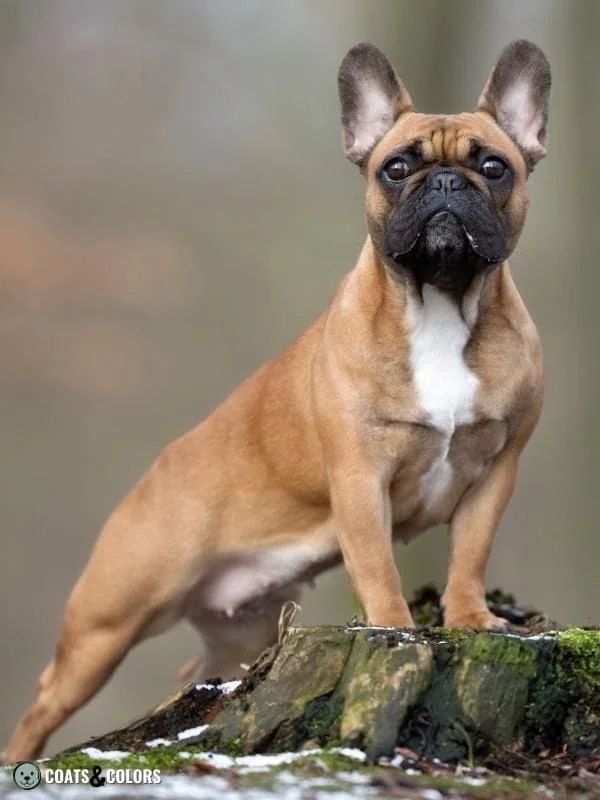
Dogs with a melanistic mask typically have a sable, agouti, saddle, or tan point pattern with or without brindle. White markings on a dog’s face can hide a melanistic mask.
Masks can be very minimal. Or they can extend and add shading to much of the ventral surface.
A mask gets its color from eumelanin. So it can be black, brown, blue, or lilac.
Wild Type (E)
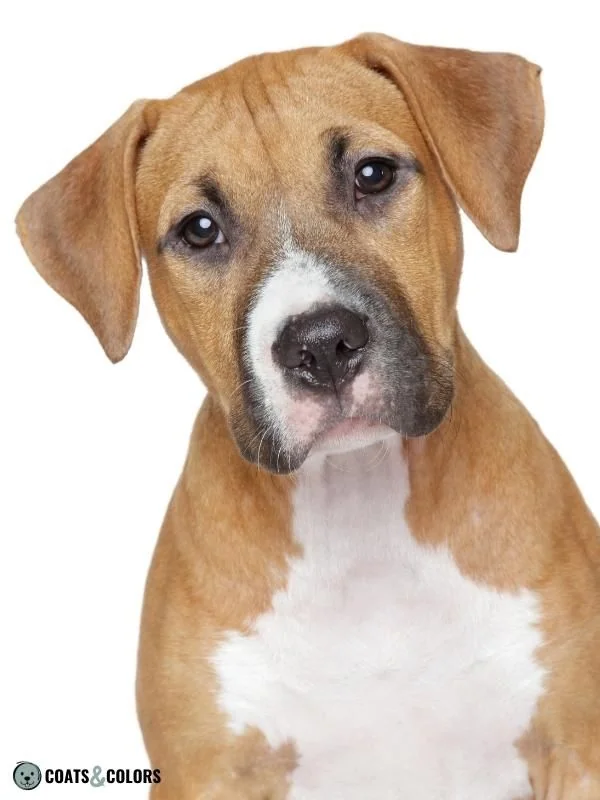
The wild-type allele E does not interfere with eumelanin expression. Whatever a dog has on its K locus and A locus will be expressed normally. Any dog that displays a regular maskless pattern with expected levels of phaeomelanin and eumelanin (sable, agouti, saddle, tan point) should test as E/-.
Northern Domino (eA)
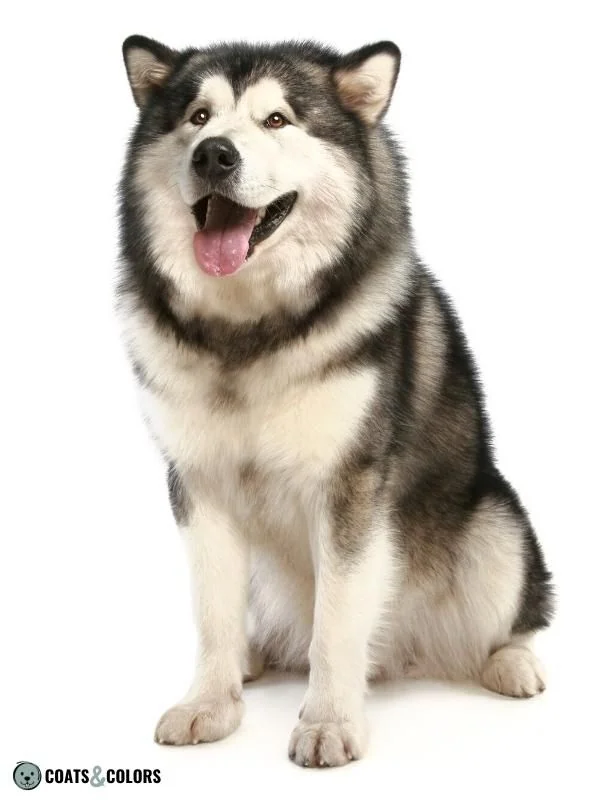
Domino restricts eumelanin production in any given pattern. It causes a light undercoat and a pale hair base while also reducing dark shading and dark hair banding. Domino usually makes any area with solid eumelanin smaller while causing larger phaeomelanin markings.
But how a dog with Northern domino actually looks depends on its original pattern[7].
Interestingly, many affected dogs have a pink stripe down their nose.
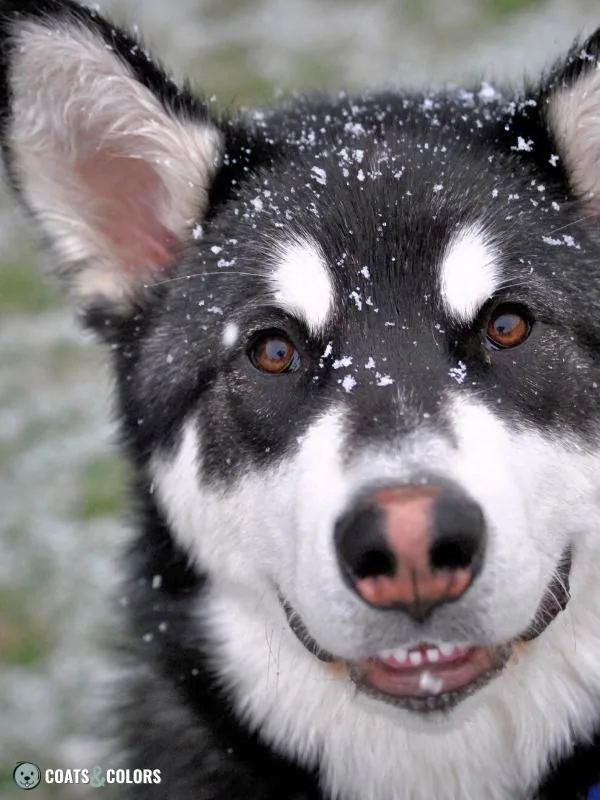
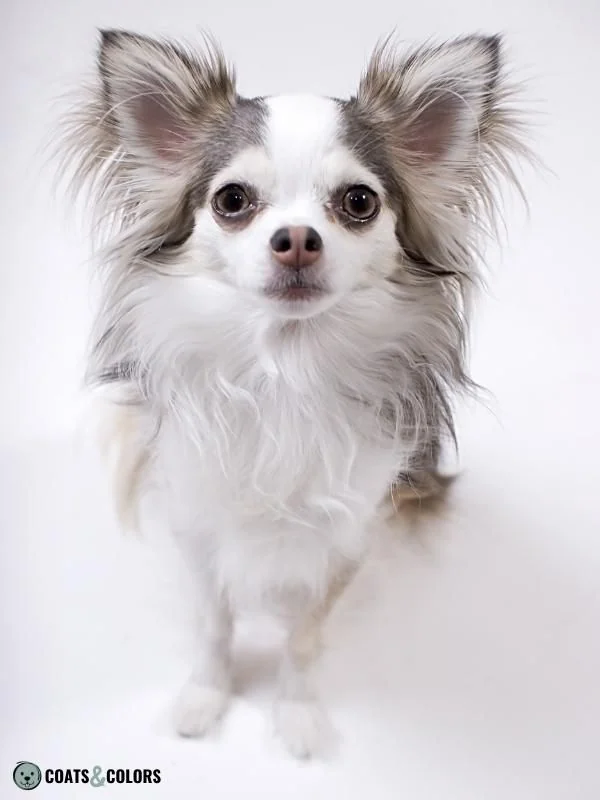
Since eA was found in dog remains from 10.000 years ago, it was named eAncient Red[6]. This allele is mostly found in Northern breeds such Alaskan Malamutes or Huskies, it is also called Northern domino.
This variant was also proven to occur in many other breeds like Chihuahua, Beagle, or Tibetan Spaniel.
Grizzle Domino (eG)
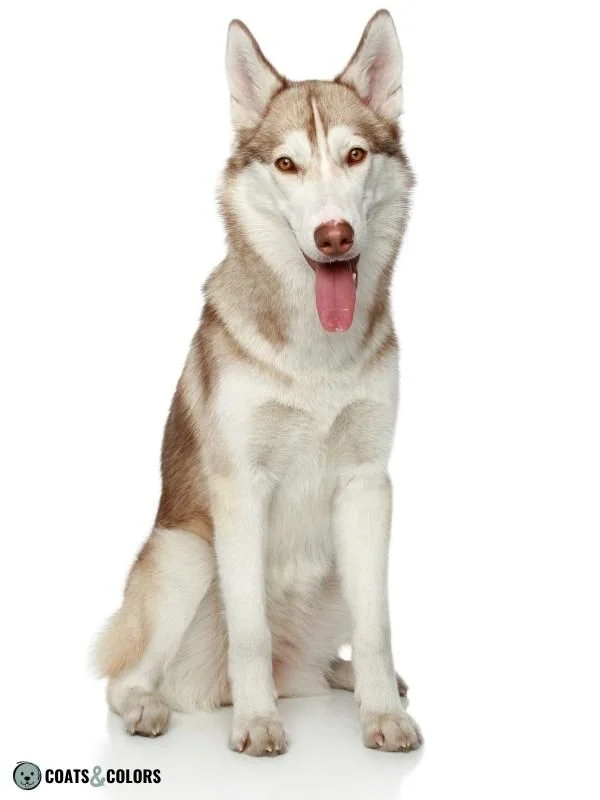
The eG allele works very similarly to Northern domino. It also limits the amount of eumelanin[3].
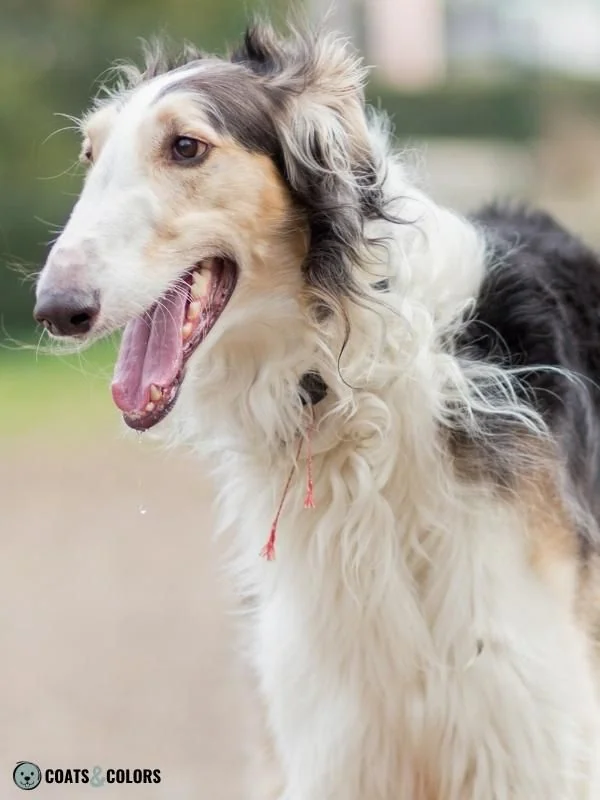
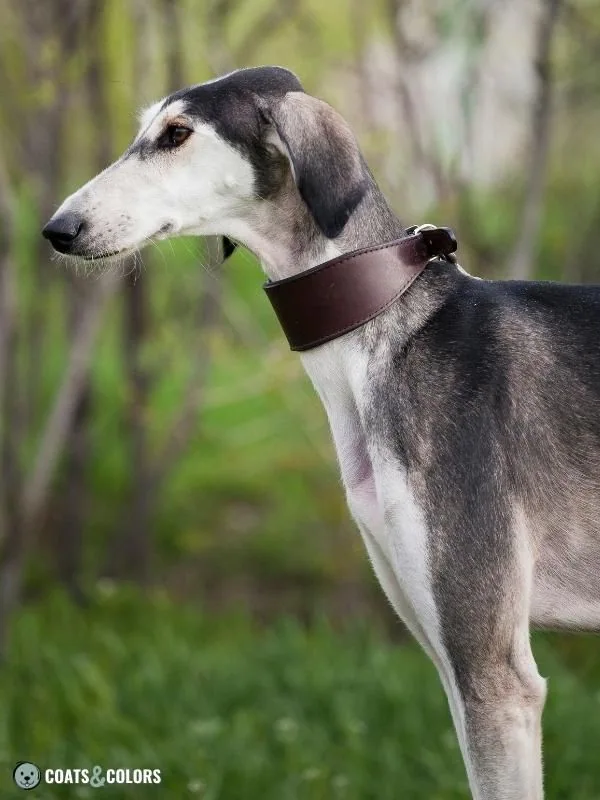
This variant is mainly found in sighthound breeds.
The most common pattern is tan point domino with pale facial markings and a widow’s peak. This phenotype is known as grizzle in Salukis, domino in Afghan Hounds, or sable in Borzos.
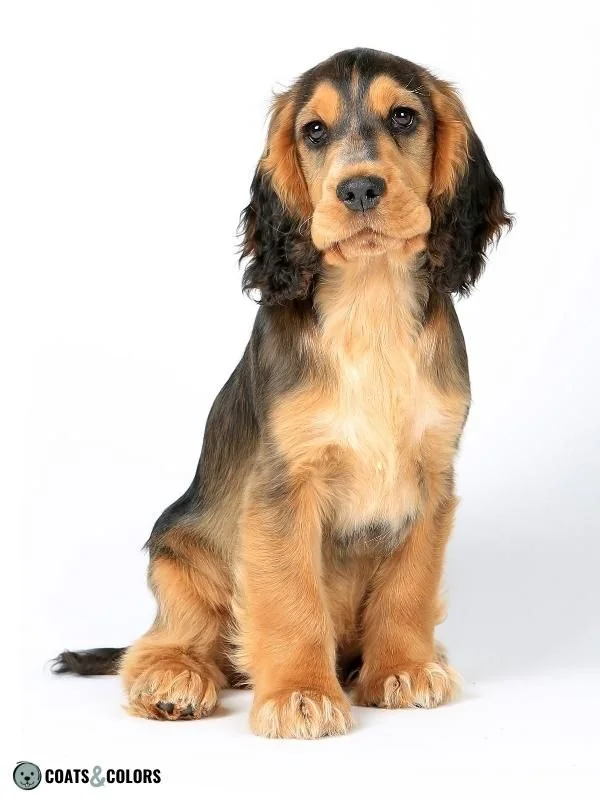
Cocker Sable (eH)
English Cocker Spaniels and American Cocker Spaniels have their own version of a domino phenotype.
The eH allele causes a sable-like pattern (cocker sable) in dominant black dogs (eH/- KB/- at/at).
Recessive Red (e1-3)
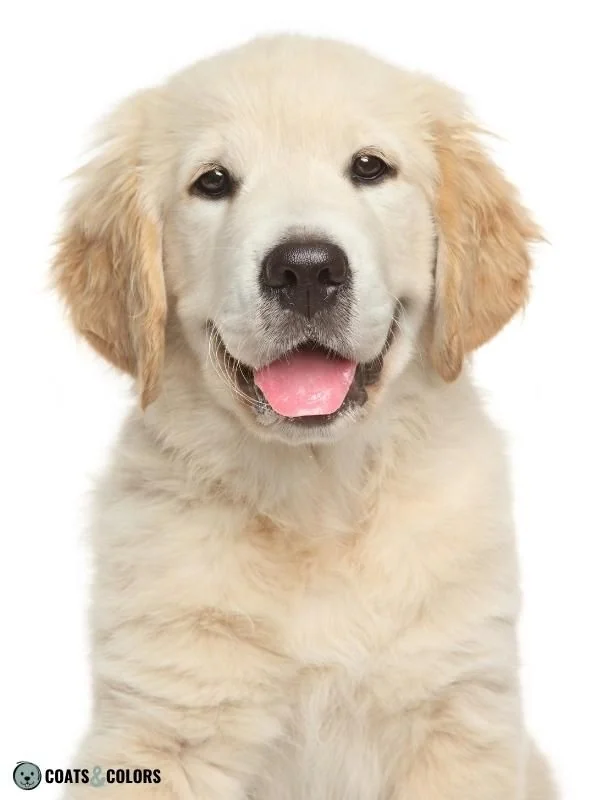
All three e alleles (e1, e2, e3) are loss-of-function variants. Having any two of these variants makes it impossible for the Melanocortin 1 Receptor to promote eumelanin production.
The e/e pattern is called recessive red.
Most breeds only have e1.
The e2 variant was found in cream-colored Australian Cattle Dogs. And e3 was found in white Huskies[1].
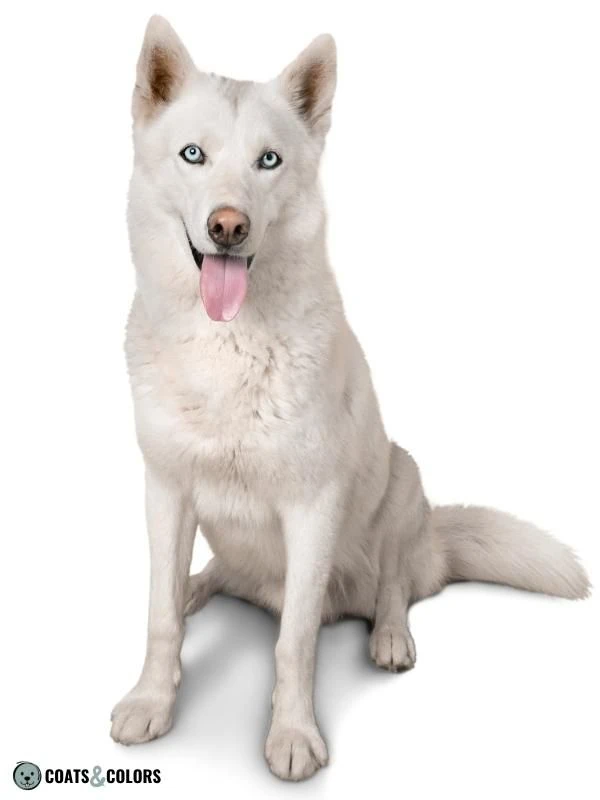
The recessive red (e/e) pattern only shows phaeomelanin.
This hides any pattern that would require at least some eumelanin.
E Locus Testing
There are some things to consider when testing a dog’s E locus.
When breeding a recessive red (e/e) dog. genetic testing is highly recommended since this coloration masks all patterns and gives no information about a dog’s genotype at other loci. This is especially true when breeding with merle since recessive red hides if a dog has a merle pattern!
Not all companies test for all versions of recessive red and domino.
When your dog has a version that can’t be detected the test result will report the wild type (E).
So if a company can only test the common e1 allele, a dog with e3/e3 genotype will likely come back as “E/E”. A dog that is actually domino (eA/e) might come back as “E/e”.
Learn More

Links
[1] Dürig N, Letko A, Lepori V, Hadji Rasouliha S, Loechel R, Kehl A, et al. Two MC1R loss-of-function alleles in cream-coloured Australian Cattle Dogs and white Huskies. Anim Genet. 2018;49(4):284–90. https://doi.org/10.1111/age.12660
[2] Newton, J., Wilkie, A., He, L. et al. Melanocortin 1 receptor variation in the domestic dog. Incorporating Mouse Genome 11, 24–30 (2000). https://doi.org/10.1007/s003350010005
[3] Dayna L. Dreger, Sheila M. Schmutz. A New Mutation in MC1R Explains a Coat Color Phenotype in 2 “Old” Breeds: Saluki and Afghan Hound. Journal of Heredity, Volume 101, Issue 5, September-October 2010, Pages 644–649. https://doi.org/10.1093/jhered/esq061
[4] S. M. Schmutz, T. G. Berryere, N. M. Ellinwood, J. A. Kerns, G. S. Barsh. MC1R Studies in Dogs With Melanistic Mask or Brindle Patterns. Journal of Heredity, Volume 94, Issue 1, January 2003, Pages 69–73. https://doi.org/10.1093/jhered/esg014
[5] Everts RE, Rothuizen J, van Oost BA. Identification of a premature stop codon in the melanocyte-stimulating hormone receptor gene (MC1R) in Labrador and Golden retrievers with yellow coat colour. Anim Genet. 2000 Jun;31(3):194-9. PMID: 10895310. https://doi.org/10.1046/j.1365-2052.2000.00639.x
[6] Ollivier M, Tresset A, Hitte C, Petit C, Hughes S, Gillet B, et al. (2013): Evidence of Coat Color Variation Sheds New Light on Ancient Canids. PLoS ONE 8(10): e75110. https://doi.org/10.1371/journal.pone.0075110
[7] Anderson, H., Honkanen, L., Ruotanen, P. et al. Comprehensive genetic testing combined with citizen science reveals a recently characterized ancient MC1R mutation associated with partial recessive red phenotypes in dog. Canine Genet Epidemiol 7, 16 (2020). https://doi.org/10.1186/s40575-020-00095-7
[8] Honkanen, L., Loechel, R., Davison, S., Donner, J., & Anderson, H. (2024). Canine coat color E locus updates: Identification of a new MC1R variant causing’sable’coat color in English Cocker Spaniels and a proposed update to the E locus dominance hierarchy. Animal Genetics. https://doi.org/10.1111/age.13398
[9] Belyakin et al (2026): Incomplete Dominance of ASIP Alleles in Hungarian Puli Dogs is Associated with MC1R Mutation. https://doi.org/10.64898/2026.03.17.712399
Hi! I’m Steffi. I am a biologist and a big time dog nerd. You are curious about coat color genetics? You’ve come to the right place! Read more.