

The Great Swiss Mountain Dog is one of the Sennenhund breeds from Switzerland. Understanding Swissie colors is very straightforward, as they only come in black tricolor.
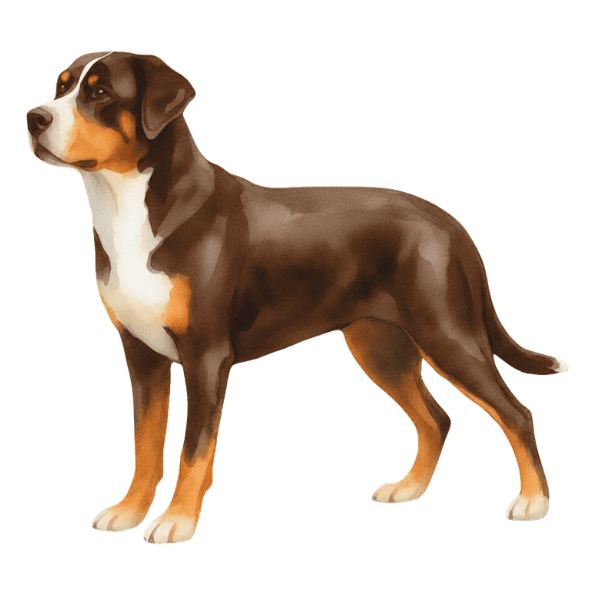
Black White & Red (Tri)
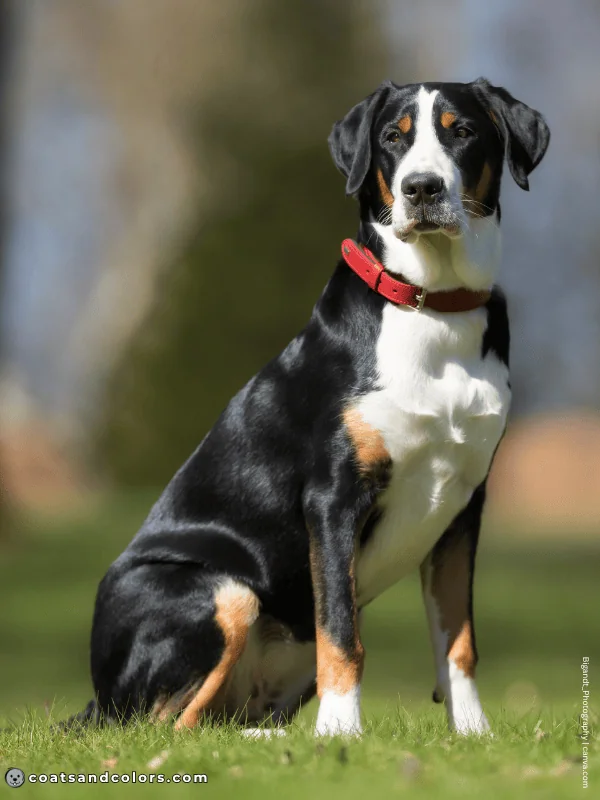
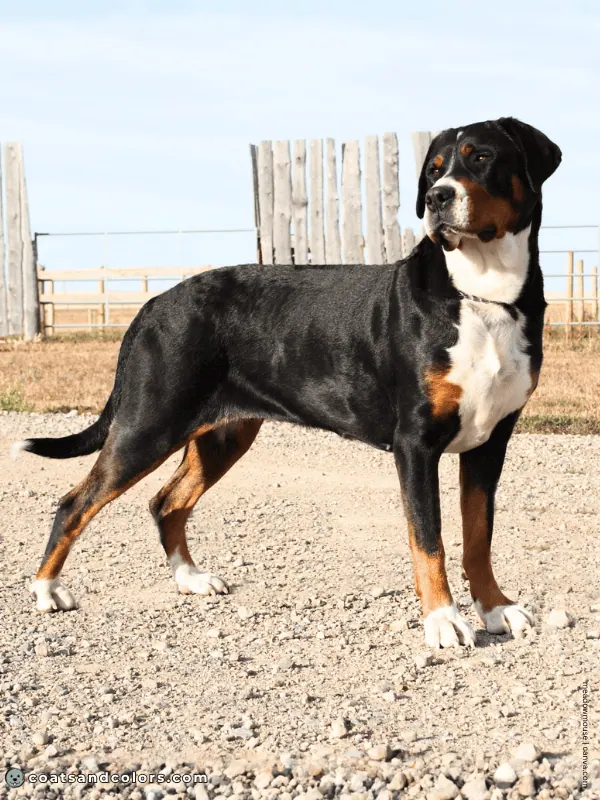
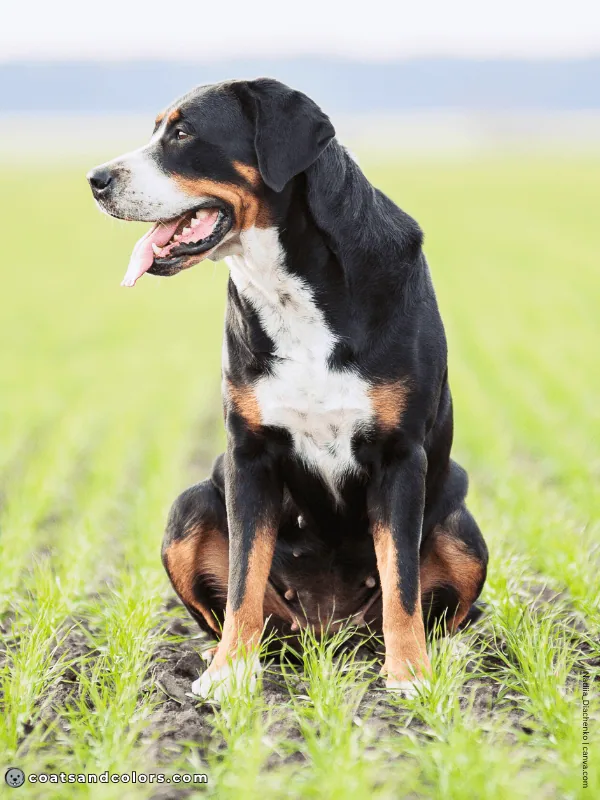
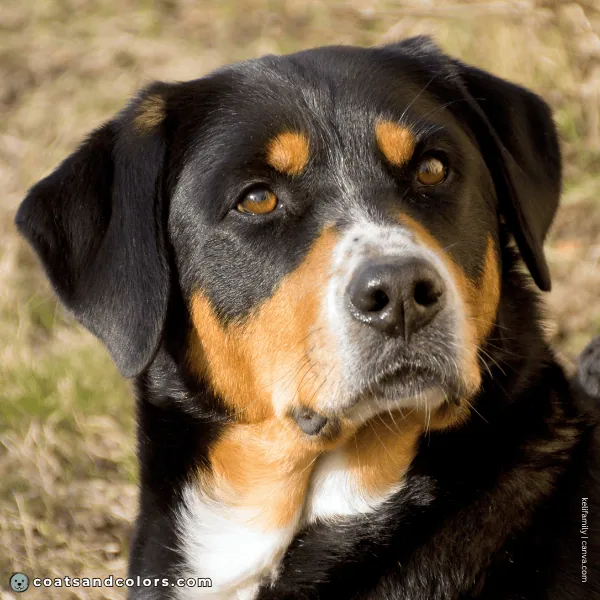
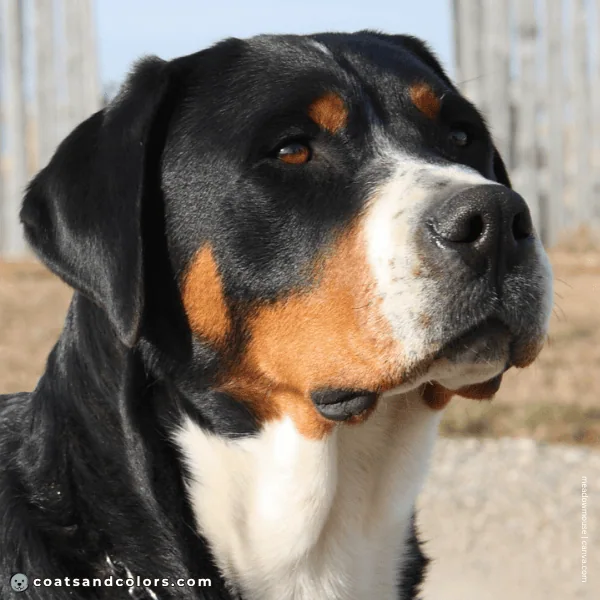
These dogs are black tricolor. They are black & tan with white markings.
It’s kind of normal for tricolor dogs to have lighter hair roots in their black coat or a yellow to grayish undercoat. Many dog breeds, including the Swissie, try to achieve solid black dorsal hairs with a dark undercoat to make the black areas look jet black. But the AKC also accepts a gray or tawny undercoat showing through, especially around the neck.
BASE PATTERN
tan point
MERLE
–
OTHER
–
EUMELANIN
black
INTENSITY
tan, red
WHITE
white markings
Faulty Colors
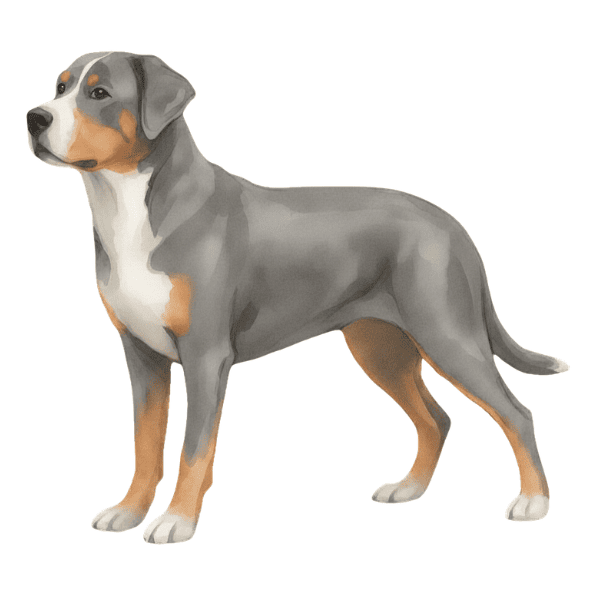
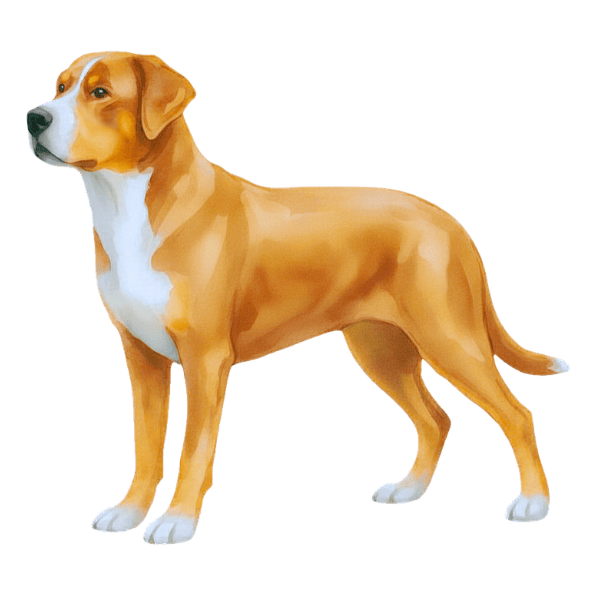
The AKC breed profile lists red & white and blue white & tan as alternate colors.
“Any color other than the “Black, Red and White” tri-colored dog described above, such as “Blue/Charcoal, Red and White” or “Red and White” is considered a disqualification.”
AKC Breed Standard[1]
“Other than tricolour coat. Main colour other than black.”
FCI Breed Standard[2]
Base Patterns
The base pattern describes the placement of phaeomelanin and eumelanin in the coat. There is an epistatic hierarchy between these genes: A locus < K locus < E locus.
- The A locus controls the basic distribution of pigment types.
- Next, the K locus can add eumelanin on top of the A locus pattern.
- Finally, the E locus regulates the general ability to produce eumelanin.
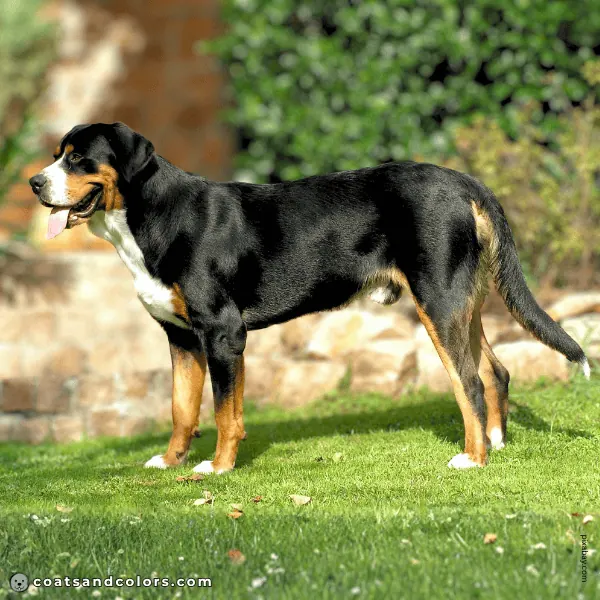
A Locus
| at | tan point |
Greater Swiss Mountain Dogs are fixed for tan points (at/at).
K Locus
| ky | wild-type |
All Greater Swiss Mountain Dogs show normal pattern expression (ky/ky).
E Locus
| E | wild-type |
Again, they are fixed for normal pattern expression (E/E).
The AKC lists red & white as a faulty color. Maybe recessive red (e) did also occur in the past?
Swiss Mountain Dog Base Patterns
| A LOCUS | K LOCUS | E LOCUS | PATTERN |
|---|---|---|---|
| at/at | ky/ky | E/E | tan point |
Base Colors
The base color is determined by the B locus and D locus.
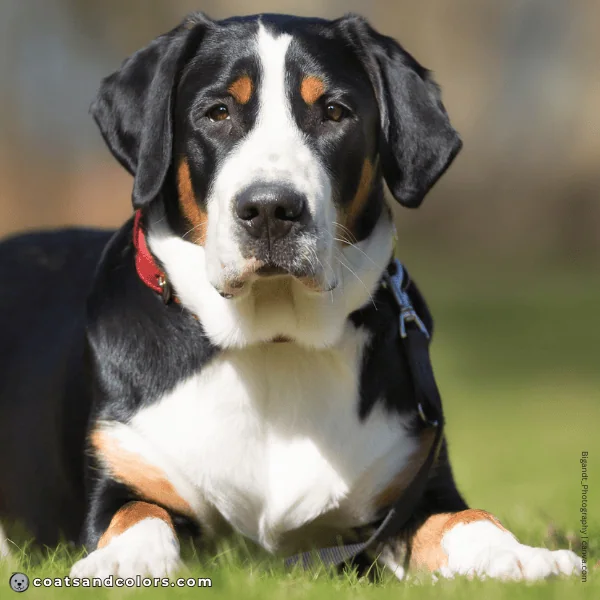
B Locus
| B | black |
Greater Swiss Mountain Dogs all have black pigment (B/B).
D Locus
| D | normal |
Greater Swiss Mountain Dogs have normal pigment (D/D).
The AKC lists blue tricolor as a faulty color. So, color dilution (d) may have been present in the past.
Red Intensity
Greater Swiss Mountain Dogs have reddish tan markings.
The FCI calls it reddish-brown, the AKC uses the term rich rust. What they mean is that they prefer an intense orange-red color and don’t want the breed to drift towards light tan and cream colors.
White Markings
The white in Swissies is typically caused by whitehead.
They have a white blaze and some white on the muzzle. The paws are white (but should not extend into white boots). White covers a large patch between chin and chest. And the tip of the tail is white. Some dogs can have a white collar (the Swissie is the only breed where this is tolerated).
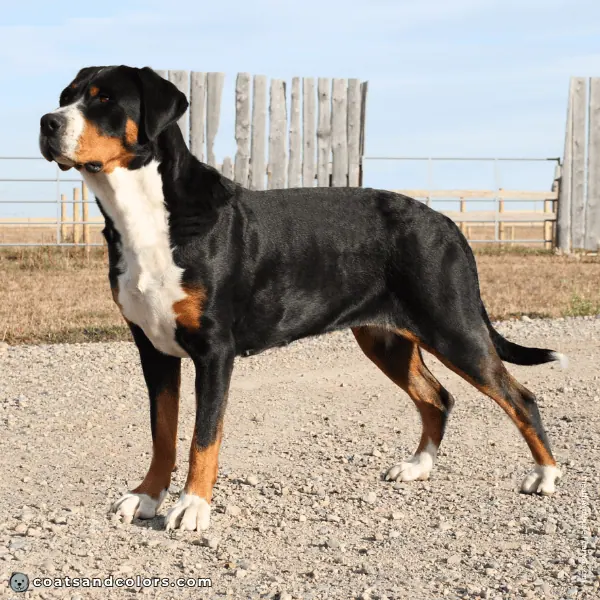
Too little white on the head (no blaze, no muzzle white) or body (no white paws, a broken chest patch, a thin white bib) are a mismark. So are “noticeably asymmetrical markings“.
More commonly, whitehead produces a little too much white. This can give a very broad blaze, face white covering the corners of the mouth, or white boots reaching beyond the pasterns or hocks.
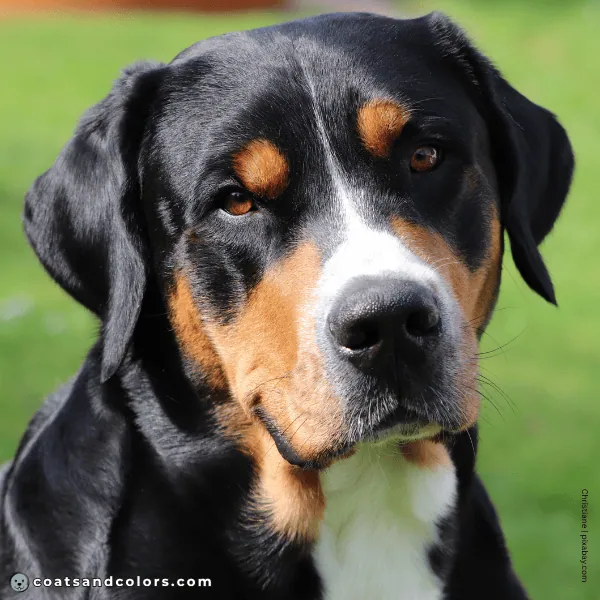
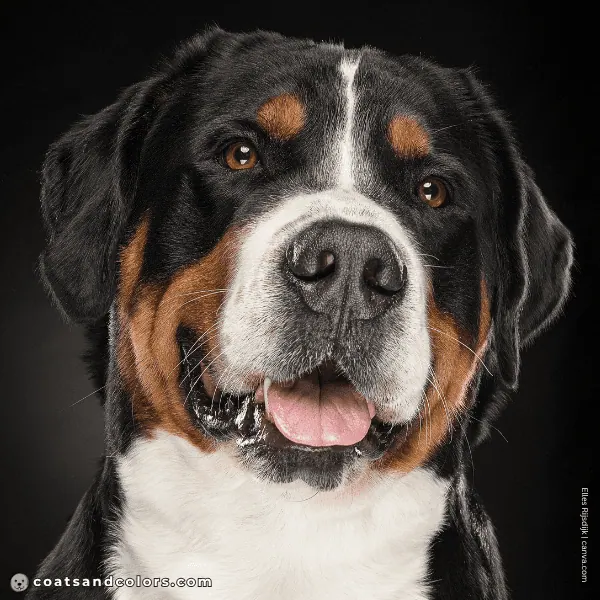
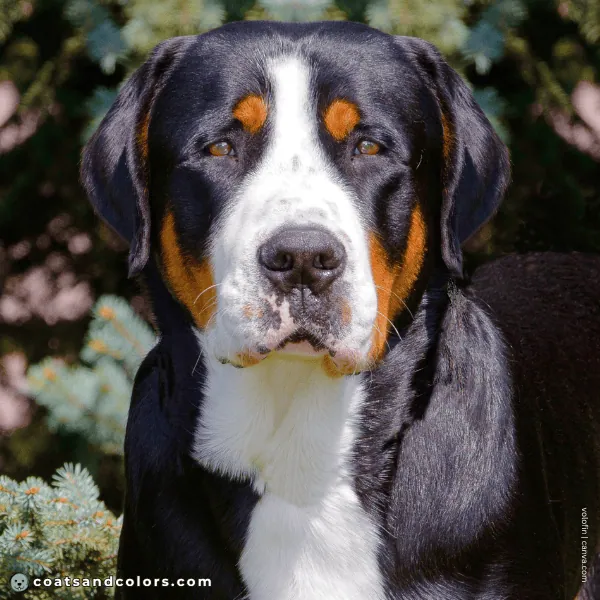
The FCI standard calls for tan markings to be visible between the black and the white markings on the cheeks, above the eyes, on both sides of the forechest, and on all four legs. This excludes extreme whitehead phenotypes, which would delete too much of the black & tan pattern.
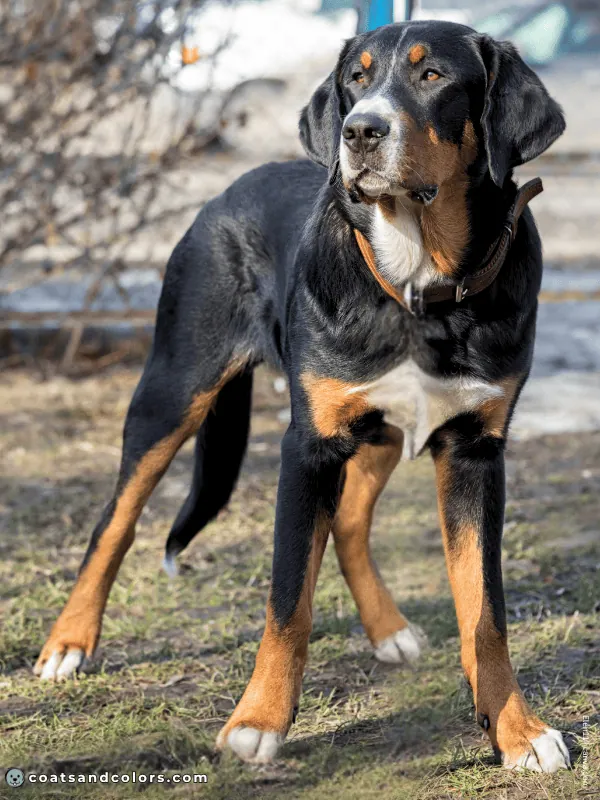
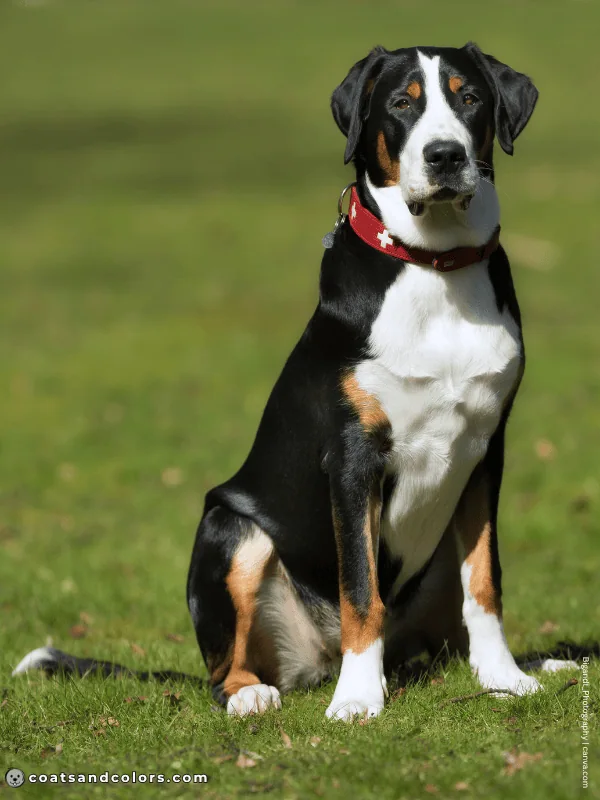
A small number of the Swiss tricolor breeds show minimal ticking.
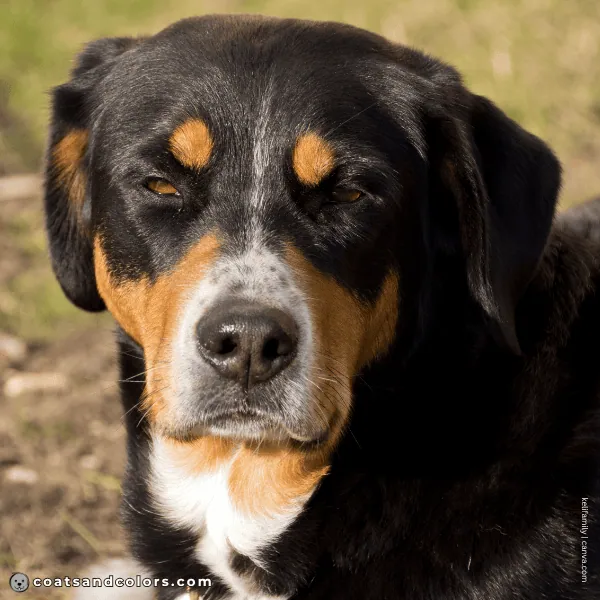
“White markings appear typically on the head (blaze) and muzzle. The blaze may vary in length and width. It may be a very thin stripe or wider band. The blaze may extend just barely to the stop or may extend over the top of the skull and may meet with white patch or collar on the neck. Typically, white appears on the chest, running unbroken from the throat to the chest, as well as on all four feet and on the tip of the tail. White patches or collar on the neck is acceptable.”
AKC Breed Standard[1]
“The white markings are on the head (blaze and muzzle), running down unbroken from the throat to the chest, also on the feet and the tip of the tail. Between the blaze and the reddish-brown markings above the eyes, a band of black should remain. A white patch on the neck or a white collar around the neck are tolerated.”
FCI Breed Standard[2]
Swissie Eye Colors
A typical Greater Swiss Mountain Dog has medium to dark brown eyes.
Lighter eye colors like amber or yellow can happen, but are deemed faulty. And some puppies with a lot of white on the face may sometimes end up with a blue eye.
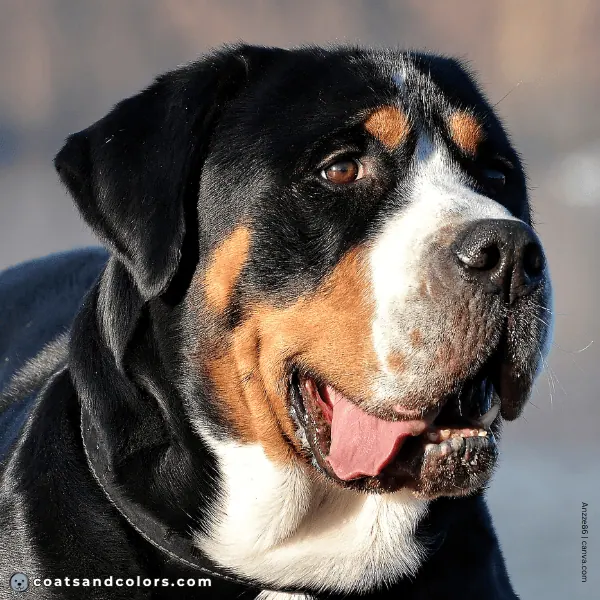
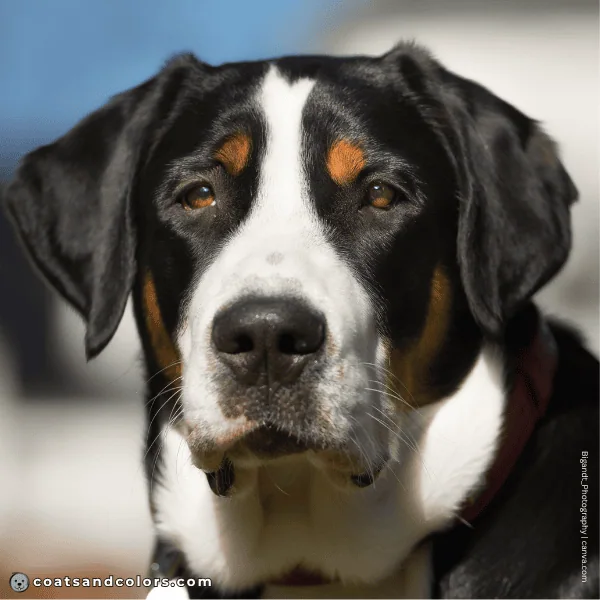
“The eyes are almond shaped and brown, dark brown preferred, medium sized, neither deep set nor protruding. Blue eye or eyes is a disqualification.”
AKC Breed Standard[1]
“Hazel to chestnut brown, with alert, friendly expression.”
“Fault: Light eyes.”
“Disqualifying Fault: One or two blue eyes (Wall eye).”
FCI Breed Standard[2]
Swissie Nose Colors
All black tricolor dogs have a black nose.

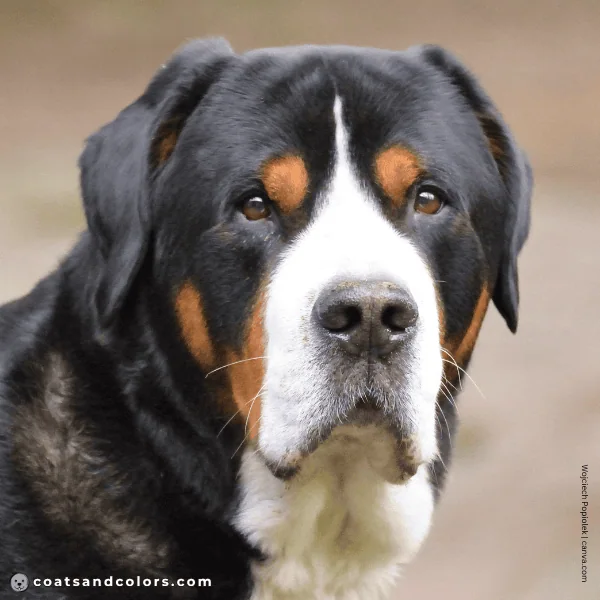
“Nose leather is always black.”
AKC Breed Standard[1]
“Nose: Black.”
FCI Breed Standard[2]
Swissie Coat Type
The Greater Swiss Mountain Dog is short-haired with a double coat.
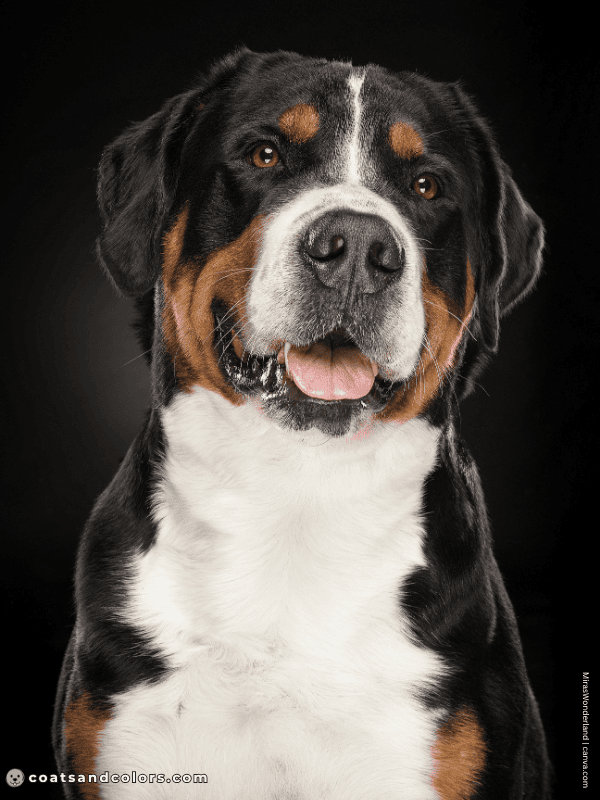
“Topcoat is dense, approximately 1-1/4 to 2 inches in length. Undercoat must be present and may be thick and sometimes showing, almost always present at neck but may be present throughout. Color of undercoat ranges from the preferred dark gray to light gray to tawny. Total absence of undercoat is undesirable and should be penalized.”
AKC Breed Standard[1]
“Double coat consisting of thick, outer coat of medium length and dense undercoat. The latter as dark grey or black as possible. Short outer coat permissible if there is undercoat.”
FCI Breed Standard[2]
Having a “long coat” is mentioned as a DQ in the FCI standard. I guess, the variant for long hair was also present in the breed.
Related Breeds
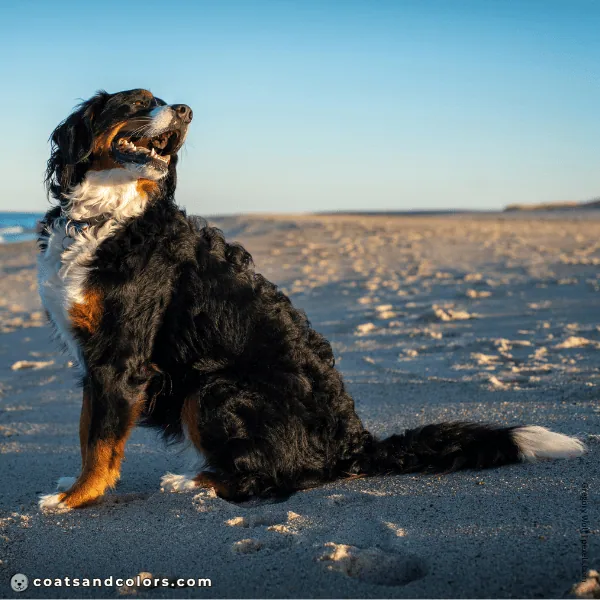
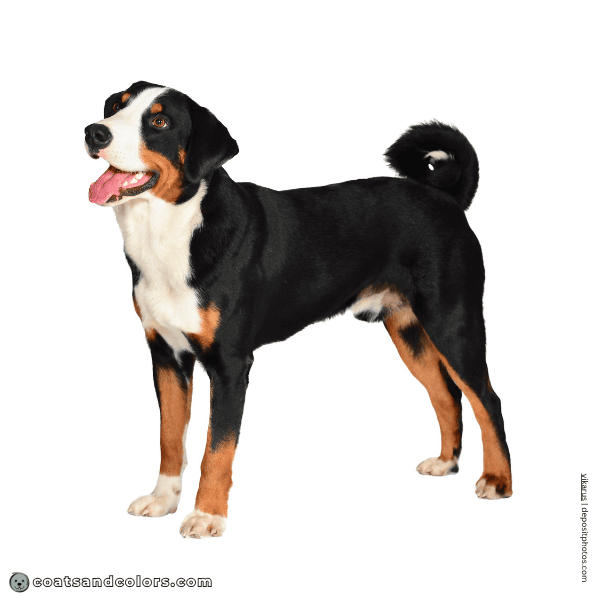
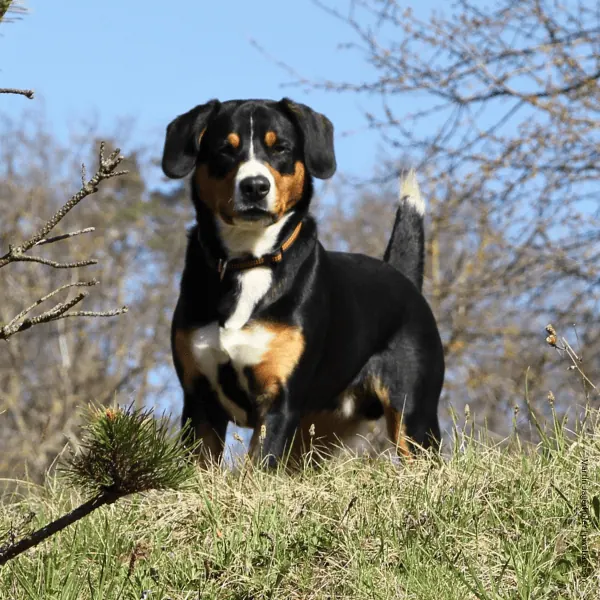
The Swissie is closely related to the other Swiss mountain dog breeds.
Learn More

Links
[1] American Kennel Club (AKC): Greater Swiss Mountain Dog
[2] Fédération Cynologique Internationale (FCI): Great Swiss Mountain Dog
[3] Royal Kennel Club (RKC): Great Swiss Mountain Dog
[4] Canadian Kennel Club (CKC): Greater Swiss Mountain Dog
[5] Dreger et al. (2019). True Colors: Commercially-acquired morphological genotypes reveal hidden allele variation among dog breeds, informing both trait ancestry and breed potential. PLoS ONE 14(10): e0223995. https://doi.org/10.1371/journal.pone.0223995
Image Credits
Anzze86/canva.com
Bigandt_Photography/canva.com
Christiane/pixabay.com
Elen11/canva.com
Elles Rijsdijk/canva.com
Gregory Wolf/pexels.com
kelifamily/canva.com
Martin Jagerhofer/pixabay.com
meadowmouse/canva.com
MirasWonderland/canva.com
Nadiia_Diachenko/canva.com
vikarus/depositphotos.com
volofin/canva.com
Wojciech Popiolek/canva.com
Hi! I’m Steffi. I am a biologist and a big time dog nerd. You are curious about coat color genetics? You’ve come to the right place! Read more.