

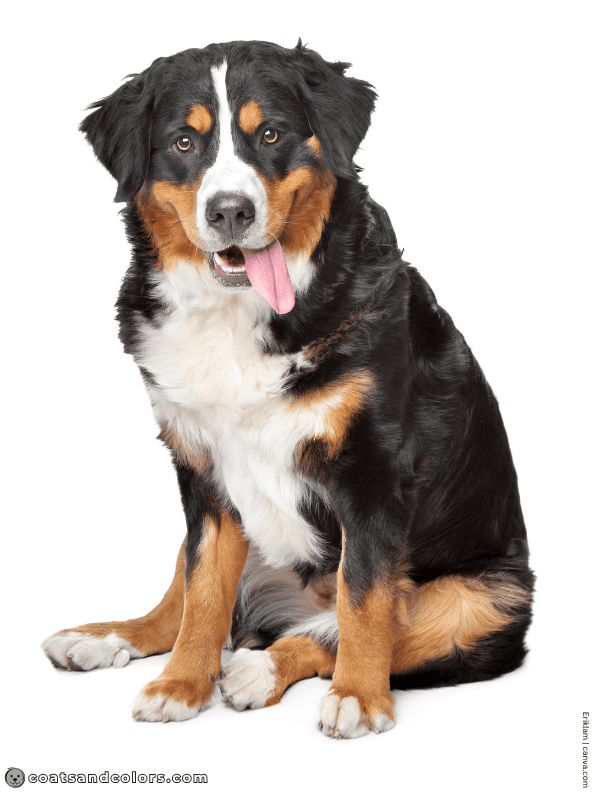
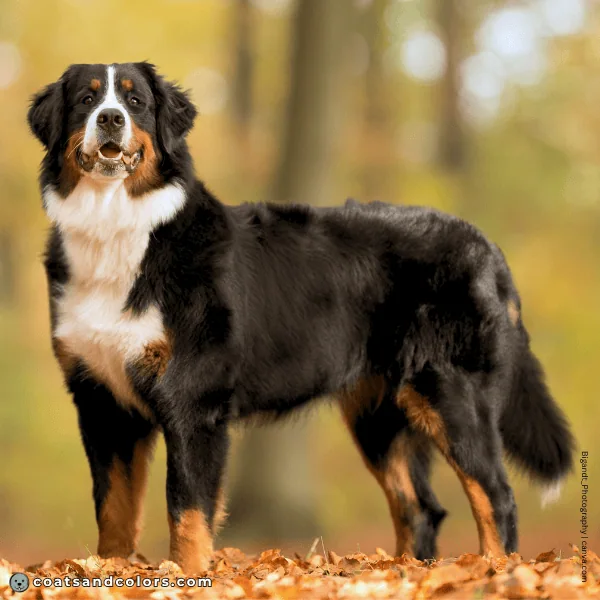
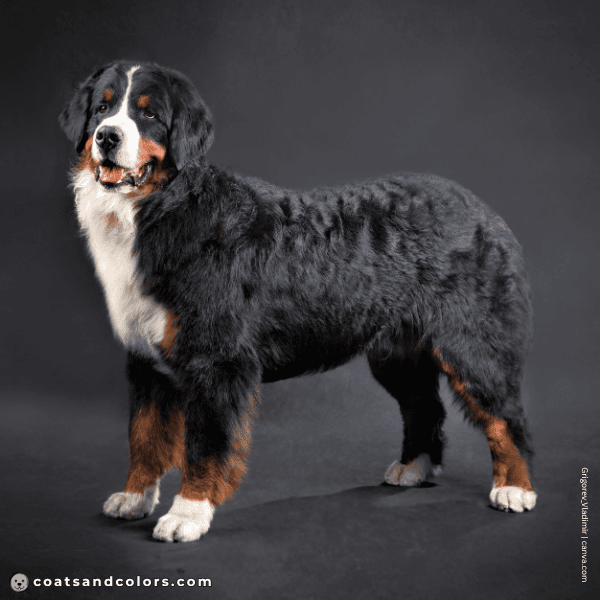
The Bernese Mountain Dog belongs to the Swiss Sennenhund group and only comes in black tricolor. Its thick black-and-tan coat is accented by flashy white markings.
Learn more about Berner colors.
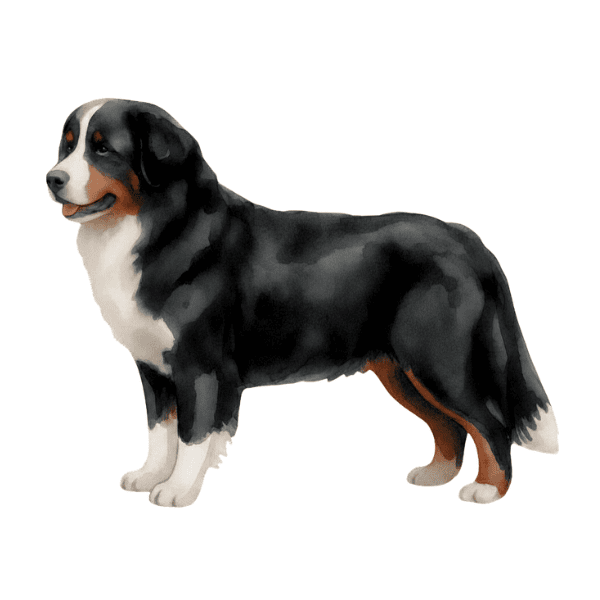
Black Rust & White
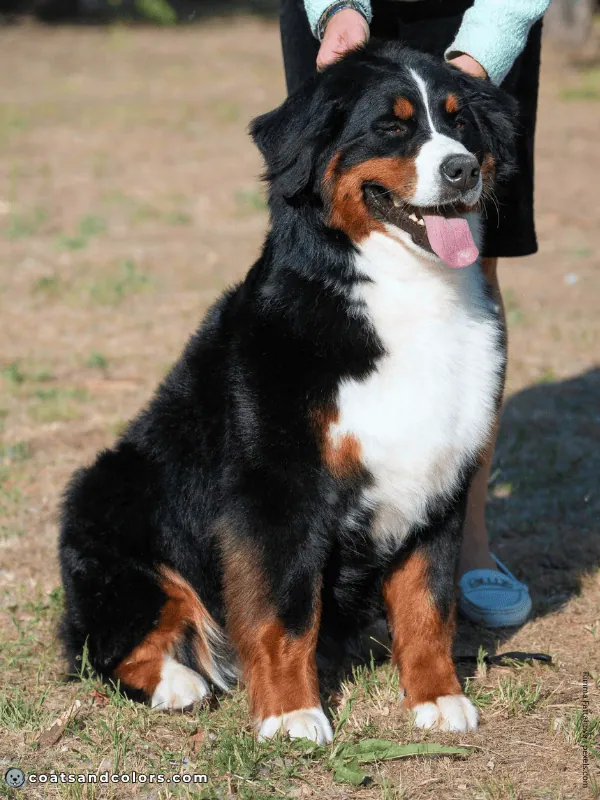
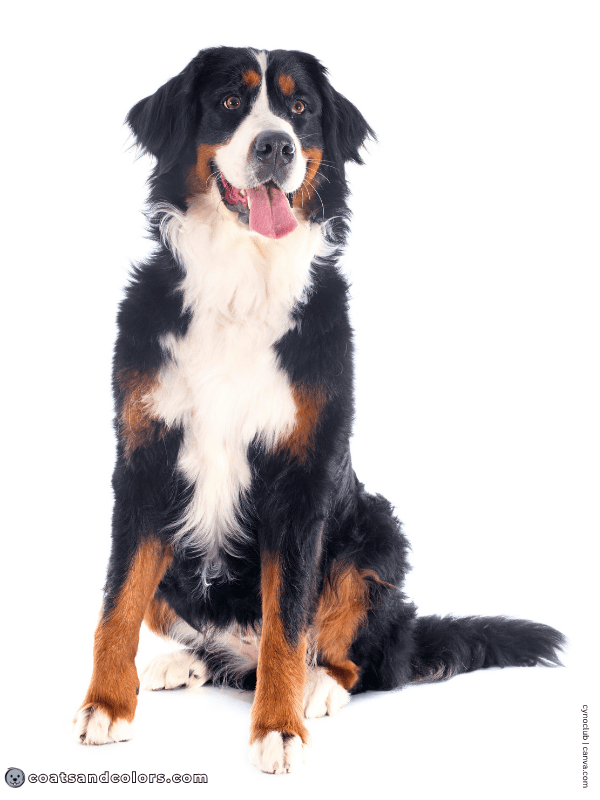
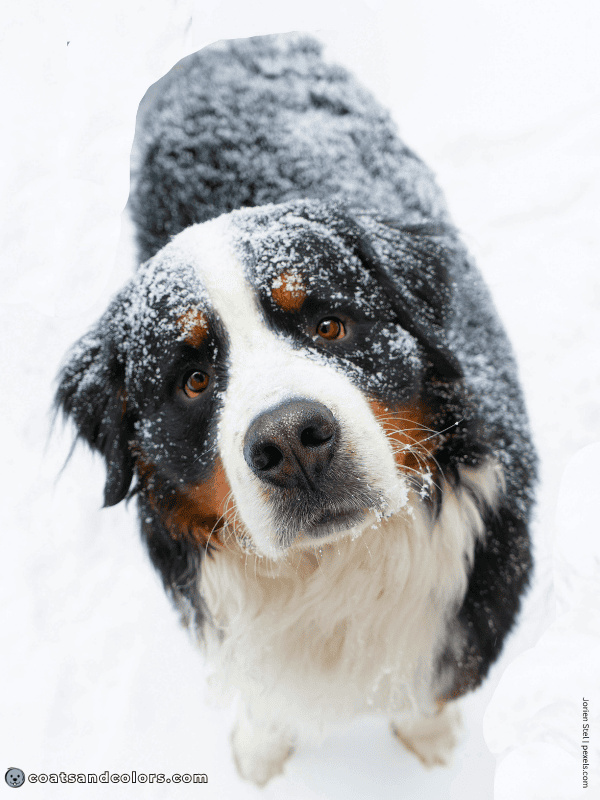
These dogs are black tricolor.
The AKC uses “black rust & white” for dogs with rusty red markings. The black coat should be jet black. A rusted black coat with “a touch of brown or red” is faulty.
BASE PATTERN
tan point
MERLE
–
OTHER
–
EUMELANIN
black
INTENSITY
red, rust
WHITE
white markings
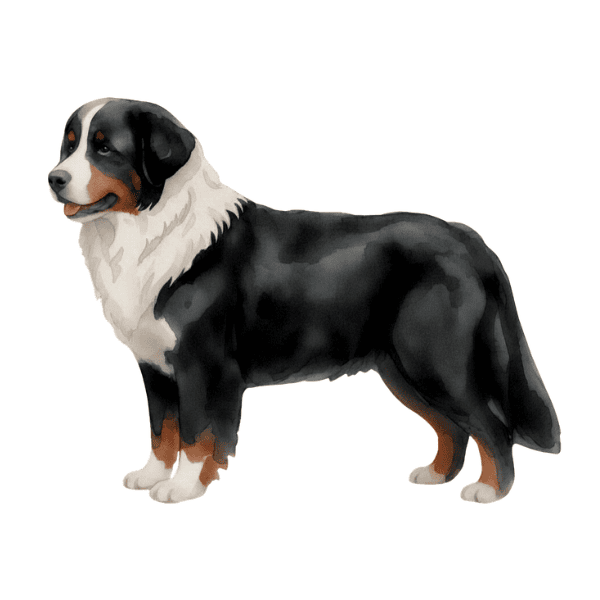
Black Tan & White
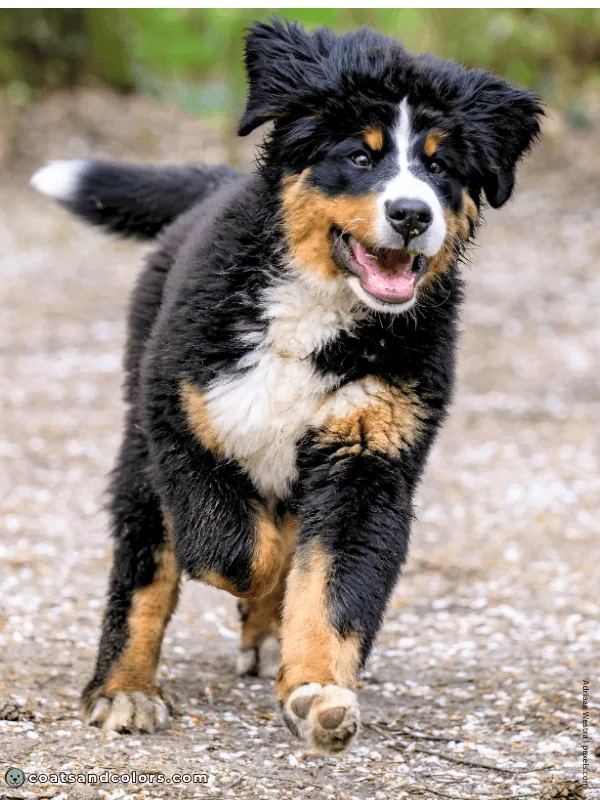
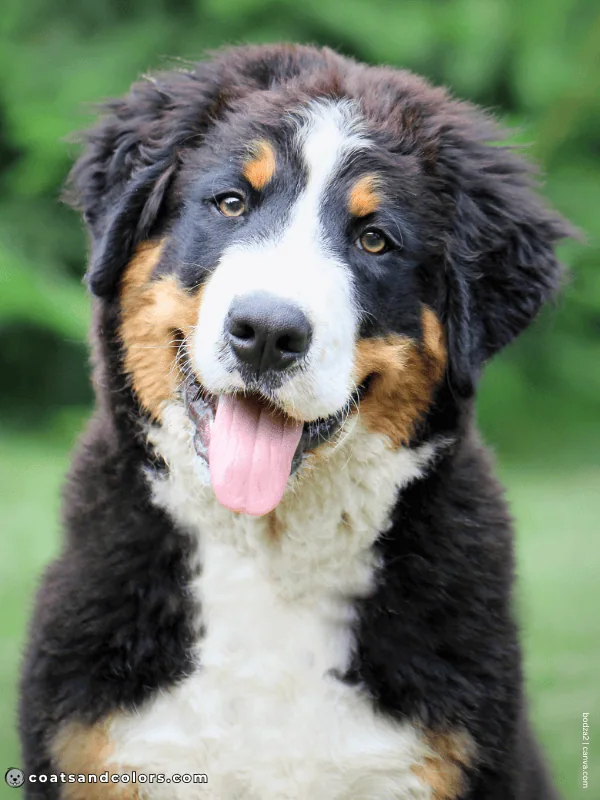
These dogs are black tricolor.
The AKC uses “black tan & white” for dogs with lighter rust markings.
BASE PATTERN
tan point
MERLE
–
OTHER
–
EUMELANIN
black
INTENSITY
tan
WHITE
white markings
Faulty Colors
“The Bernese Mountain Dog is tri-colored. The ground color is jet black. The markings are rich rust and clear white. Symmetry of markings is desired.”
“Disqualification: Any ground color other than black.”
AKC Breed Standard[1]
“Disqualifying Faults: Other than tricoloured coat. Other main colour than black. One or two blue eyes (wall eye).”
FCI Breed Standard[2]
All proper Berners are tricolor (black & tan + white).
The AKC lists some bicolor variations as alternate colors (rust & white, black & white, black & rust)[1]. This tells us which coat colors might have existed in the past.
Apparently, there has been some Newfie introgression in the earlier days of the breed[6]. And their dominant black variant (KB/-) will override the tan point pattern. Red and white (e/e) was a normal pattern for Swiss farm dogs, before it was decided to fix the breed for a tricolor coat.
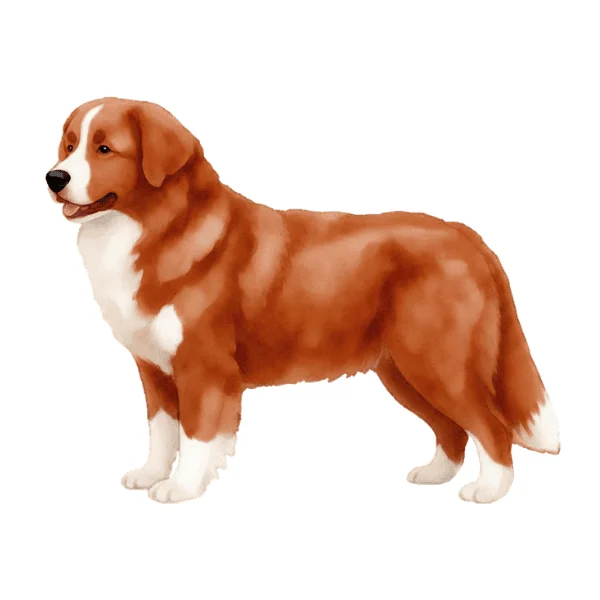
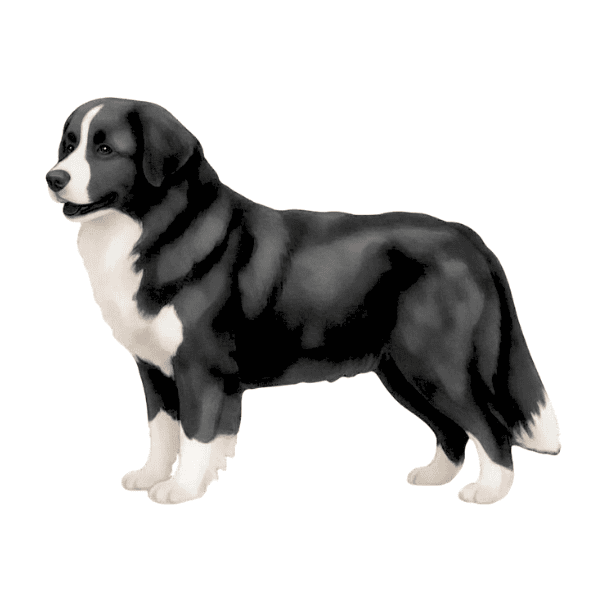

There are also a lot of mismarks regarding the distribution of white markings. Dogs can neither have too little white (absence of white on head is a fault) nor too much white (white collar, white socks). And “disturbingly asymmetrical white markings” (whatever this means) or ticking are also not desired.
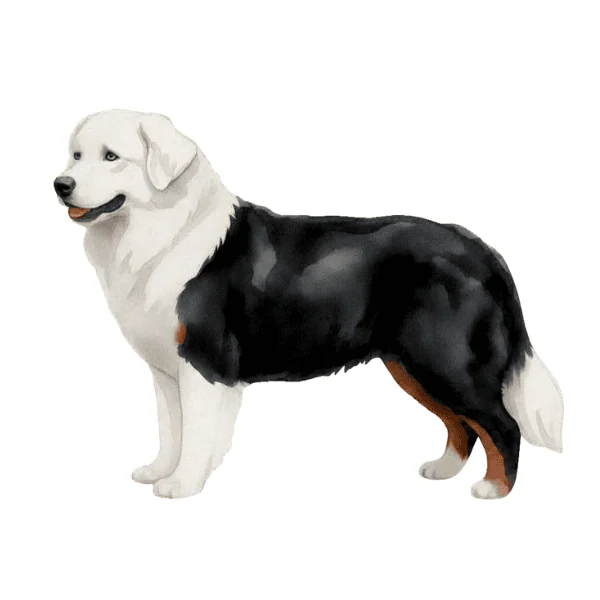
And, of course, some color breeders might produce some non-standard colors, too:
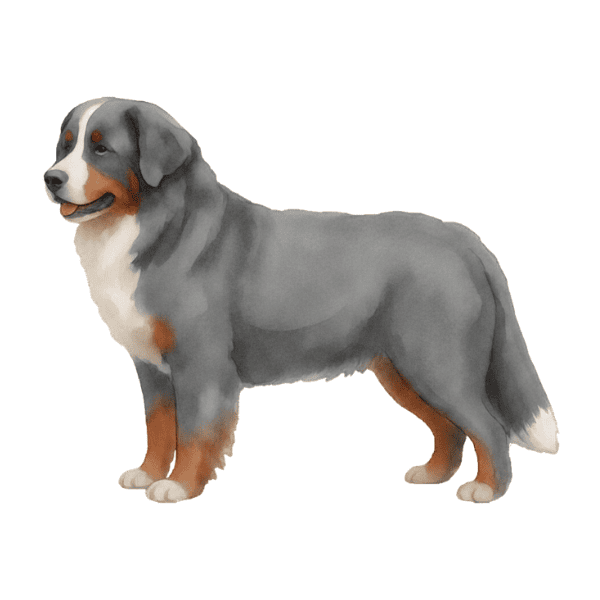
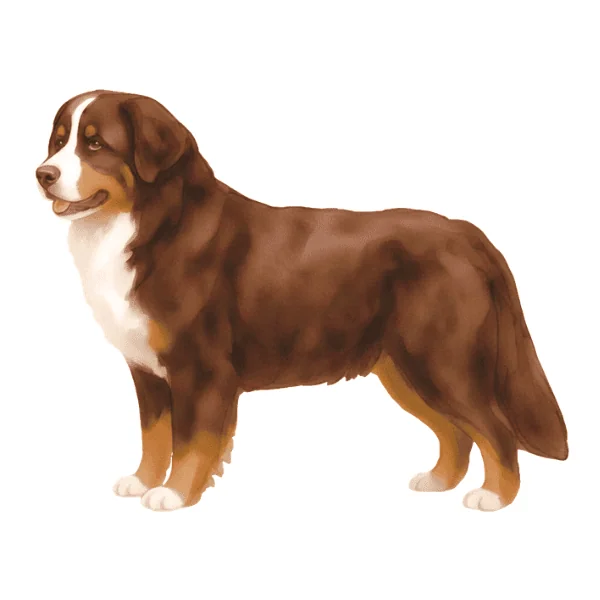
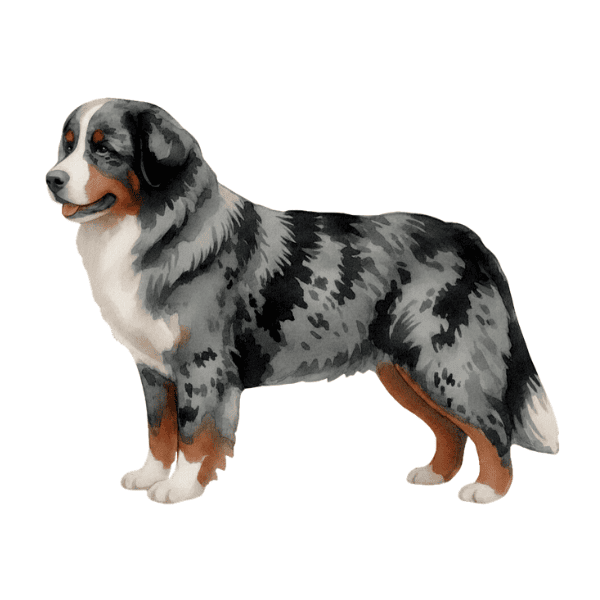
Base Patterns
The base pattern controls the placement of phaeomelanin and eumelanin in the coat. There is an epistatic hierarchy between these genes: A locus < K locus < E locus.
- The A locus controls the basic distribution of pigment types.
- Next, the K locus can add eumelanin on top of the A locus pattern.
- Finally, the E locus regulates the general ability to produce eumelanin.
A Locus
| at | tan point |
Bernese Mountain Dogs are fixed for tan points (at/at).
K Locus
| ky | wild-type |
Bernese Mountain Dogs are fixed for normal pattern expression (ky/ky).
E Locus
| E | wild-type |
Again, Bernese Mountain Dogs are fixed for normal pattern expression (E/E).
BMD Base Pattern
| A LOCUS | K LOCUS | E LOCUS | PATTERN |
|---|---|---|---|
| at/at | ky/ky | E/E | tan point |
Base Colors
The base color is determined by the B locus and D locus.
B Locus
| B | black |
Bernese Mountain Dogs have black pigment (B/B) at the B locus.
D Locus
| D | normal |
The D locus controls color dilution. Bernese Mountain Dogs have normal pigment (D/D).
Red Intensity
The color intensity of phaeomelanin can vary a lot between individuals.

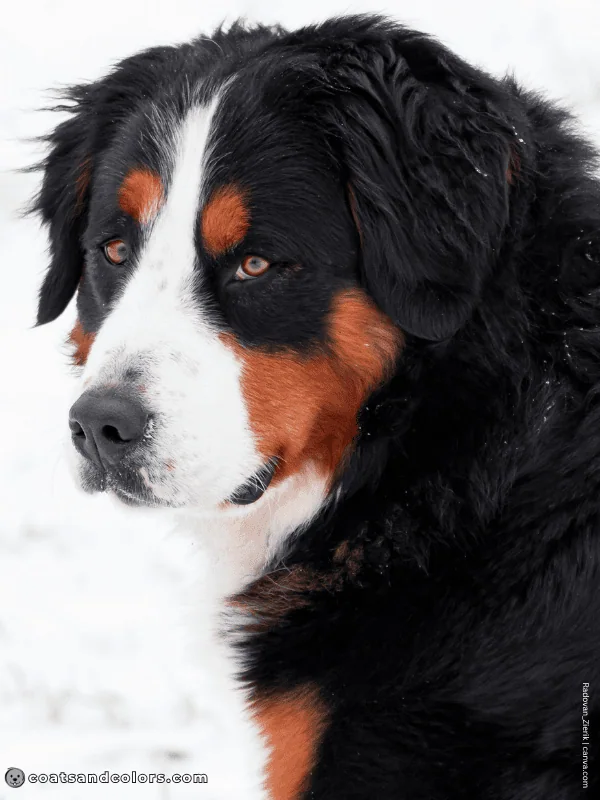
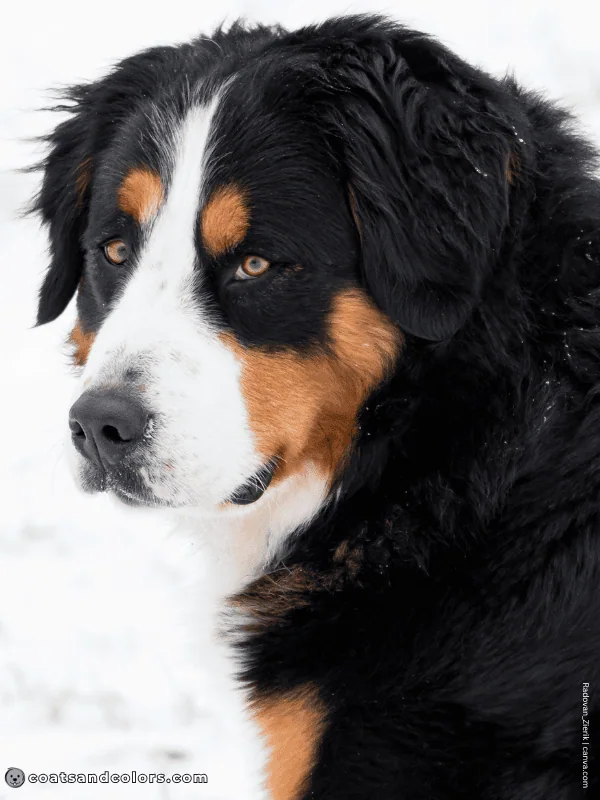
A Bernese Mountain Dog typically shows rusty red or at least very reddish tan markings in its tricolor pattern. Lighter tan colors are not desired.
“The markings are rich rust and clear white. […] Rust appears over each eye, on the cheeks reaching to at least the corner of the mouth, on each side of the chest, on all four legs, and under the tail.”
AKC Breed Standard[1]
“text”
FCI Breed Standard[2]

White Markings
Different traits can remove pigment from the coat and replace it with white.
The Berner breed tests as solid as in non-piebald (S/S).
Instead, the white in Bernese Mountain Dogs is caused by whitehead.
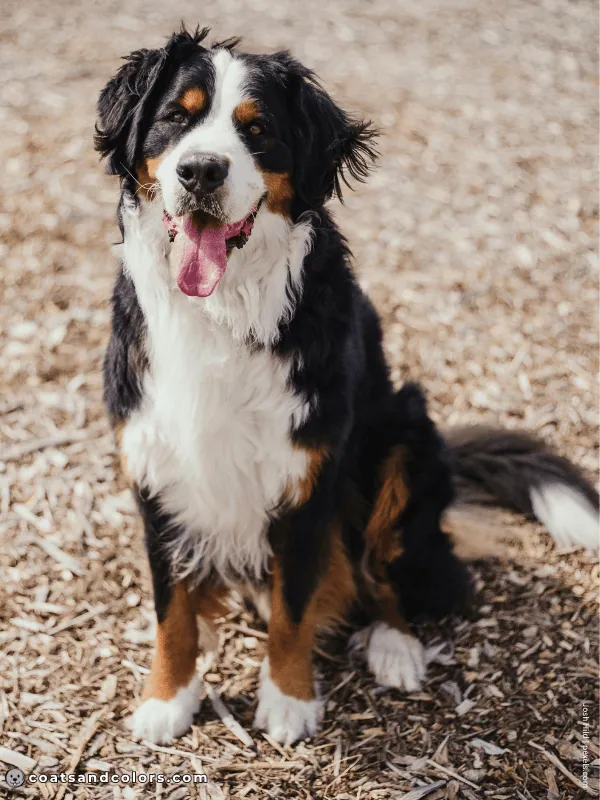
Berners are black tri, they are supposed to have symmetrical and moderate white markings on the face and an unbroken white patch between their chin and chest.
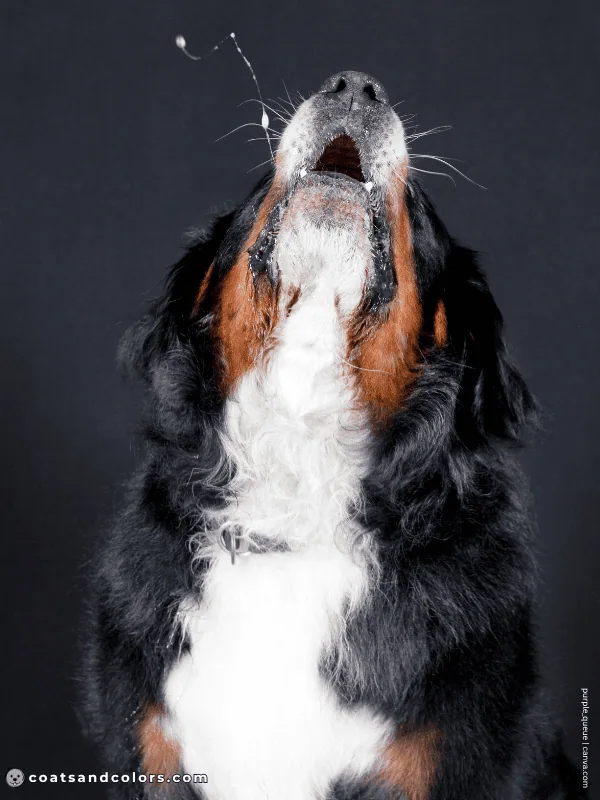
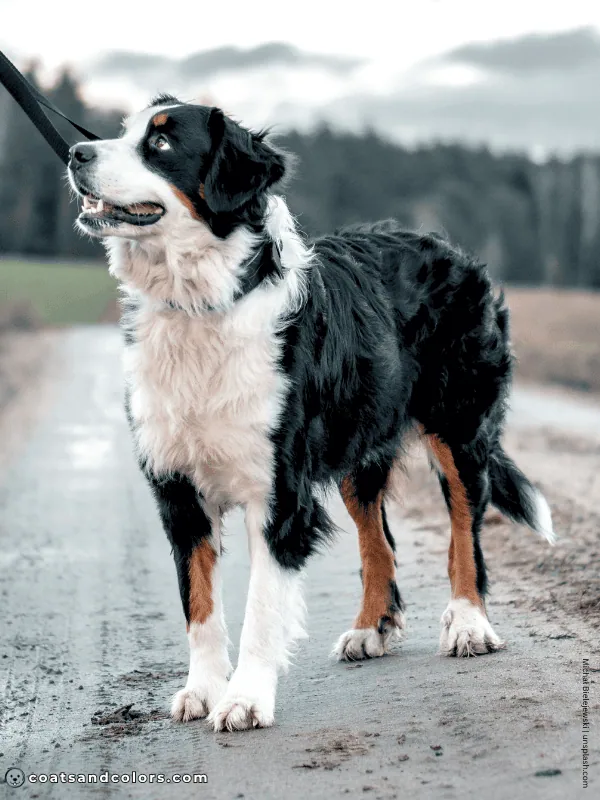
Many have white paws or a white tip on their tail. But these markings are not essential.
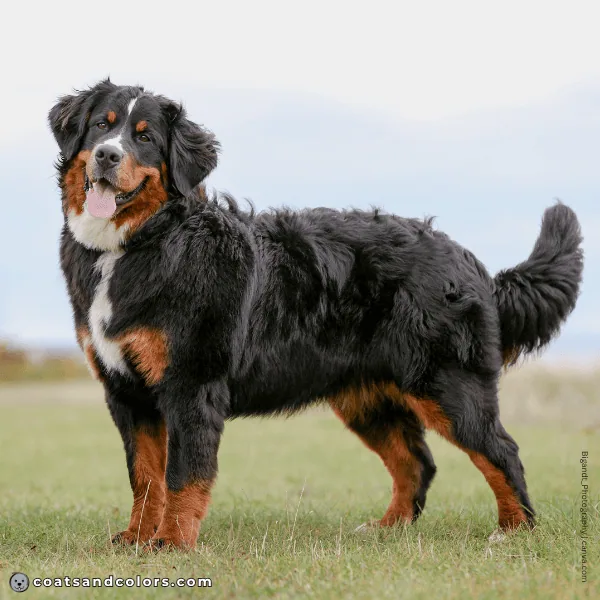
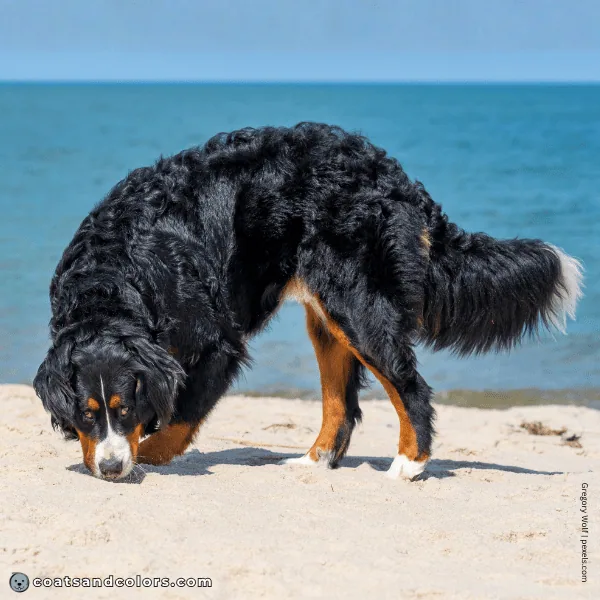
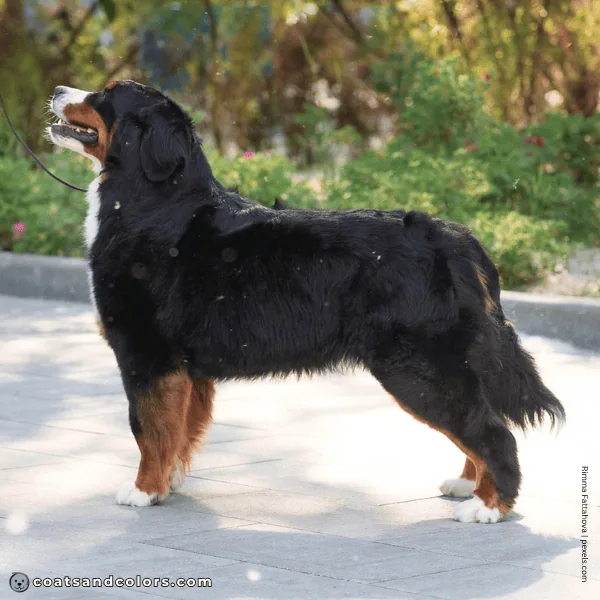
A white muzzle band and a white blaze are a must. Blazes can be thin or broad. But the white should not cover the corner of the mouth or the tan pips above the eyes.
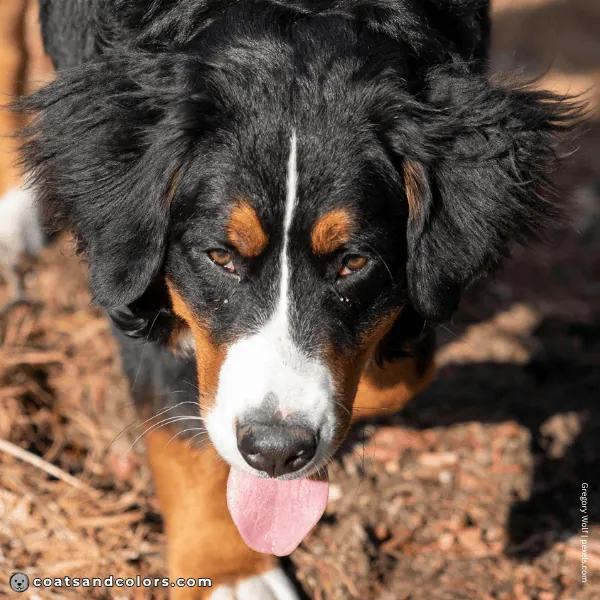
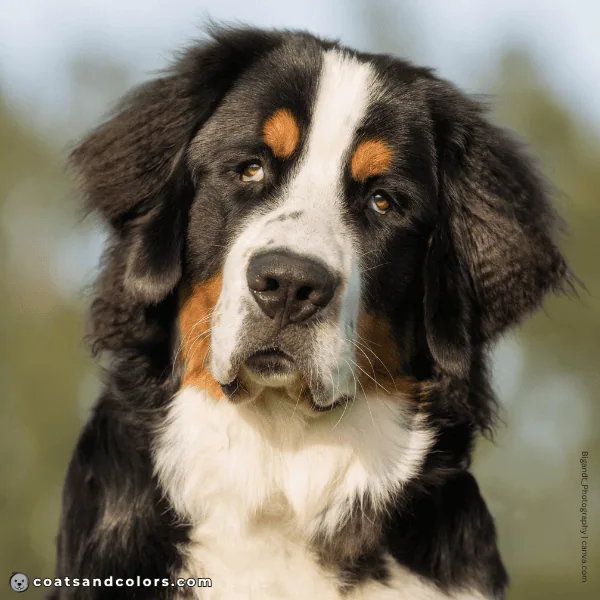
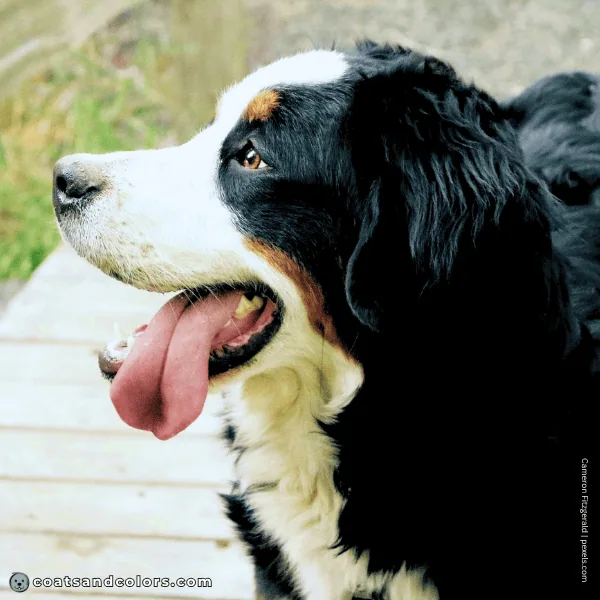
“There is a white blaze and muzzle band. A white marking on the chest typically forms an inverted cross. The tip of the tail is white. White on the feet is desired but must not extend higher than the pasterns. Markings other than described are to be faulted in direct relationship to the extent of the deviation. White legs or a white collar are serious faults.”
AKC Breed Standard[1]
“Slight to medium-sized symmetrical white head marking (blaze) and white chest marking (cross) are essential. Preferred but not essential, white paws, white not reaching higher than pastern, white tip to tail.”
RKC Breed Standard[3]
“A blaze extending towards the nose on both sides to a muzzle band.”
“Moderately broad, unbroken white marking on throat and chest.”
“Desirable: white feet, white tip of tail.”
“The blaze should not reach the tan markings above the eyes, and the white muzzle band should not extend beyond the corners of the mouth.”
FCI Breed Standard[2]
Some dogs have enough white to cause a faulty white collar, white boots, or white front legs.
The FCI provides a whole list of mismarks:
- Absence of white on head.
- Blaze too large and/or muzzle band reaching noticeably beyond the corners of the mouth.
- White collar.
- Large white patch on nape of neck.
- White markings on forelegs reaching distinctly beyond half-way of pasterns.
- Disturbingly asymmetrical white markings on head and/or chest.
- Black ticks and stripes within the white on the chest.
- “Dirty” white (strong spots of pigmentation).”
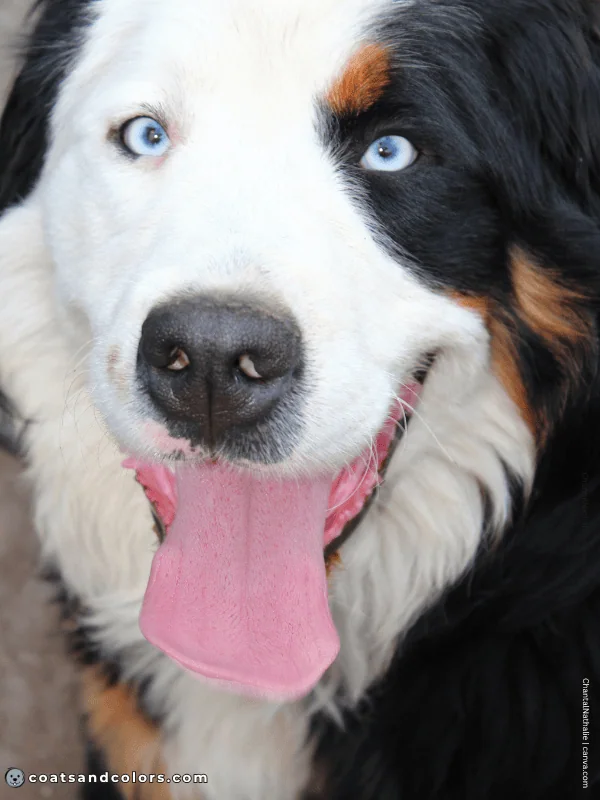
Too much white can cover the corner of their mouth or the eye pips (which needs to show rust) or cause a broad hourglass blaze. Even more extreme whitehead phenotypes can cause split faces or fully white heads (all of which are linked to a chance for blue eyes or hearing impairment).
Bernese Mountain Dog Eye Colors
Berners have brown eyes.
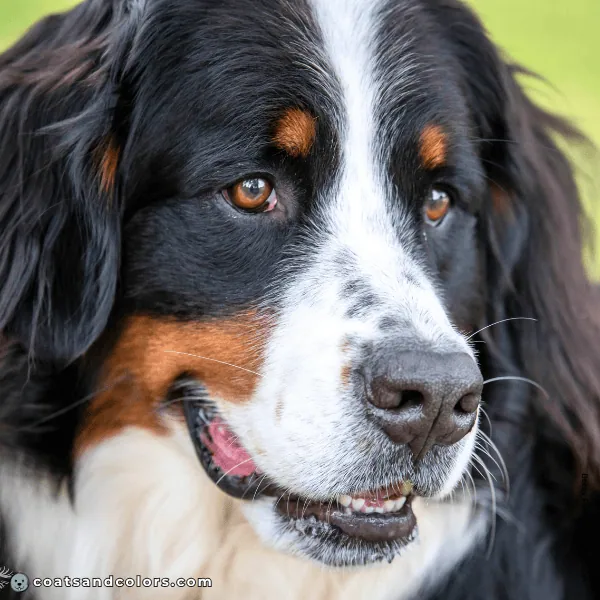
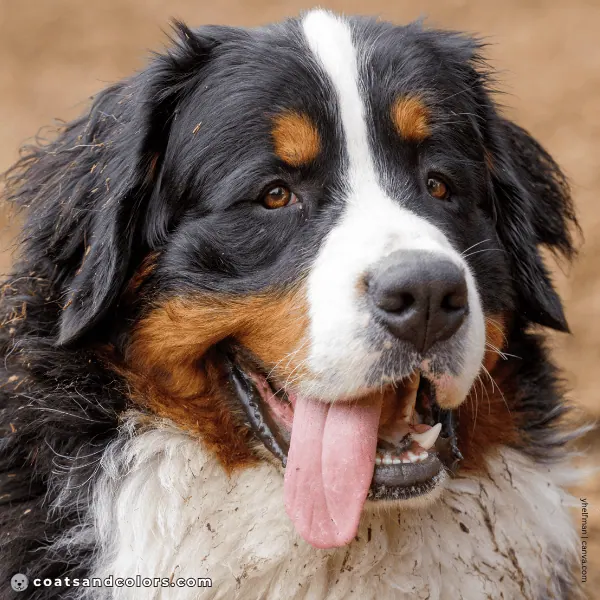
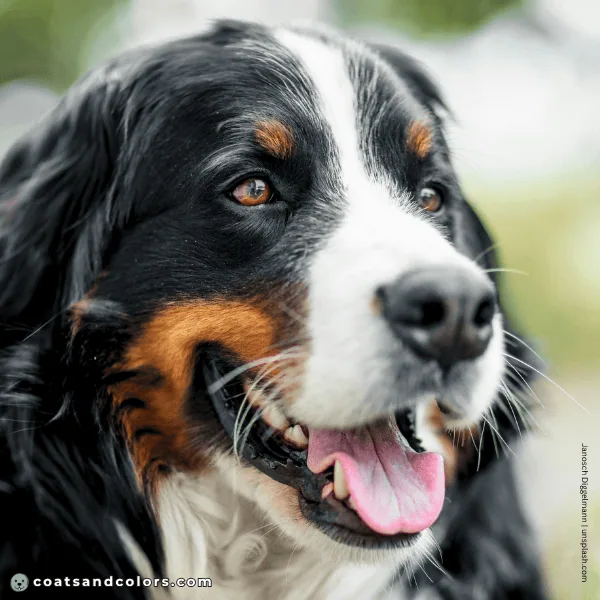
Having too much white in the face is linked to an increased chance of having blue eyes.
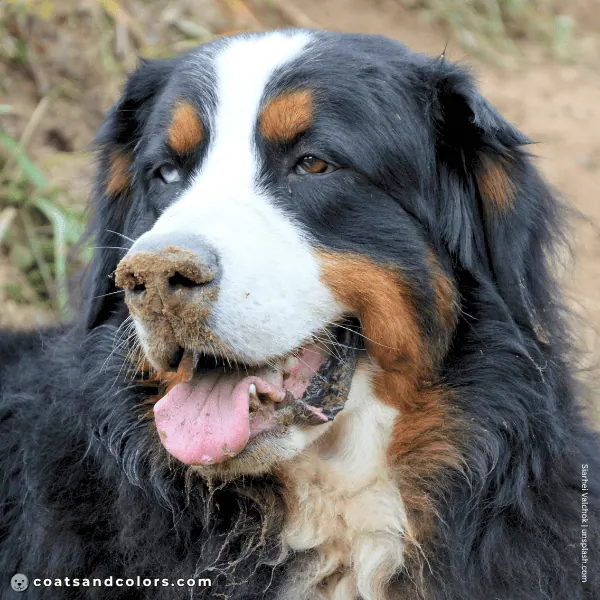
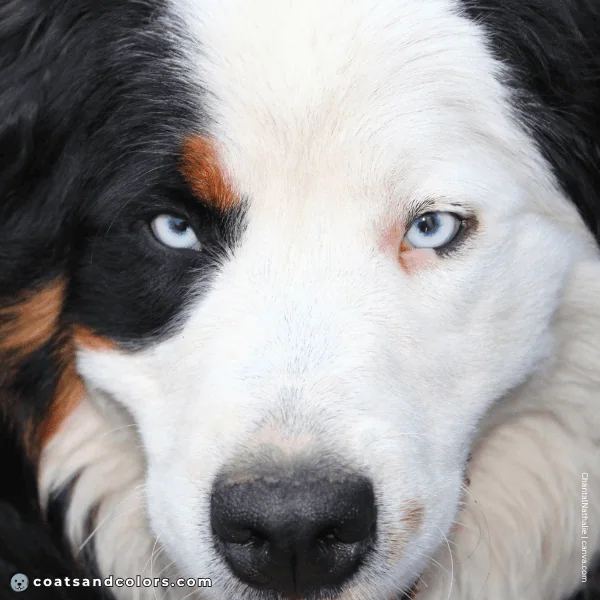
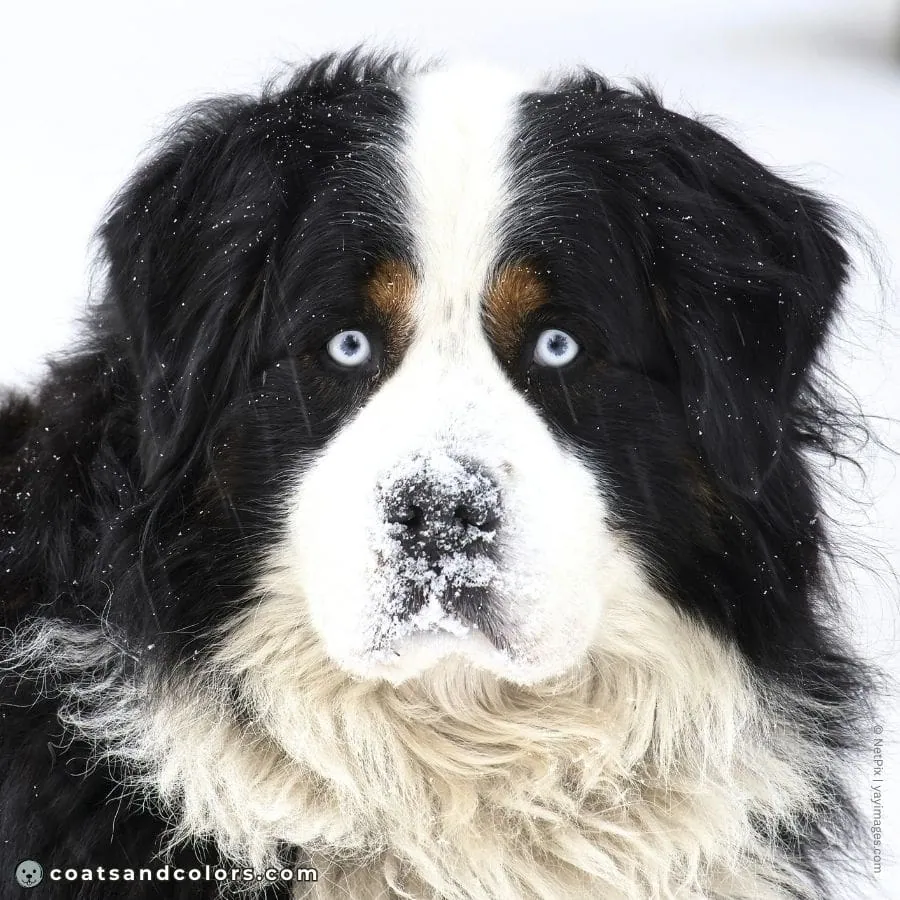
“The eyes are dark brown […] Blue eye color is a disqualification.”
AKC Breed Standard[1]
“Eyes: Dark brown.“
FCI Breed Standard[2]
Bernese Mountain Dog Nose Colors
All Berners are black tricolor. All of them have a black nose. However, some dogs may show weak nose pigment with a slightly faded grayish or brownish tinge.
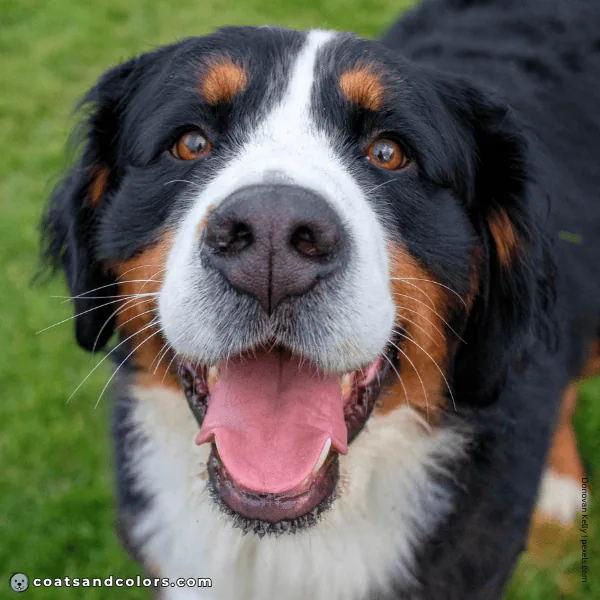
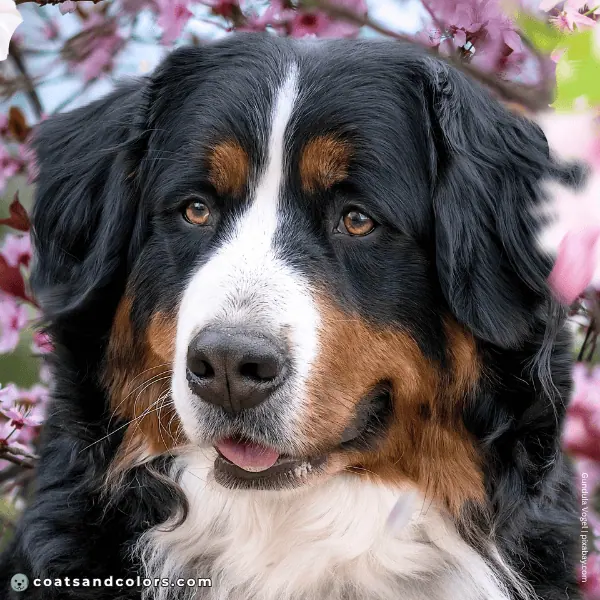
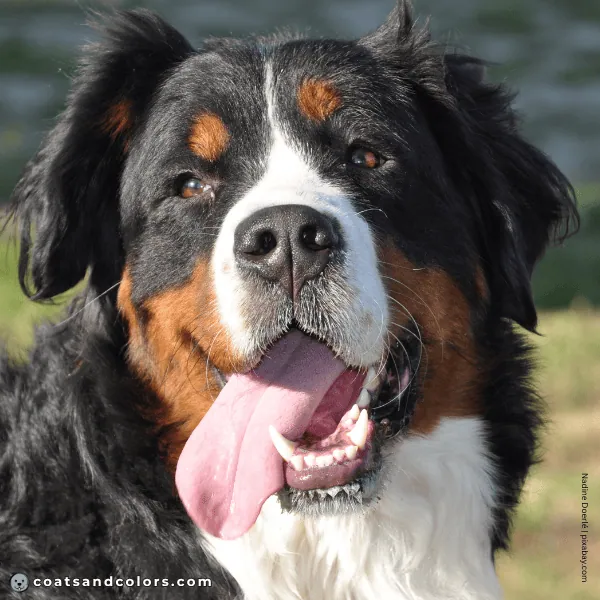
The whitehead trait often gives a pink-spotted nose that takes some time to fill in.
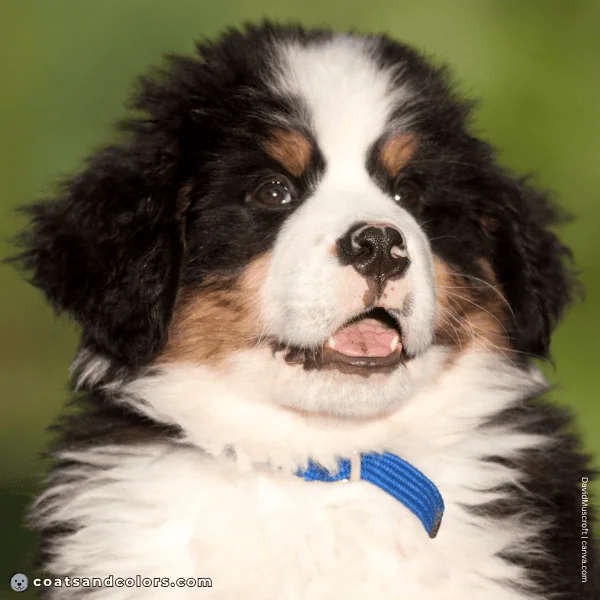
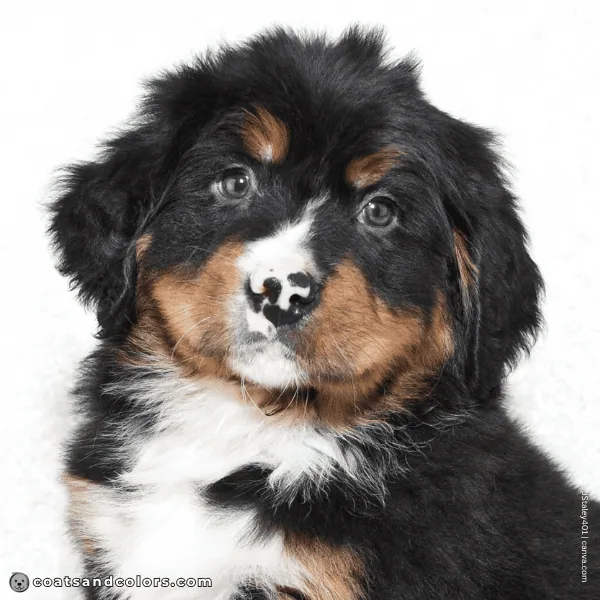
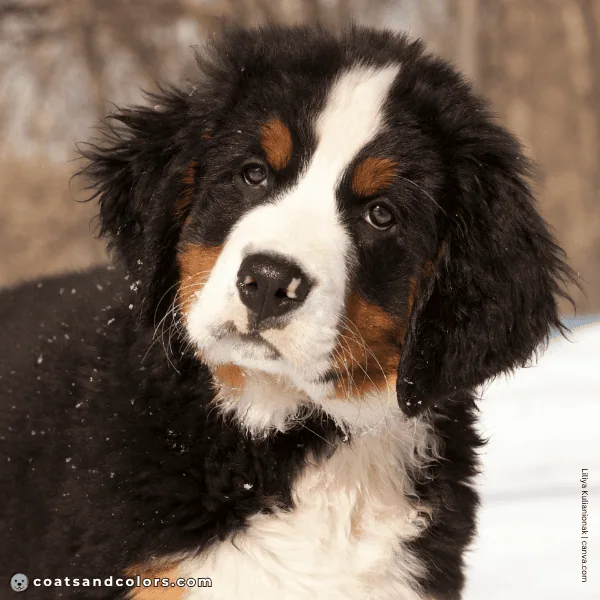
“The nose is always black.”
AKC Breed Standard[1]
“Nose: Black.”
FCI Breed Standard[2]
Bernese Mountain Dog Coat Type
The Bernese Mountain Dog is long-haired with a double coat.
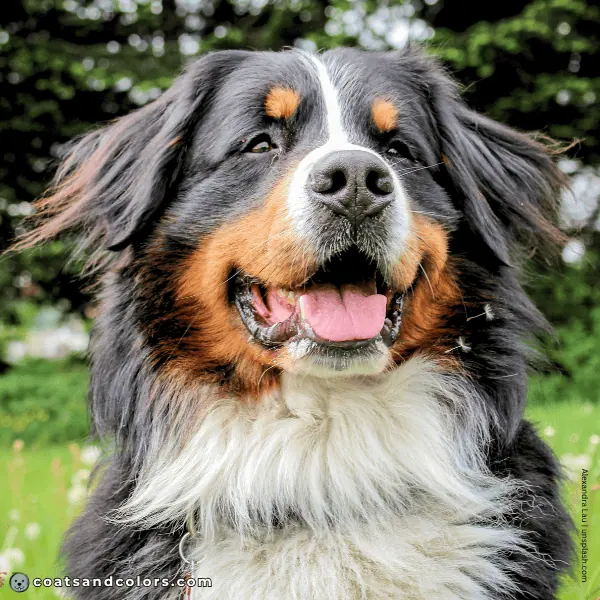
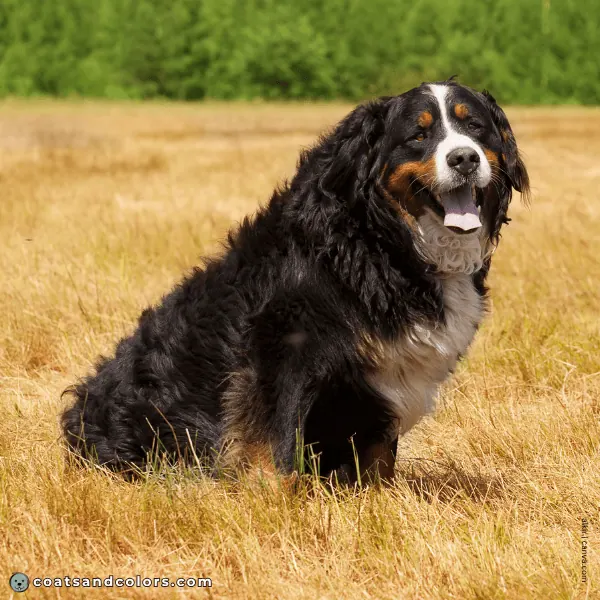
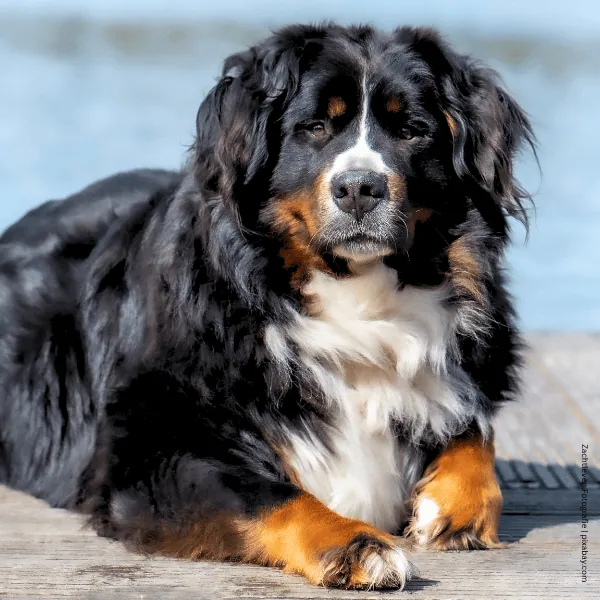
“The coat is thick, moderately long and slightly wavy or straight. It has a bright natural sheen.”
AKC Breed Standard[1]
“Long, shining, straight or slightly wavy.”
FCI Breed Standard[2]
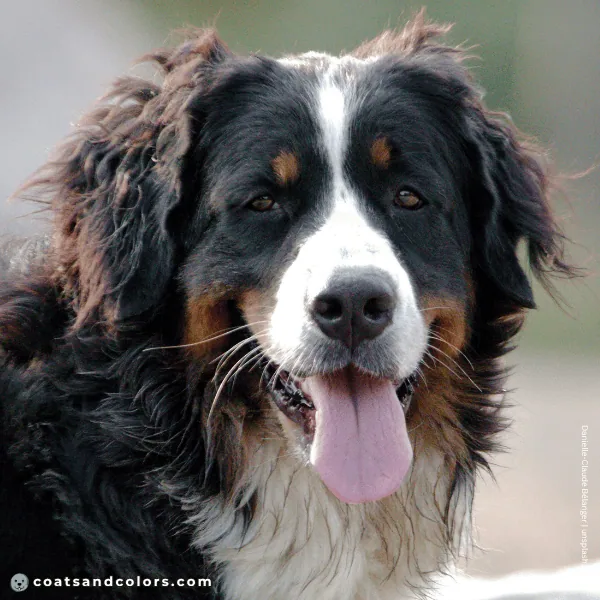
Some Bernese Mountain Dogs have a very wavy coat, so I guess the curly trait is present in the breed. But “extremely curly or extremely dull-looking coats are undesirable,” according to the AKC.
Related Breeds
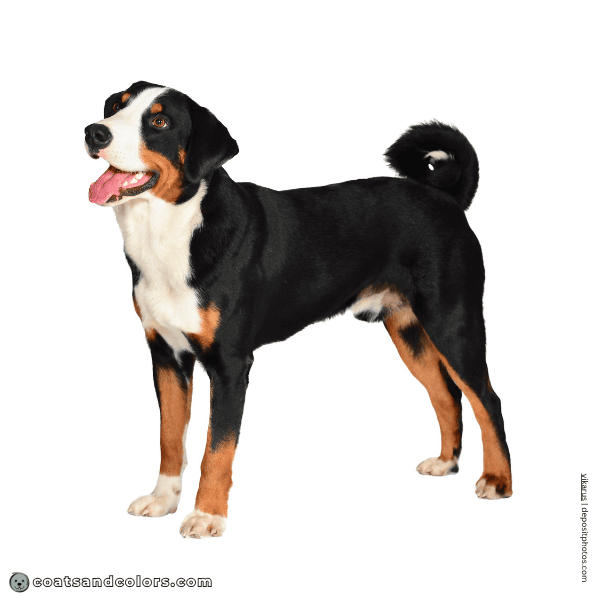
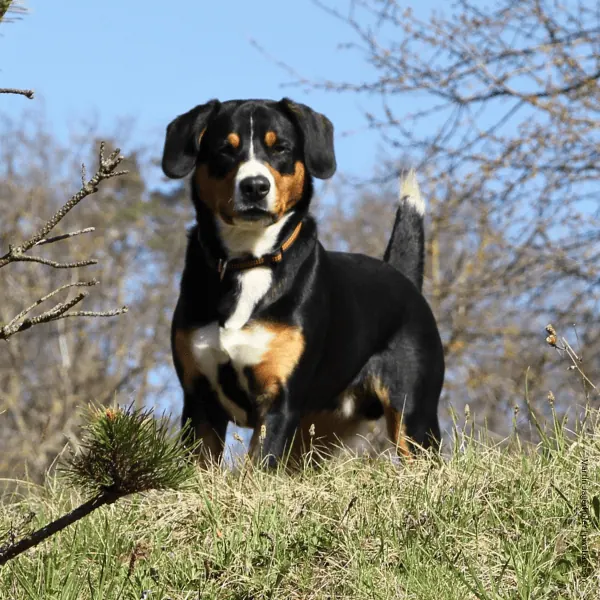
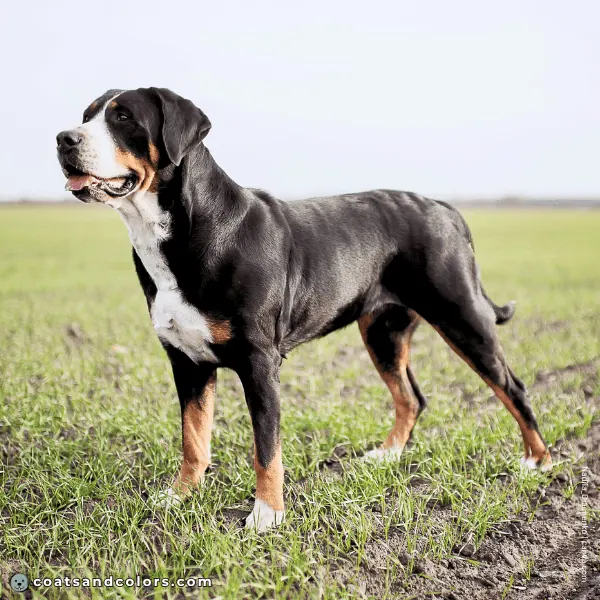
The Bernese Mountain Dog is closely related to the other Swiss mountain dog breeds.
Learn More


Links
[1] American Kennel Club (AKC): Bernese Mountain Dog
[2] Fédération Cynologique Internationale (FCI): Bernese Mountain Dog
[3] Royal Kennel Club (RKC): Bernese Mountain Dog
[4] Canadian Kennel Club (CKC): Bernese Mountain Dog
[5] Dreger et al. (2019). True Colors: Commercially-acquired morphological genotypes reveal hidden allele variation among dog breeds, informing both trait ancestry and breed potential. PLoS ONE 14(10): e0223995. https://doi.org/10.1371/journal.pone.0223995
[6] Rita Hörter: Bernese Mountain Dogs (pdf)
[7] Letko et al. Genomic Diversity and Runs of Homozygosity in Bernese Mountain Dogs. Genes 2023. https://doi.org/10.3390/genes14030650
Image Credits
Adriaan Westra/pexels.com
Alexandra Lau/unsplash.com
alkir/canva.com
Becky Potter/unsplash.com
Bigandt_Photography/canva.com
bodza2/canva.com
Cameron Fitzgerald/pexels.com
ChantalNathalie/canva.com
cynoclub/canva.com
Danielle-Claude Bélanger/unsplash.com
DavidMuscroft/canva.com
Donovan Kelly/pexels.com
Eriklam/canva.com
Gregory Wolf/pexels.com
Grigorev_Vladimir/canva.com
Gundula Vogel/pixabay.com
Janosch Diggelmann/unsplash.com
Jorien Stel/pexels.com
JStaley401/canva.com
Liliya Kulianionak/canva.com
Martin Jagerhofer/pixabay.com
Michał Bielejewski/unsplash.com
Michel Viard/canva.com
Nadiia_Diachenko/canva.com
Nadine Doerlé/pixabay.com
NetPix/yayimages.com
purple_queue/canva.com
Radovan_Zierik/canva.com
Rimma Fattahova/pexels.com
Siarhei Valchok/unsplash.com
vikarus/depositphotos.com
yhelfman/canva.com
Zachtleven Fotografie/pixabay.com
Hi! I’m Steffi. I am a biologist and a big time dog nerd. You are curious about coat color genetics? You’ve come to the right place! Read more.
5 thoughts on “Bernese Mountain Dog Colors”
Comments are closed.