

The Alpine Dachsbracke is a short-legged scent hound prized for its tracking abilities. With their dense and harsh double coat, these sturdy dogs from Austria come in two coat color varieties.
Deer Red
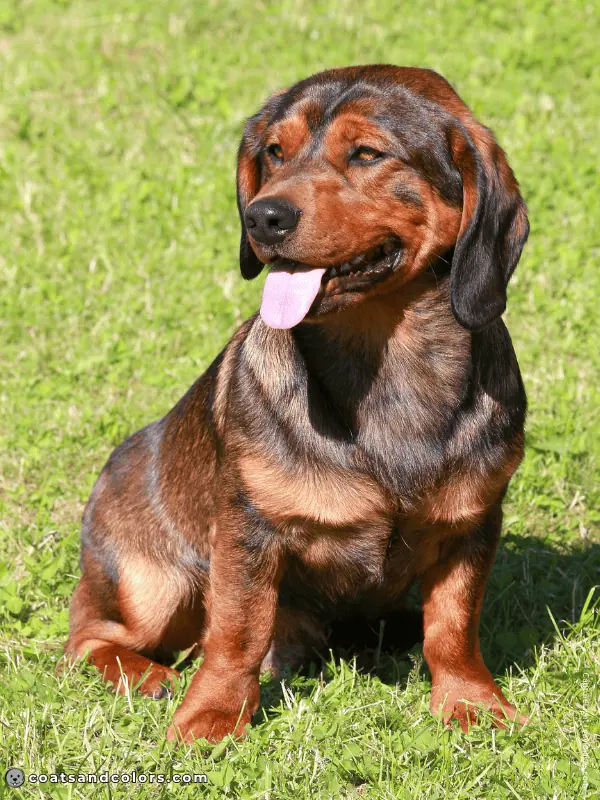
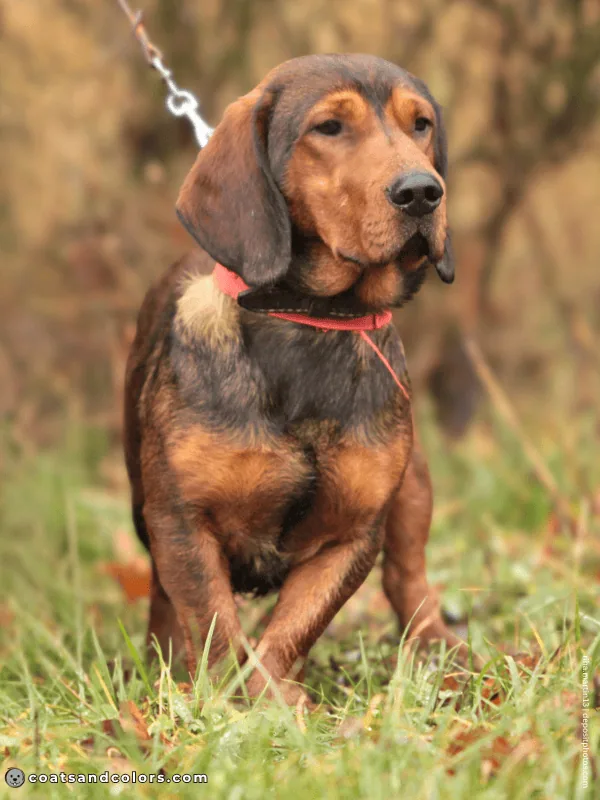
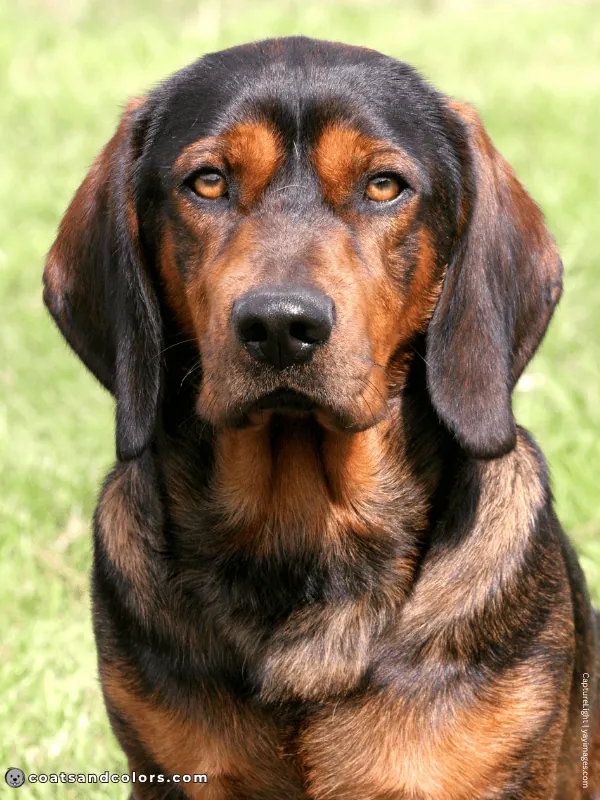
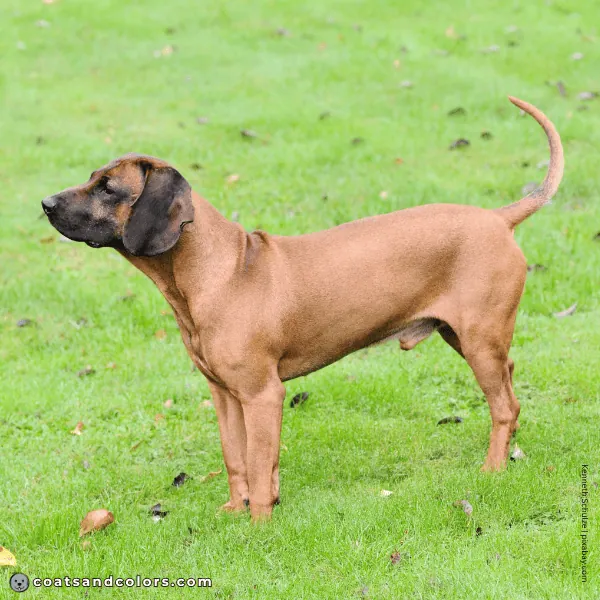
The FCI breed standard states that the ideal color is a dark “deer red” with black sabling, often with a pointy widow’s peak on their forehead. So they are shaded sable with high red intensity.
BASE PATTERN
sable
MERLE
–
OTHER
–
EUMELANIN
black
INTENSITY
red
WHITE
solid
Black & Tan

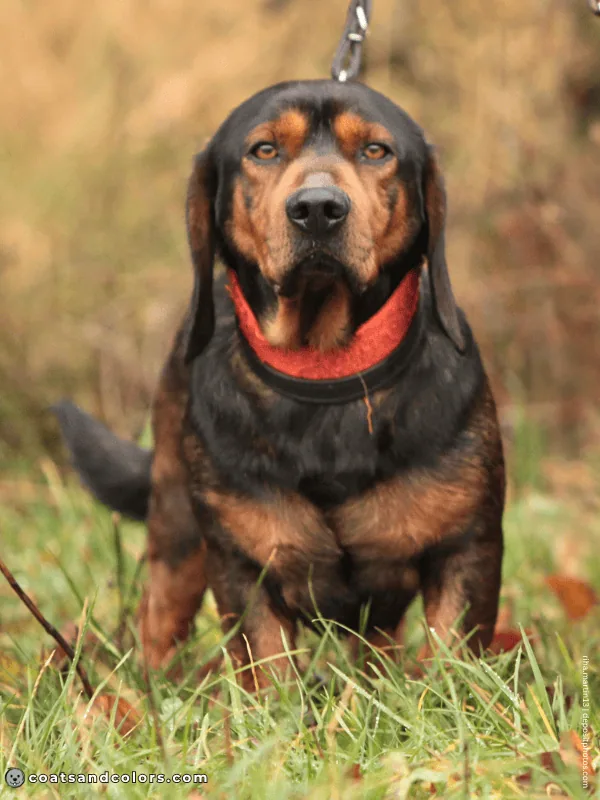
The black & tan Alpine Dachsbracke has a solid black dorsal coat with well-defined orange-red to red markings on their cheeks and above their eyes, chest, lower legs, and under their tail.
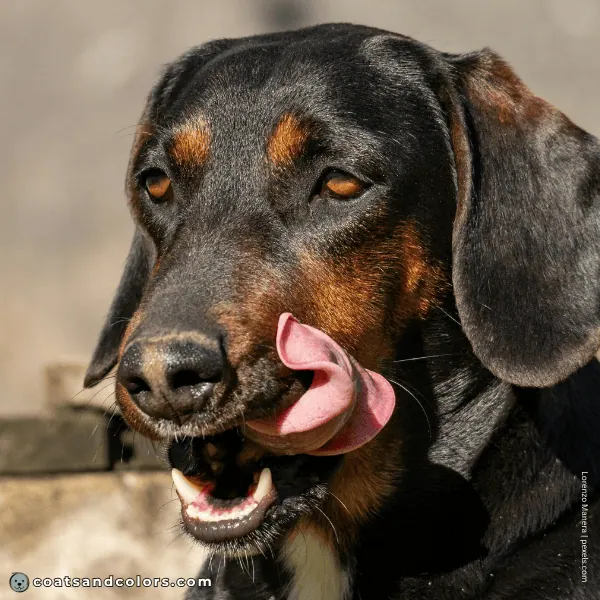
Just like the Austrian Black & Tan Hound, these dogs are often called “Vieräugl” for their eye pip markings (a diminutive that alludes to the illusion of “four eyes” in this pattern).
BASE PATTERN
tan point
MERLE
–
OTHER
–
EUMELANIN
black
INTENSITY
red
WHITE
solid
Base Patterns
The base pattern describes the placement of phaeomelanin and eumelanin in the coat. There is an epistatic hierarchy between the A locus < K locus < E locus.
- The A locus controls the basic distribution of both pigment types.
- Next, the K locus can add black to the A locus pattern.
- Finally, the E locus regulates the general ability to produce black pigment.
A Locus
| Ay | clear sable |
| Ays | shaded sable |
| at | tan point |
The Alpine Dachsbracke can be sable (Ay/- or Ays/-) or tan point (at/at). Most red dogs are heterozygous (Ay/at) and often show an intermediate phenotype with more dark shading than Ay/Ay would.
Red puppies often have a dark overlay and show transitional points when they clear into their adult coat.
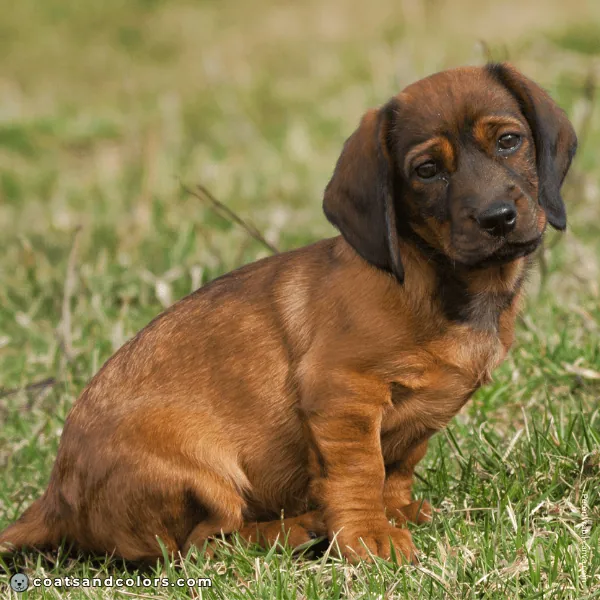
Many deer red dogs have so extensive dark overlay that they look Ays/at. But the shaded sable allele (Ays) has not been confirmed as this is a rare breed and color testing is not really a priority for breeders.
K Locus
| ky | wild-type |
The Alpine Dachsbracke is fixed for ky/ky (normal A locus pattern expression).
E Locus
| E | wild-type |
The Alpine Dachsbracke is fixed for E/E (normal A locus pattern expression).
Alpine Dachsbracke Base Patterns
The genotypes of Alpine Dachsbracke breed standard patterns:
| A LOCUS | K LOCUS | E LOCUS | PATTERN |
|---|---|---|---|
| Ay/- | ky/ky | E/E | sable “deer red” |
| at/at | ky/ky | E/E | tan point “black & tan” |
Base Colors
The base color is determined by the B locus and D locus.
B Locus
| B | black |
The Alpine Dachsbracke is fixed for black pigment (B/B).
D Locus
| D | dense |
The Alpine Dachsbracke is fixed for normal pigment (D/D).
Red Intensity
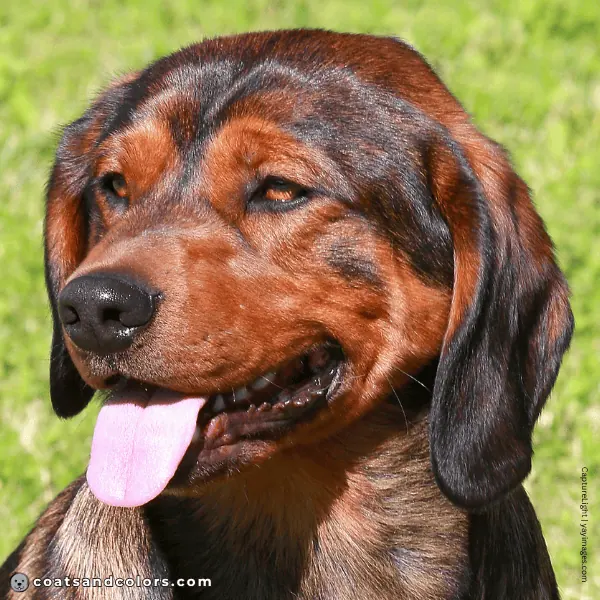
The color intensity of phaeomelanin has a gradient of colors of possible colors between high intensity red and low intensity cream colors.

The red intensity in this breed is called deer red in sable dogs and red-brown markings for black & tan dogs. So they obviously prefer very intense red colors.
White Markings
Some traits can remove pigment from the coat and replace it with white markings.
But the coat colors in Alpine Dachsbracke are solid (S/S) without white markings.
“White star on chest permitted.”
FCI Breed Standard[2]
Alpine Dachsbracke Eye Colors
They have brown eyes, dark eyes are preferred.
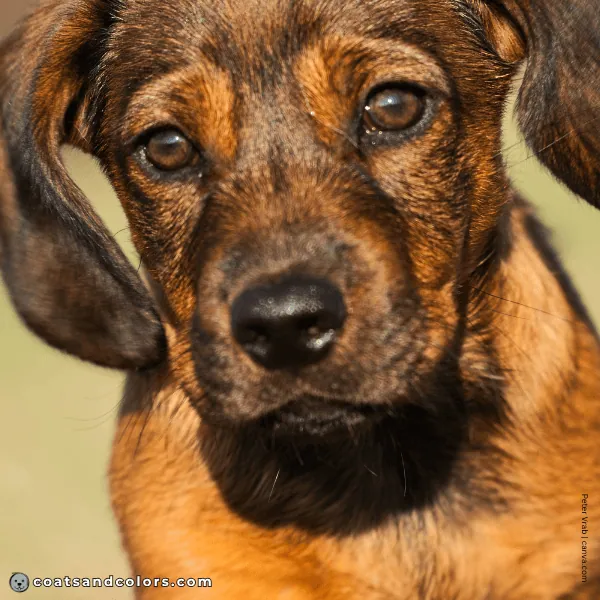
“With dark brown iris.”
“Fault: Too light eye […]“
FCI Breed Standard[2]
Alpine Dachsbracke Nose Colors
They have a black nose.
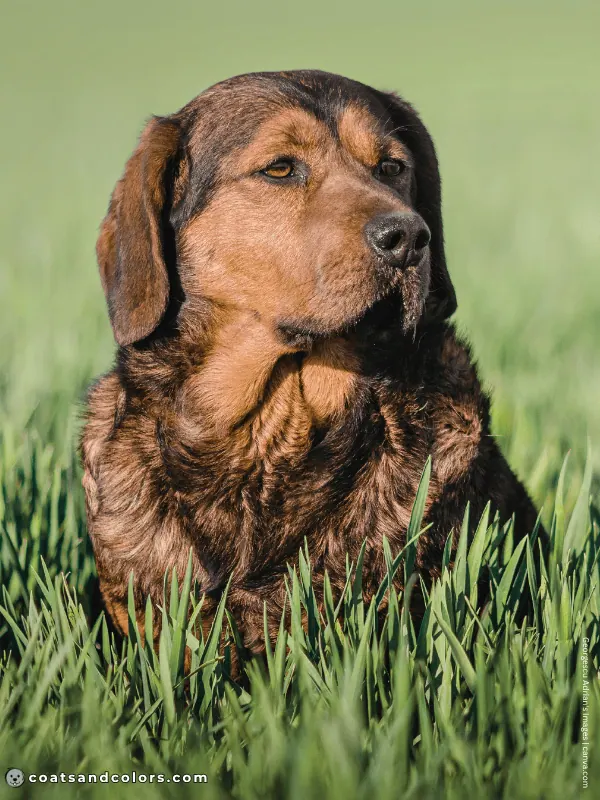
“Nose: Black.”
FCI Breed Standard[2]
Alpine Dachsbracke Coat Type
The FCI standard says that this is “a robust, weather-resistant working dog used by the mountain huntsman“. It should have a thick coat with a proper undercoat.
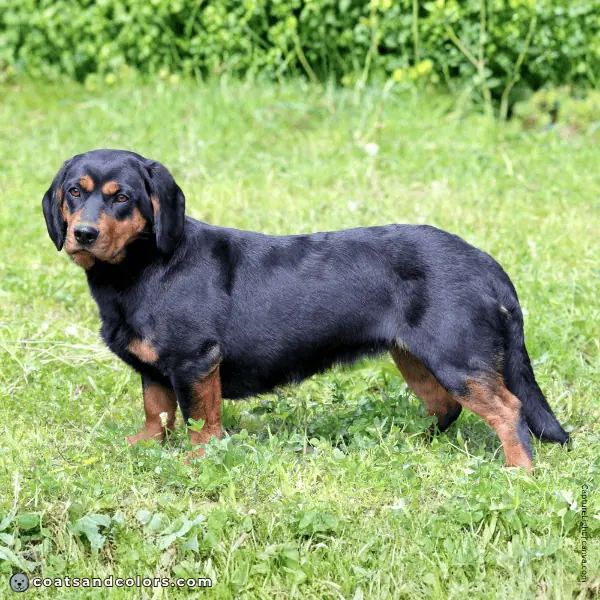
“The double coat consists of very thick top coat and a dense undercoat, which covers the whole body and is close fitting.”
FCI Breed Standard[2]
The basic hair morphology is determined by hair length and the presence of furnishings or curls. Other factors, like hair thickness or the amount of undercoat, can vary within each coat type.
This causes a spectrum of coat types with different degrees of shedding and different coat textures, e.g. thick hair with a stiff and coarse feel, as opposed to fine hair with a silky or cotton-like quality.
Related Breeds
The Alpenländische Dachsbracke is an old scenthound breed and likely related to similar hunting dogs from Europe.
The origin of the breed is pretty much unknown. The Austrian breed club insists that this short-legged hunting dog has an ancient history and is not closely related to Dachshunds.
Learn More

Links
[1] American Kennel Club (AKC): not recognized
[2] Fédération Cynologique Internationale (FCI): Alpine Dachsbracke
[3] UK Kennel Club (KC): not recognized
[4] Canadian Kennel Club (CKC): not recognized
[5] Dreger et al. (2019). True Colors: Commercially-acquired morphological genotypes reveal hidden allele variation among dog breeds, informing both trait ancestry and breed potential. PLoS ONE 14(10): e0223995. https://doi.org/10.1371/journal.pone.0223995
[6] Klub Dachsbracke. Picture Gallery.
Image Credits
CaptureLight/yayimages.com
Georgescu Adrian’s Images/canva.com
Kenneth Schulze/pixabay.com
mb-fotos/canva.com
Peter Vrab/canva.com
riha.martin13/depositphotos.com
Zuzule/canva.com
Hi! I’m Steffi. I am a biologist and a big time dog nerd. You are curious about coat color genetics? You’ve come to the right place! Read more.