

The Alaskan Malamute is a powerful sled dog, built for transport and endurance in harsh northern conditions. This breed carries a thick, double coat designed for extreme cold. The Malamute also comes with a range of different coat colors, which I will explain to you in this blog post.
Agouti & White
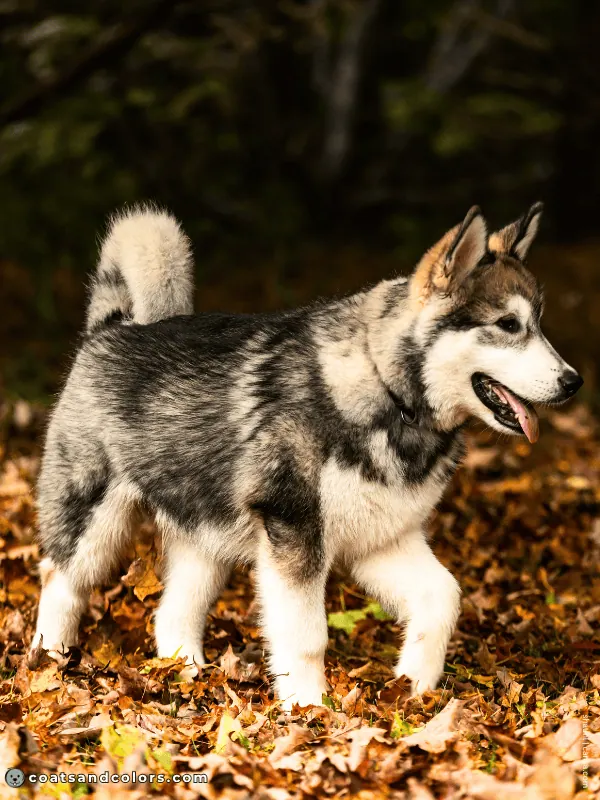
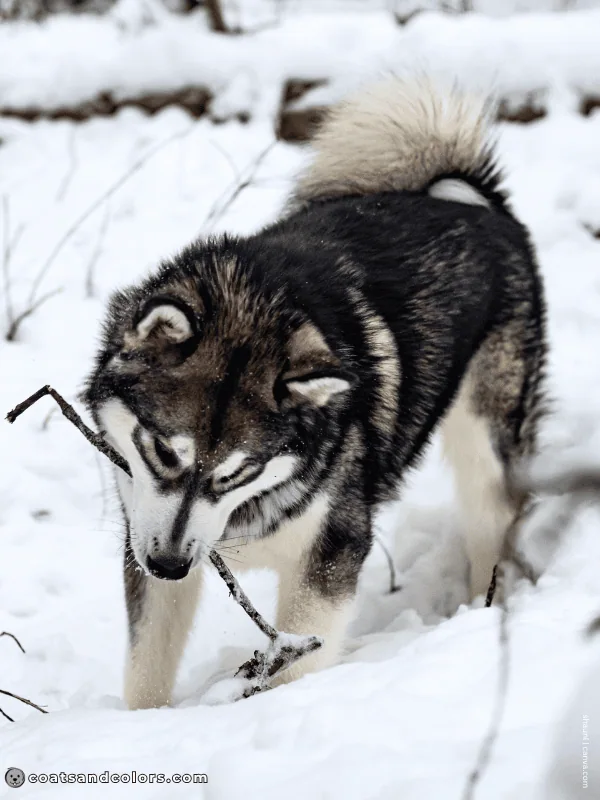

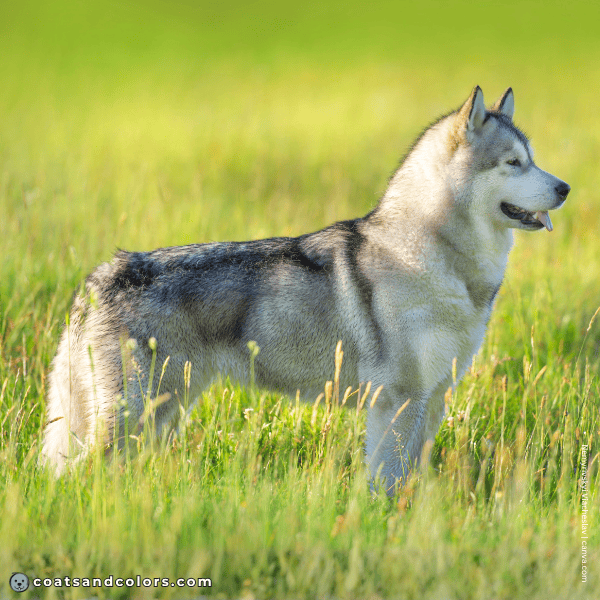
An agouti & white Alaskan Malamute has a black-based agouti pattern.
Agouti causes banded dorsal hairs and ventral tan markings.
The tan tends to be a very pale cream color in this Nordic breed.
The agouti pattern causes face markings with goggles and a nose bar of banded hairs (they call this a “full mask“). The pale tan markings are visible on the cheeks and eyebrows.
At birth, agouti & white Malamute puppies have a very dark sooty look. This is very obvious next to domino siblings, which already have very tan markings at birth.
The Royal Kennel Club lists Agouti & White, Wolf Grey & White, and Wolf Sable & White as common Alaskan Malamute colors. I guess, these are just lighter or darker variations of agouti.
BASE PATTERN
agouti
MERLE
–
OTHER
–
EUMELANIN
black
INTENSITY
white
WHITE
solid
minimal white
Gray & White
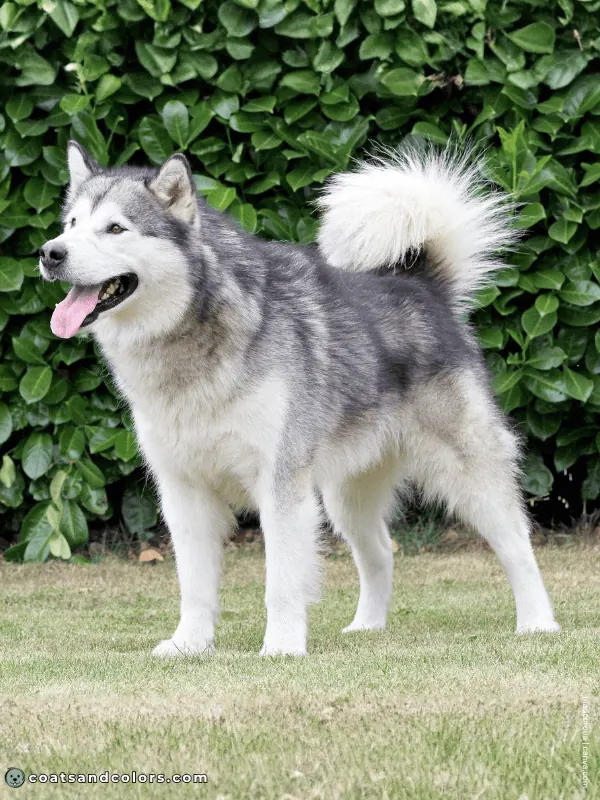
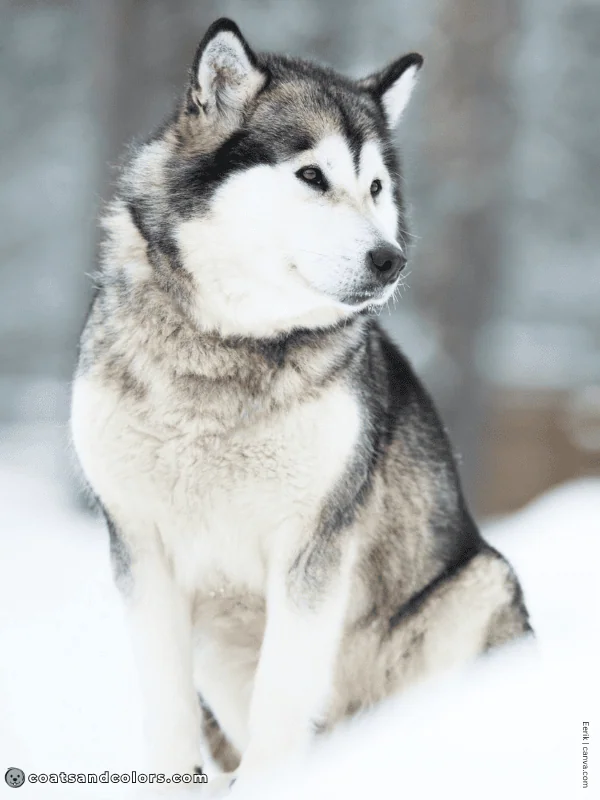
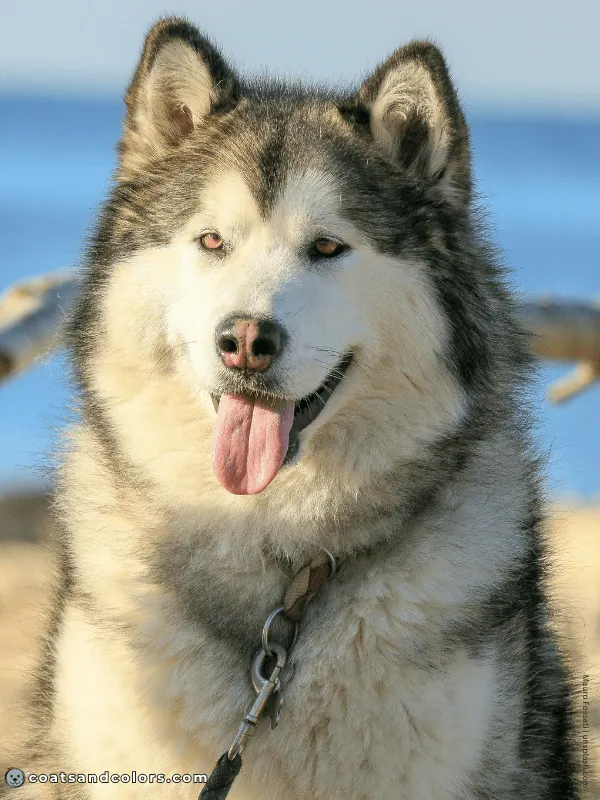
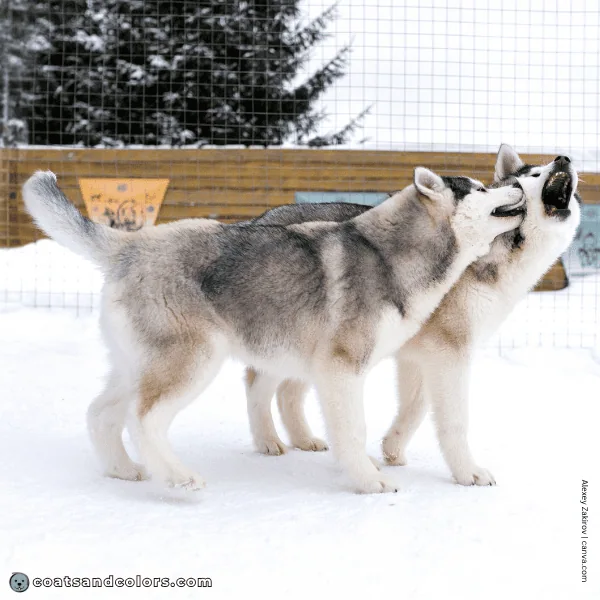
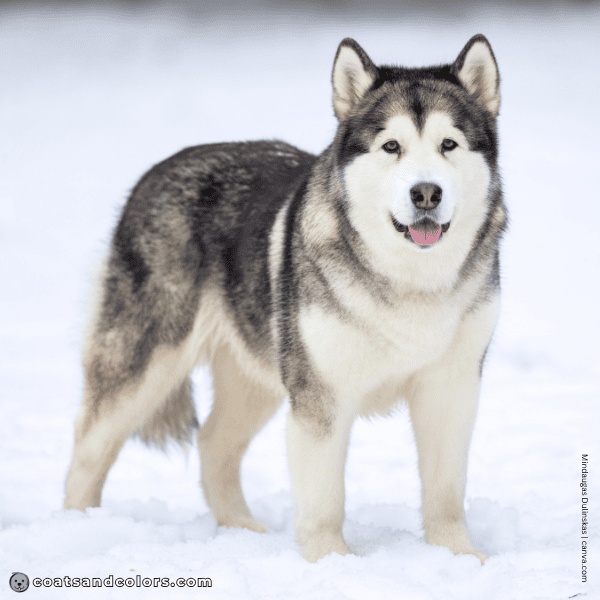
A gray Alaskan Malamute has a black-based agouti domino pattern. Domino reduces the amount of eumelanin (black) and increases the amount of phaeomelanin (cream).
The domino trait removes most of the normal agouti face markings. A gray and white puppy is typically born with already very large, crisp face markings on the cheeks and eyebrows.

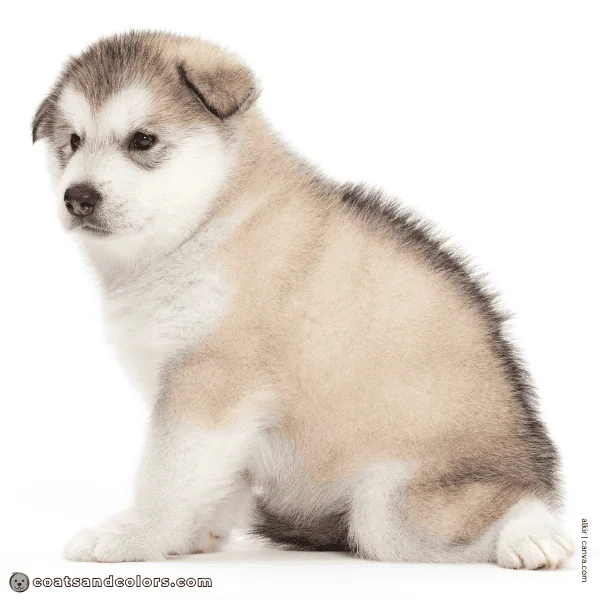
Some, but not all, dogs with domino have a pink stripe down the nose.
Another telltale sign of domino is the extended phaeomelanin banding at the base of the coat and severely reduced eumelanin banding except along the topline. Individual hairs may be light with only a black tip and little or no actual banding. Agouti domino creates an overall grizzled appearance with a reduced amount of dark areas when compared to normal agouti & white.
All in all, the combination of reduced black banding on the topline and pale gray, cream, or white undercoat creates the impression of gray guard hairs on the body.
The agouti pattern in an individual dog can be quite dark (often in tan point carriers aw/at), and the effect of domino can vary. Some dogs keep more of their black pigment than others. Thus, a very dark gray & white dogs may be confused with seal & white (aka tan point domino).
BASE PATTERN
agouti domino
MERLE
–
OTHER
–
EUMELANIN
black
INTENSITY
white
WHITE
solid
minimal white
Black & White
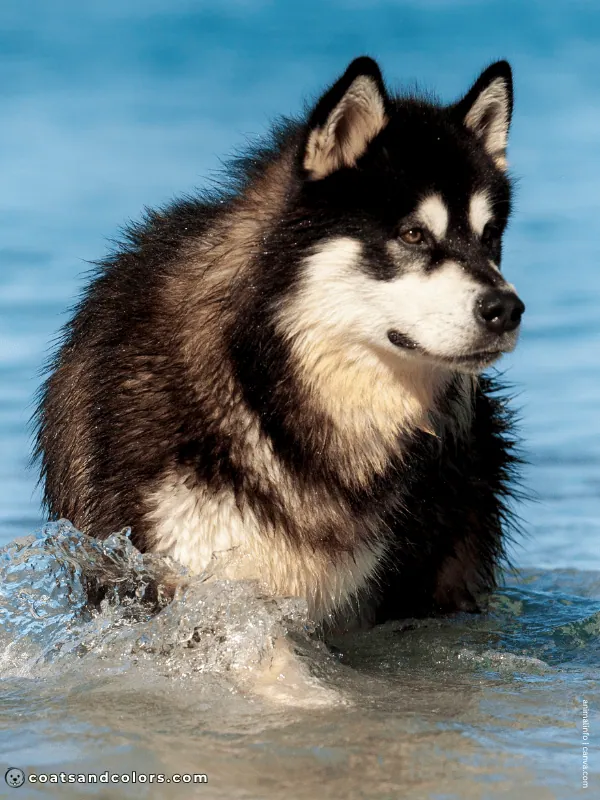
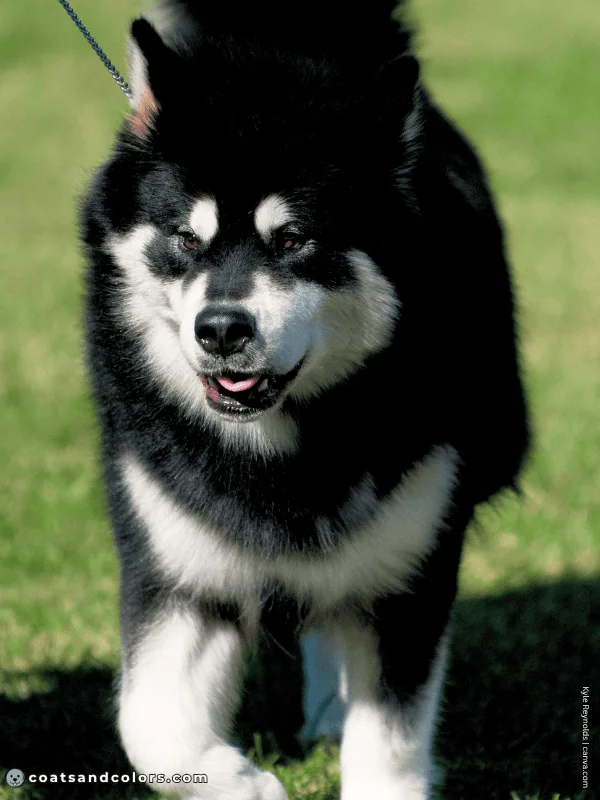
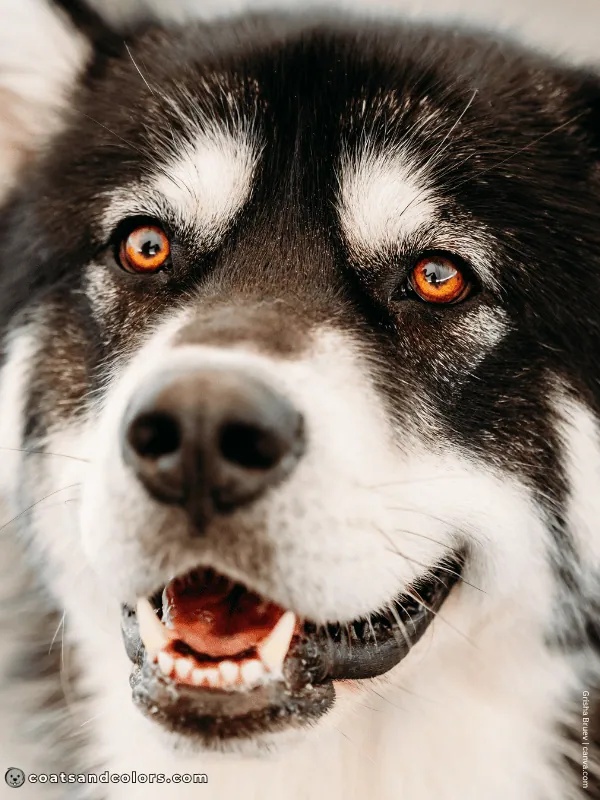
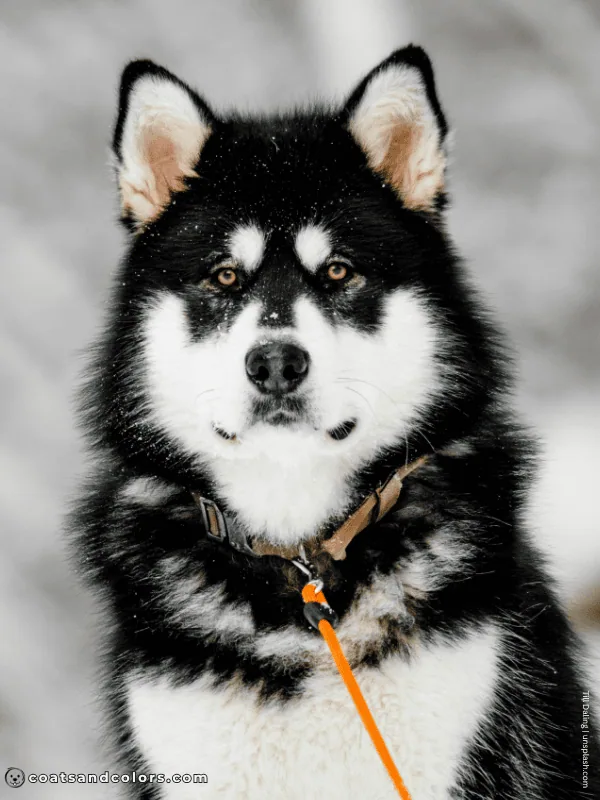
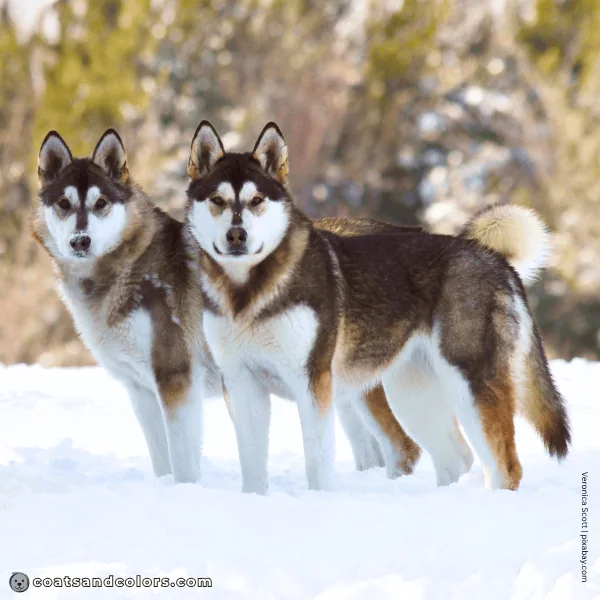
A black & white Alaskan Malamute has a black-based tan point pattern. This pattern causes a mainly solid black dorsal coat with ventral tan markings. The very low red intensity in Malamutes makes their tan markings appear white. Malamutes with this pattern have black guard hairs (which can have a pale base) on their back and a black or dark gray undercoat.
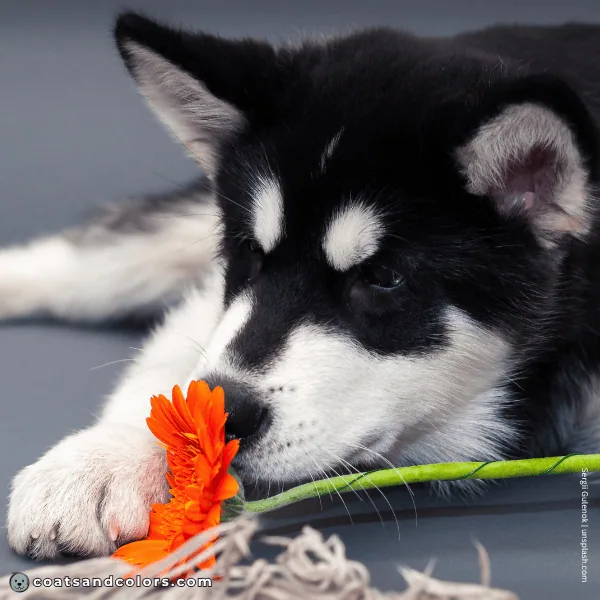
Puppies can look almost black at birth and will keep most of their face markings into adulthood, including a black cap, black nose bar, and black around the eyes.
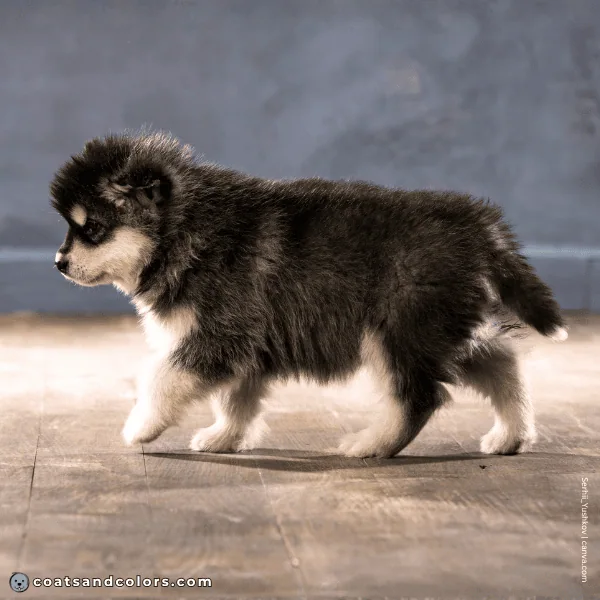
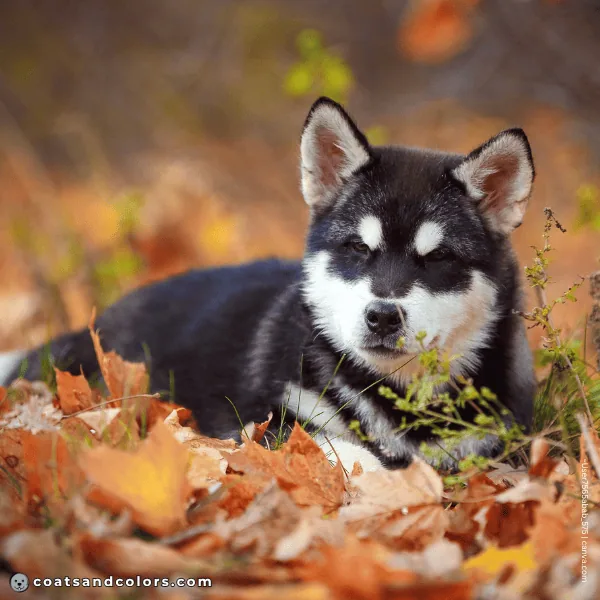
Malamute people are so used to the pale open face markings from domino, that they might call the dark face markings in a non-domino tan point dog “extreme black masking“.
BASE PATTERN
tan point
MERLE
–
OTHER
–
EUMELANIN
black
INTENSITY
white
WHITE
solid
minimal white
Seal & White
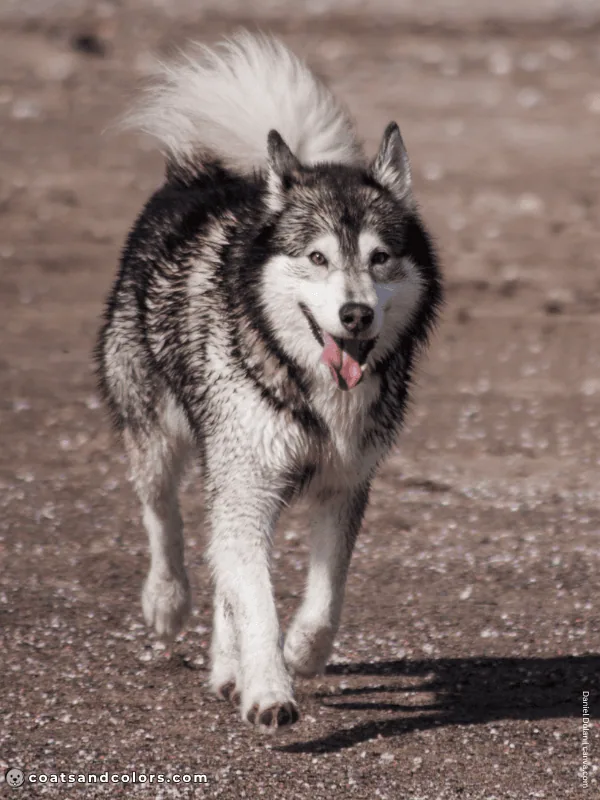
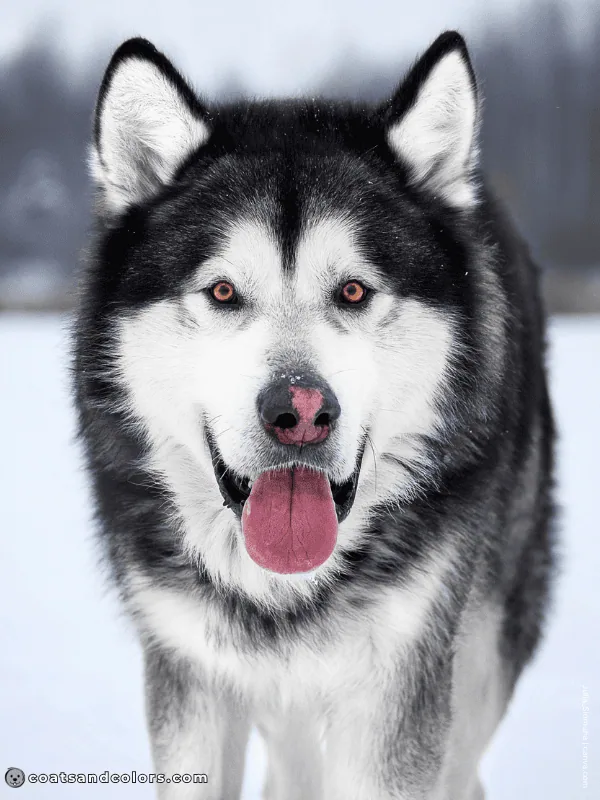
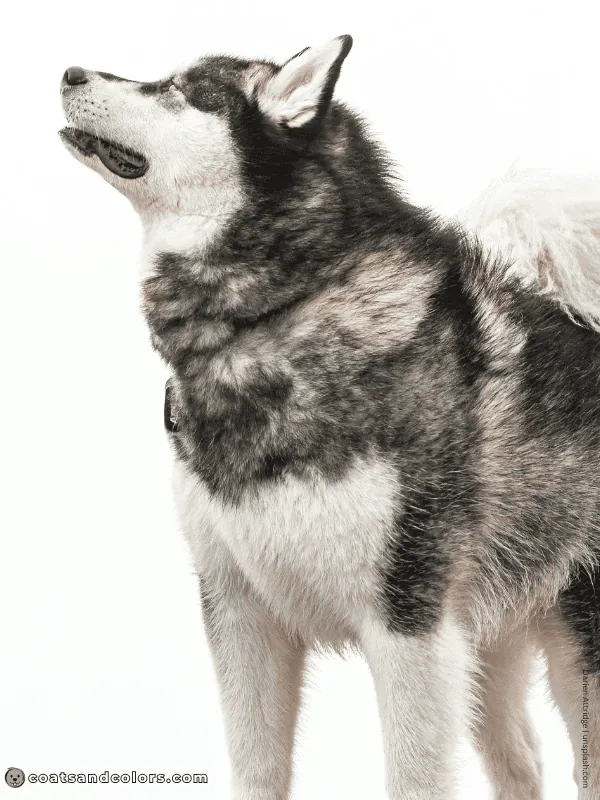
The Alaskan Malamute breed term for tan point domino is “seal & white”. Domino decreases the amount of eumelanin (black) and increases the amount of phaeomelanin (cream).
Tan point domino usually comes with pale face markings, a dark cap, and some residual dark goggles or a residual nose bar running down the bridge of the nose.
Some seals keep full face markings (solid nose bar and goggles), but will still show extended white cheek markings and eye pips compared to a real black & white dog.
A very dark seal & white puppy may resemble a black & white puppy, but seal puppies will already have much larger white eyebrows at birth.
Alaskan Malamutes with seal & white can have some shades of gold or red on their legs, ears, or tail, pooling along the edges of their dorsal pattern. These markings are called “trimmings“.
Seal & white dogs can have black or tipped guard hairs. The domino will cause a pale hair base or some pale hair banding in the dorsal coat and very pale white or cream undercoat.
BASE PATTERN
tan point domino
MERLE
–
OTHER
–
EUMELANIN
black
INTENSITY
white
WHITE
solid
minimal white
Red & White
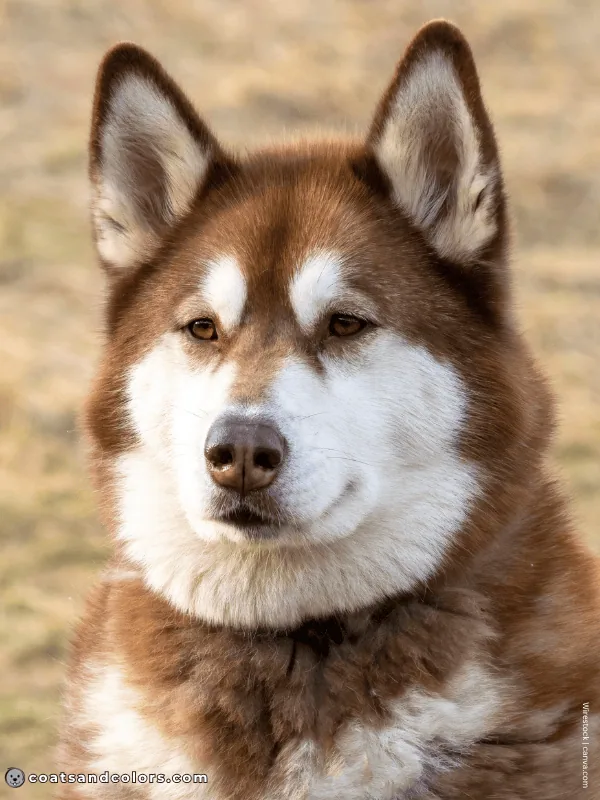
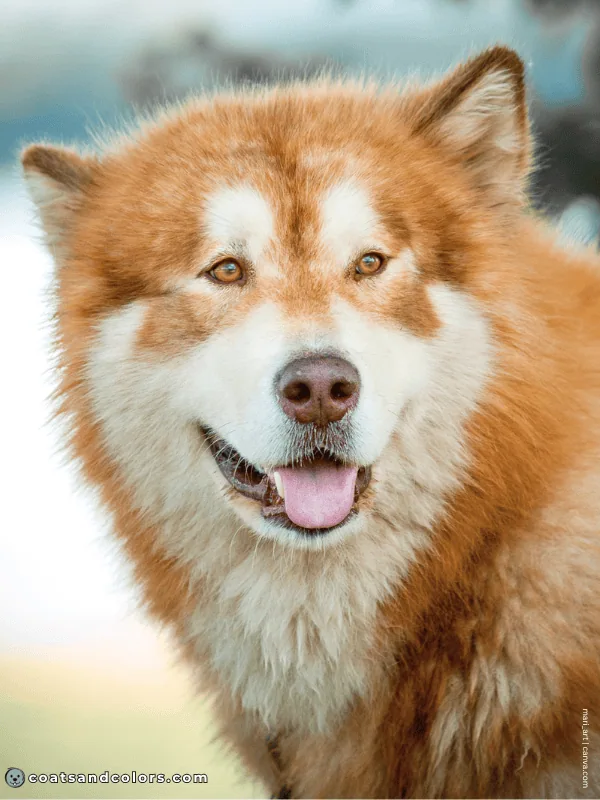

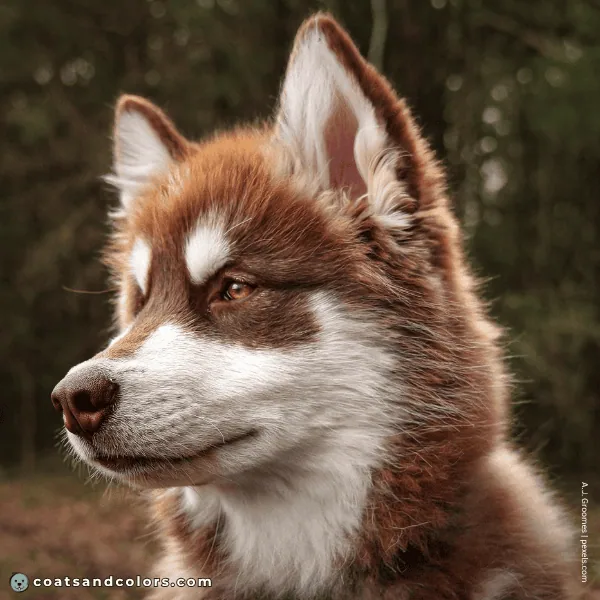
A red & white Alaskan Malamute has chocolate brown eumelanin.
This is yet another breed term! In Alaskan Malamutes, red means chocolate brown. The term red & white is used for about any pattern with brown eumelanin.
The shade of brown can vary from light liver brown to very dark mahogany brown. Red Malamutes will always have a brown nose, brown eye rims, and brown lips.
The brown pigment in patterns with reduced eumelanin (domino) may appear beige or orangey. Just like reduced black appears gray from a distance.
Malamute folks have different names for different brown-base patterns:
- red agouti means brown agouti
- light red or gray red means brown agouti domino
- mahogany red means brown & tan
- dark red or seal red means brown tan point domino
People easily confuse the breed terms red & white (brown eumelanin) and sable & white (red phaeomelanin). Dogs with both traits (brown + intense phaeomelanin) are “sable red“.
BASE PATTERN
agouti
tan point
agouti domino
tan point domino
MERLE
–
OTHER
–
EUMELANIN
brown
INTENSITY
white
WHITE
solid
minimal white
Blue & White
A blue & white Alaskan Malamute has diluted black eumelanin.
Blue refers to diluted black eumelanin. This is super rare in Alaskan Malamutes.
Dilution will lighten all the black color to slate gray. Affected dogs have gray hair tipping or banding, gray skin pigment, gray eye rims, gray lips, and a gray nose.
The eye color is often a pale yellow-green or hazel color.
Just like brown pigment, blue eumelanin can affect any pattern a Mal can have:
- dark blue means blue-based tan point domino.
- blue agouti means blue-based agouti.
- blue & white means blue-based tan point.
- light blue means blue-based agouti domino.
BASE PATTERN
agouti
tan point
agouti domino
tan point domino
MERLE
–
OTHER
–
EUMELANIN
diluted black
INTENSITY
white
WHITE
solid
minimal white
Sable & White
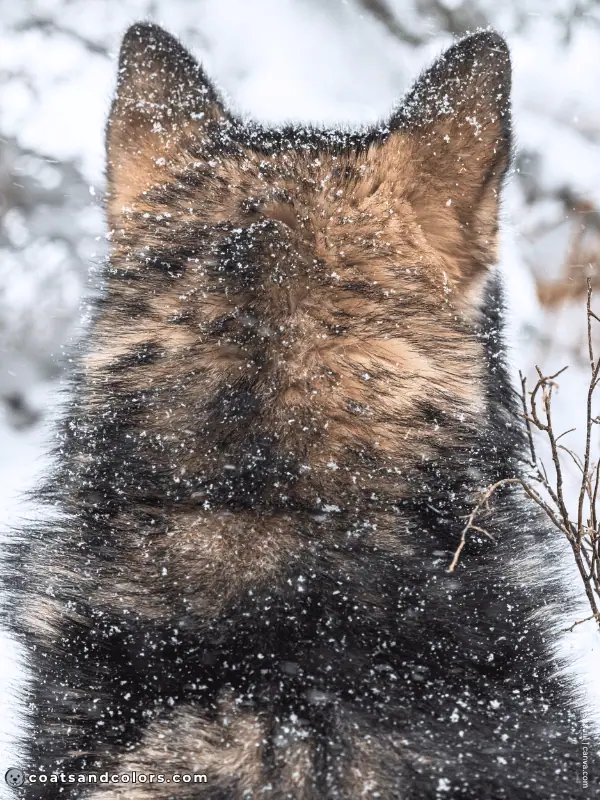
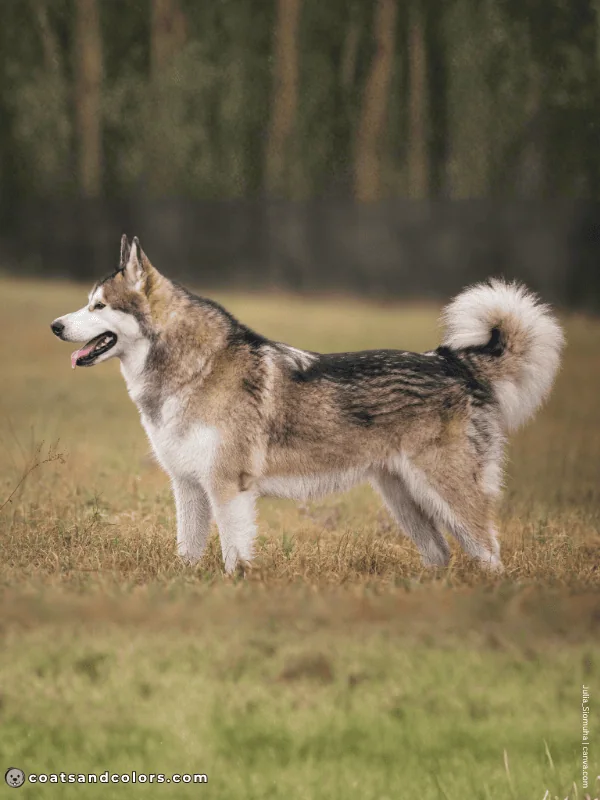
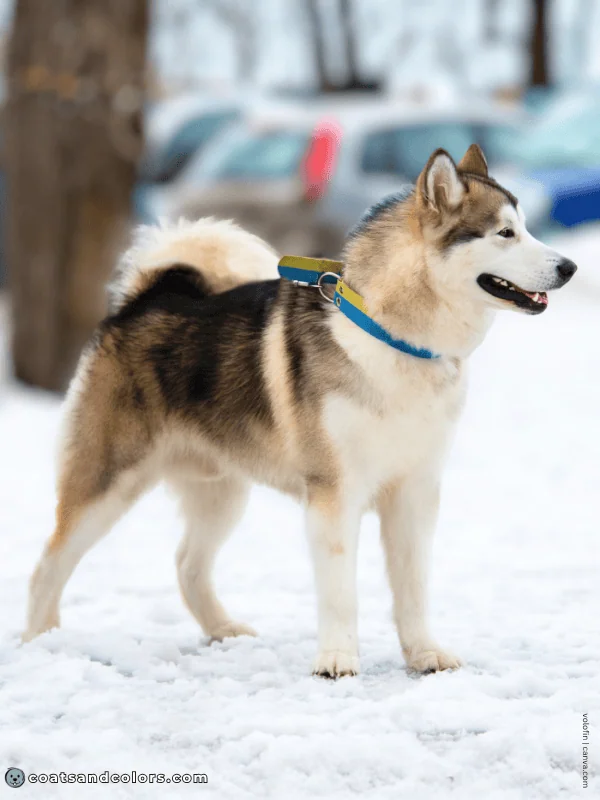
A sable & white Alaskan Malamute has red phaeomelanin.
In color genetics, “sable” usually means a red coat with or without dorsal sabling. Just think of “traditional sable breeds” like the Malinois, Pug, or Leonberger!
Being “sable” can mean any pattern with an unusually rich phaeomelanin intensity showing through on the body. These dogs have a peach, yellow, orange, or red undercoat, red shades in their face markings, and red undertones in their dorsal coat.
You can translate “sable” in this breed into “with red phaeomelanin“. It’s often used to replace the “and white” part in pattern names. For example: A “seal and white” is tan point domino with cream phaeomelanin. A “seal sable” is a tan point domino with red phaeomelanin.
Whatever reduces the phaeomelanin intensity in the majority of Malamutes is absent in sable & white dogs. This causes their phaeomelanin to keep a more intense color.
These dogs are often genetically “gray & white” (aw domino) or “seal & white” (at domino), but are classified as “sable & white” purely due to the color of phaeomelanin in their pattern.
There is also a gradual transition between a tan that still classifies a dog as “sable” to a just slightly lighter cream pigment found in many dogs that would be classified as “gray” or “seal” patterns. This leaves somewhat of a gray area with some dogs being “almost sable”.
The phenotypes in the “sable” category are very diverse. That is, sable is just a breed term for about any pattern with a decent amount of orange undertones. But a tan point domino (“seal sable” or “dark sable”) will naturally be much darker than an agouti domino (just “sable”).
It seems like only agouti dominos are registered as sable.
About any Malamute pattern can come with a sable coloration. There are many terms people might use for these other patterns, e.g. agouti sable, red sable, black sable, etc.
Any agouti, black, gray, or seal dog can have red sable trimmings. This refers to areas with red pigment concentrating in areas where the darker dorsal coat meets the lighter markings on the lower body. But red trimmings on a dog with otherwise pale phaeomelanin don’t make it sable.
BASE PATTERN
agouti domino
MERLE
–
OTHER
–
EUMELANIN
black
INTENSITY
golden, orange, red
WHITE
solid
minimal white
Silver & White
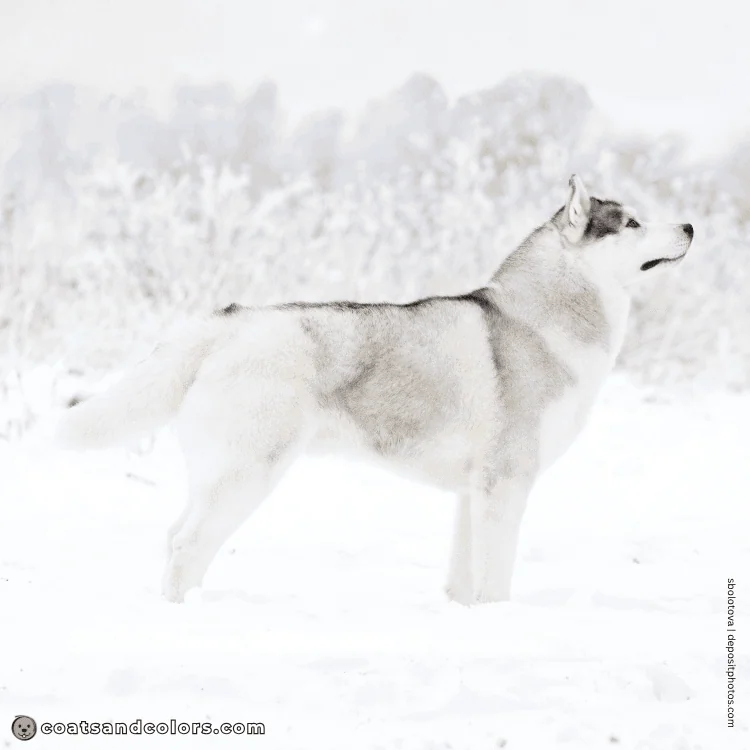
A silver & white Alaskan Malamute has a very light gray color.
They only have minimal black hair tipping and a white undercoat.
Silver can refer to any atypically light version of agouti domino. However, there is no clear definition of just how light a “light gray” must be to be called “silver.”
Silver & white puppies may look almost white at birth or have a very pale buff color with some dark shading or a dorsal stripe of tipped hairs. Some have hints of black eye shadow, but never a black nose bar. Their guard hairs are very light with minimal black tipping.
In adult silver Malamutes, you will find a very pale silvery color with a white undercoat, a white hair base with maybe some black hair tips along the topline.
Their face markings are often very reduced to white with a silvery cap on the forehead. Dogs that carry tan point (Ay/at) can sometimes keep more sabling and may be called “dark silver”.
Some believe that a few of these silver dogs might actually have a true sable pattern (E/- Ay/-), looking silver due to the very low phaeomelanin intensity.
In theory, a silver Mal can have a brown or blue base color instead of black, which would further lighten the contrast between its white undercoat and its minimal pattern.
BASE PATTERN
sable
agouti domino
MERLE
–
OTHER
–
EUMELANIN
black
INTENSITY
white
WHITE
solid
minimal white
White
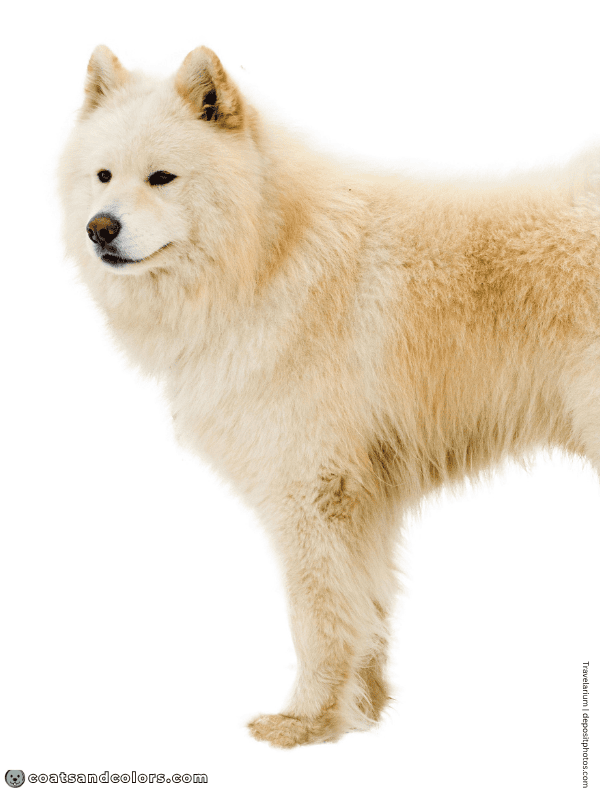
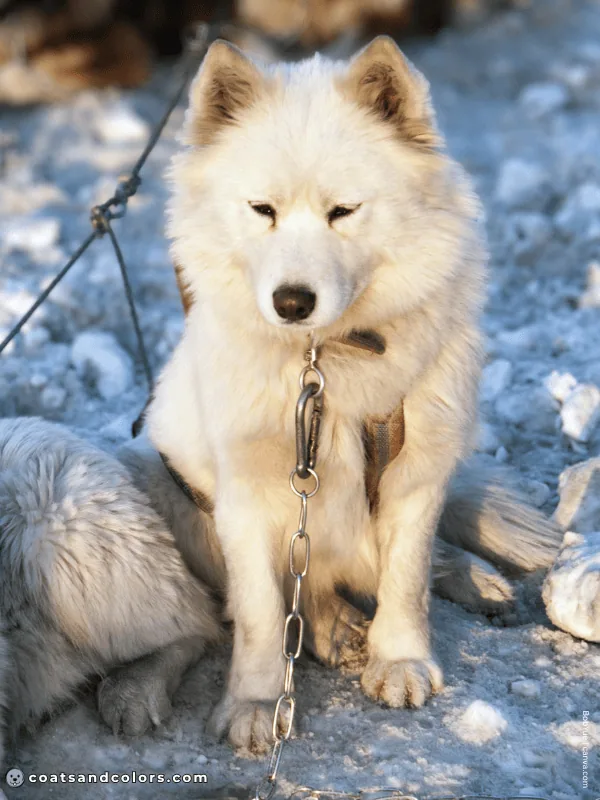
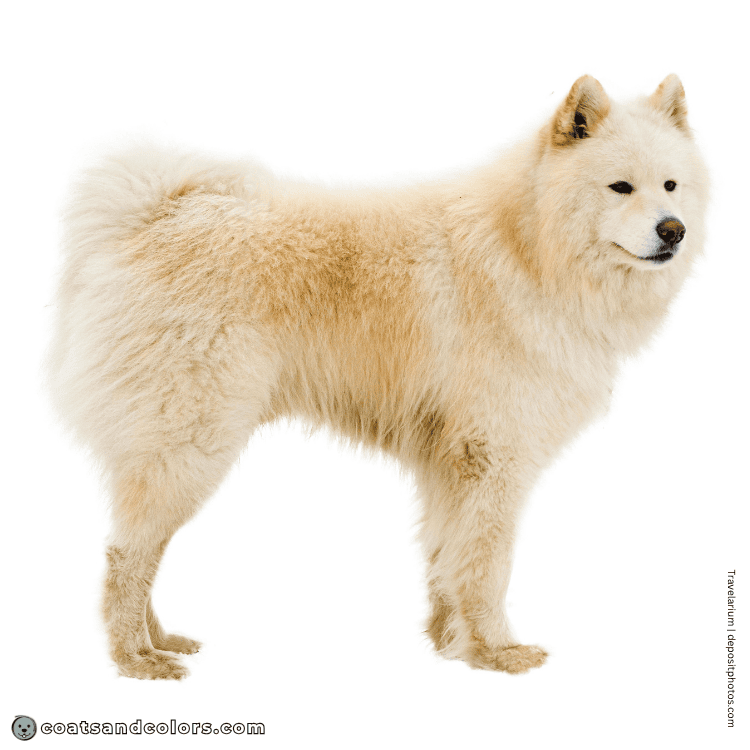
A white Alaskan Malamute is solid white, often with some light reddish shading.
White Malamutes are recessive red (e/e). An all-white Alaskan Malamute is born without any black in its coat, since these dogs can not have eumelanin in their hair.
They are almost solid with white guard hairs and a white undercoat. Many dogs have some reddish ear lacing or shades of cream or biscuit on their head or in their dorsal stripe.
Most white Alaskan Malmutes have a black nose that typically fades to pink, which is quite normal for dogs with the e/e pattern. White dogs can have a brown or blue nose. But the lack of eumelanin (either black or brown with or without dilution) in their coat and the already faded nose doesn’t cause an obvious change in overall phenotype, so there is no real term for this.
There is a slim chance for sable domino (Ay/- ky/ky eA/-) in this breed.
The domino trait deletes much of the already sparse black hair tipping, and affected dogs often look solid white. The only difference is that sable domino puppies can still have some dark puppy shading or stray black hairs, which is impossible in true white e/e Malamutes.
BASE PATTERN
recessive red
MERLE
–
OTHER
–
EUMELANIN
(diluted) black
(diluted) brown
INTENSITY
white
WHITE
solid
minimal white
Breed Terms
Most Alaskan Malamutes express either an agouti domino or a tan point domino pattern. The domino trait partially removes eumelanin from any pattern. But the effect varies a lot, and domino can sometimes leave more and sometimes less of the original face markings.
These are some common breed terms for Alaskan Malamute markings.
Necklace
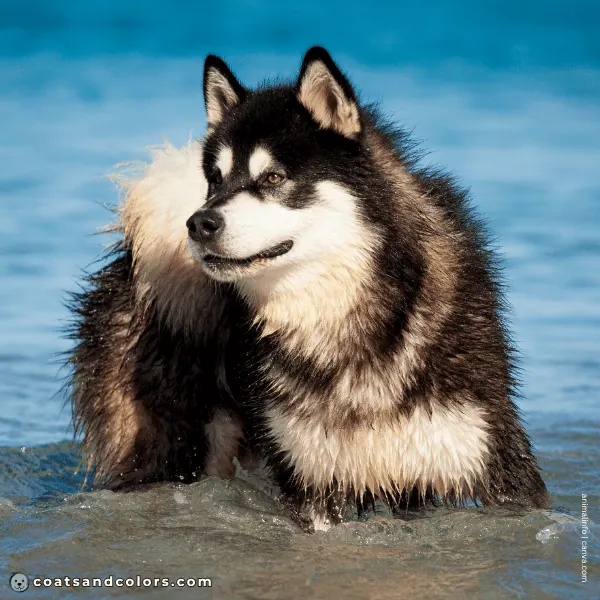
If a dog has a band of dark-pigmented hair around its white chest, this is a “necklace“. Dogs without a necklace have a “white chest“. In dogs with two partially pigmented dark bands, this is called an “eagle“.
Cap
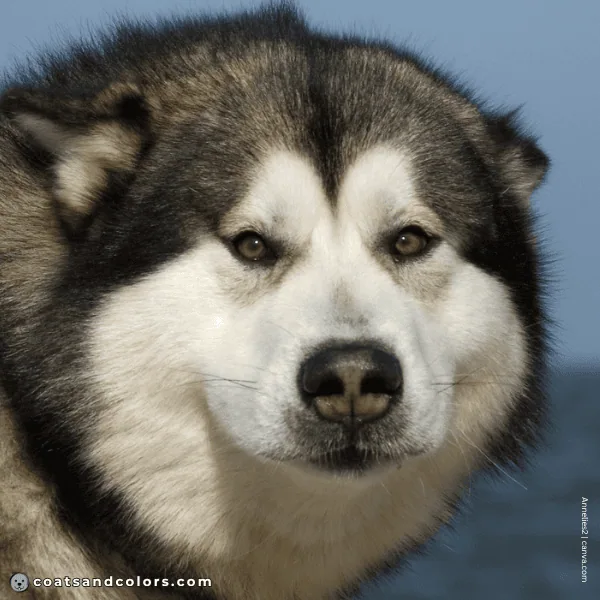
Alaskan Malamutes often have some pattern covering the top of the head and ears, ending in a pointed widow’s peak in the center of the forehead. In Malamutes, this is called a cap.
Eye Shadow
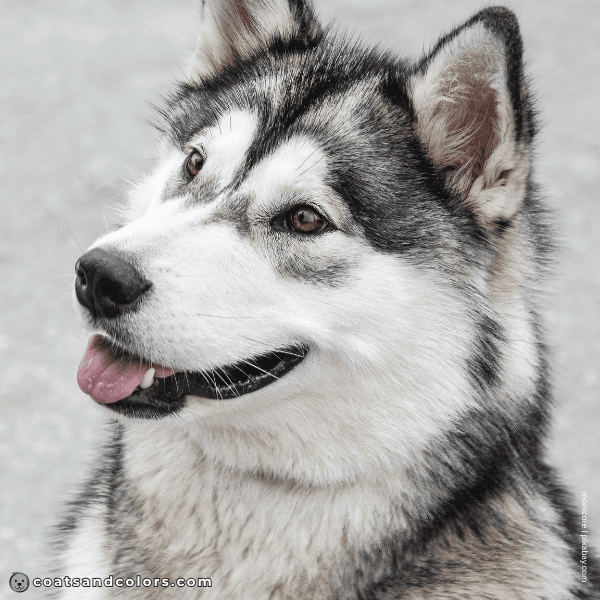
When Malamute people talk about eye shadow, they mean the dark markings under the eye that do not quite extend out or connect to the cap.
Goggles
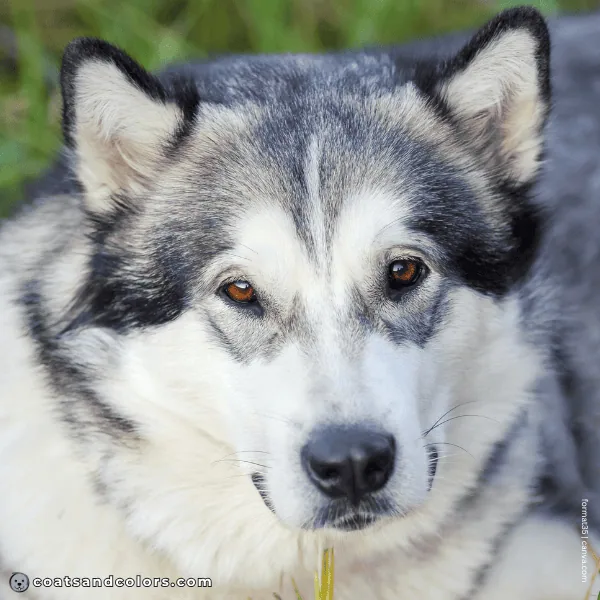
But if the eye shadow Malamute markings extend sideways and connect to the cap and form circles around the eyes, they are called goggles.
Nose Bar
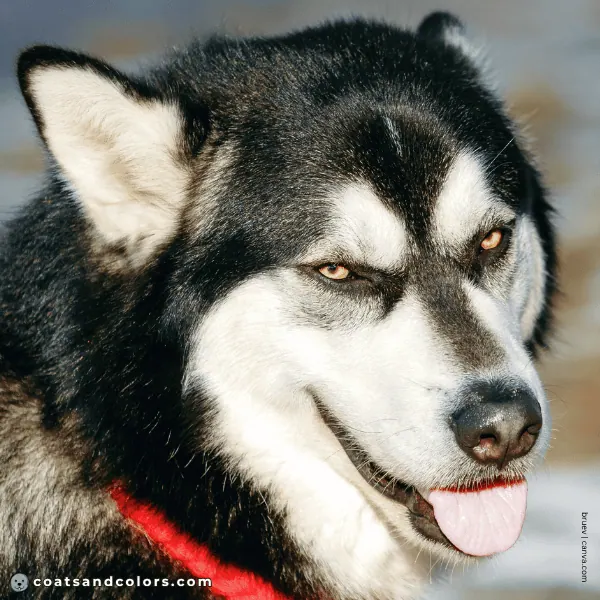
The term nose bar refers to a dark or banded stripe of coat down the nose.
Open Face
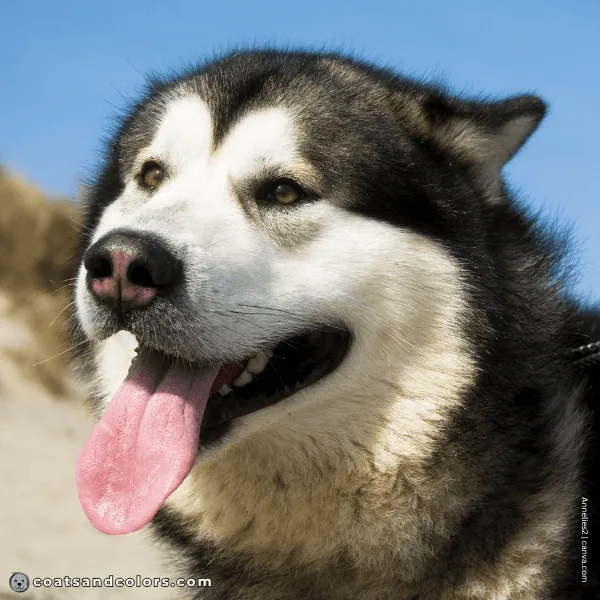
Having an open face means the dog has no other markings on the face than his cap. This refers to an all-white face pattern with little to no pigment under the eyes.
Closed Face
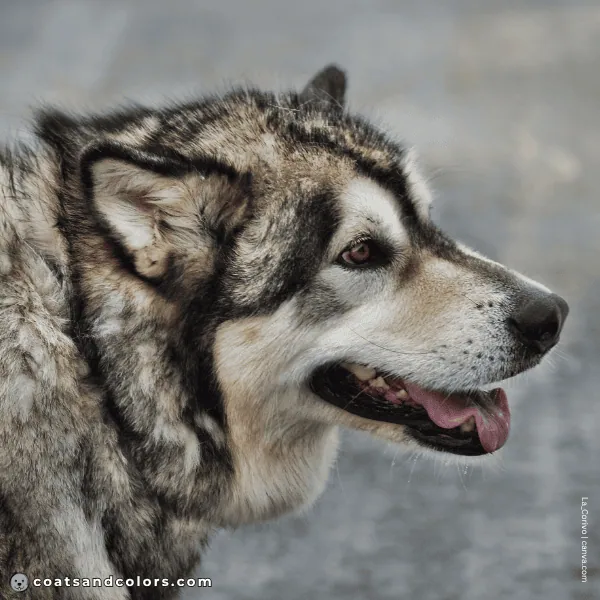
Having a closed face means the dog has a fully pigmented pattern without any distinct white markings on the face. This is quite rare in Alaskan Malamutes.
Mask
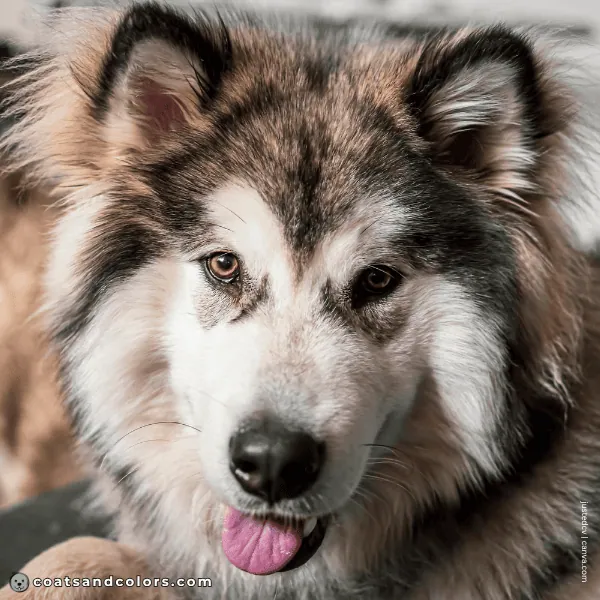
Full Mask
A “mask” refers to a dog with a combination of a cap and goggles, but no nose bar. This happens when domino leaves lots of residual face overlay in tan point or agouti dogs.
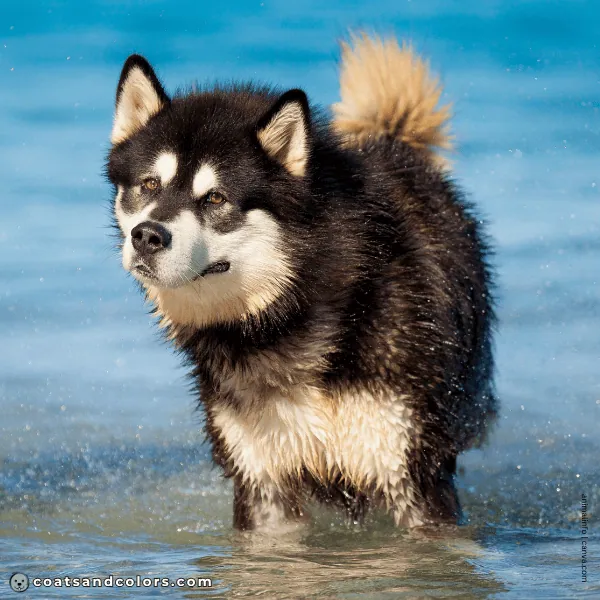
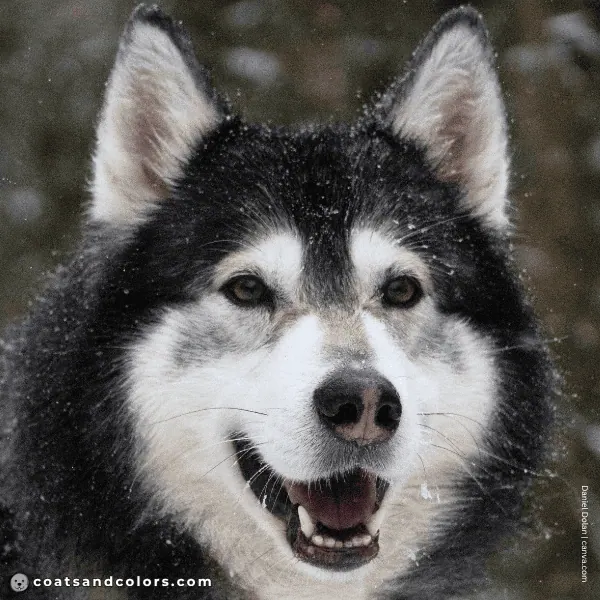
Dogs with a “full mask” have a nose bar as well as goggles and a cap. This happens in tan point or agouti patterns without domino, with puppies being born very dark and “mud-faced“.
Base Patterns
The base pattern describes the placement of phaeomelanin and eumelanin in the coat.
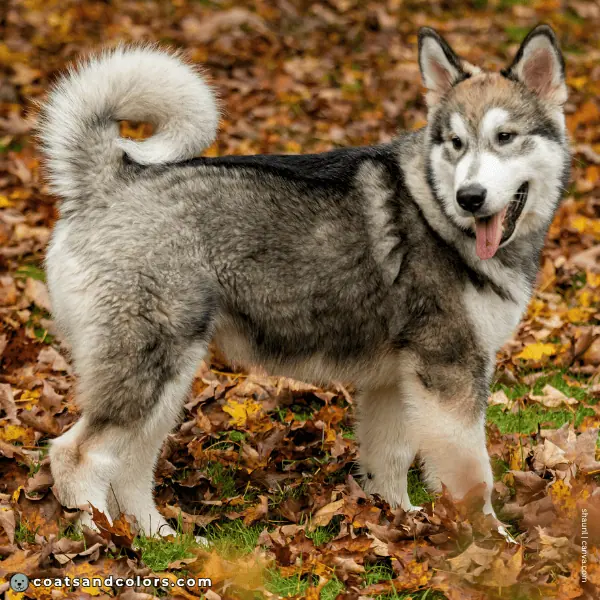
agouti
E/- ky/ky aw/-
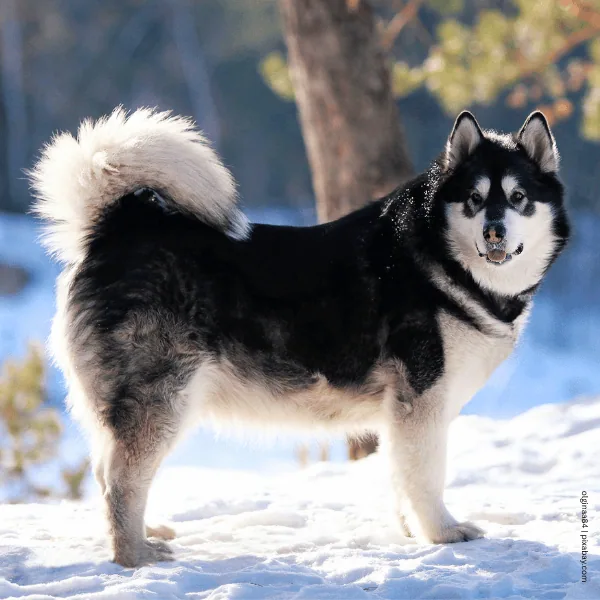
tan point
E/- ky/ky at/-
recessive red
e/e
agouti domino
eA/- ky/ky aw/-
tan point domino
eA/- ky/ky at/-
A Locus
| aw | agouti |
| at | tan point |
| a | recessive black |
The majority of Malamutes have agouti (aw) or tan points (at). Other patterns are very rare.
K Locus
| ky | wild-type |
Malamutes are fixed for a patterned coat (ky/ky).
E Locus
| E | wild-type |
| eA | ancient red, domino |
| e | recessive red |
Malamutes can have a normal A locus pattern (E/-). Many of them express domino (eA/-). Any dogs with two copies of recessive red will be solid white (e/e).
Alaskan Malamute Base Patterns
The genotypes of Alaskan Malamute breed standard patterns:
| A LOCUS | K LOCUS | E LOCUS | PATTERN |
|---|---|---|---|
| aw/- | ky/ky | E/- | agouti “agouti & white” |
| aw/- | ky/ky | eA/- | agouti domino “gray & white, sable & white” |
| at/at | ky/ky | E/- | tan point “black & white” |
| at/at | ky/ky | eA/- | tan point domino “seal & white” |
| e/e | recessive red “white” |
This is a very simplified Alaskan Malamute color chart:

Base Colors
The base color is determined by the B locus and D locus.
B Locus
| B | black |
| b | brown |
The B locus modifies black pigment to chocolate brown in b/b dogs.
Malamutes can have either black or brown pigment.
D Locus
| D | dense |
| d | diluted |
The D locus controls color dilution.
Malamutes mainly have normal pigment (D/-). Color dilution is accepted, but rare in this breed. The dilution of black is called blue. There seems to be no breed term for the dilution of brown.
Alaskan Malamute Base Colors
The genotypes of possible base colors in the Alaskan Malamute breed:
| B LOCUS | D LOCUS | BASE COLOR |
|---|---|---|
| B/- | D/- | black “black” |
| b/b | D/- | brown “red” |
| B/- | d/d | diluted black “blue” |
| b/b | d/d | diluted brown (?) |
Red Intensity
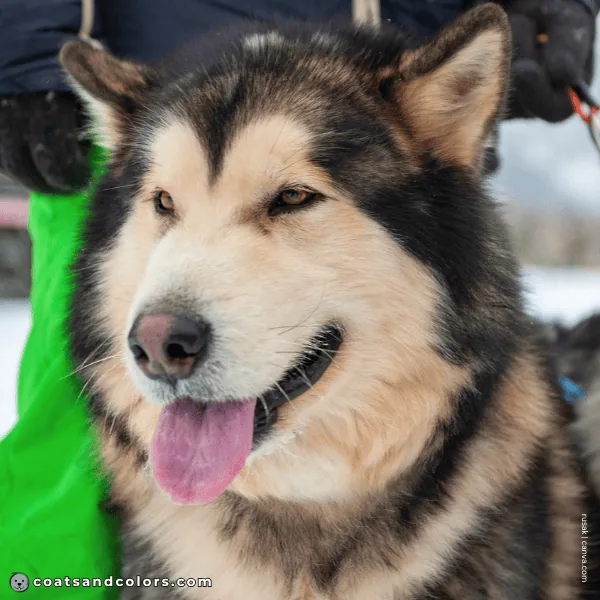
The color intensity of phaeomelanin in the phenotype is a polygenic trait, meaning it is regulated by a number of different genes. The Alaskan Malamute breed has selected for very low intensity cream and ivory colors across all patterns. Dogs with medium intensity yellow or tan pigment are called “sable“.

The breed standards describe the most common phaeomelanin intensity in Alaskan Malamutes simply as white. Only some dogs show colors from gold to red or other “shadings of sable” (this breed uses “sable” for any intensity that is richer than the typical cream/ivory/white).
“White is always the predominant colour on underbody, parts of legs, feet, and part of face markings.”
AKC Breed Standard[1]
FCI Breed Standard[2]
White Markings
Several different traits can remove pigment from the coat and replace it with white markings.
Malamutes may test positive for piebald-type spotting (sP). However, S locus testing is not reliable in Nordic breeds. Even dogs that test as sP/sP tend to have only very minor white markings.
Malamutes often have minimal white markings, some consider them Irish markings.
The little white in Malamutes often happens to be in or next to areas like the paws or muzzle that already look white due to the very pale phaeomelanin in this breed.
This can make true white markings in Malamutes hard to spot.
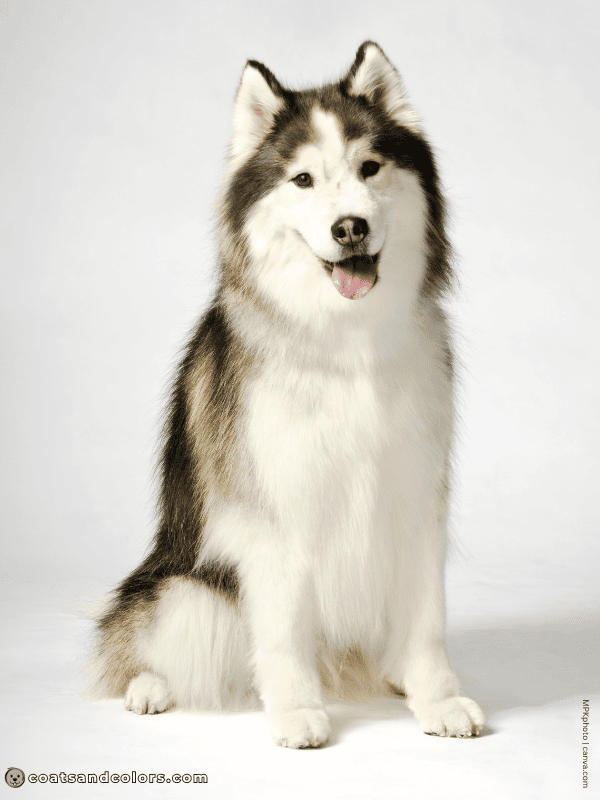
Mals typically never show extended piebald, only very few dogs express visible body white. This can include a white collar, “splashing“, a white “withers spot” or “nape spot, as well as solid white legs.
Some have a blaze, a white stripe that extends from the pointy end of the cap up the forehead. Most blazes are short and narrow, but they can sometimes get wide or irregular. A small white spot on the forehead that is not connected to a blaze is called a “star“.
Being domino (eA) can increase the amount of white compared to non-domino (E) siblings.
“A white blaze on the forehead and/or collar or a spot on the nape is attractive and acceptable. The Malamute is mantled, and broken colors extending over the body or uneven splashing are undesirable.”
AKC Breed Standard[1]
FCI Breed Standard[2]
“White blaze on forehead, white collar, or spot on nape permissible. Heavy mantling of unbroken colour acceptable, broken colour extending over body in spots or uneven splashings undesirable.”
RKC Breed Standard[3]
Alaskan Malamute Eye Colors
Malamutes typically have brown eyes.
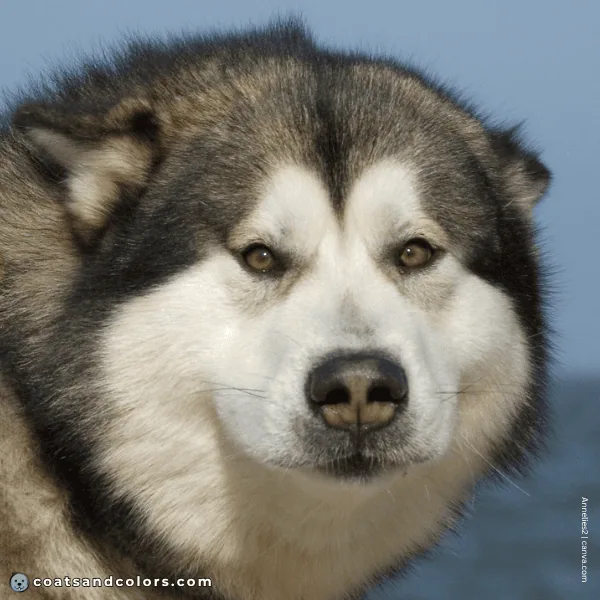
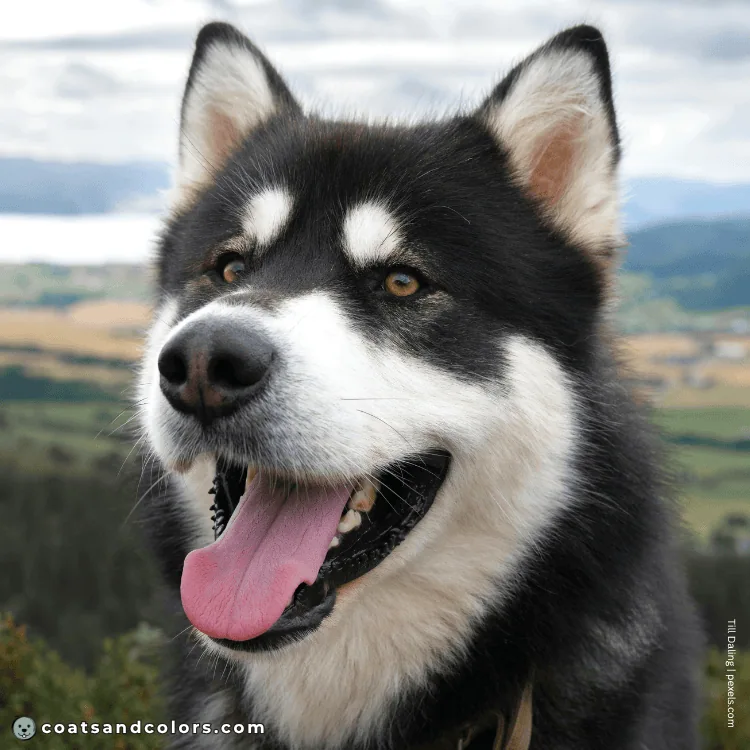
But “red & white” dogs with brown pigment often show lighter eye colors, especially when young.
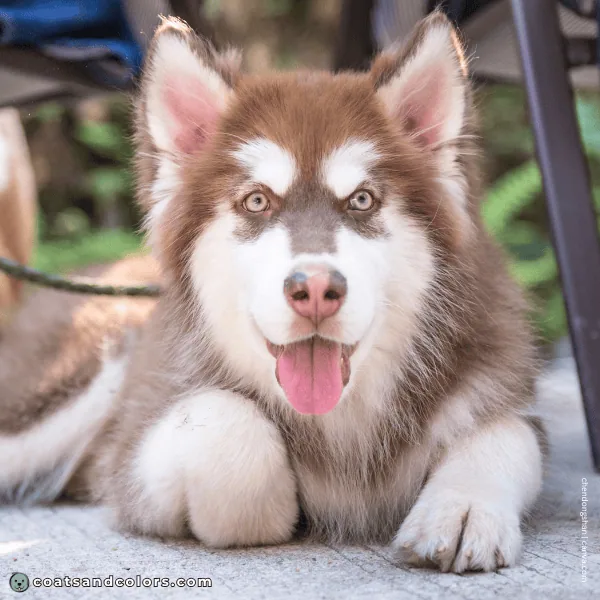
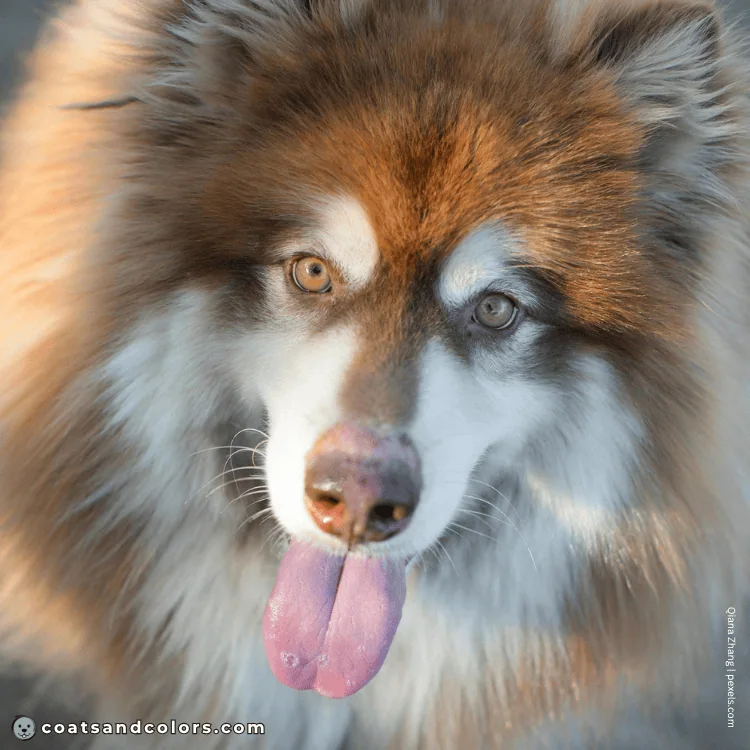

Malamutes should never have blue eyes, meaning they don’t have the ALX4 blue eye trait. A Malamute with blue eyes is considered a Siberian Husky cross.
“The eyes are obliquely placed in the skull. Eyes are brown, almond shaped and of medium size. Dark eyes are preferred. Blue eyes are a disqualifying fault.“
AKC Breed Standard[1]
“Brown, almond shaped, moderately large, set obliquely. Dark eyes preferred, except in red and white dogs where light eyes are permissible. Blue eyes highly undesirable.”
RKC Breed Standard[3]
Alaskan Malamute Nose Colors
Black dogs have black noses. Chocolate “red” dogs have liver noses.
Dogs with color dilution will have gray noses (diluted black) or lilac noses (diluted chocolate).
Dogs with domino patterns often show a pink stripe down their nose.
And white dogs often have very faded pinkish noses.
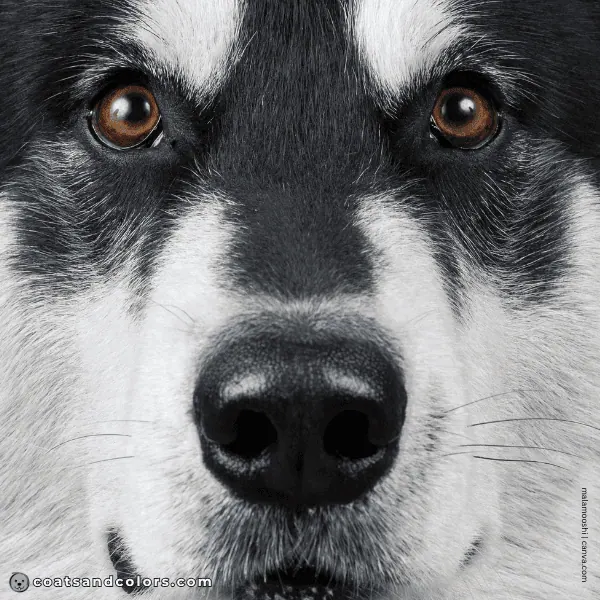
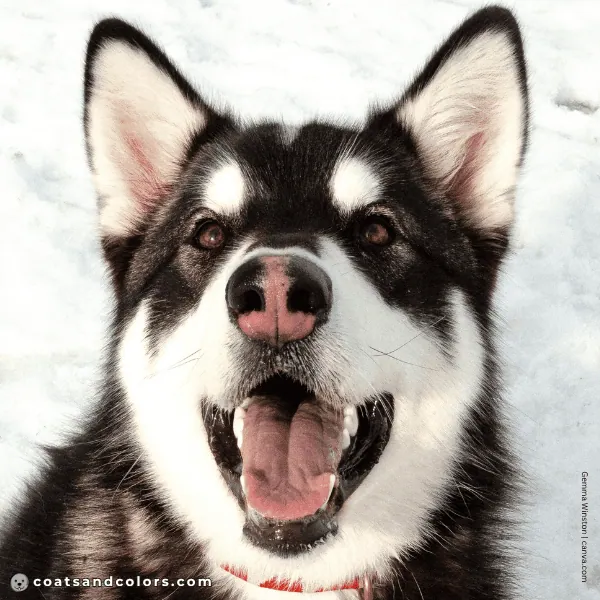
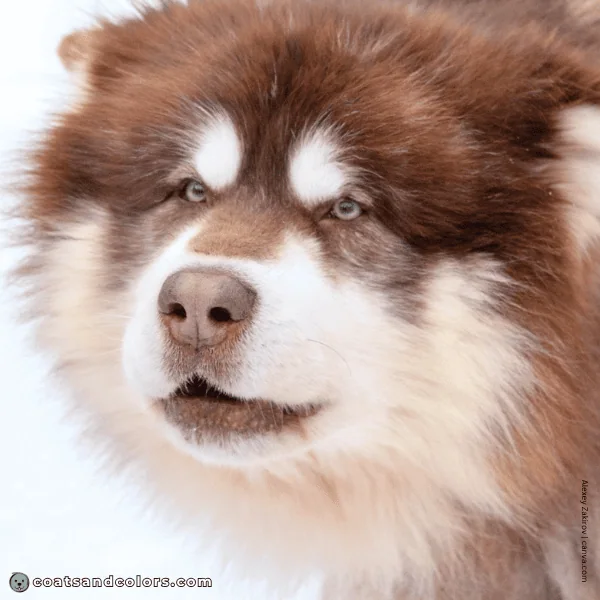
“In all coat colors, except reds, the nose, lips, and eye rims’ pigmentation is black. Brown is permitted in red dogs. The lighter streaked “snow nose” is acceptable.”
AKC Breed Standard[1]
“Nose black except in red and white dogs when it is brown. Pink streaked ‘snow nose’ acceptable.”
RKC Breed Standard[3]
Alaskan Malamute Coat Type
The Alaskan Malamute coat type is characterized by its thickness and dense growth. The coat’s length is relatively short to medium, but can be longer at the ruff, back, rump, and tail.
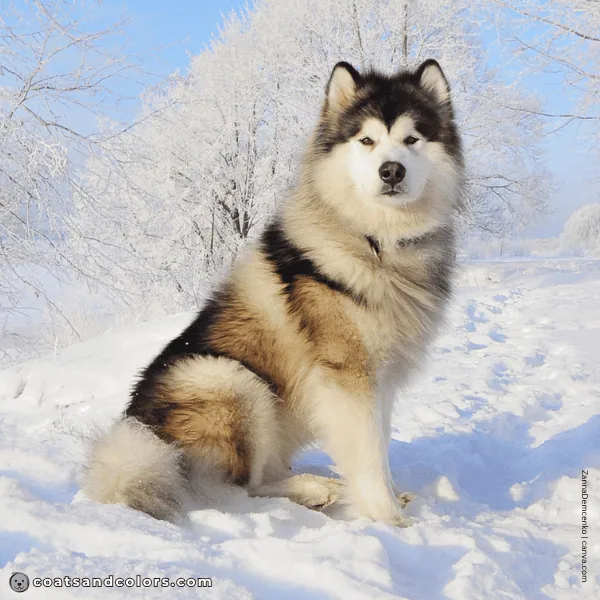
Genetically, Malamutes should be short-haired without any feathering on the legs or ears.
The rare wooly Malamute has lots of thick undercoat and long feathering on its legs, ears, and tail. The coat on its torso drapes down the sides or parts down the middle of the back.
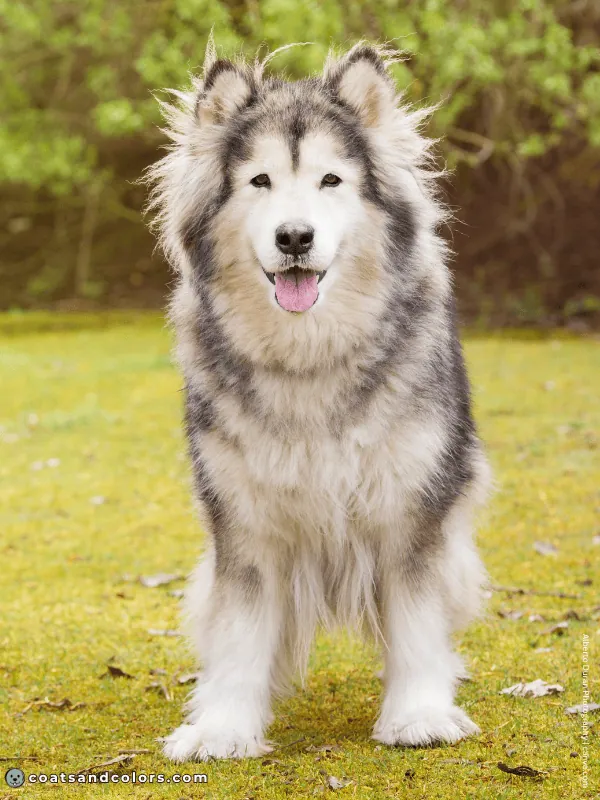
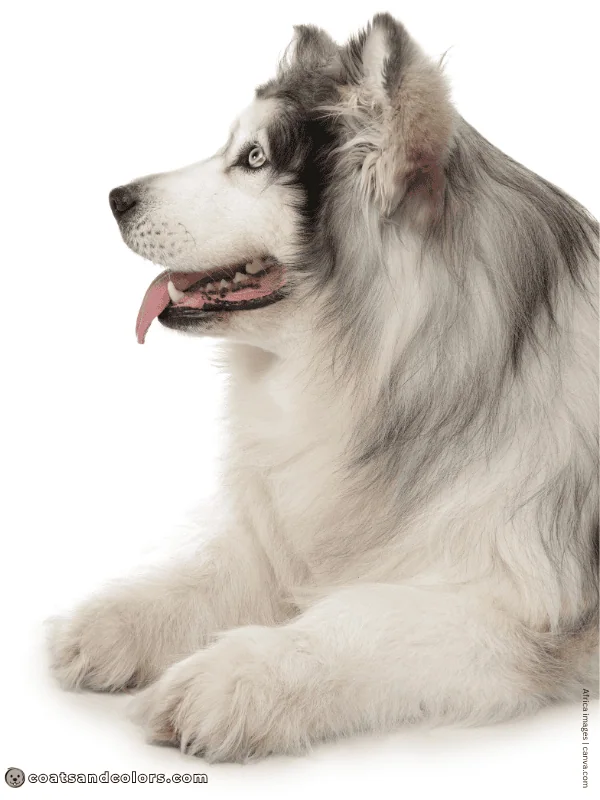
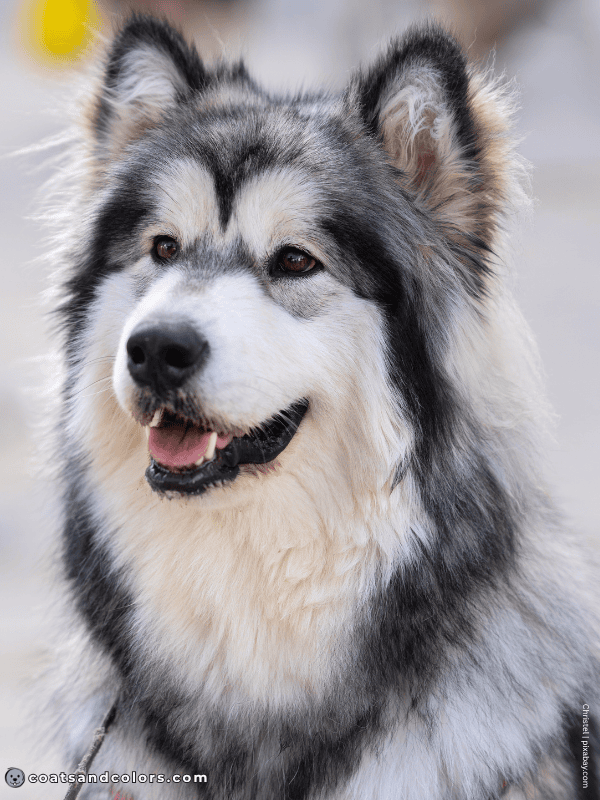
“The Malamute has a thick, coarse guard coat, never long and soft. The undercoat is dense, from one to two inches in depth, oily and woolly. The coarse guard coat varies in length as does the undercoat. The coat is relatively short to medium along the sides of the body, with the length of the coat increasing around the shoulders and neck, down the back, over the rump, and in the breeching and plume.”
AKC Breed Standard[1]
“Thick, coarse guard coat, not long and soft. Dense undercoat, […], oily and woolly. Coarse guard coat stands out, with thick fur around neck. Guard coat varies in length as does undercoat, but in general coat of medium length along sides of body, increasing somewhat around shoulders and neck, down back and over croup, as well as in breeching and plume.”
RKC Breed Standard[3]
The coat type can significantly affect how we perceive coat colors. In spitz-type breeds, the hair often stands off the body due to their thick undercoat.
The basic hair morphology is determined by hair length and the presence of furnishings or curls. Other factors, like hair thickness or the amount of undercoat, can vary within each coat type.
Alaskan Malamutes have a very thick coat, they are high-shedding dogs.
Related Breeds
Learn More

Links
[1] AKC Breed Standard: Alaskan Malamute
[2] FCI Breed Standard: Alaskan Malamute
[3] RKC Breed Standard: Alaskan Malamute
[4] CKC Breed Standard: Alaskan Malamute
[5] Dreger et al. (2019). True Colors: Commercially-acquired morphological genotypes reveal hidden allele variation among dog breeds, informing both trait ancestry and breed potential. PLoS ONE 14(10): e0223995. https://doi.org/10.1371/journal.pone.0223995
[6] Alaskan Malamute Club of America. Judges Education
[7] Nichole Royer (2007): Malamute Coat Color Genetics
Image Credits
~User7565abab_575/canva.com
Africa Images/canva.com
Alberto Duran Photography/canva.com
Alexey Zakirov/canva.com
alkir/canva.com
animalinfo/canva.com
Annelies2/canva.com
Artsiom Petrushenka/canva.com
Atstock Productions/canva.com
BobYue/canva.com
bruev/canva.com
Christel/pixabay.com
Daniel Dolan/canva.com
Darien Attridge/unsplash.com
Eerik/canva.com
Gemma Winston/canva.com
Grisha Bruev/canva.com
Josué Fernando Flores/pexels.com
Julia_Siomuha/canva.com
justedcv/canva.com
Kateryna Babaieva/pexels.com
Kyle Reynolds/canva.com
La_Corivo/canva.com
LiuMeiLi/canva.com
madcorona/canva.com
malamooshi/canva.com
mari_art/canva.com
Mauro Fossati/unsplash.com
Mindaugas Dulinskas/canva.com
monicore/pixabay.com
MPKphoto/canva.com
Nemyrivskyi Viacheslav/canva.com
No Glory’s Images/canva.com
PJHathway/canva.com
Qiana Zhang/pexels.com
rusak/canva.com
Sandro Alphonse/unsplash.com
sbolotova/depositphotos.com
Serhii_Yushkov/canva.com
shaunl/canva.com
Till Daling/pexels.com
Veronica Scott/pixabay.com
volofin/canva.com
Wirestock/canva.com
ZannaDemcenko/canva.com
Павел Гавриков/pexels.com
Hi! I’m Steffi. I am a biologist and a big time dog nerd. You are curious about coat color genetics? You’ve come to the right place! Read more.
2 thoughts on “Alaskan Malamute Colors”
Comments are closed.