

The eA allele at the E locus is responsible for various “domino” phenotypes. It modifies other patterns to show reduced eumelanin and increased phaeomelanin expression. Different domino phenotypes go by different names in different breeds, but eA is most common in sled dogs.
What is Northern Domino?
Domino reduces eumelanin expression and increases phaeomelanin expression.
But it can for sure take some practice to recognize it.
Domino modifies whatever base pattern a dog has, depending on its K locus and A locus.
The most common examples are agouti domino (ky/ky aw/- eA/-) and tan point domino (ky/ky at/- eA/-), which represent the most common “husky colors“. Domino modifies the ventral tan markings in these patterns to extend into large “open face” markings.
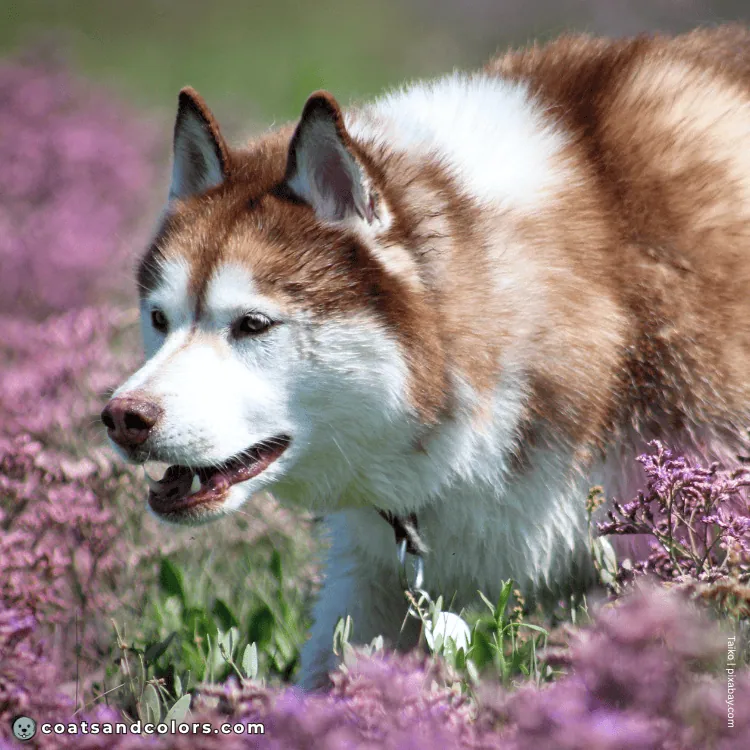
It often takes some time after birth for these patterns to develop, because domino patterns require increased phaeomelanin and very young puppies often show delayed phaeomelanin expression. But even domino puppies will typically already have larger face markings.

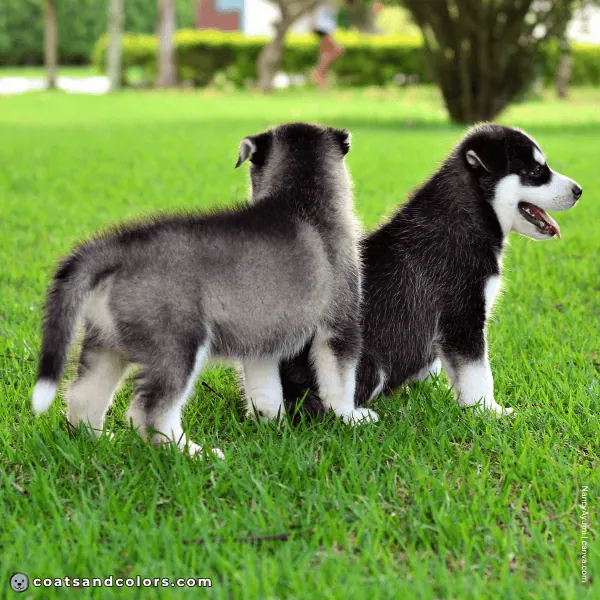
Domino typically removes quite some dark pigment from any pattern. In patterned dogs (agouti, tan point), darker dorsal hairs will still show a dark tip, but reduced dark banding towards the base.
And dogs that should be solid dark (dominant black or recessive black) can look awfully patterned with lots of grayish tan due to being “black domino“.
The eA Allele
The E locus is part of the system that tells pigment cells what type of pigment they should produce. Different alleles at the E locus control how much eumelanin a dog can show in its pattern.
Domino is a reduced-function mutation that can be described as “partial recessive red”. True recessive red fully inhibits eumelanin production, domino can only partially reduce the spread of eumelanin.
The eAncient Red variant is responsible for different phenotypes with lesser-than-expected eumelanin in a variety of dog breeds. Why ancient? Well, this allele was found in 10.000 year old dog remains[2].
Some older texts still refer to this allele simply as eD as in eDomino.
Northern domino (eA) is an incomplete recessive to melanistic mask (Em) and wild type (E). But dominant to recessive yellow (e). Its interaction with other domino alleles (eG, eH) is not yet understood.
Any masked or normally pigmented dog could be a carrier of Northern domino (Em/eA, E/eA). Some sources tell me that some carriers might show reduced eumelanin (e.g. a just so slightly less pronounced mask in Em/eA puppies next to Em/E siblings), which hints at incomplete dominance.
But real Northern domino is only expressed in dogs that are eA/eA or eA/e. Being eA/e might give an overall lighter pattern compared to eA/eA due to weak incomplete dominance of E locus alleles [1].
The effect of Northern domino combined with other domino alleles (eA/eG, eA/eH) is unknown since such pairings are very rare[1]. But eA is very similar to eG, while eH should cause a stronger effect.
Domino Phenotypes
An eA/- genotype impacts any phenotype provided by the K locus and A locus.
Domino decreases the amount of eumelanin in any pattern. It often also turns a dog’s whiskers, hair roots, and undercoat very pale and can create a prominent vertical pink stripe on the nose.
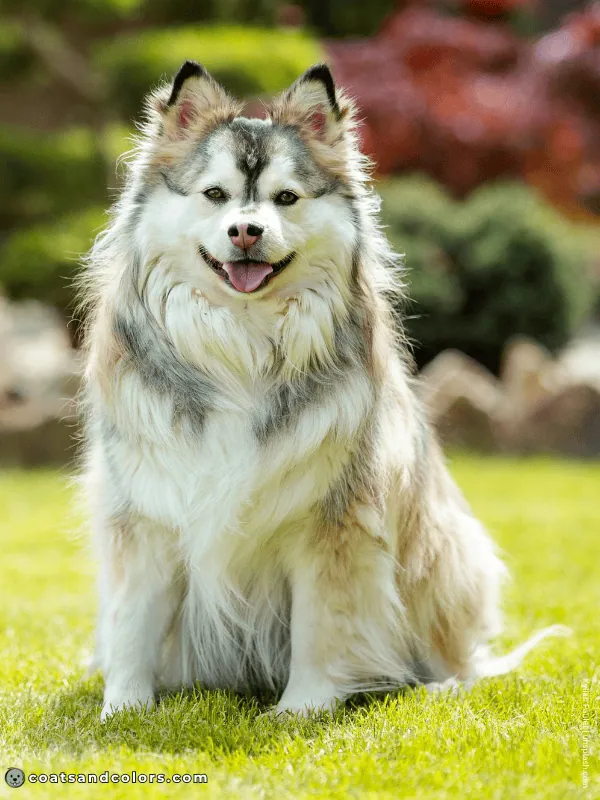
But Northern domino gives very different phenotypes depending on the actual background it works on. Even in affected dogs, its expression varies from very minimal to very extreme phenotypes.
A locus patterns span a broad range from very yellow to very black patterns and often show some overlap due to incomplete dominance at the A locus. This is reflected in their domino versions, e.g. a very light tan point domino can mimic a very dark agouti domino.
And in some cases, it can be surprisingly hard to distinguish between domino patterns and some other patterns. For example, sable domino can resemble regular recessive red (a pale sable domino can look very solid cream), sable (clear sable and sable domino can look similar), tan point (KB/- at/- domino can mimic normal points), or wolfgray (KB/- aw/- domino can look very agouti-like)[1].
Domino Base Colors
Domino patterns can come in any of the possible base colors. Most Northern breeds have black pigment, but chocolate (often called “red“) is also common. What they usually don’t have is color dilution. So you’ll mostly find black or brown domino patterns in purebred dogs.
Domino vs Countershading
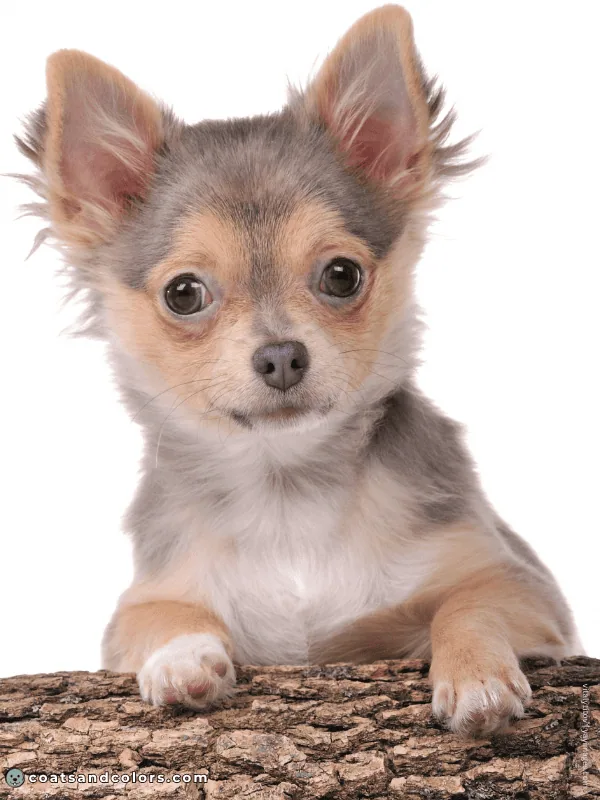
Dogs with domino patterns tend to have a very light whitish intensity.
Although it might not be the domino that lightens their coat. Maybe domino just makes a dog more susceptible to unknown intensity modifiers. This is one of the still unsolved mysteries of dog coat colors, but we know that light phaeomelanin only affects recessive red and domino dogs in some breeds.
In addition, countershading can lighten the ventral phaeomelanin. Some people find it hard to distinguish between the extended whitish open face markings in some domino patterns and the whitish ventral tan from countershading. It doesn’t help that many domino breeds have both at the same time!

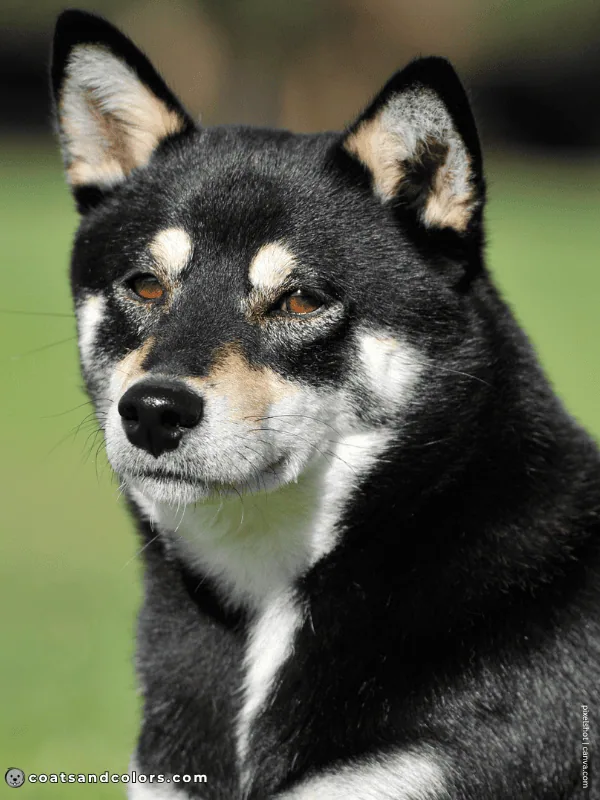
Black Domino
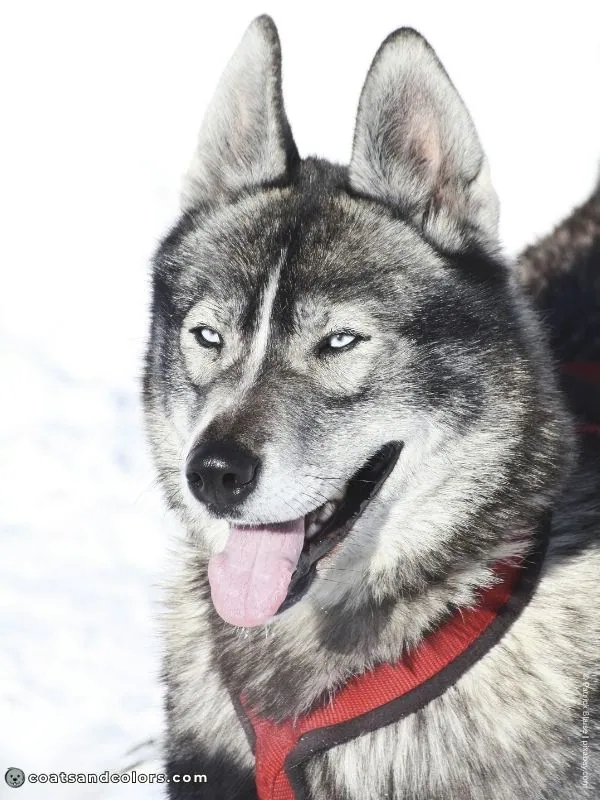
A dominant black (KB/-) dog should have a solid dark coat. But domino (KB/- eA/-) downregulates black from the K locus, so the A locus pattern becomes visible to some degree.
In dominant black domino dogs, the A locus pattern will often be expressed to some degree. Some of their otherwise masked A locus pattern may become visible. This can cause an even gray overlay or mimic a patterned look by resembling normal E/- ky/ky phenotypes.
KB domino combined with sable often results in a uniform gray color (some breeds call it “blue“). Or it can mimic a sable pattern with some gray overlay on the back and face. KB domino combined aw (agouti) can look uniformly grayish or mimic agouti, just more smudgy and grizzled.
KB domino combined at (tan points) or asa (saddle pattern) often expresses with a smutty grayish overcast on all areas that would normally be red in these patterns. Many Husky x Lab mixes have these sooty gray face markings. Sometimes, this combination can very much mimic normal tan points.
A reader suggested some dogs with domino + dominant black + tan points (eA/- KB/- at/-) might be hard to tell apart from normal E/- ky/ky at/a phenotypes which also often causes small-ish smutty points.
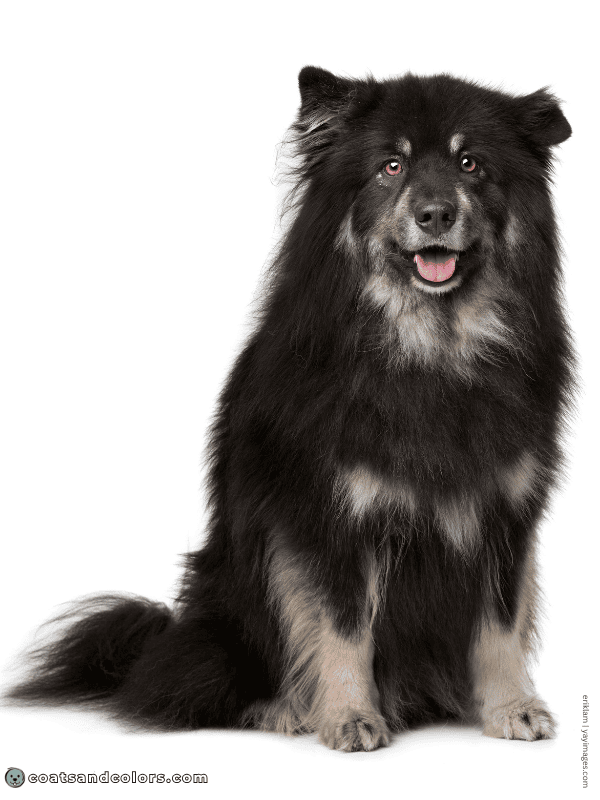
Brindle Domino
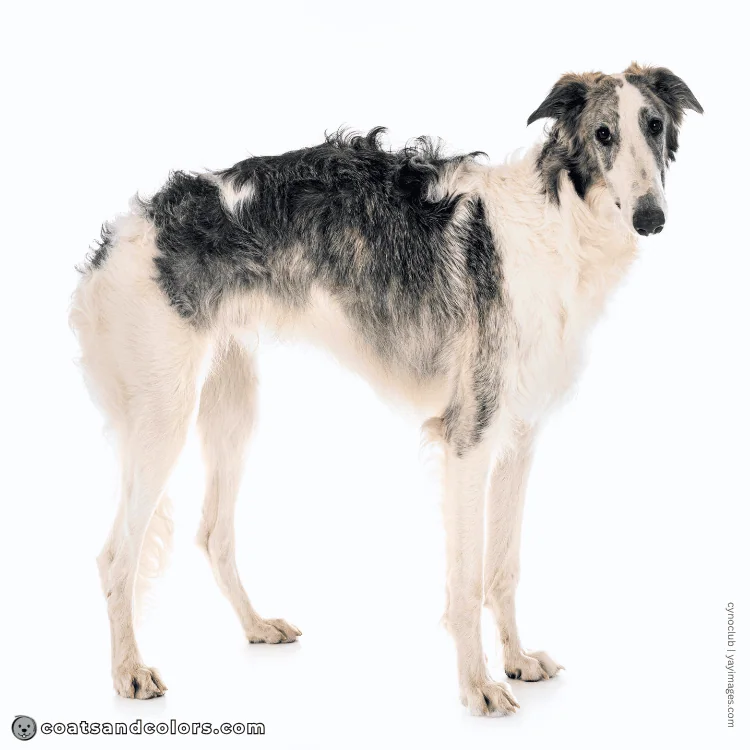
Brindle causes a pattern with dark eumelanin stripes on a red background. Since brindle (kbr) is not that common in domino breeds, this phenotype is not as common as in sighthound domino.
On brindle patterns (kbr/- eA/-), domino can fade brindle striping.
Domino can make brindle striping less distinct and turn it smudgy and gray “phantom bridling”. Many domino brindles show reduced brindling altogether with no visible striping on their extremities.
Domino can make brindle visible in black dorsal coat. For example, in dogs with brindle points and domino (eA/- kbr/- at/-), some striping may suddenly appear on the dog’s faded black mantle area.
Sable Domino
Since can remove all sabling from a sable pattern (ky/ky eA/- Ay/-). This phenotype resembles clear sable or even recessive red and is sometimes called fawn domino or cream domino.
Since puppy coats in sable dogs can be way darker than in adults, some dark sable shading or pale face pattern may still be visible at birth and fade out later on. The study that described the eA allele mentioned that this interesting phenotype is found rather often in Drever and Cirneco dell’Etna[1].
Agouti Domino
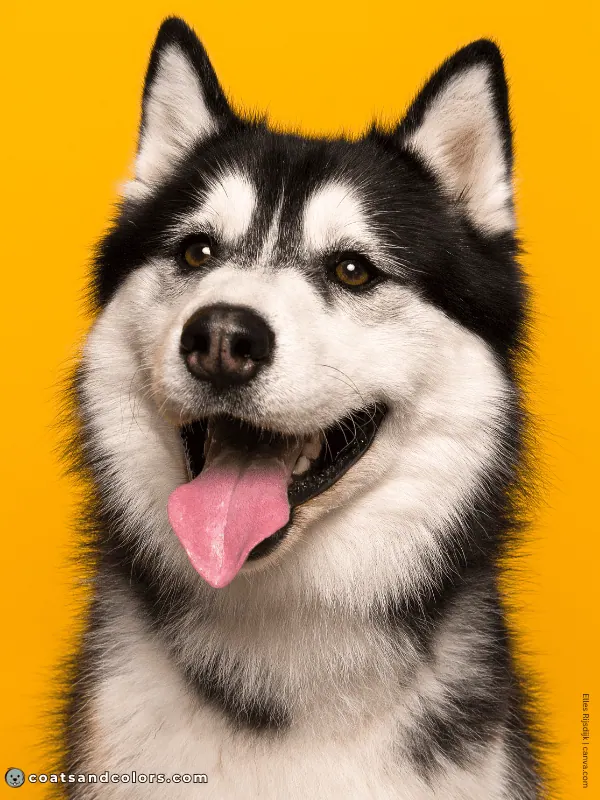
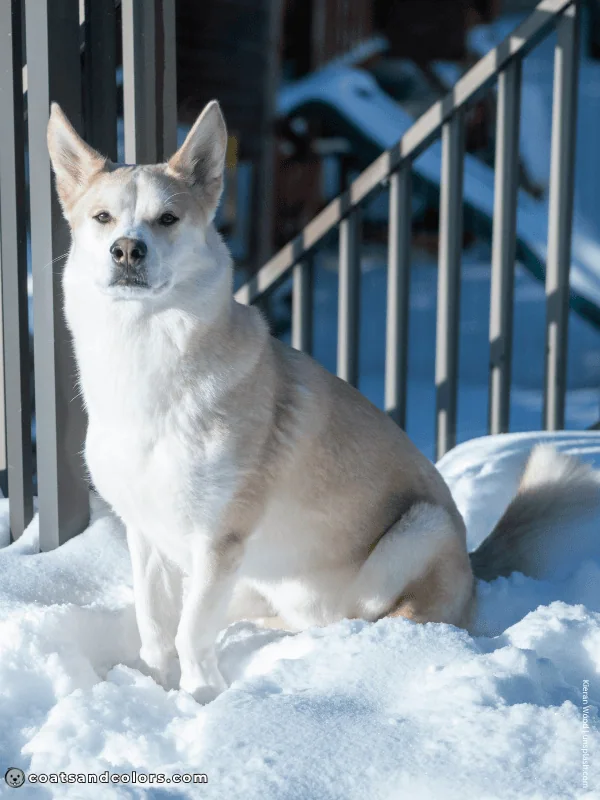
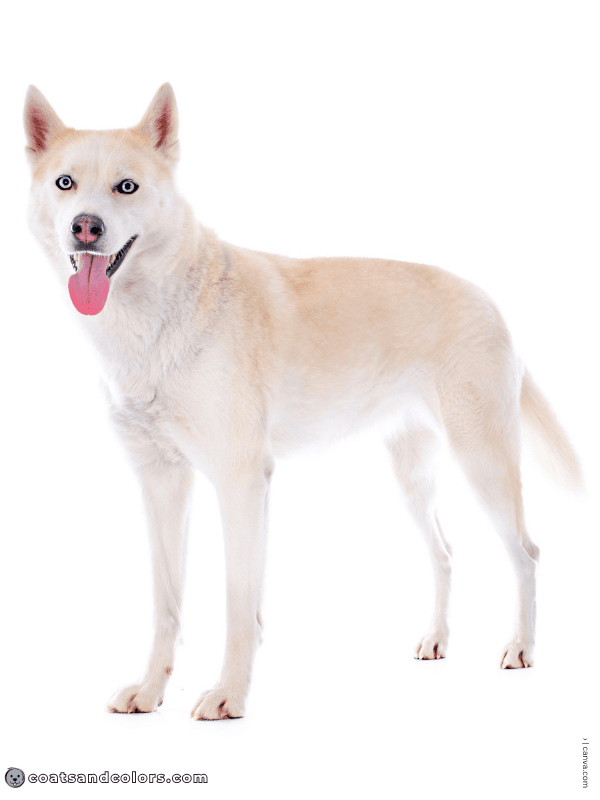
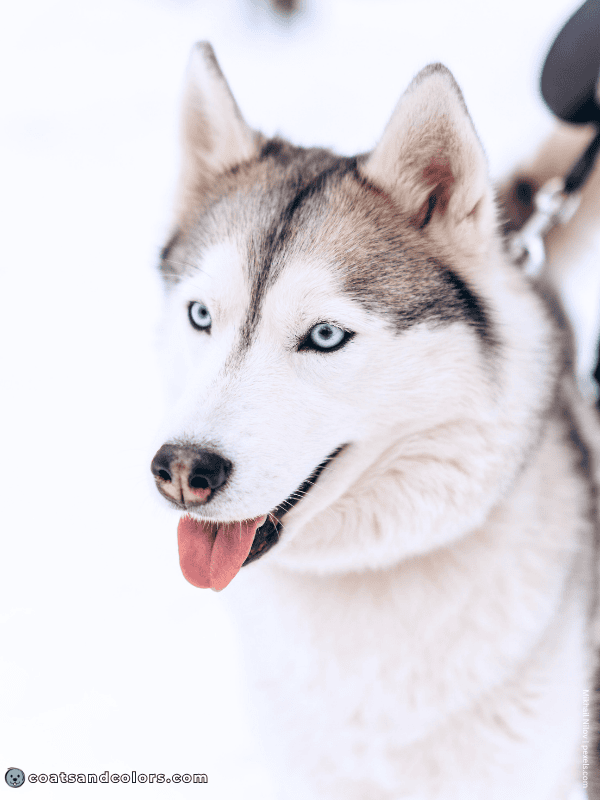
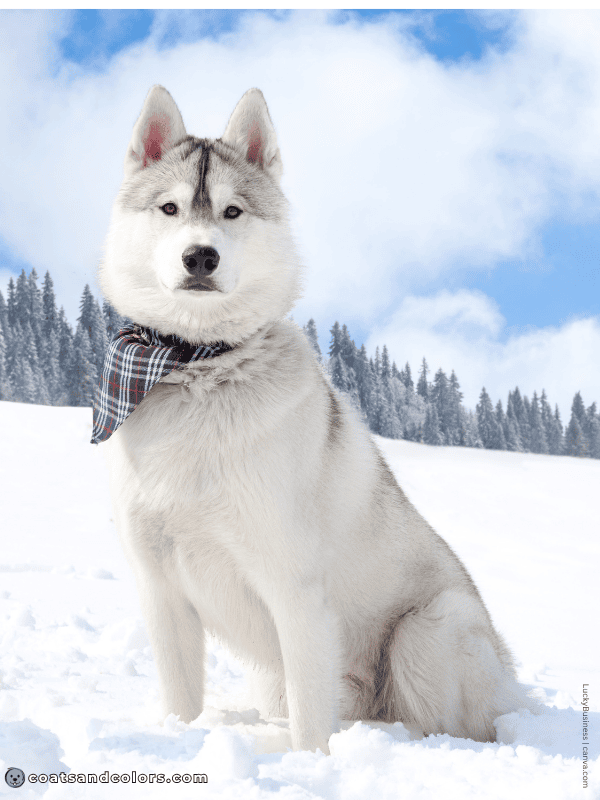
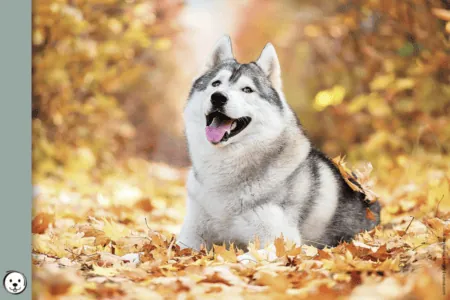
Agouti domino (ky/ky eA/- aw/-) is one of the most common phenotypes in some Northern breeds. It produces the light “open face” markings typical for gray & white Siberian Huskies or Alaskan Malamutes. Normal agouti puppies are born with a heavy dark overlay, while agouti domino puppies typically already show very crisp and pale tan markings that will grow in size.
This pattern often has a widow’s peak, and the dark overlay on the back can roughly resemble that of a shaded sable pattern. Only some agouti domino dogs keep some dark face shading like a residual nose bar or a little bit of residual spectacle pattern with some minimal black shading under the eyes.
Some aw dominos can look very dark and patterned. Domino removes some of the dark hair banding from the dorsal agouti pattern and is often combined with very light phaeomelanin. It more often creates a light phenotype with a pale hair base and a grizzly grayish look.
Saddle Domino
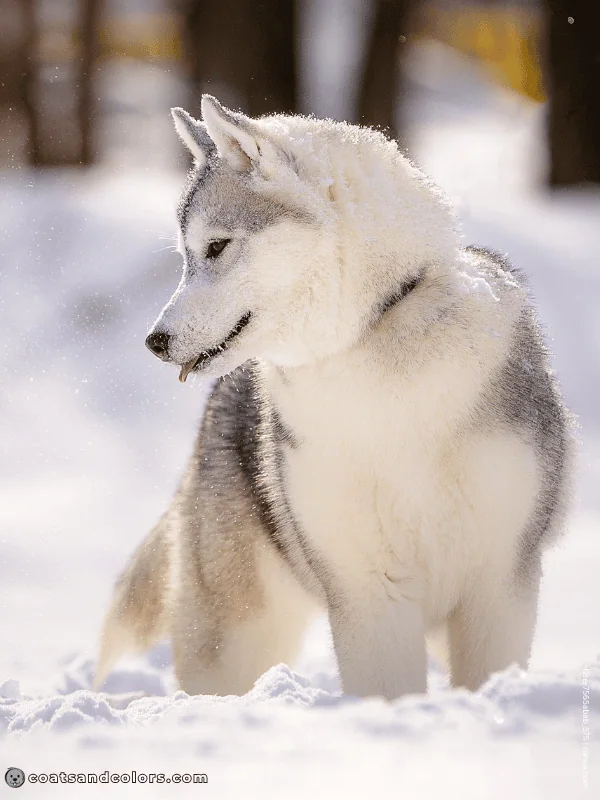
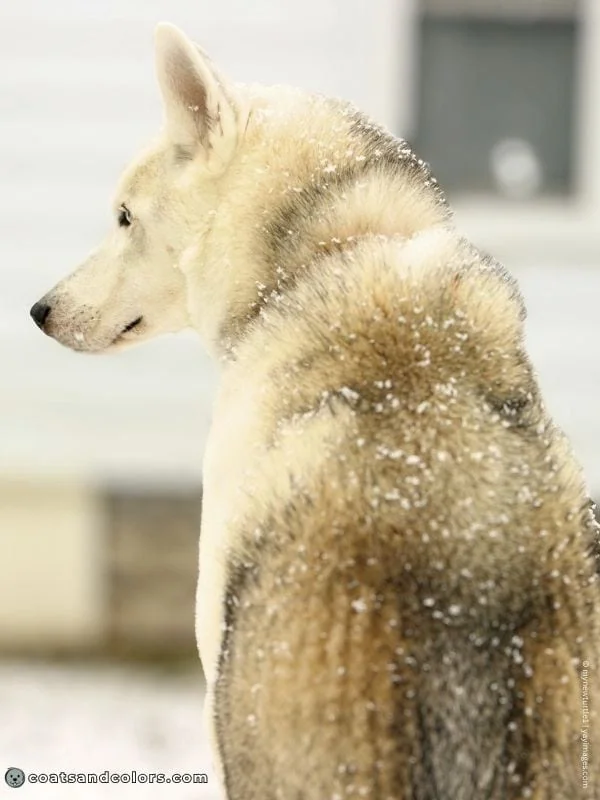
Domino causes saddles to shrink to a patch of shaded coat on the lower back, sometimes up to the point where the saddle is barely noticeable anymore. Northern breeds often have pale phaeomelanin. In Beagles, this creates a red phenotype with a very minimal saddle called “pied” in this breed.

Tan Point Domino
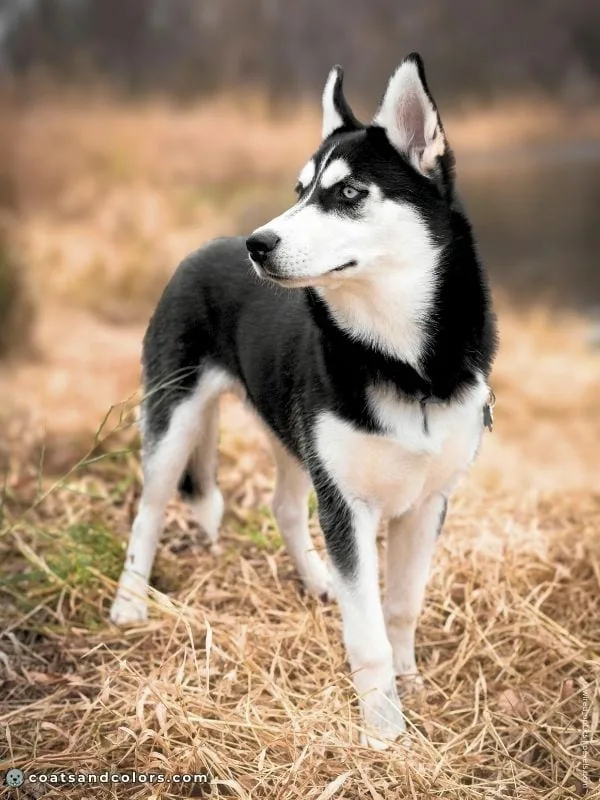
Domino with tan points (ky/ky eA/- at/-) creates one of the most common domino phenotypes.
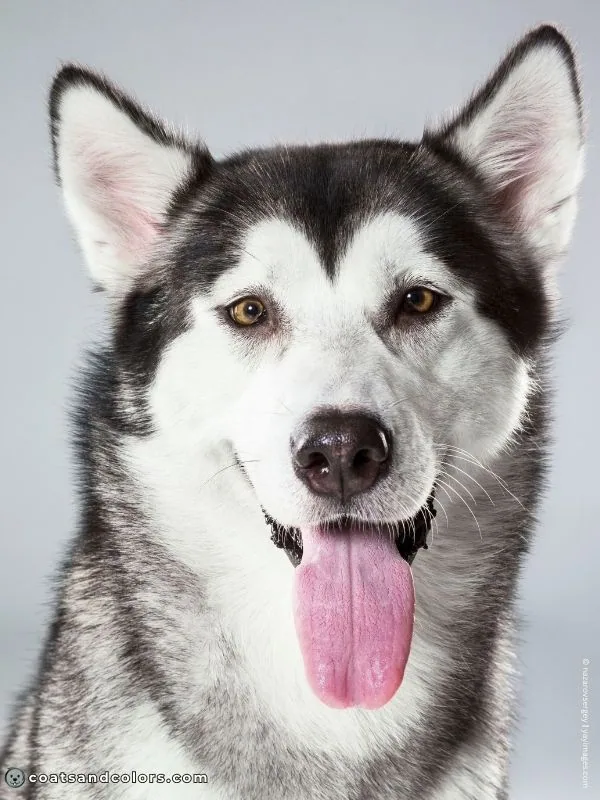
A tan point domino pattern gives extended pale facial markings with a widow’s peak and a residual dark nose bar running from the forehead not all the way to the nose leather.
The pale coat with dark hair tips can mimic a very dark shaded sable pattern. Sometimes the darker areas on the dog’s back get small enough to look like creeping tan on a non-domino dog.
In Alaskan Malamutes, this phenotype is called seal & white (but its not real seal). In Siberian Huskies, very crisp black-based tan point domino patterns are called black & white.
Recessive Black Domino
Recessive black should cause a solid dark color.
But a/a domino can cause an unexpectedly “patterned” phenotype with smutty tan markings or a dark agouti-like pattern and pale undercoat. Some dogs with ky/ky eA/- a/a have lighter goggles.
Merle Domino
Yes, domino can even modify a merle pattern! Beautiful Suri of Josephine Lange in Germany (probably Mh/m ky/ky at/at eA/e) is one of the rare examples of a tan point domino merle.
Breeds with eA
Northern domino is common in Northern and spitz-type breeds. But it was found in lots of other types of dog breeds, too[1]. This shows how much intermixture there has been before closing studbooks, he?
- East-Siberian Laika
- Finnish Lapphund
- Finnish Spitz
- Karelian Bear Dog
- Lapponian Herder
- Nordic Spitz
- Siberian Husky
- West-Siberian Laika
- Greenland Dog
- Nenets Laika
- Alaskan Klee Kai
- Pomsky
- Basenji
- Cirneco Dell’Etna
- Kritikos Lagonikos
- Peruvian Hairless Dog
- Mexican Hairless Dog
- Basset Fauve de Bretagne
- Beagle
- Drever
- English Foxhound
- Finnish Hound
- Hungarian Hound
- Plott
- Serbian Hound
- Chesapeake Bay Retriever
- Deutsche Bracke
- Pyrenean Mastiff
- Chihuahua
- Chinese Crested Dog
- Phalene
- Löwchen
- Pug
- Tibetan Spaniel
- Alaskan Husky
- Chinook
- Northern Inuit
- Tamaskan Dog
- Saarlooswolfdog
- German Shepherd
- Berger d’Auvergne
Learn More

Links
[1] Anderson et al. (2020). Comprehensive genetic testing combined with citizen science reveals a recently characterized ancient MC1R mutation associated with partial recessive red phenotypes in dog. Canine Genet Epidemiol. https://doi.org/10.1186/s40575-020-00095-7
[2] Ollivier et al. (2013). Evidence of Coat Color Variation Sheds New Light on Ancient Canids. PLoS ONE. https://doi.org/10.1371/journal.pone.0075110
Image Credits
Maria Ortega/pixabay.com
vitalytitov/yayimages.com
cynoclub/canva.com
Mikhail Nilov/pexels.com
NancyAyumi/canva.com
eriklam/yayimages.com
Kieran Wood/unsplash.com
Kylian Paulet/unsplash.com
cynoclub/yayimages.com
AcidFern/unsplash.com
pixelshot/canva.com
Elles Rijsdijk/canva.com
Patrick Blaise/pixabay.com
Taïko/pixabay.com
nazarovsergey/yayimages.com
wired_optics/pexels.com
mynewturtle1/yayimages.com
Kurt Pas/canva.com
~User7565abab_575/canva.com
AnatoliiFoto/yayimages.com
dpcrestock/yayimages.com
LuckyBusiness/canva.com
Hi! I’m Steffi. I am a biologist and a big time dog nerd. You are curious about coat color genetics? You’ve come to the right place! Read more.