

Understand the basic machinery that turns genes into coat colors.
DNA
DNA contains all the instruction manual of your dog.
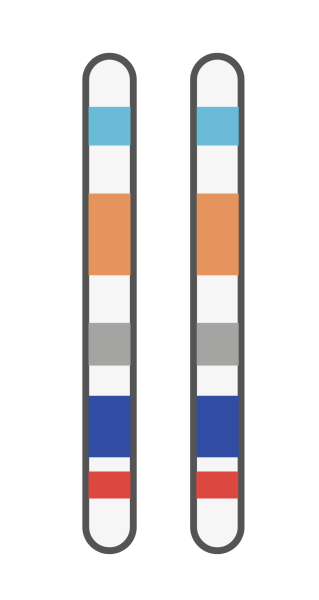
The DNA is split into separate DNA molecules called chromosomes.
Dogs have 78 chromosomes. they can be sorted into 39 pairs.
One chromosome of each pair was inherited from the father and one from the mother.

Genes
A single gene is a small segment of DNA that holds the manual on how to build something biologically meaningful. Most genes encode the building plan for a protein.
For example, tyrosinase is an enzyme (a type of protein) that makes melanin.
The chromosomes in a pair share the same genes.
This means that every dog has two copies of every gene. One on each chromosome in a pair.
Locus
The locus means the physical location within the DNA sequence.
For example, the term locus can refer to a gene locus (e.g. the Merle locus). Or it can refer to the site of a mutation within a gene sequence (e.g. the bd locus within the larger B locus).
Alleles
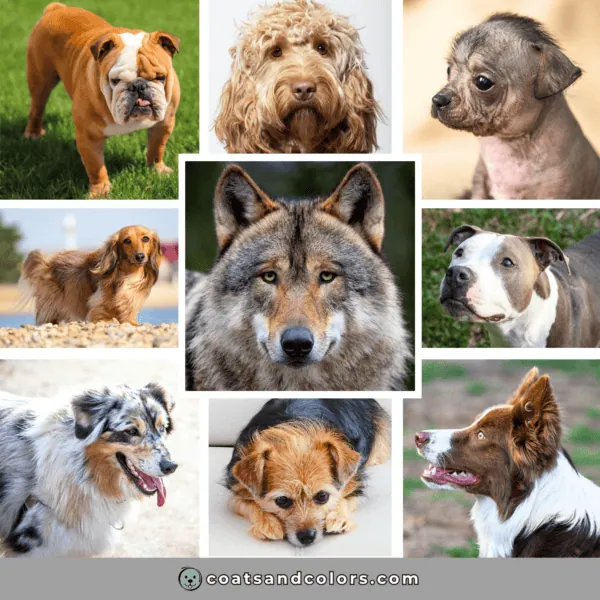
Dogs can have alternative versions of the same gene.
These gene variants are called alleles.
The most common or ancestral gene variant as it occurs in nature is called the wild-type.
Each new allele is the result of a genetic mutation.
A small change in the DNA sequence can alter the activity of the encoded protein.
And this can affect all kinds of visible traits.
Allelic Series
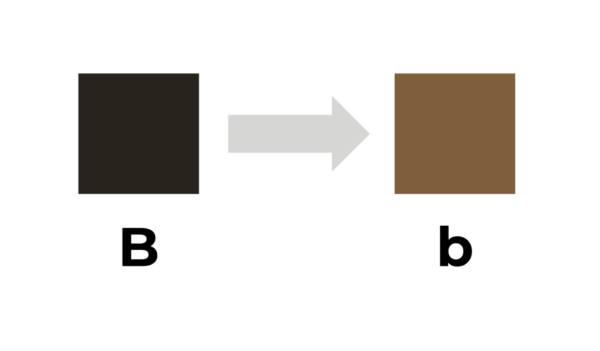
The list of known alleles for a gene is called its allelic series.
For example, the variant for black pigment B represents the wild-type. But there is also the mutated allele for brown pigment b. The allelic series of the B locus contains B and b.
Heterozygous vs Homozygous
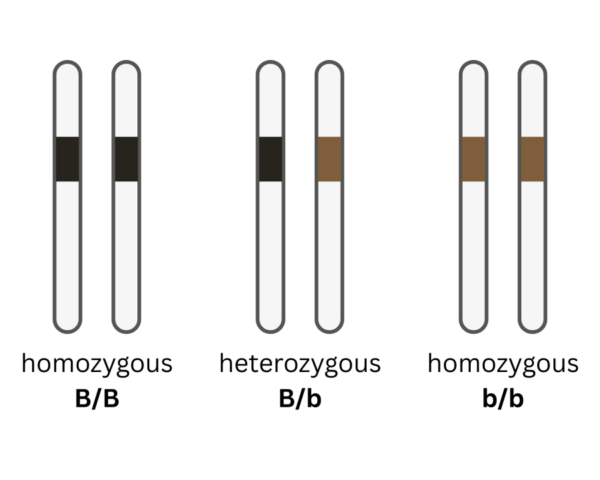
Dogs have two alleles per gene. One from each parent.
So we write a pair of letters for each gene. We separate the alleles of each gene with a “/” for readability.
A dog that has two exact same alleles (e.g. B/B or d/d) is homozygous at this locus.
A dog with two different alleles (e.g. M/m or KB/ky) is heterozygous at this locus.
Genotype
The genotype means the genetic code of a dog, a list of all relevant alleles.
For example, E/e B/b D/D is a genotype.
Different genes each get assigned a unique letter to write down the genotype.
The more dominant alleles get an uppercase letter, recessive alleles get a lowercase letter.
For example, the B locus allelic series consists of B and b.
For series with more than two alleles, we use a suffix to clarify the function of an allele.
For example, the K locus allelic series consists of KB, kbr, and ky.
This is short for KBlack, kbrindle, and kyellow.
To understand these letters is the key to understanding coat color genetics.
If we don’t know the full genotype, we can use “–” as a placeholder (e.g. B/-).
Some companies report the absense of a tested trait as “N“. For example, if they test for a curly coat (Cu) and the dog has one allele for curly and one allele for straight hair, they might report Cu/N.
Phenotype
Gene expression turns the genotype into the visible phenotype.
If we talk about the phenotype, we discuss what we can see.
For example, the breed standards of different breeds list their desired phenotype.
Be aware that phenotype descriptions are most often not based on genetics.
In breed descriptions and everyday language, the same term can mean different things to different people. And very different wording can be used to describe the exact same coat color.
If I just tell people my dog is “brown“, everyone might imagine a very different color.
Many breeds use made-up breed terms (Dachshund merle is “dapple“, Poodle tan points are “phantom“, etc.). You have to be versed in breed terminology to know what they mean.

In color genetics, we try to find common ground and only use terms with a proper definition.
To us, “brown” always means chocolate brown eumelanin.
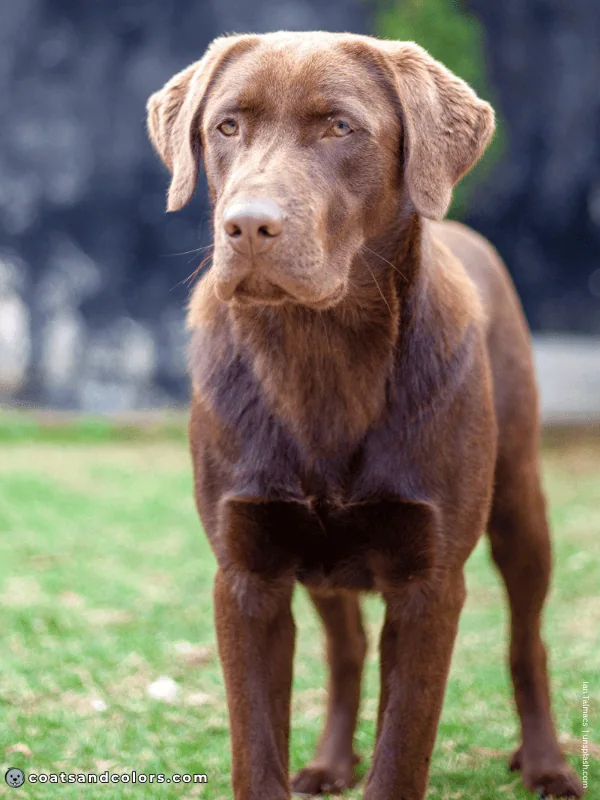
We often say stuff like [eumelanin color]-based [pattern] with [other traits].
And we use some common terms that have the same meaning for everyone.
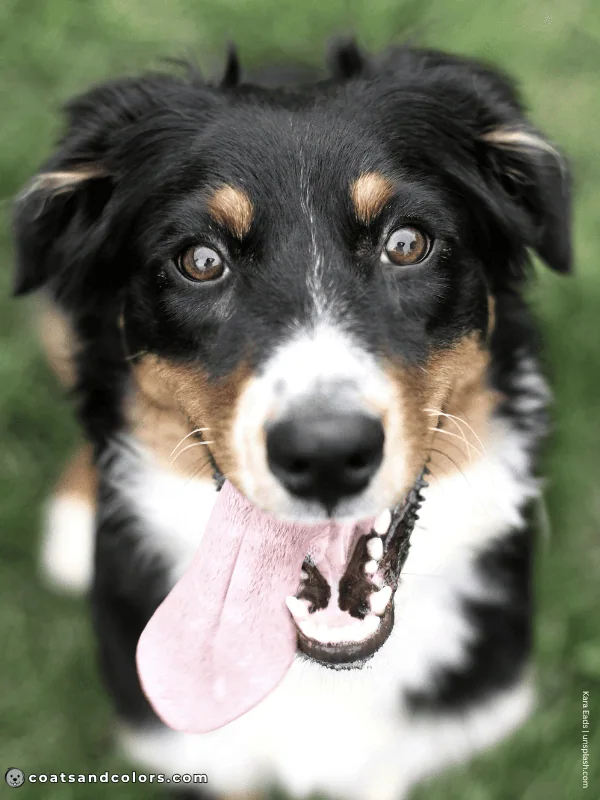
For example, black-based tan point with white markings is also known as black tricolor.
Dominance
A heterozygous dog has two different alleles of a gene.
Which allele gets expressed in the phenotype is determined by dominance.
Complete Dominance
A dominant allele can show complete dominance over a more recessive alleles.
The dominant B for black shows complete dominance over the recessive b for brown.
Dogs with B/B will express black pigment. Dogs with B/b will also express black. Only dogs with b/b can express brown. A heterozygous B/b dog carries the recessive b allele without expressing it.
Having a B allele will fully suppress the b allele.
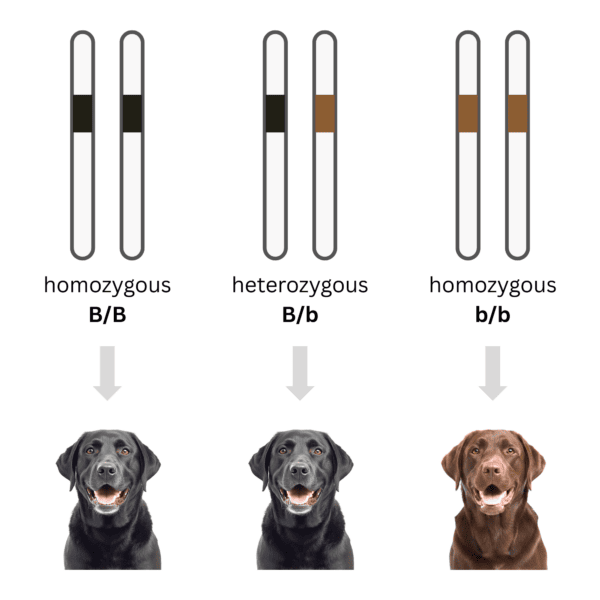
For completely dominant traits, it does not matter if a dog has one or two dominant alleles.
One copy of the dominant gene is enough to fully hide the presenc eof the recessive allele.
- A dog that is B/B is not “more black” than a B/b dog.
- A dog that is kbr/kbr is not “more brindle” than a kbr/ky dog.
Incomplete Dominance
In some cases, a heterozygous genotype can lead to a blend of both traits.
We call this incomplete dominance.
In this case, the more dominant allele can not fully mask the effect of the more recessive allele.
You get visibly less expression of a trait in dogs that have just one copy.
For example, sP can causes white. But sP/sP will on average delete more pigment than S/sP.
The S allele does not fully suppress the sP allele.

For incomplete dominance, the expression of a trait increases in dogs with two copies.
- A dog that is sP/sP is likely to show “more white” than a S/sP dog.
- A dog that is M/M is likely to show “more merle” than a M/m dog.
Order Of Dominance
The alleles of a gene can be sorted by their order of dominance.
B is dominant. And b is recessive.
Actually, there are several b alleles, e.g. bd, bc, bs, be, bh
These represent different mutations that all lead to a total loss of function.
But none of them is dominant over the other.
B > bd bc bs be bh
If we can not establish an order of dominance, we can cluster alleles that have the same outcome.
B > b
Epistasis
We only call it “dominance” when we discuss alleles of the same gene.
The B allele at the K locus is dominant over the b allele at the B locus.
We call it epistasis when we discuss the interaction between totally different genes.
The gene at the E locus is epistatic over the gene at the B locus. It controls whether a dog can deposit eumelanin in its coat in the first place. Dogs with e/e can not have eumelanin in their hair shaft.

Epistasis happens when the expression of one gene interferes with the expression of another gene.
This often happens when a gene that controls an early step in a biochemical pathway or assembly line fails and this blocks the expression of all subsequent genes.
- Hairlessness hides coat color traits. You can’t deposit pigment in the hair if you don’t have hair.
- Albinism hides other coat color traíts. You can’t deposit pigment in the hair if you can’t make pigment.
- Being solid black hides red intensity. You can not see red colors if the coat has no phaeomelanin.
- Being solid yellow hides merle. You can not see merle if the coat has no eumelanin.
Modifier Genes
If a gene affects the phenotypic expression of another gene we call it a modifier gene. This is a form of epistatic interaction (one gene affecting the expression of another gene).
Modifier genes require another gene whose effect they can modify.
- If a dog has white markings, untestable modifiers control the average amount of white.
- Only dogs with white markings can express ticking.
- Only dogs with phaeomelanin in their coat can have countershading.
- Only Great Danes with merle can express harlequin.
Breeders select for many traits that modify the expression of other traits.
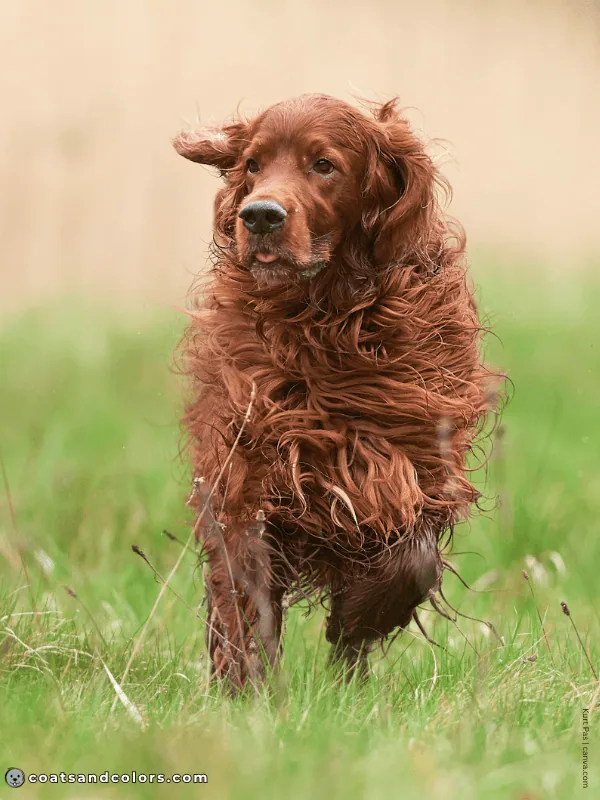
For example, Irish Setter breeders selected for intensity modifiers that cause a rich mahogany color in their red dogs. Or for nicer coat textures or the right amount of feathering in their long-haired dogs.
But not everything is genetic.
Many patterns have a touch of randomness built in. You can’t control the exact pattern of a merle dog. Or the exact patching in a parti pattern. Not all phenotypes are controlled by modifiers.
Further Reading
If you want to learn more, there are plenty of great resources available for free!
- Genetic Science Learning Center: Basic Genetics.
- The Useful Genetics Project: Course Material.
- Khan Academy: Mendelian genetics.
Image Credits
Ian Talmacs/unsplash.com
Kara Eads/unsplash.com
Hi! I’m Steffi. I am a biologist and a big time dog nerd. You are curious about coat color genetics? You’ve come to the right place! Read more.