

How two black dogs can have brown puppies.
Labradors are one of the best breeds for understanding how coat color genetics actually work.
See, Labs only have a small set of well-defined colors that everyone can recognize. And their genetics are just complicated enough to be genuinely interesting without being overwhelming.
How Inheritance Works
Before we look at Labs specifically, a quick recap of how color genes are inherited.
Every dog carries two copies of each gene. One inherited from its mother, one from its father.
- A homozygous dog has two identical alleles.
- A heterozygous dog has two different alleles.
For heterozygous dogs, the order of dominance between their different alleles controls how each genotype will translate into a visible phenotype.
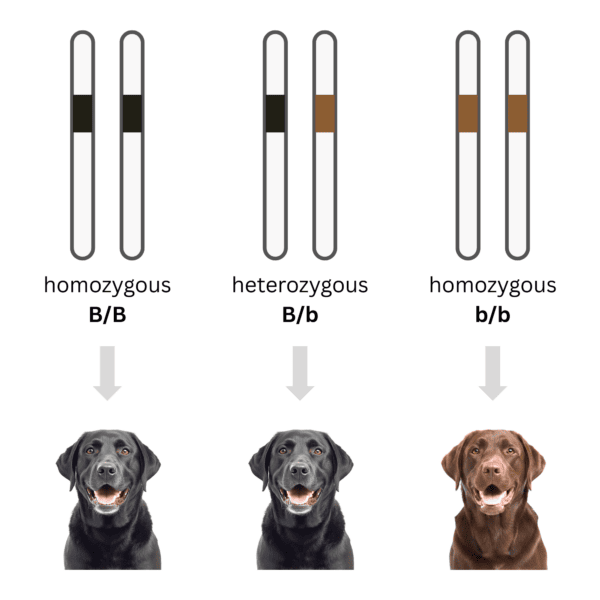
When two dogs breed, each parent passes on only one of their two copies to each puppy. Which allele is chosen at random, so each puppy has a 50% chance of inheriting either copy.
You are already familiar with the concept when you think about puppy genders. Daddy is X/Y, mommy is X/X. All puppies will get X from their dam. But they can get either the X or the Y from their sire.
X/X puppies are girls. X/Y puppies are boys.
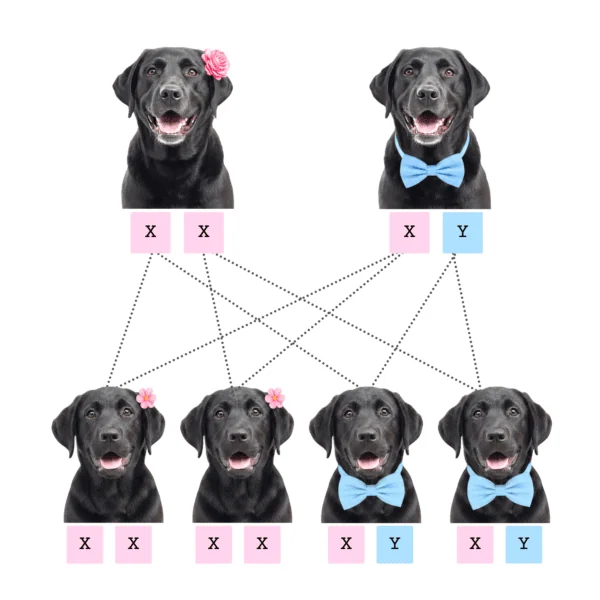
Each puppy has a random 50% chance to be a boy or a girl. This does not mean that half of each litter will be boys and the other half will be girls! Puppy chances are not guaranteed ratios.
It’s the same for coat color alleles.
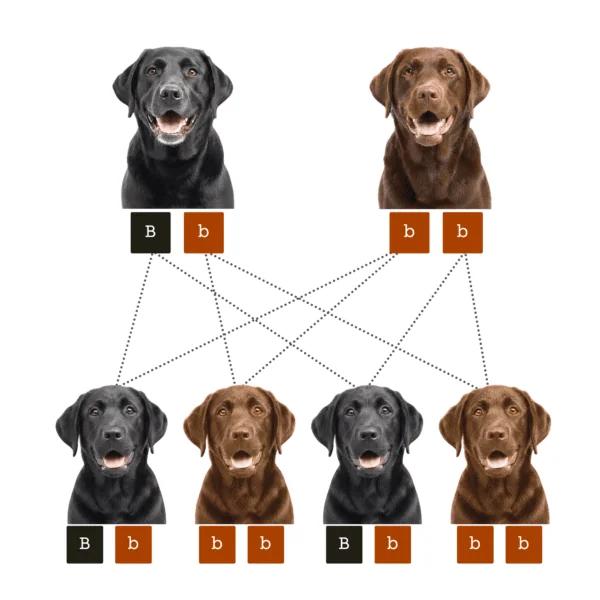
When someone says a breeding has a 50% chance of producing a chocolate puppy, it doesn’t mean half of all puppies will be chocolate. It means each individual puppy has a 50% chance!
In reality, you could get only chocolate puppies. You could get none. It’s the same principle as flipping a coin. For example, getting heads three times in a row doesn’t change the odds of the fourth flip.
With that established, let’s look at some Labradors.
Chocolate Carriers
Imagine we breed two black Labradors. They produce a bunch of black puppies.
No surprises.
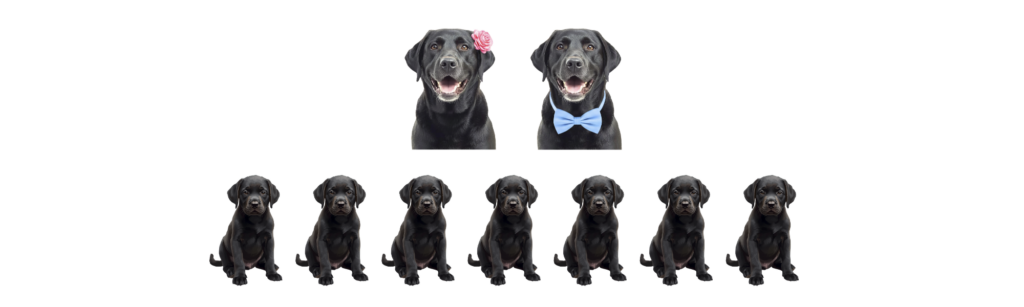
Now we breed the same black Labradors again.
This time we got black puppies and a chocolate puppy!

Where did the chocolate puppy come from?
The answer lies at the B locus we already talked about earlier.
This gene controls whether a dog produces black or brown eumelanin.
The B locus has two possible alleles:
- B – black eumelanin
- b – brown eumelanin
B is dominant. And b is recessive.
Here’s what each combination looks like:
| Genotype | Phenotype |
|---|---|
| B/B | black eumelanin |
| B/b | black eumelanin |
| b/b | brown eumelanin |
A dog that is B/b has black pigment. But it can still pass on B or the hidden b to its offspring. If that offspring also inherits b from the other parent, it ends up b/b.
This is exactly what happened with our second litter.
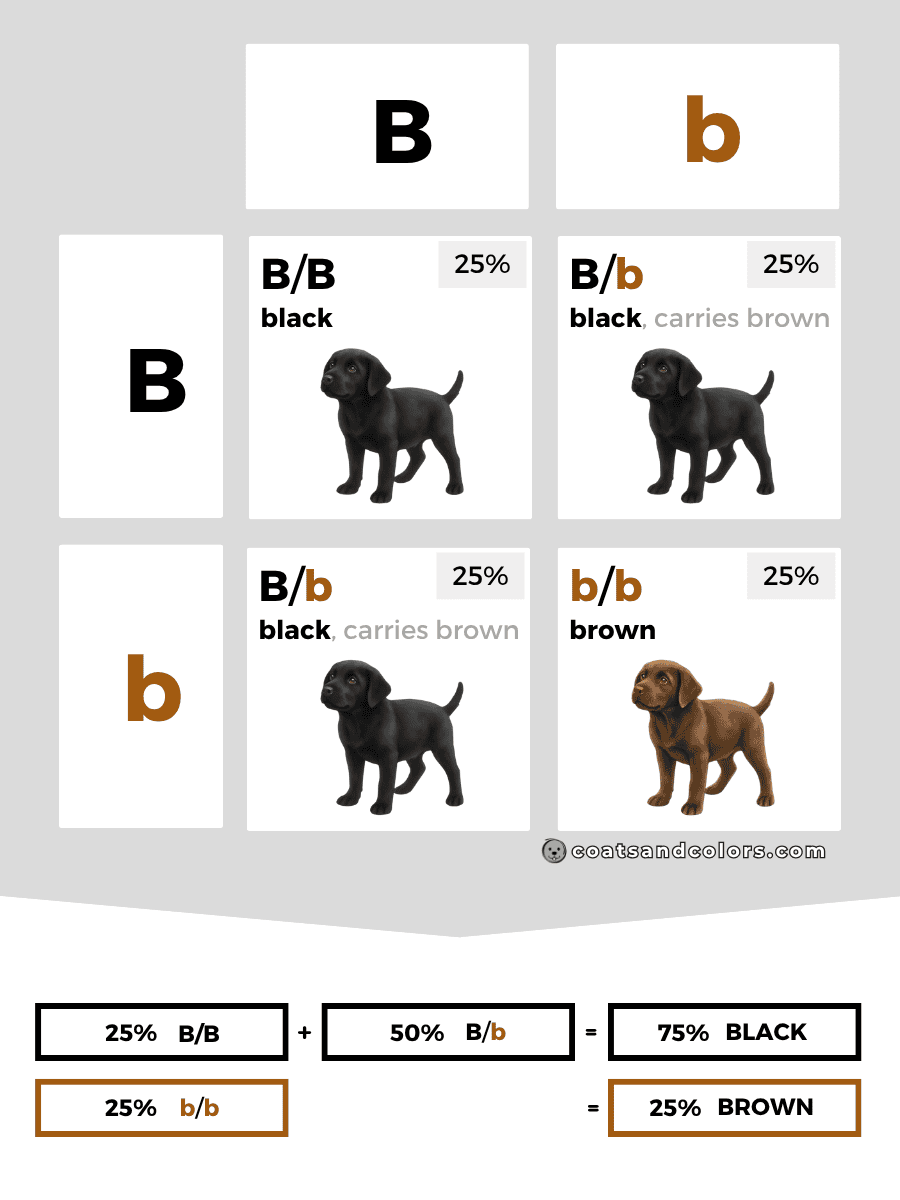
Both parents are black, but carry chocolate (B/b x B/b).
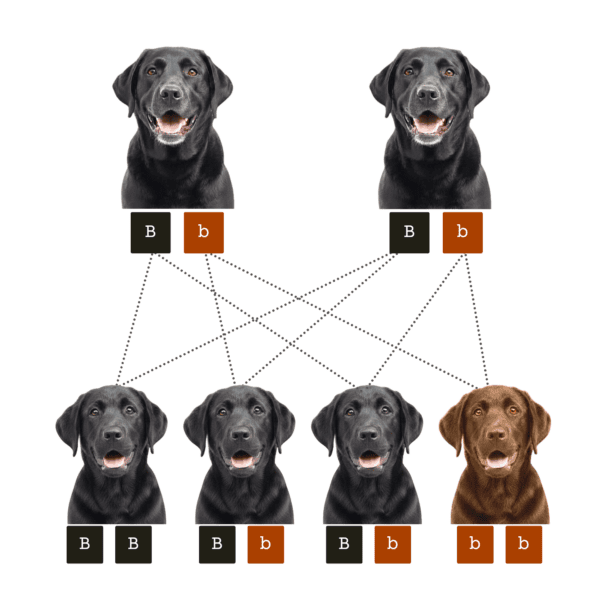
Of course, you do not want to draw the whole family each time you want to predict color.
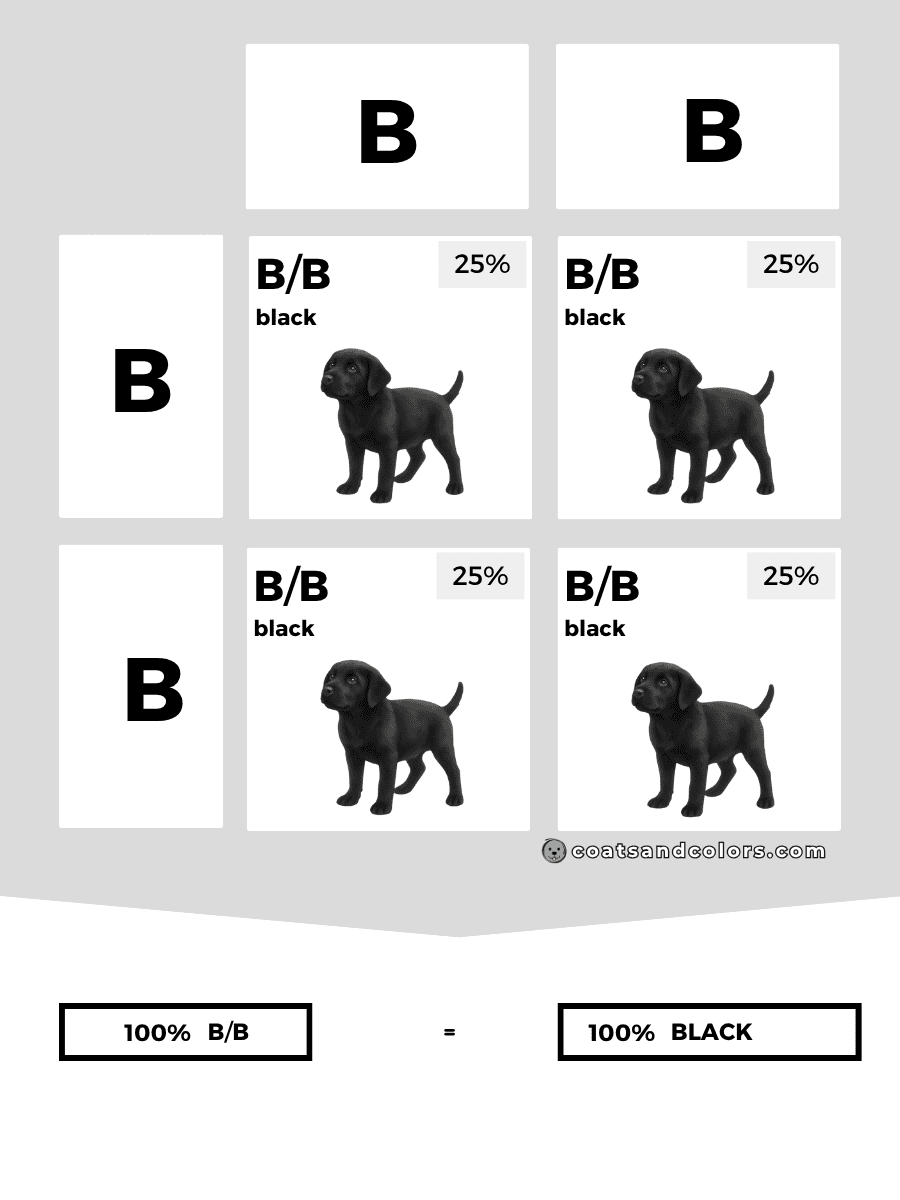
A better tool for visualizing all possible outcomes is a Punnett square. Each parent contributes one allele per locus to each puppy. And a Punnett square maps out all possible combinations.
Each of the four cells in the Punnett square represents a chance of 25% (1-in-4).
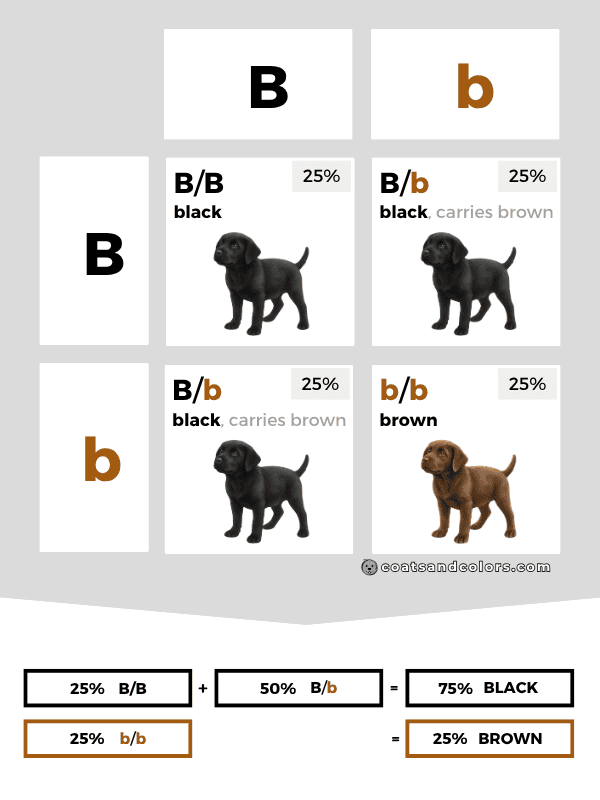
When two B/b dogs are bred, there’s a 25% chance for each puppy to get b from both parents.
Notice that any of the black puppies in our example litters could be homozygous for black (B/B) or a chocolate carrier (B/b). You cannot tell by looking which is which.
That’s why breeders need to test if they want to keep a b carrier for their breeding program.

Recessive Traits
Recessive alleles like b can stay hidden for generations.
A black dog with no chocolate in its recent ancestry can still be a b carrier. At every step, there was is a 50% chance that the b allele got passed on to the next generation.
This is how “surprise colors” occasionally emerge in breeding programs.
A recessive allele will be quietly passed down until two carriers finally meet and may produce a puppy that expresses the recessive trait. This gets more likely if dogs share a common “carrier” ancestor.
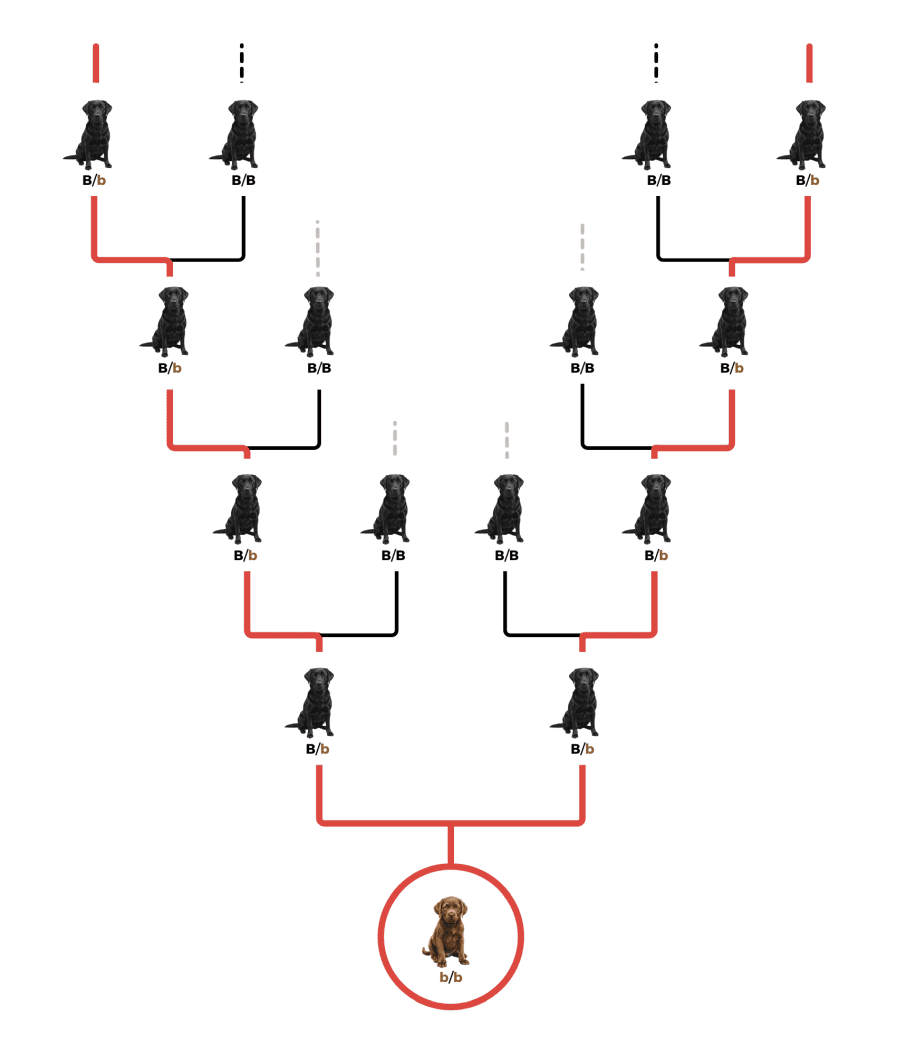
The same principle applies to all recessive traits.
Recessives can travel invisibly through a lineage for many generations before two carriers happen to be paired. DNA testing has dramatically changed how breeders can trace these alleles.
Today it’s possible to test for all kinds of recessive traits, revealing what a dog secretly carries.
Epistasis
The black vs chocolate example above is a perfect illustration of dominant and recessive inheritance.
But there’s more!
Imagine we breed another pair of black Labradors.
This time, they produce a litter of black puppies and yellow puppies.
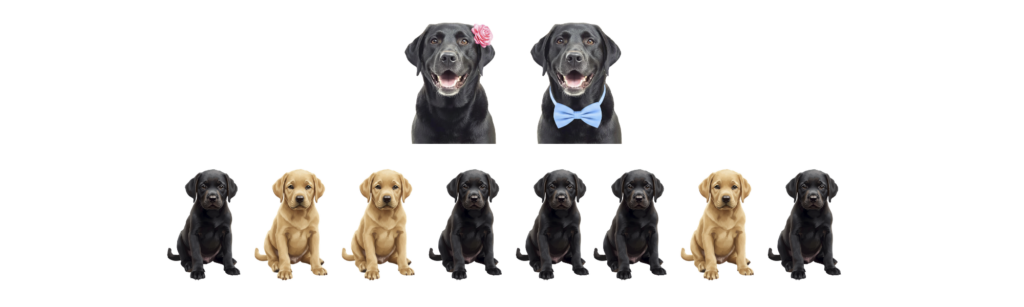
To explain yellow Labs we need to look at a second locus, which complicates the explanation.
The E locus controls whether eumelanin (black or chocolate pigment) is present in the coat.
The relevant alleles for Labradors are:
- E – normal pattern expression
- e – recessive red
E is dominant. And e is recessive.
| Genotype | Phenotype |
|---|---|
| E/E | solid black or chocolate |
| E/e | solid black or chocolate |
| e/e | solid yellow |
A dog with E/- will express whatever pattern it has on its other genes.
It just so happens that almost all Labradors are KB/KB.
The KB pattern produces a solid eumelanic coat. Because Labs should be fixed for KB/KB, the K locus never varies between individual dogs and doesn’t need to be included in breeding calculations.
But it matters conceptually: The reason a black Lab is solid black (rather than black & tan or brindle) is the K locus. The B locus genetics just control pigment color, not where the pigment shows up.
An E/E or E/e Labrador is solid black or chocolate depending on its B locus genotype.
But a dog that is e/e at the E locus cannot produce any black or brown pigment in its coat.
Instead, an e/e dog will only show phaeomelanin.
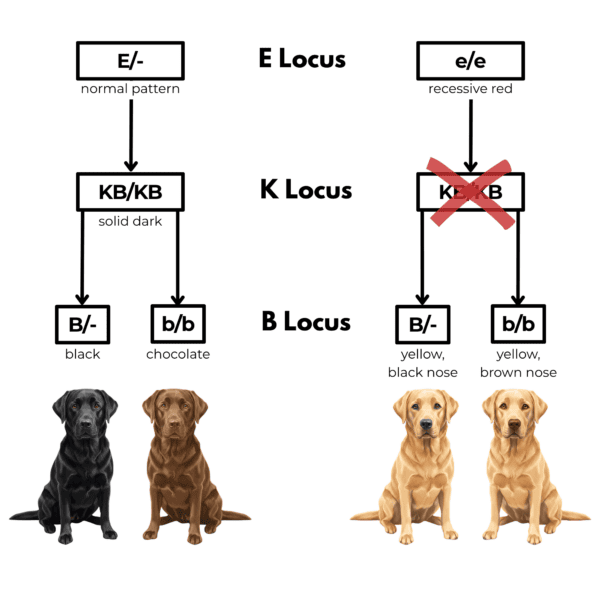
We call it epistasis when one gene affects the expression of another gene.
The E locus controls the expression of the K locus.
The e/e pattern overrides the KB/KB pattern.
The e/e genotype blocks eumelanin only from the coat. But not from the nose color, eye color, or skin pigment. All areas that still show eumelanin are pigmented according to their B locus.
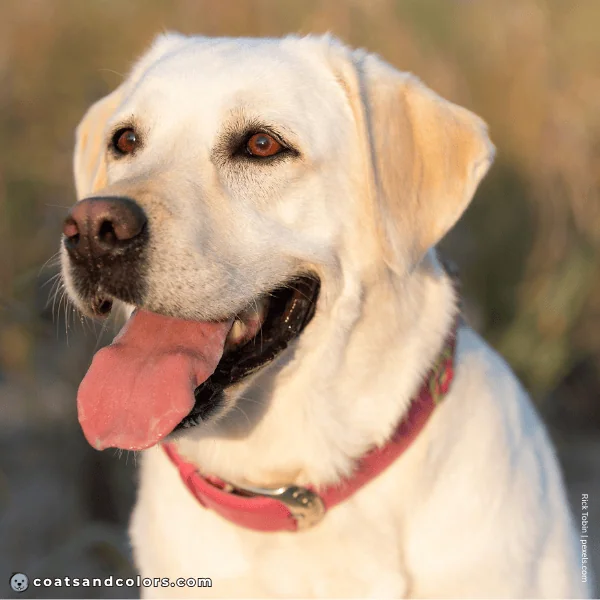
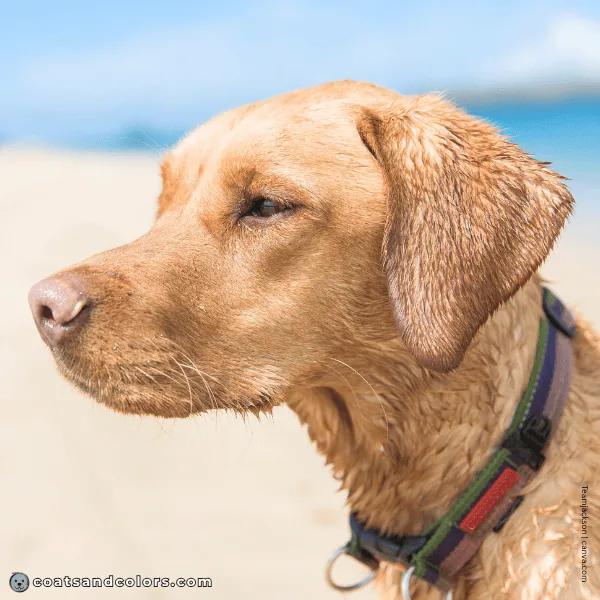
The yellow e/e Labradors are still either black or chocolate. But they can not show it in their coat. But we can still determine the eumelanin base color by looking at their nose.
Things like that can be important for breeders. Per their breed standard, all yellow Labs should have a black nose (e/e B/-). The brown-based yellow (e/e b/b) or “Dudley” is not an accepted color.
Be aware that almost all yellow Labradors in real life have weak nose pigment, which can fade any base color to pink. You have to look at the rim of the nose to guess their real base color.
Predicting a Litter
We can now play Labrador breeder and predict some puppy colors!
The B locus has two alleles, B or b.
This means a breeding dog can be B/B, B/b, or b/b.
This already gives us 6 possible breeding combinations for the B locus!
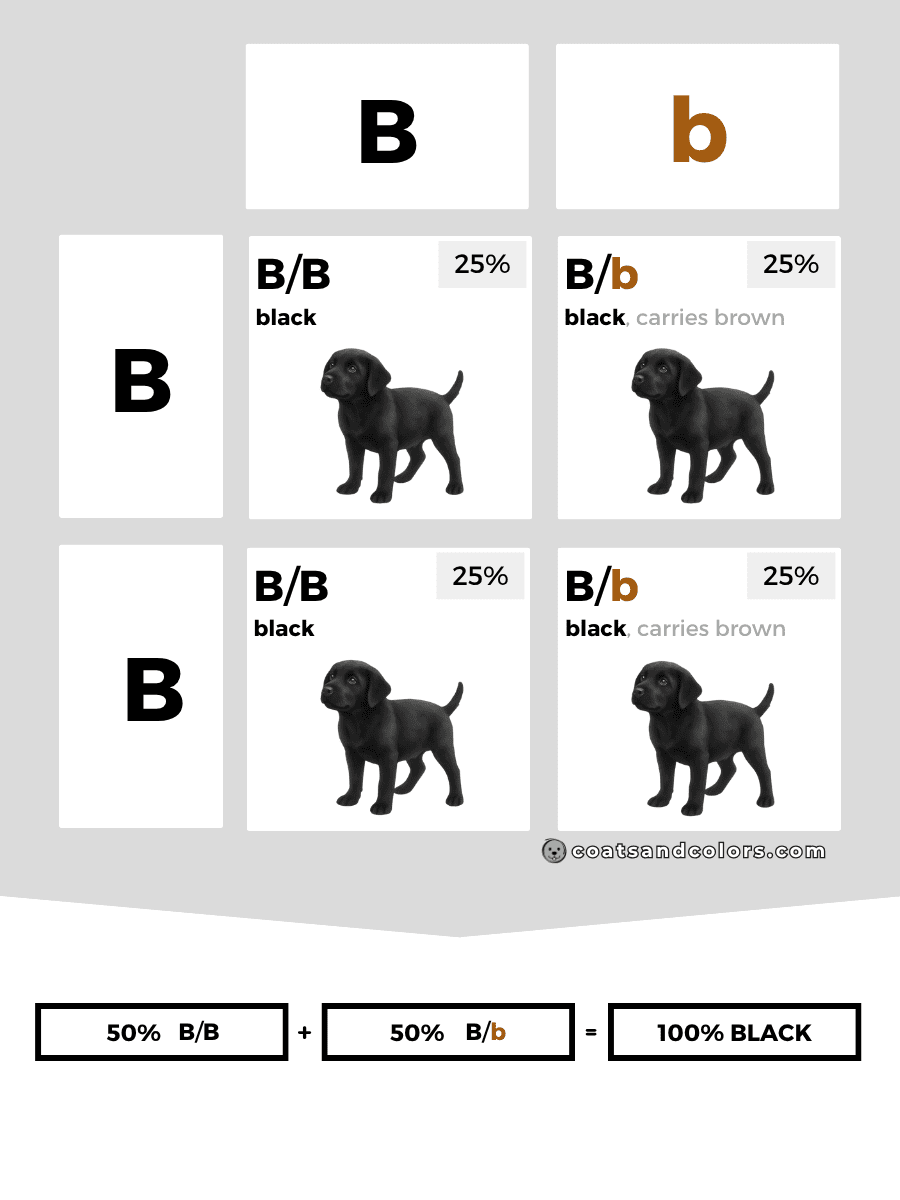
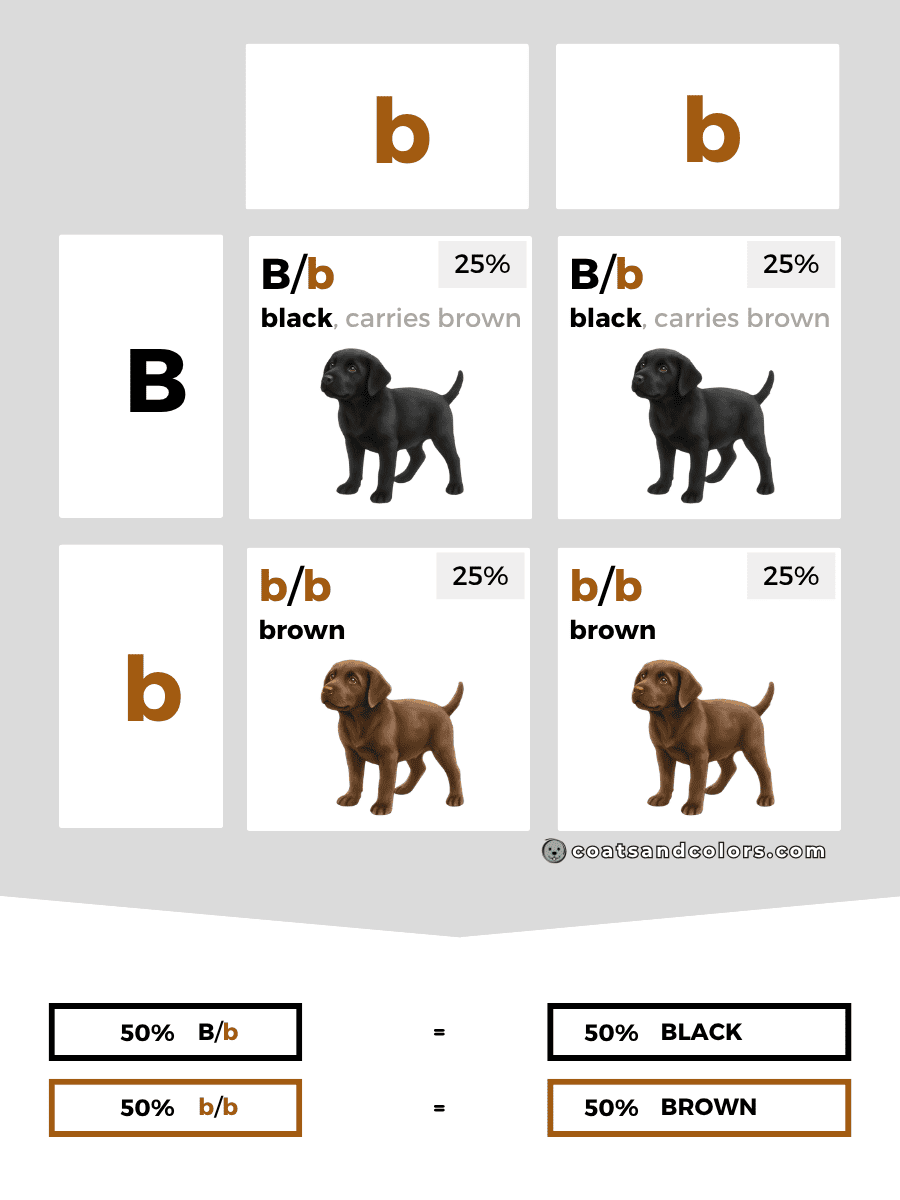
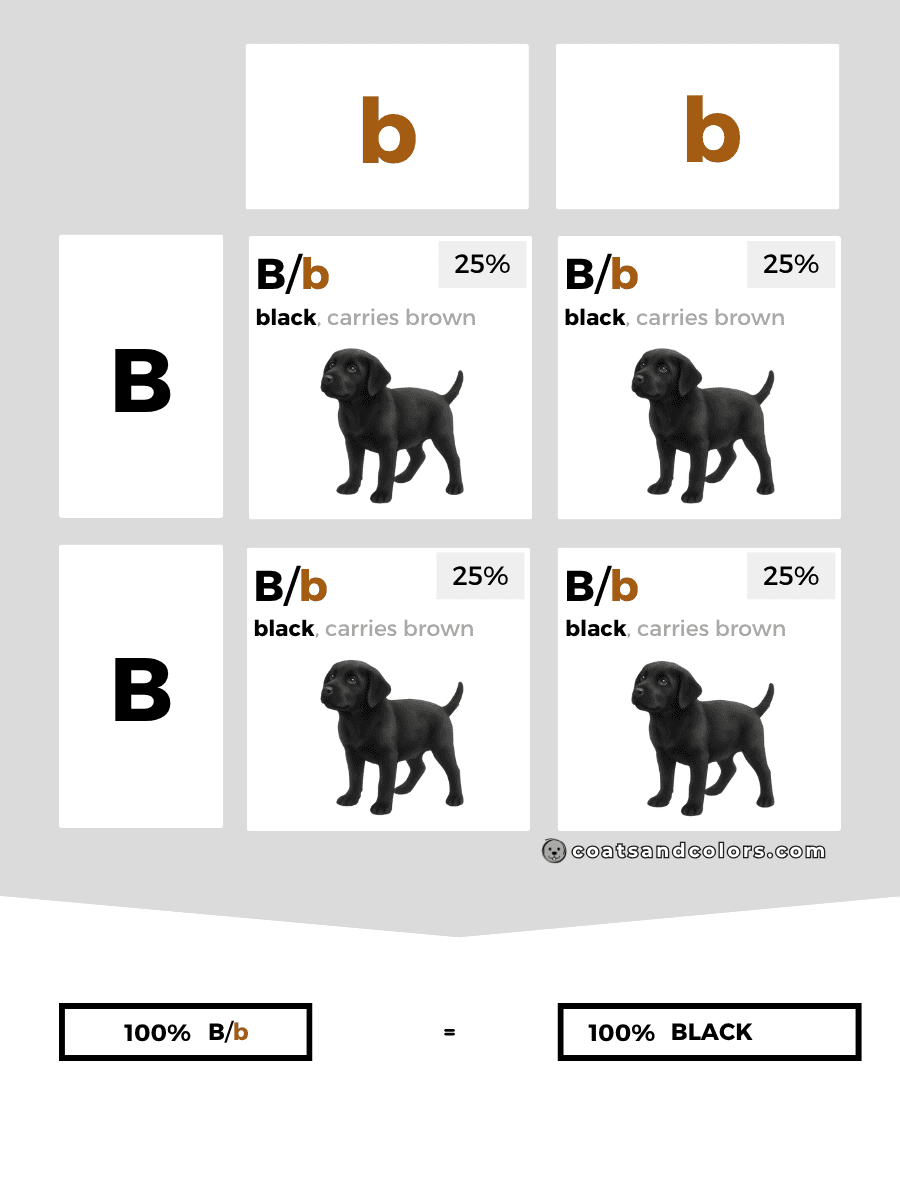
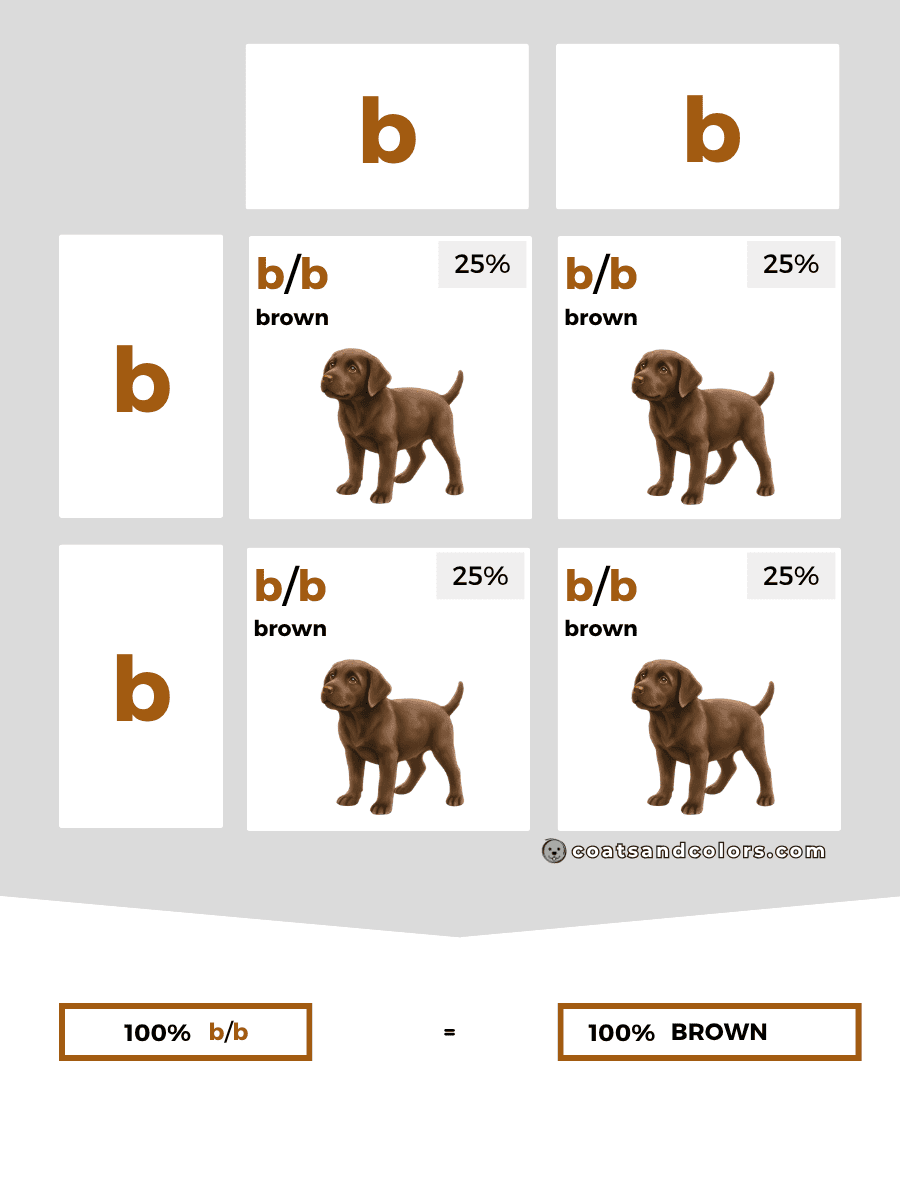
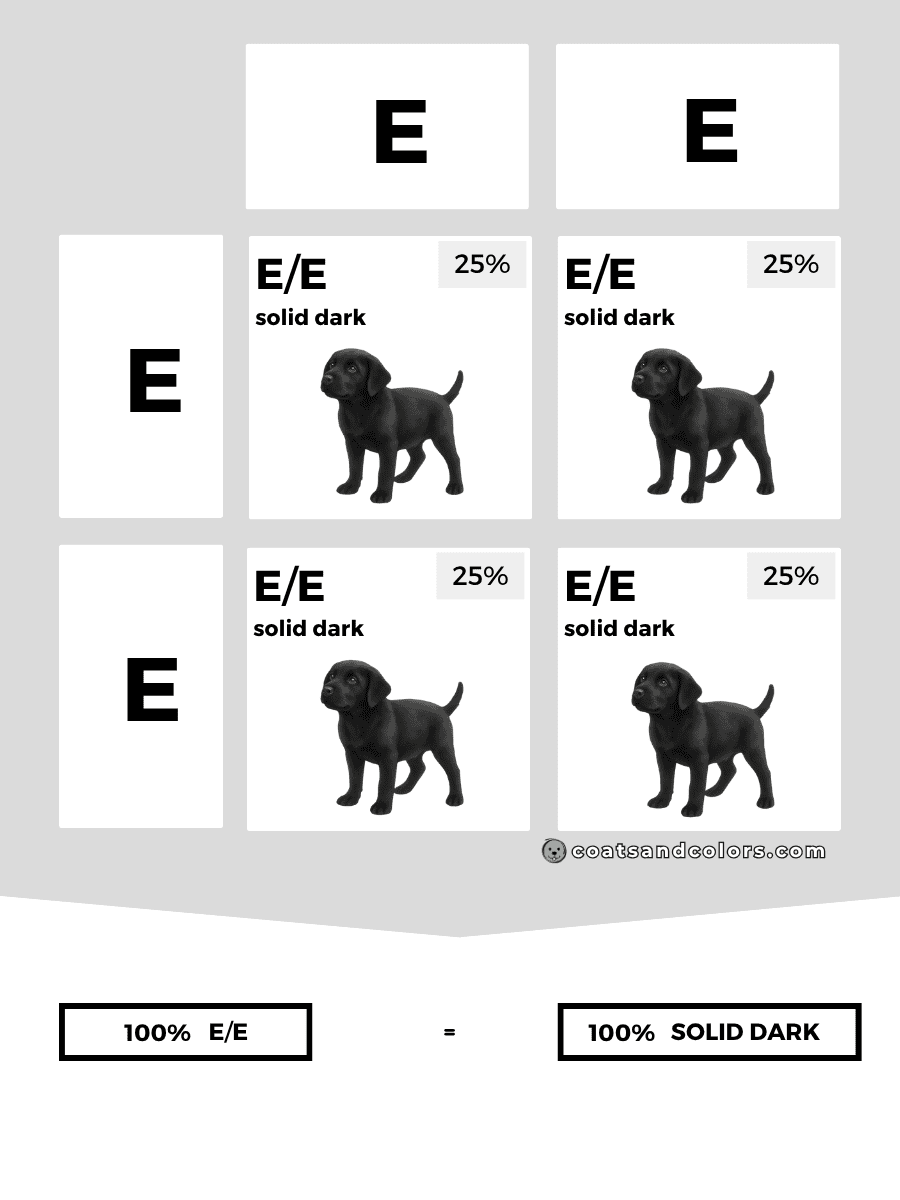
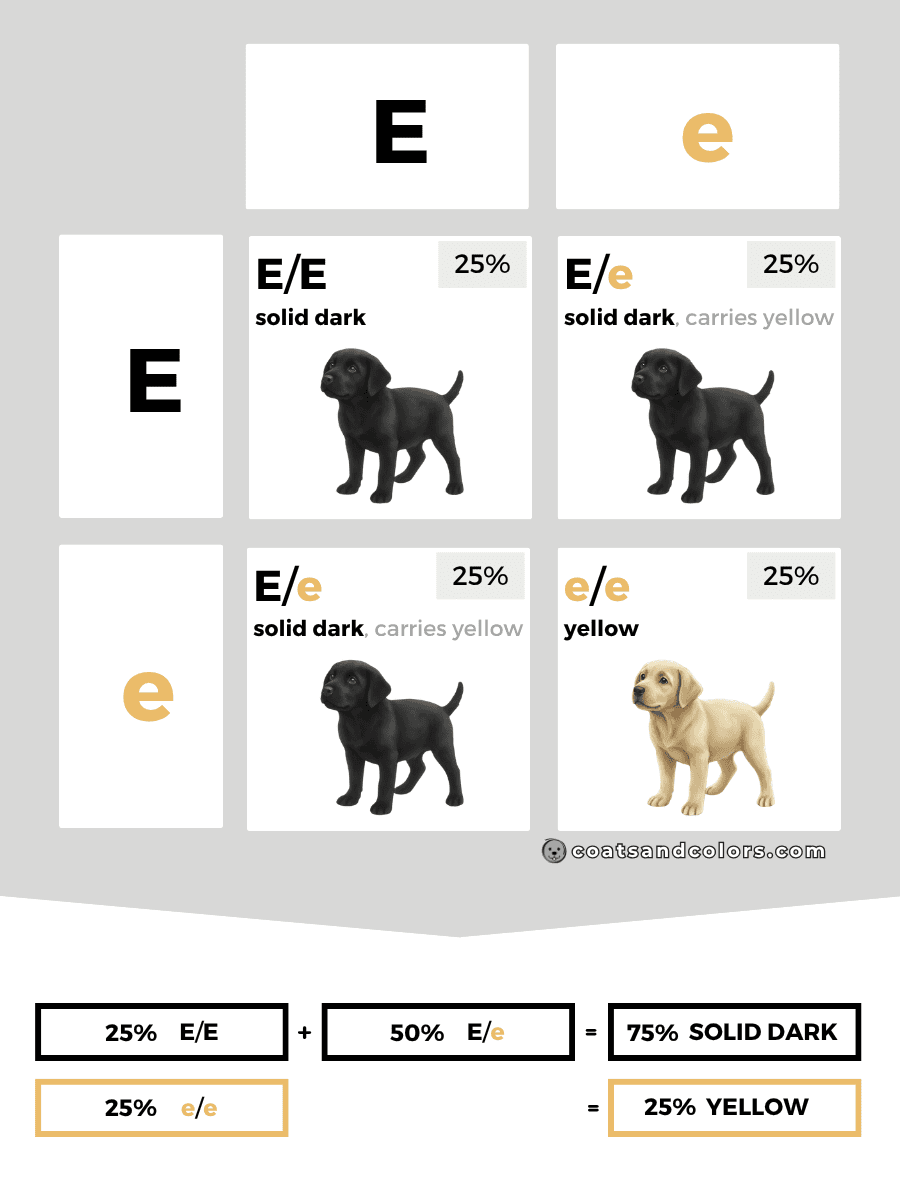
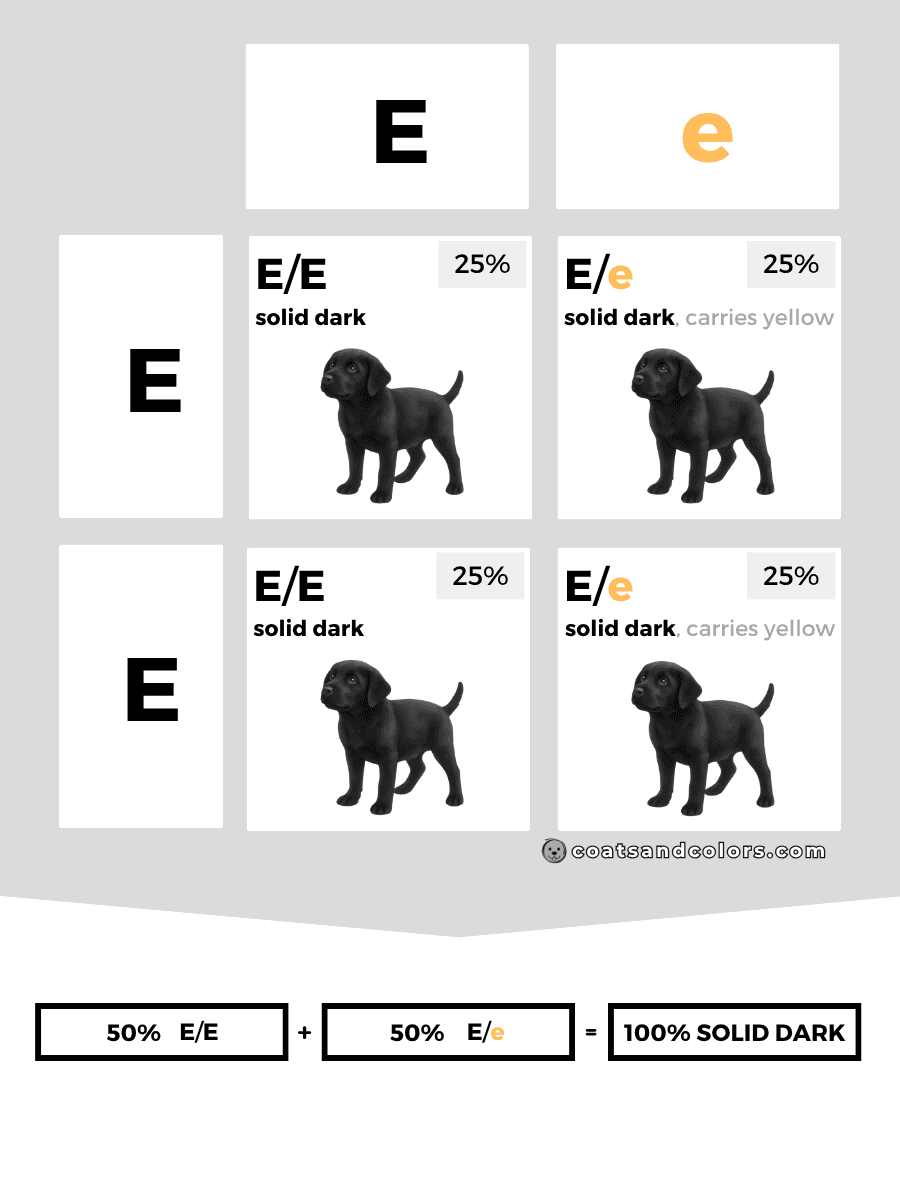
In Labradors, the E locus only has two relevant alleles, E or e.
Breeding dogs can be E/E, E/e, or e/e.
This gives us yet another 6 possible breeding combinations just for the E locus!
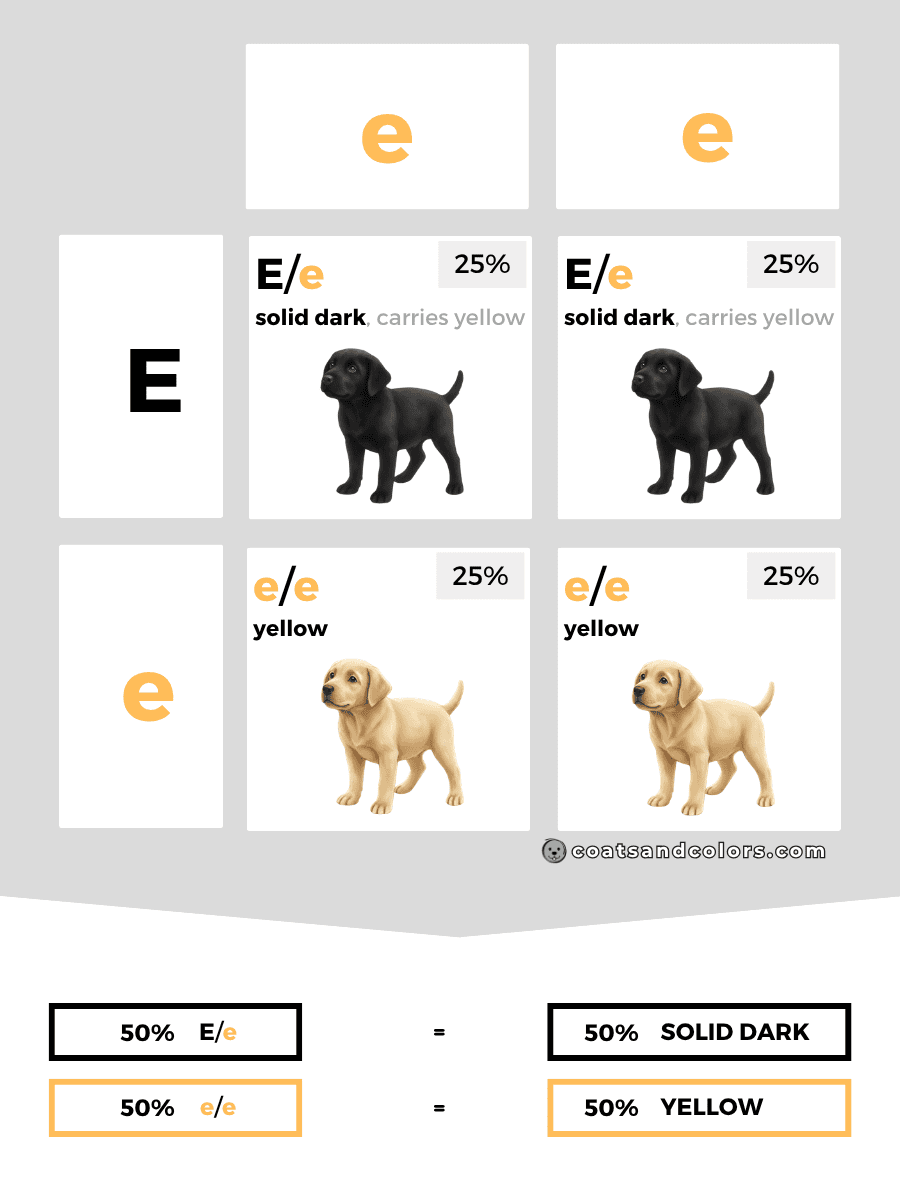
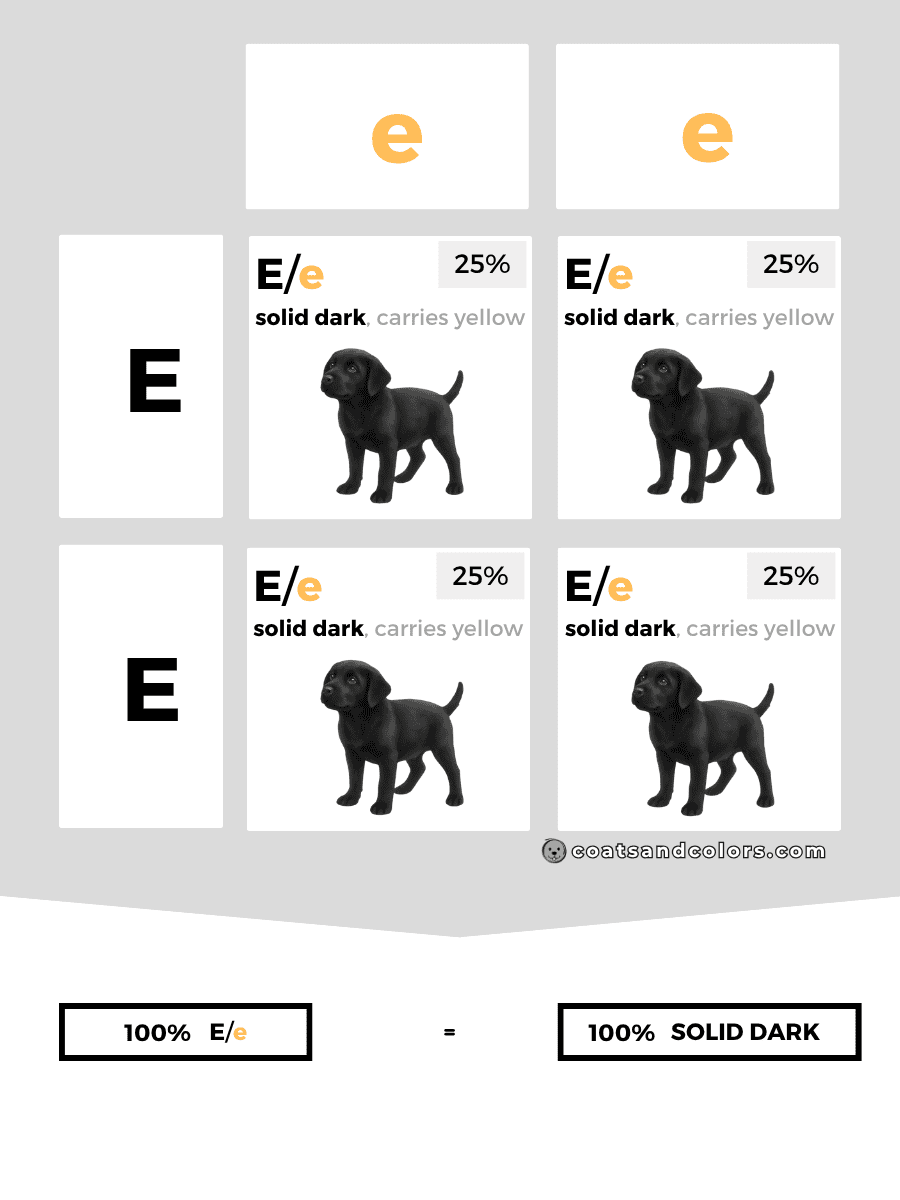
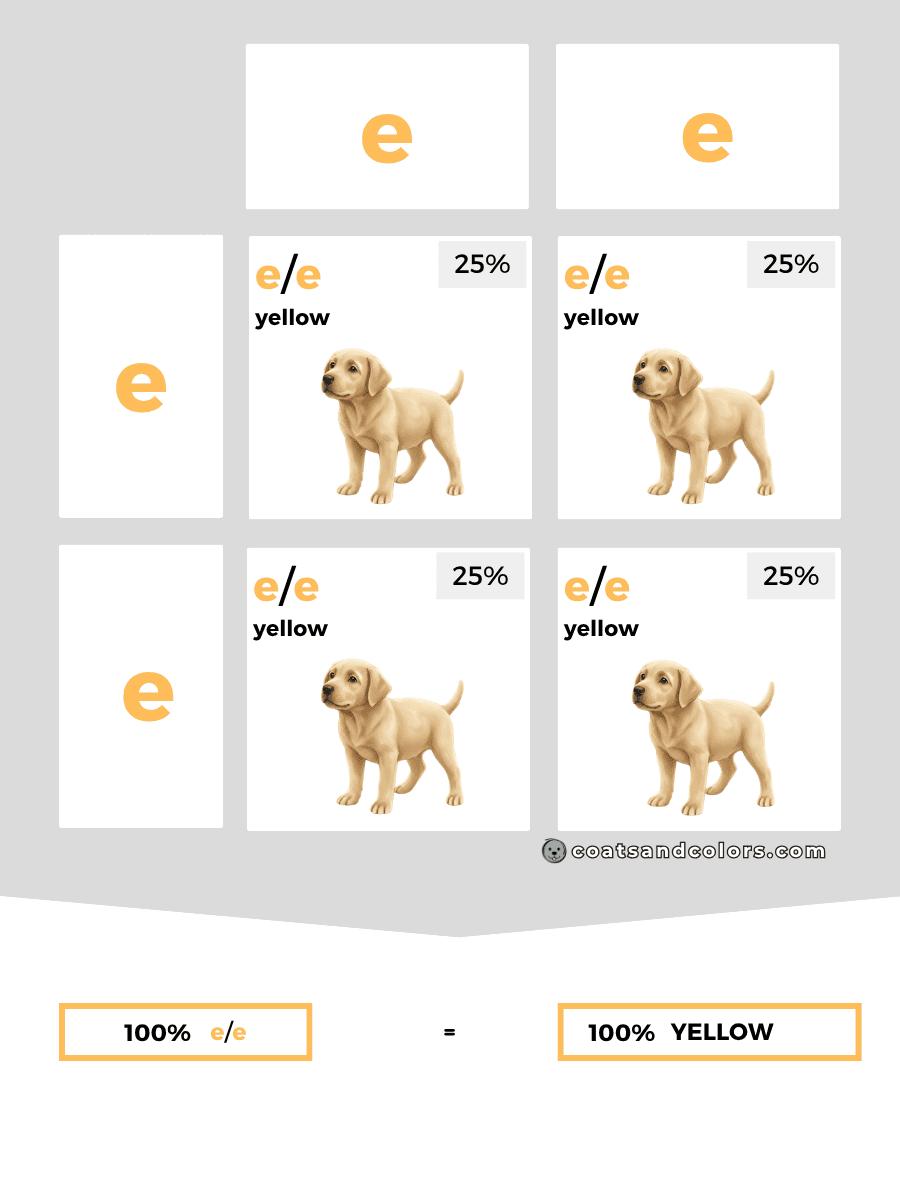
Now let’s apply this.
We have two black Labs, both are E/e B/b.
They both look black, but both carry yellow (e) and chocolate (b).

Only one allele per gene will make it into germ cell. With two genes, we first have to find all the possible combinations of one B locus allele and one E locus allele that are possible.
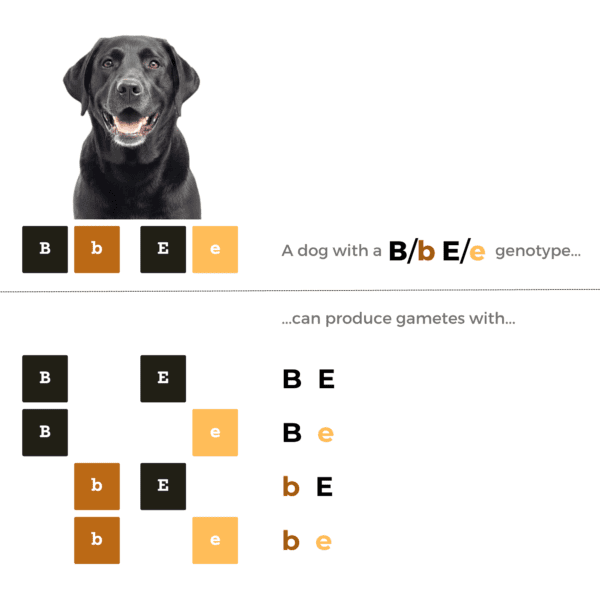
What can their litter look like?
There are two ways to approach this:
First of all, we can just draw a larger Punnett square that includes both genes.
We now have four possible gamete combinations each.
This gives us 16 cells total, so now each cell only represents a chance of 6.25% (1-in-16).
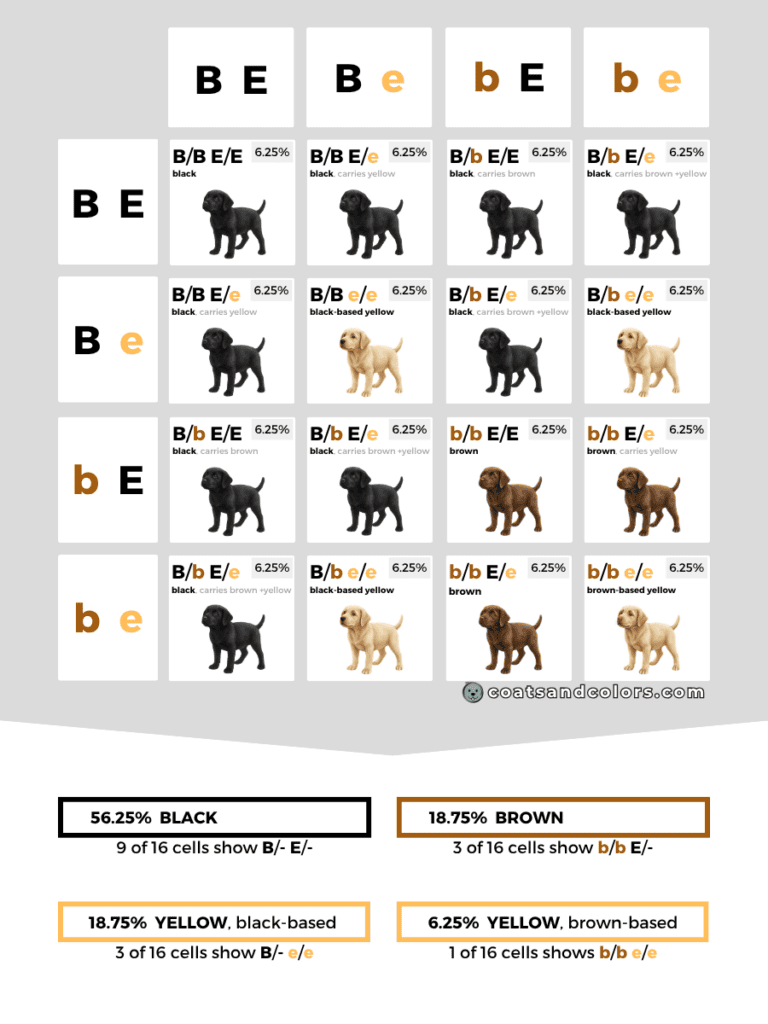
Or we could also approach this one gene at a time.
First, we look at E/e × E/e at the E locus. Then we map out B/b × B/b at the B locus separately.
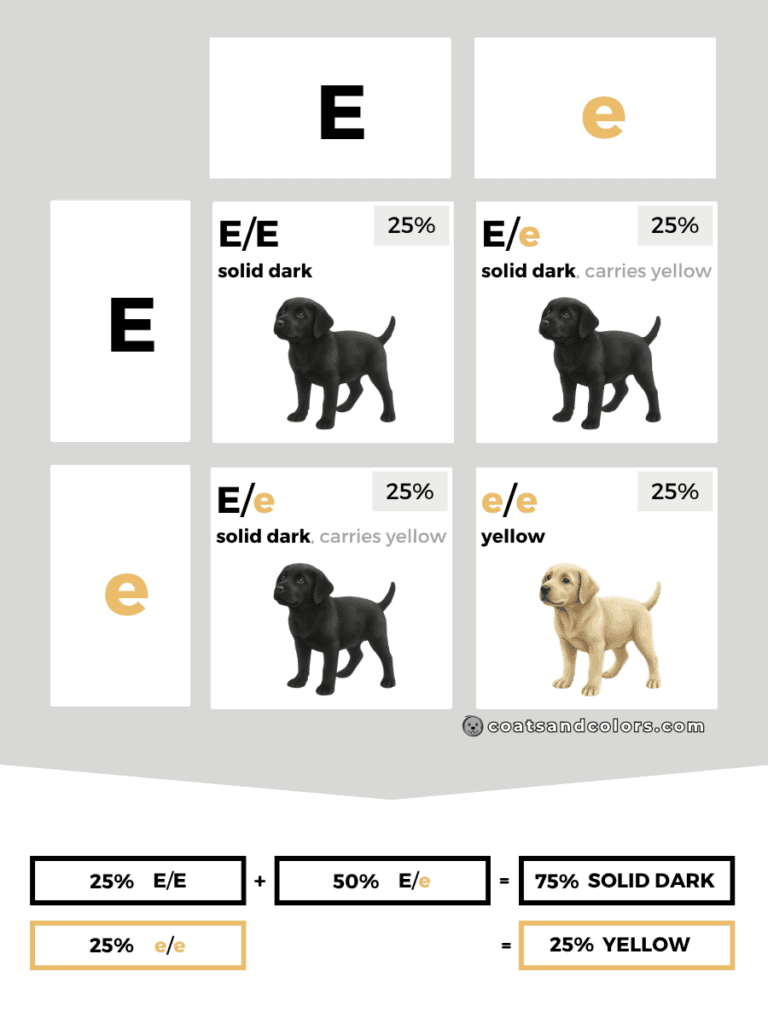
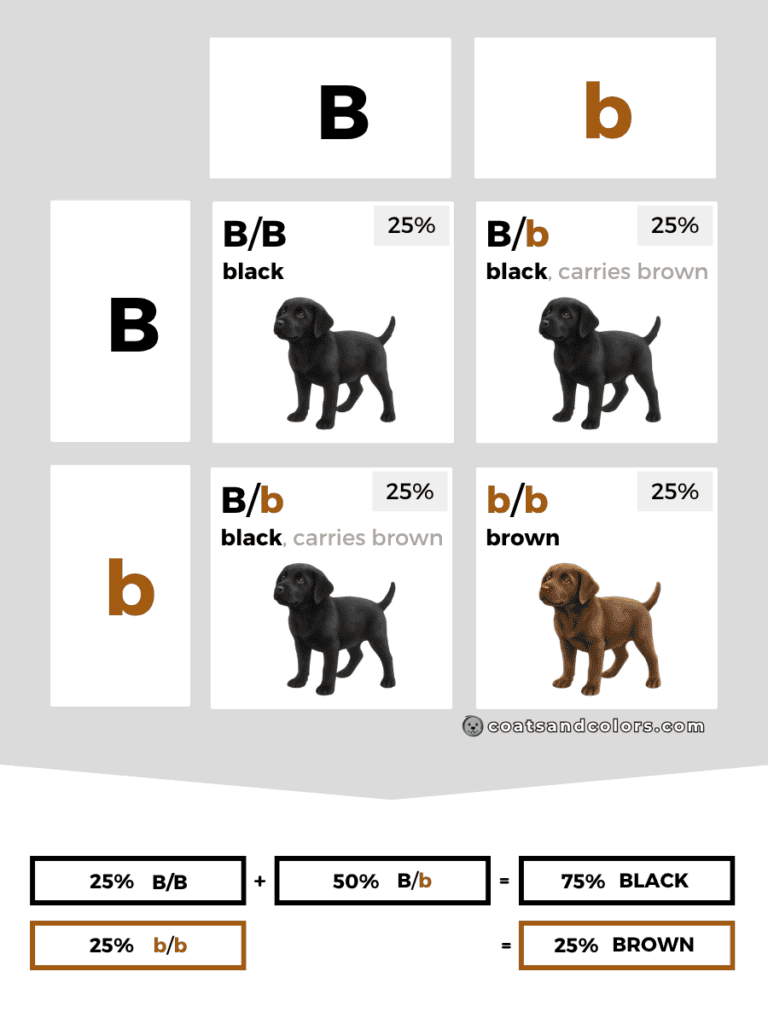
Now, that we have the chances for each possible outcome, we can multiply the odds.
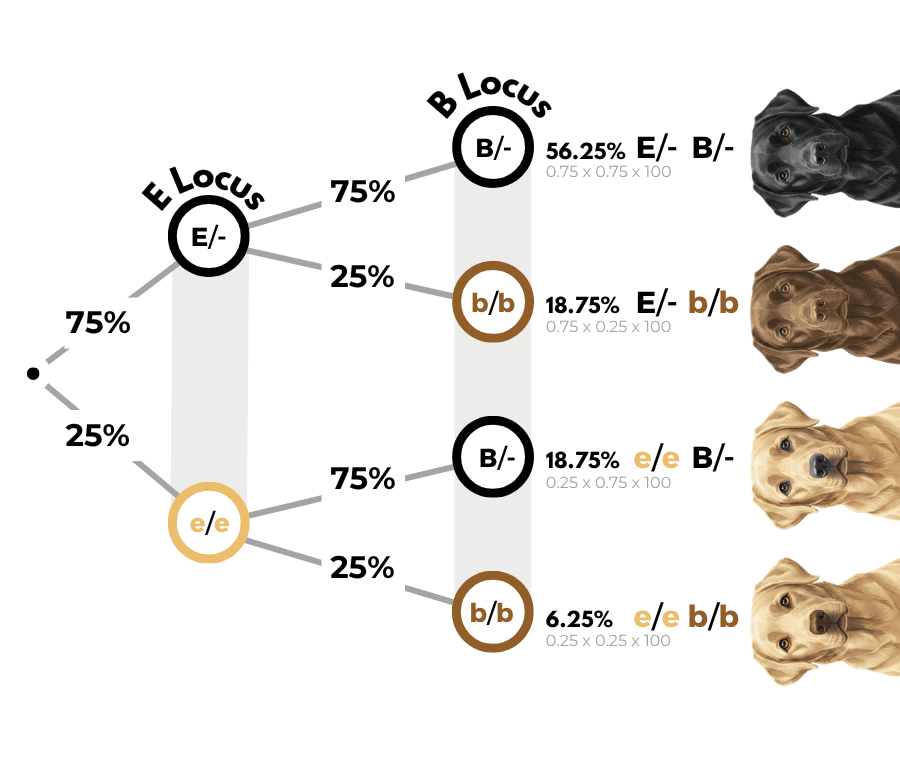
The conclusion for both methods stays the same:
A B/b E/e x B/b E/e litter can produce all four possible combinations.
It’s more likely to get black than brown or yellow puppies. But how mother nature will deal her cards is random. So you can never predict the exact ratio of colors from a breeding.
This concludes our journey into Labrador colors. I hope you learned a lot!
Now you can go and learn how to use a Punnett square to work out combinations yourself.
Learn More


Image Credits
Rick Tobin/pexels.com
Teamjackson/canva.com
Garosha/canva.com
Hi! I’m Steffi. I am a biologist and a big time dog nerd. You are curious about coat color genetics? You’ve come to the right place! Read more.