

Let’s talk about how traits get passed from parent to puppy.
Between Generations
Every body cell has pairs of homologous chromosomes.
The chromosomes in each pair share the same genes.
This means each cell has two copies of each gene. One on each chromosome in a pair.
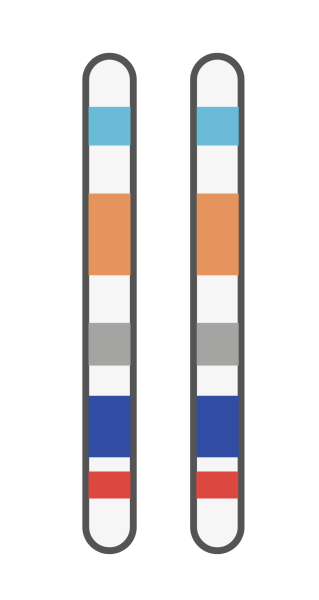
For each gene, a dog can have two identical alleles. We call this a homozygous dog.
Or they can have two different alleles. We call this a heterozygous dog.
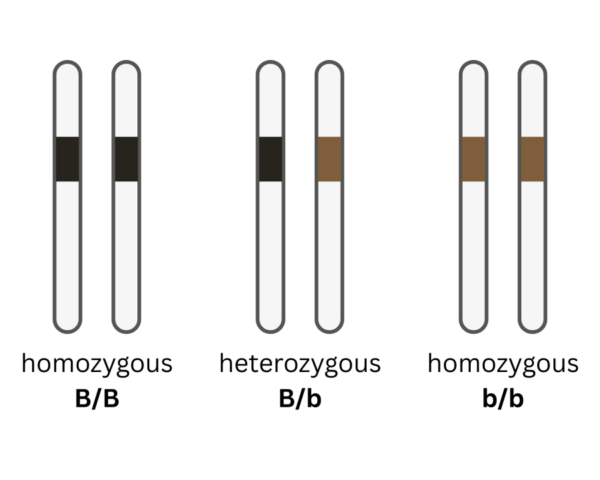
But a sperm cell or an egg cell only has only one copy of each gene.
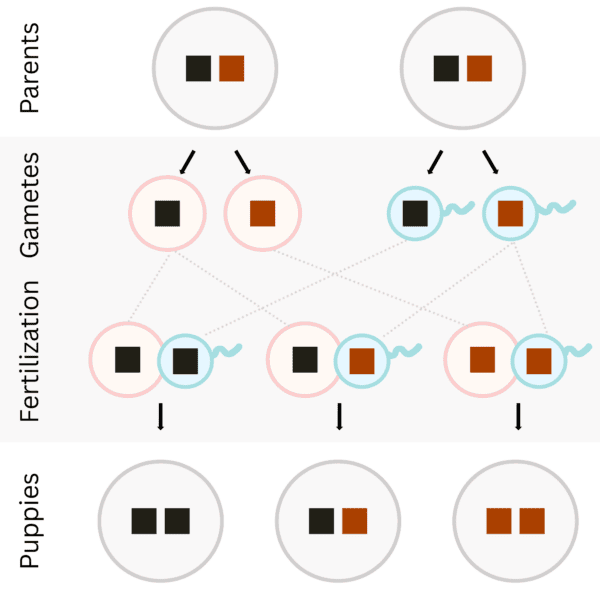
That reduction from two copies of each gene to one copy of each gene happens through a special type of cell division called meiosis. This makes sure that each parent provides exactly half the information.
When two germ cells fuse, the genetic information joins into a new double set of chromosomes. Only a fertilized egg cell has all the necessary information to develop into an embryo.
So each parent gives half the information it has. This information combines to build a new puppy.
Gametes
The germ cells (sperm or egg) are called gametes.
When dogs breed, each parent can pass on just one of its two alleles per gene.
A homozygous dog will have the same allele in all its gametes. For example, a B/B dog can only pass on B. All its puppies will be B/- and automatically have black pigment.
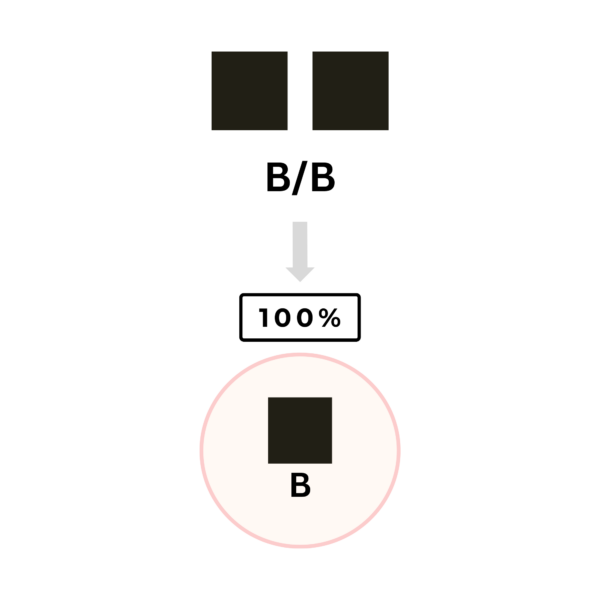
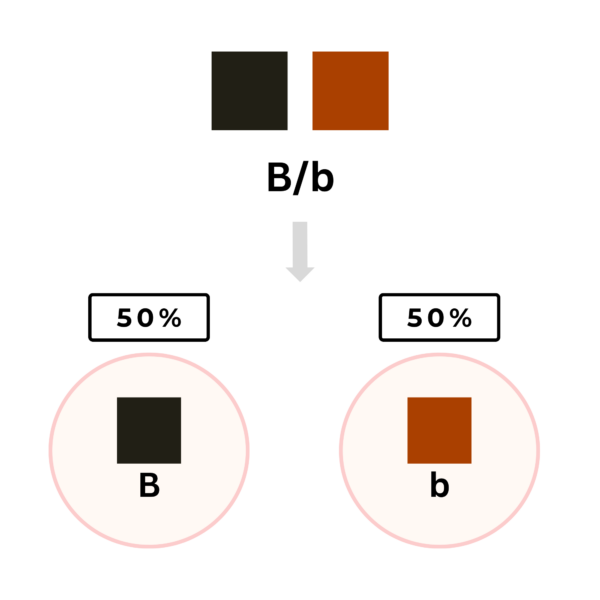
A heterozygous dog has two different alleles and can produce gametes with one or the other. For example, a B/b dog can pass on either B or b. The chance for either is a random 50%.
Predicting puppy colors typically means tracking two or more genes simultaneously.
Say, a solid yellow dog might be e/e (solid yellow) and B/B (black pigment).
All it’s gametes will pass on e B. There is no other option.
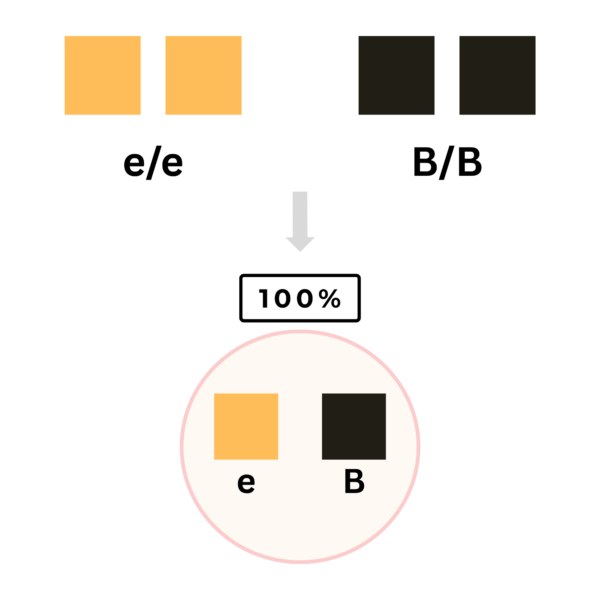
This is essentially the situation in Golden Retrievers. They are fixed for e/e B/B and can not produce other colors anymore. Many purebred dog breeds show trait fixation with a 100% homozygous dogs.
For example, all Dobermans have tan points (at/at), they can only pass on at. Weimaraners are all solid brown with color dilution (KB/KB b/b d/d) and can only pass on KB and b and d.
But there are, of course, many dogs where you find more than one option.
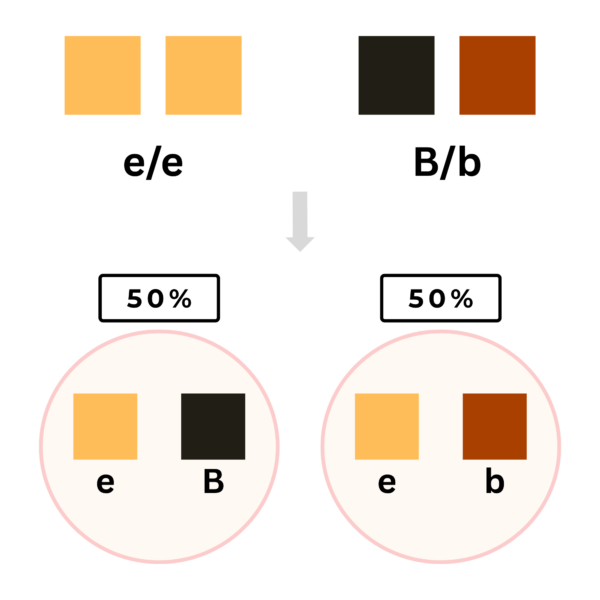
A yellow Labrador might be e/e (solid yellow) B/b (black pigment, carries chocolate).
A dog like this can produce gametes with e B or e b.
Let’s say we have a dog is M/m (merle) and B/b (black pigment, carries chocolate).
This dog can produce gametes with M B or M b or m B or m b.
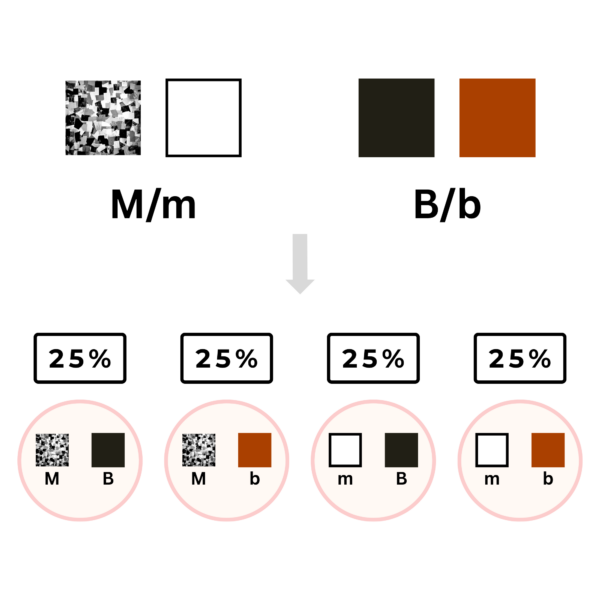
This random assortment happens for all genes.
A dog can have millions of distinct allele combinations in its germ cells. This quickly gets complicated to draw by hand, even if we just consider the handful of relevant color genes.
And that’s why breeders use Punnett squares to predict puppy colors.
What Colors Can My Dog Produce?
To know what colors a dog can produce, you have to know its genotype.
The genotype is the list of a dog’s alleles.
If you had genetic testing done, great!
You know the exact alleles for each locus. And you also know that each allele of a pair has a random 50% chance to be passed on to the next generation.
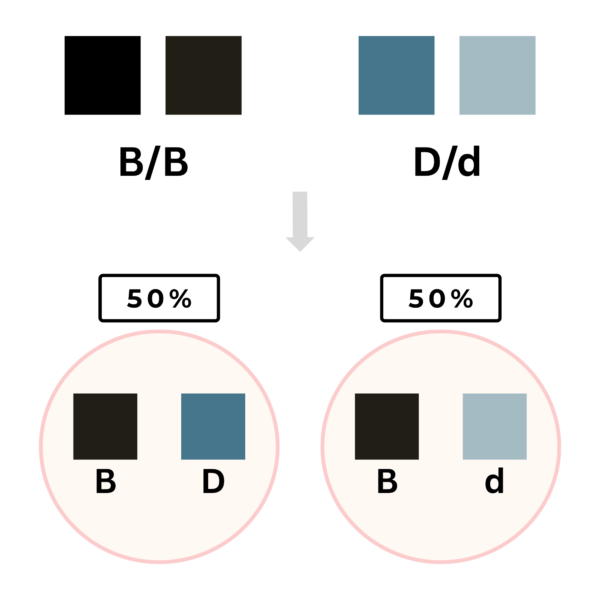
For example, take a dog that tested as B/B D/d.
It can pass on only B at the “black locus“. All its puppies will be B/- and have black pigment. It can also pass on either D or d at the “dilution locus“. So it can produce D/- or d/- puppies.
Without genetic testing, you have to rely on phenotype and pedigree analysis.
You can reverse-engineer some of the genotype from the phenotype.
For example, a solid black dog has to be B/- D/-. It expresses B and D in its phenotype.
You know with certainty that a B/- D/- dog can pass on B and D. But you can not see if it is B/B or B/b ( a chocolate carrier) or if it is D/D or D/d (a dilution carrier).
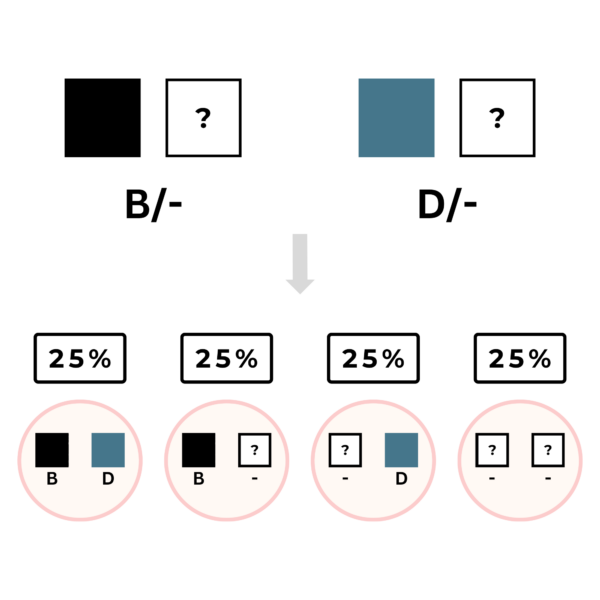
That’s the sneaky thing about recessive traits. They are not visible in the phenotype of carriers.
In cases like this, some pedigree analysis can help.
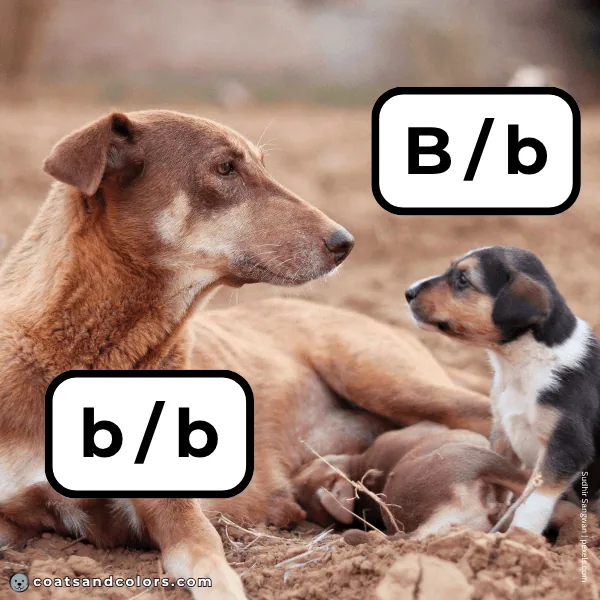
A black dog (B/-) with a chocolate parent (b/b) has be a chocolate carrier (B/b) itself.
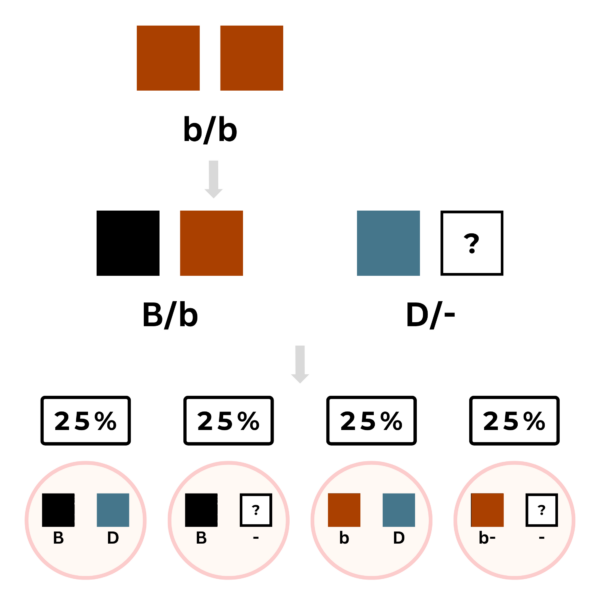
A normal-pigmented dog (D/-) with a diluted parent (d/d) has be a dilution carrier (D/d) itself.
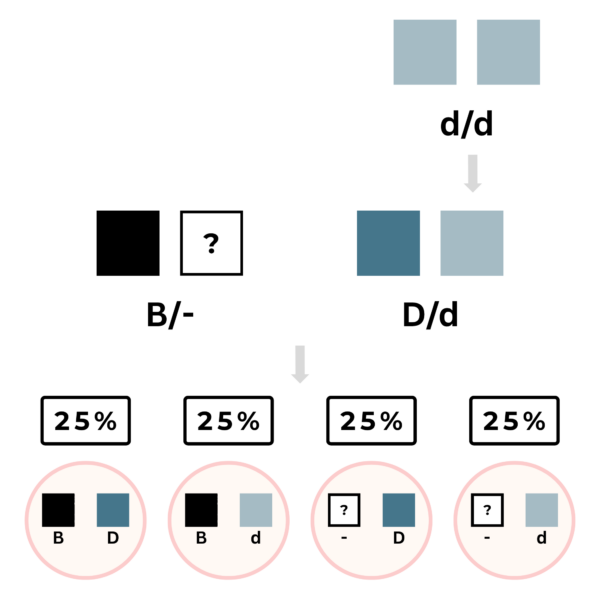
This works well enough for some breeds.
But you rarely get the full picture via guessing.
Maybe you have data from previous litters?
A black dog (B/-) that has already produced a chocolate puppy (b/b) has to be B/b. If your D/- dog has already produced a diluted puppy (d/d) it has to be D/d.
Decades ago, all a breeder could do was a test breeding to see if their dog carried recessive traits. But in this day and age, you have genetic testing at your disposal. So why not use it?
Guessing is not a great way to plan a breeding. It can be especially detrimental if potentially harmful mutations are involved. I beg of you, please never just “guess” if a dog is merle.
Some merle lengths can be non-expressing in the phenotype. And epistatic interactions can hide if a dog is merle or not. Always make sure, that one of the partners is safe to breed a merle dog to.
Learn More



Image Credits
Sudhir Sangwan/pexels.com
sansubba/canva.com
Hi! I’m Steffi. I am a biologist and a big time dog nerd. You are curious about coat color genetics? You’ve come to the right place! Read more.