

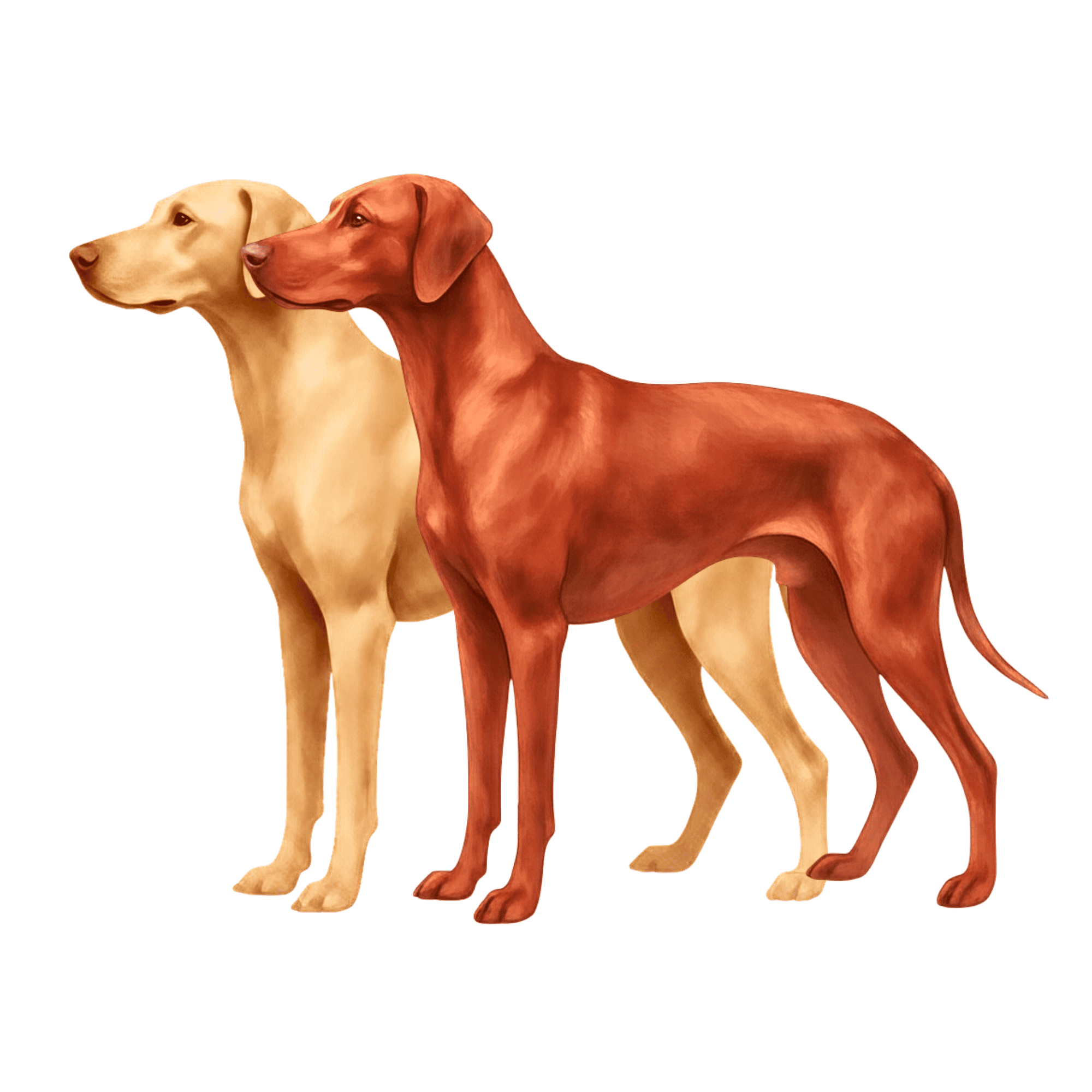
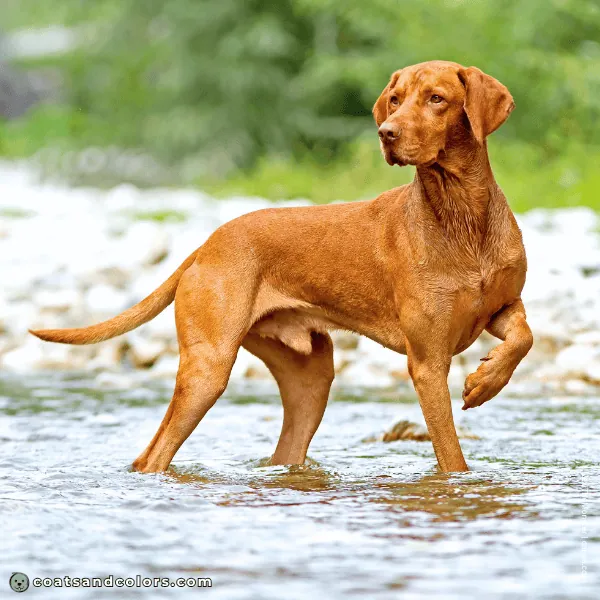
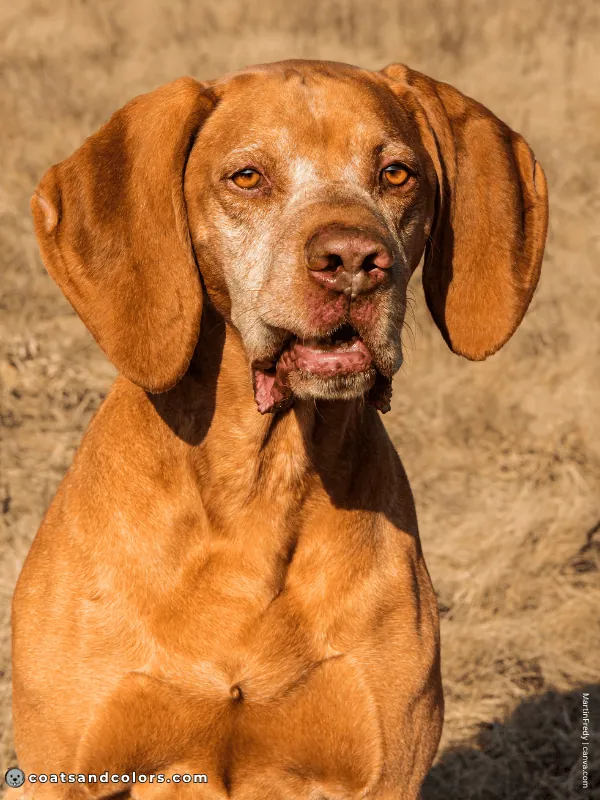
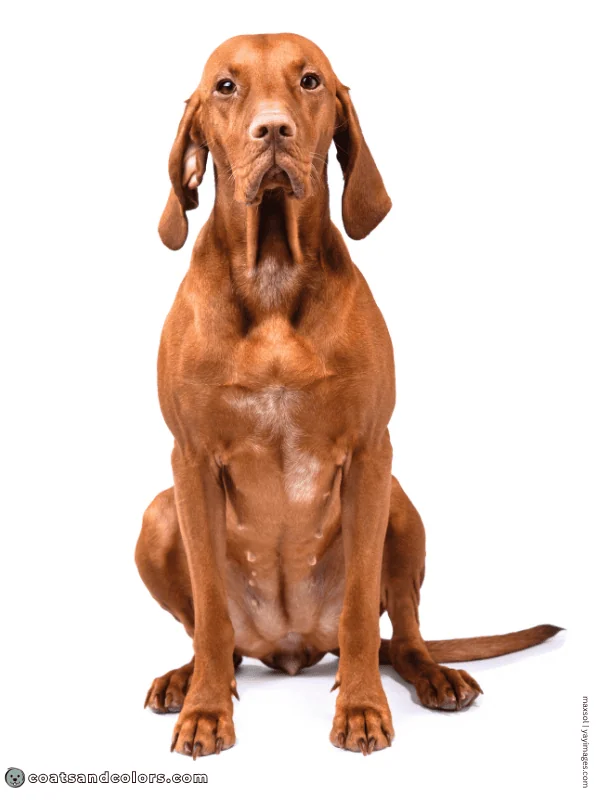
The Hungarian Vizsla palette ranges from solid golden to rust colors.
Golden Rust
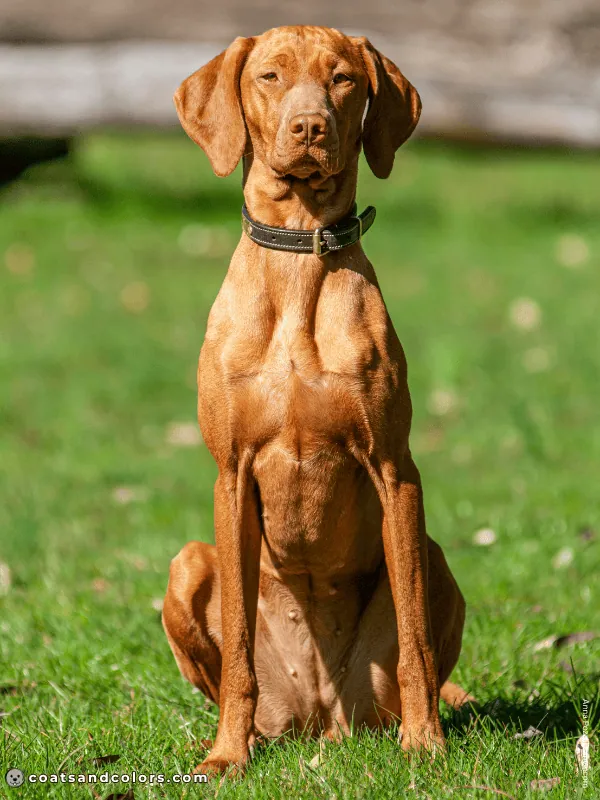
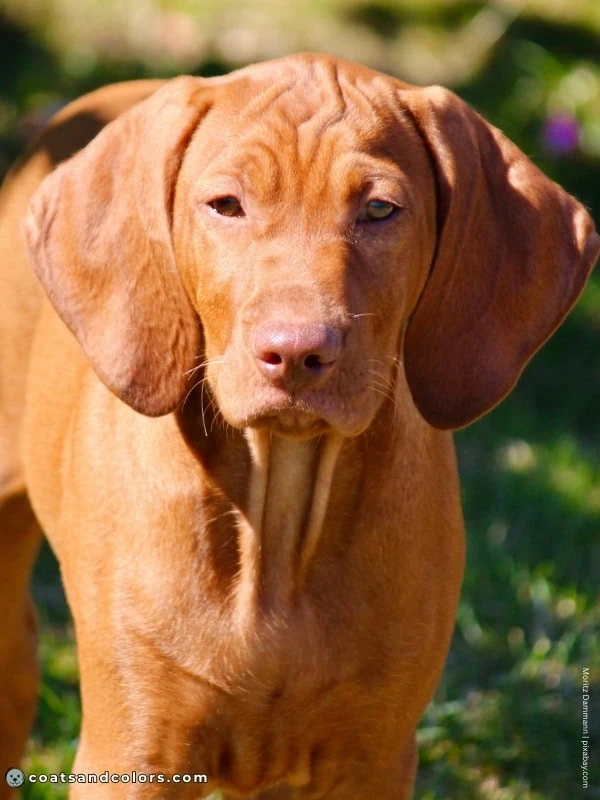
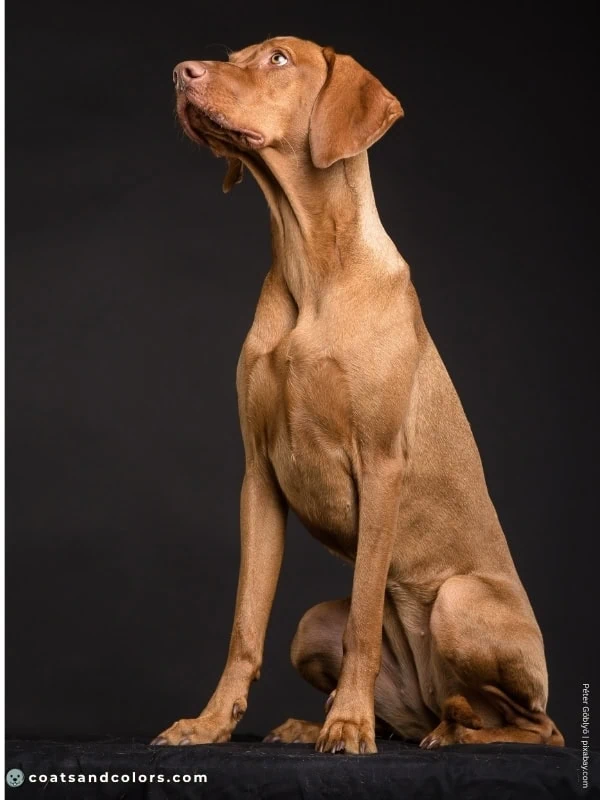
These dogs express brown-based recessive red (b/b e/e).
The ideal Vizsla color is golden rust. Their coat has a bright orange color.
BASE PATTERN
recessive red
MERLE
–
OTHER
–
EUMELANIN
brown
INTENSITY
golden rust
WHITE
solid
Sandy Gold
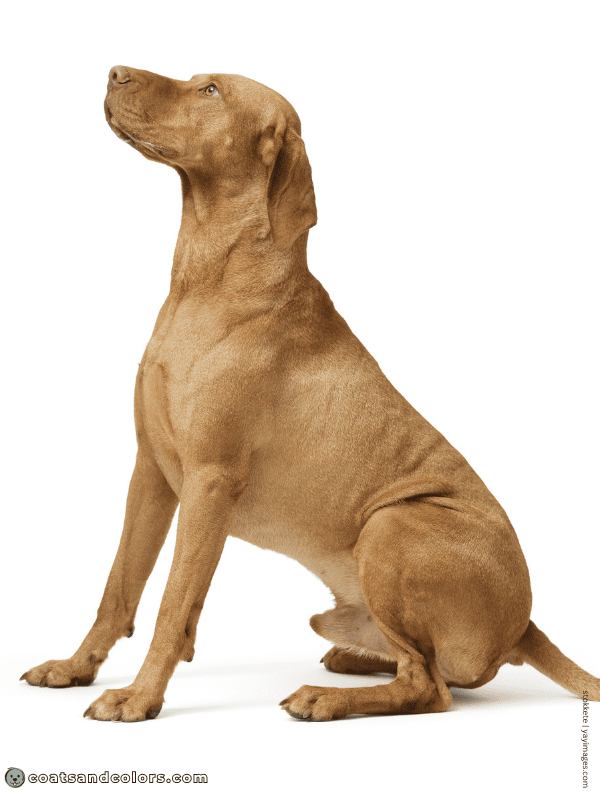
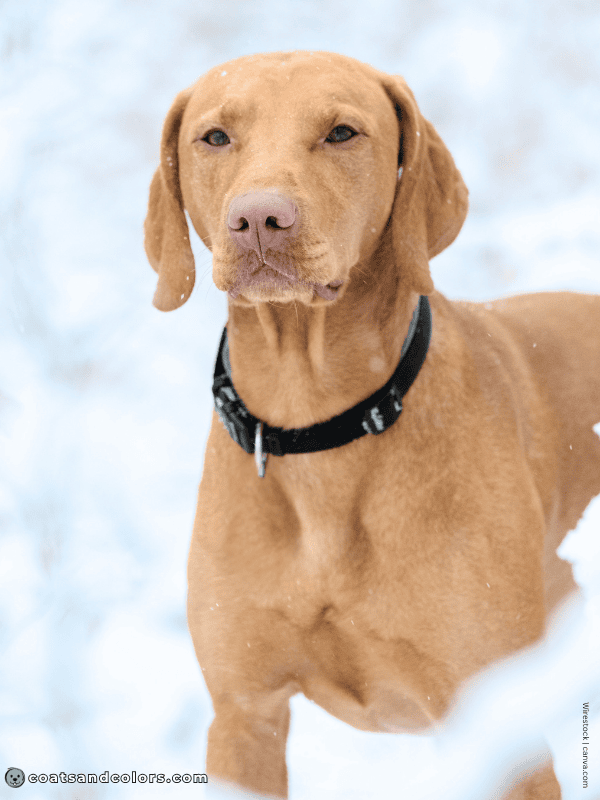
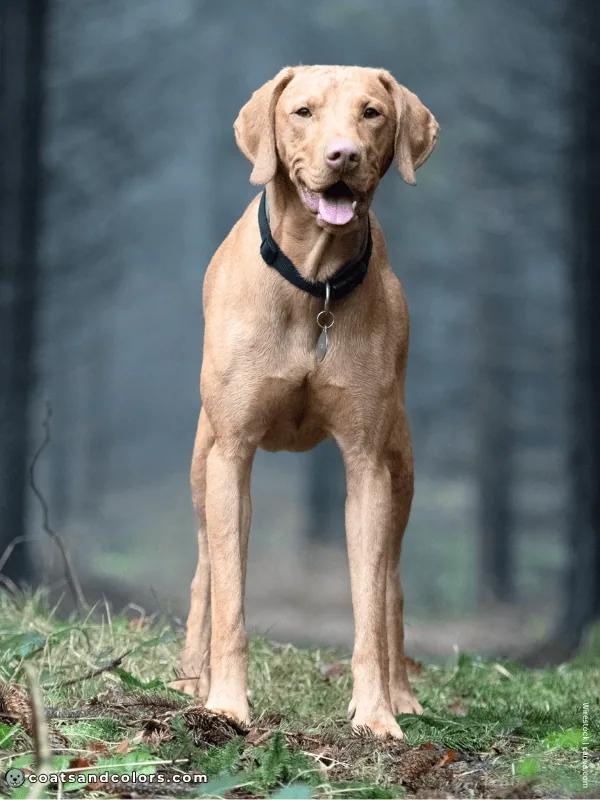
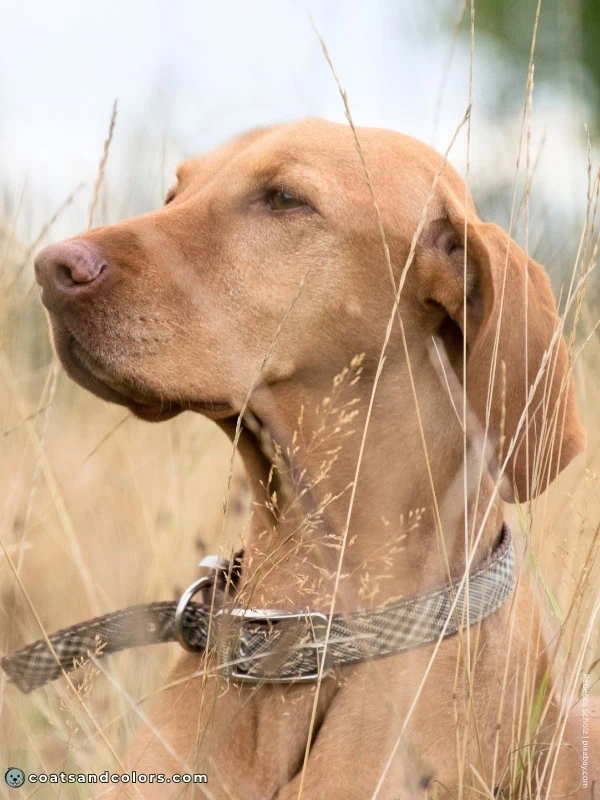
The FCI recognizes golden or semmelgelb as a possible Vizlsa color. This “rusty yellow” is essentially the lightest possible shade that could still pass as a “light orange” color.
Any lighter than this would make a dog look too sandy, yellow, or cream.
BASE PATTERN
recessive red
MERLE
–
OTHER
–
EUMELANIN
brown
INTENSITY
golden, sandy, semmelgelb
WHITE
solid
Mahogany Red
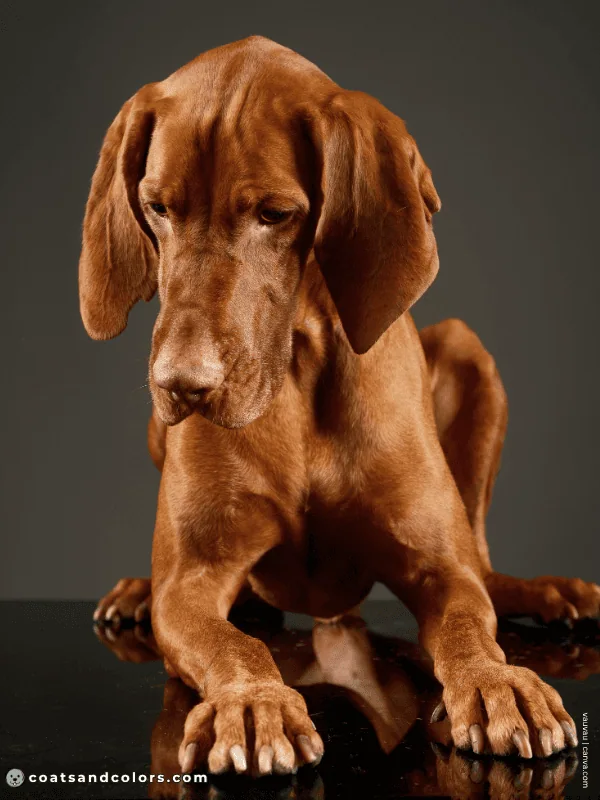
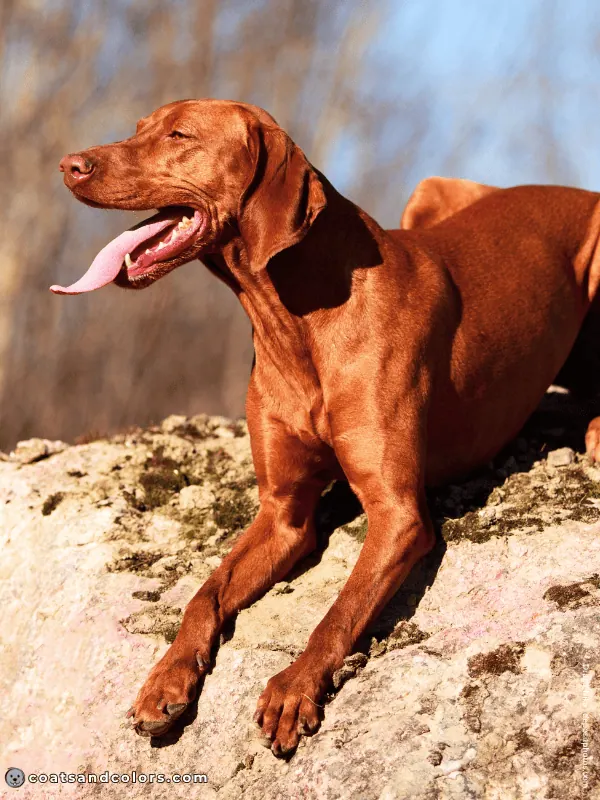
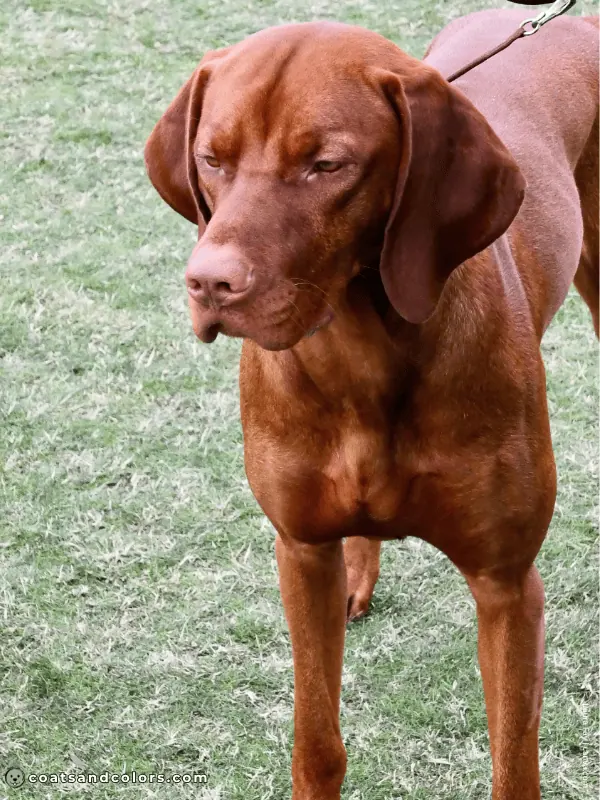
Dogs with very intense dark rust, red, or mahogany colors are not desired.
BASE PATTERN
recessive red
MERLE
–
OTHER
–
EUMELANIN
brown
INTENSITY
red, rust, mahogany
WHITE
solid
Faulty Colors
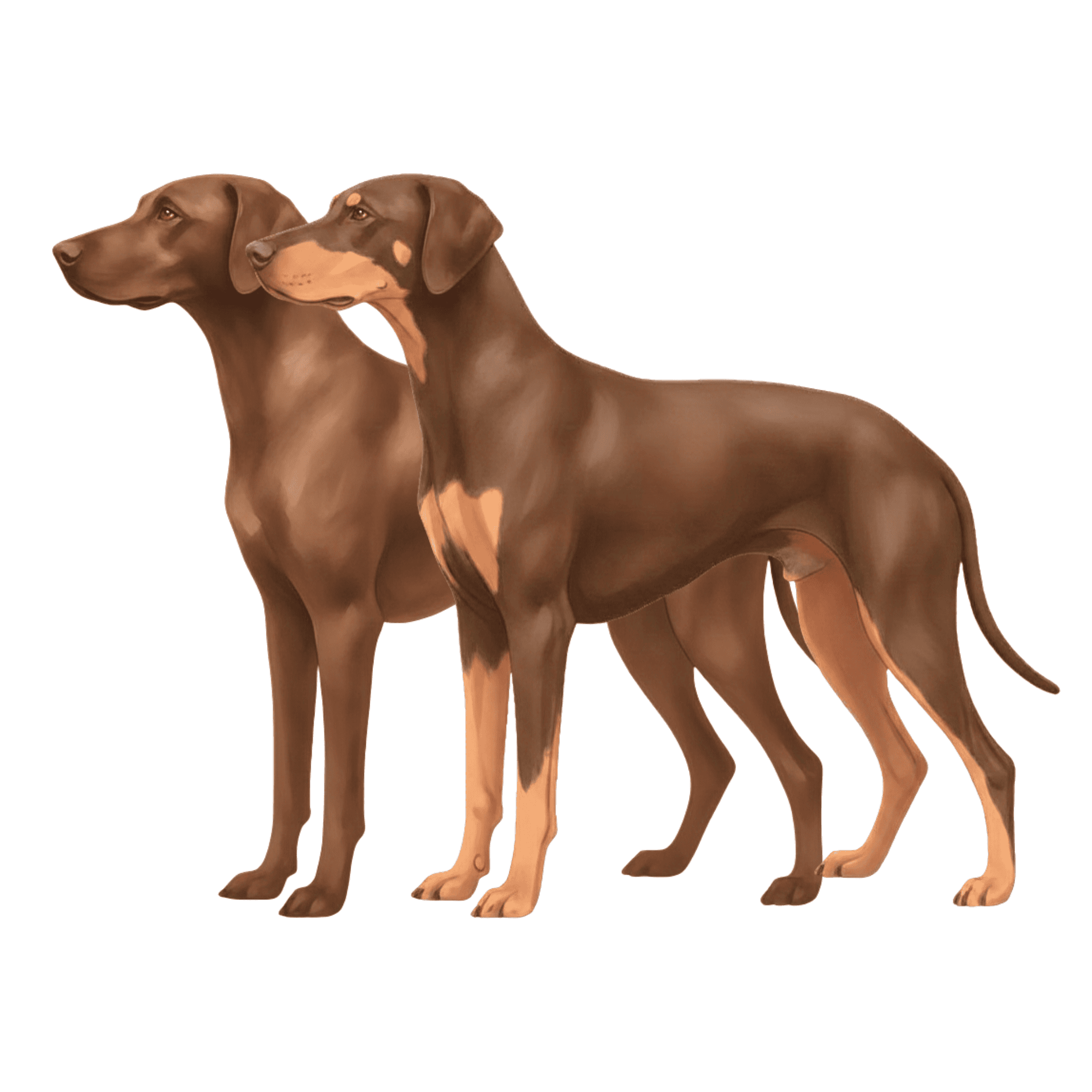
The whole breed is recessive red (e/e). So there aren’t too many mismarks that could happen.
“DQ: Dark brown or pale yellow colour. Parti-coloured, not uniformly coloured.”
FCI Breed Standard[2]
Base Patterns
The base pattern describes the placement of phaeomelanin and eumelanin in the coat. There is an epistatic hierarchy between the A locus < K locus < E locus.
A Locus
| Ay | clear sable |
| at | tan point |
| a | recessive black |
Most Vizslas have one or two tan point alleles (at) at their A locus. Some have sable (Ay) or recessive black (a). However, they can not express these patterns due to their e/e genotype.
K Locus
| KB | dominant black |
| ky | wild-type |
Vizslas can have any of the known variants at their K locus. The wild-type variant (ky) is most common, but dominant black (KB) is also present. And even brindle (kbr) is possible (but unlikely).
Because Vizslas are e/e, they cannot express any of these patterns.
E Locus
| e | recessive red |
Vizlas are fixed for recessive red (e/e). This means they can not express eumelanin in their coat. All of their hairs only show phaeomelanin. And they will have light whiskers.
Dogs with this pattern can have some shades of darker red on their upper body or face.
The FCI mentions “dark brown” and “not uniform in color” as mismarks.
A solid dark or tan point pattern would require a dog to be E/-. So the dominant E allele was also present in the past (maybe because a clear sable from Ay/- E/- ky/ky also looks solid red).
Vizsla Base Pattern
| A LOCUS | K LOCUS | E LOCUS | PATTERN |
|---|---|---|---|
| *any* | *any* | e/e | recessive red |
Base Colors
The base color is determined by the B locus and D locus.
B Locus
| b | brown |
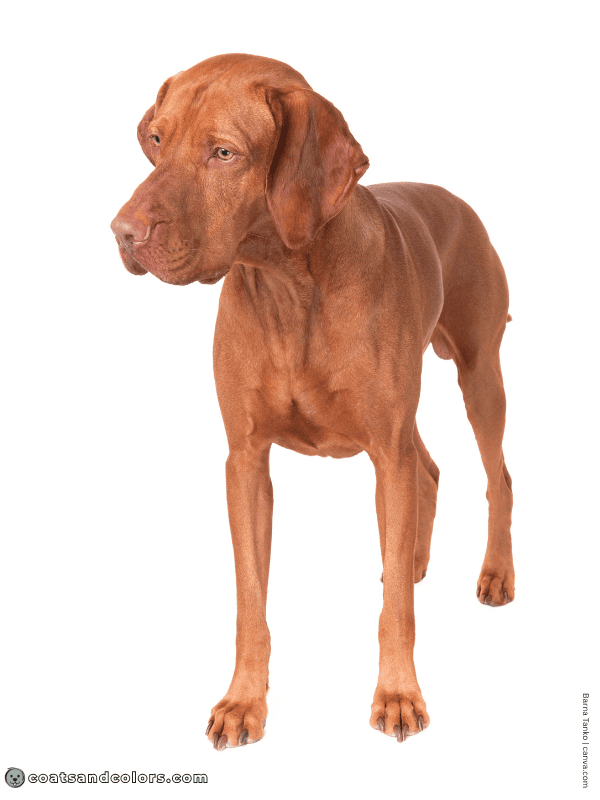
Vizlas have brown eumelanin (b/b).
The AKC says that a black nose is a disqualifying fault. This implies that some dogs in the past still were B/- before the breed got fixed for a chocolate nose. And a faded black nose can look very brownish.
D Locus
| D | normal |
Vizslas have normal pigment (D/D).
Some Vizlas may carry for color dilution (maybe via Weimaraner ancestors). This would cause a lilac nose in homozygous d/d dogs. Color dilution can sometimes affect red intensity (e.g. “buff” in Tollers).
Red Intensity
The ideal Vizsla has a “golden rust” or “russet gold” color. Basically orange with a touch of yellow.
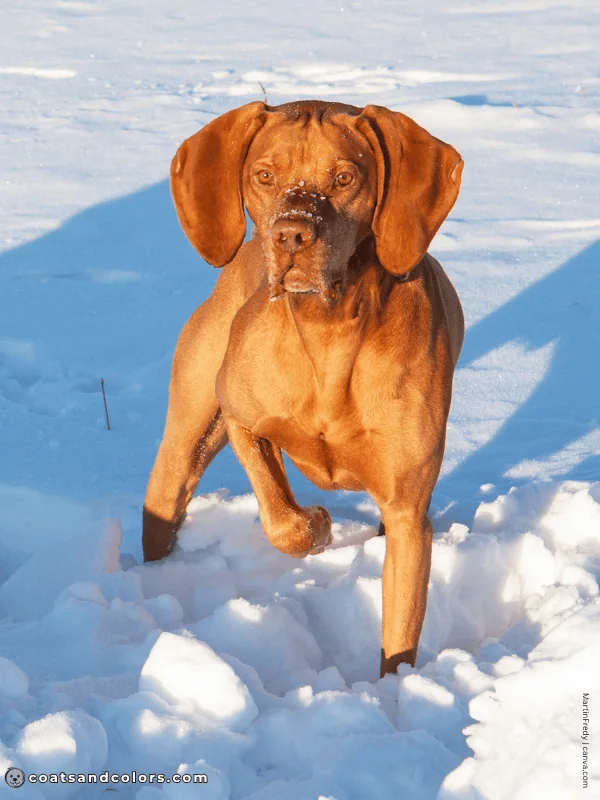
The standard of the national Magyar Vizsla Klub in Hungary calls the ideal color a “bun yellow” (meaning a bread roll or “baguette” color). The FCI standard kept this term and calls it “semmelgelb“.
Some coat color change in young Vizlas is to be expected. Puppies tend to be born with a more blonde coat that will darken over time as red pigment continues to build up after birth.
“Golden rust in varying shades. Lighter shadings over the sides of the neck and shoulders […] are common.”
AKC Breed Standard[1]
“Various shades of russet gold and dark sandy gold (semmelgelb). The leathers may be a little darker, otherwise uniform in colour.“
FCI Breed Standard[2]
In some dogs, you will find slightly lighter “sandy” or darker “deep red” and “mahogany” shades of phaeomelanin. The FCI breed standard describes “red, brownish or lightened colour” as undesirable and “pale yellow” as a disqualifying color. The AKC considers an intense “dark mahogany” to be faulty.
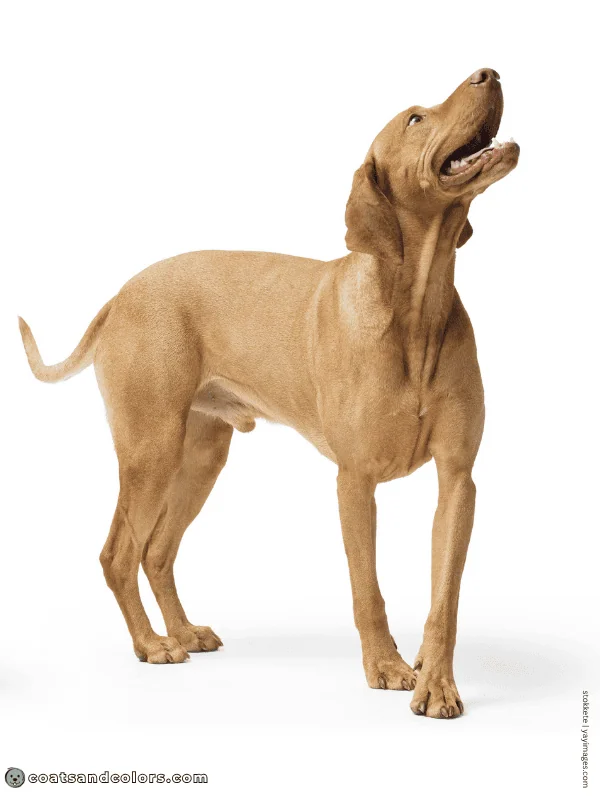
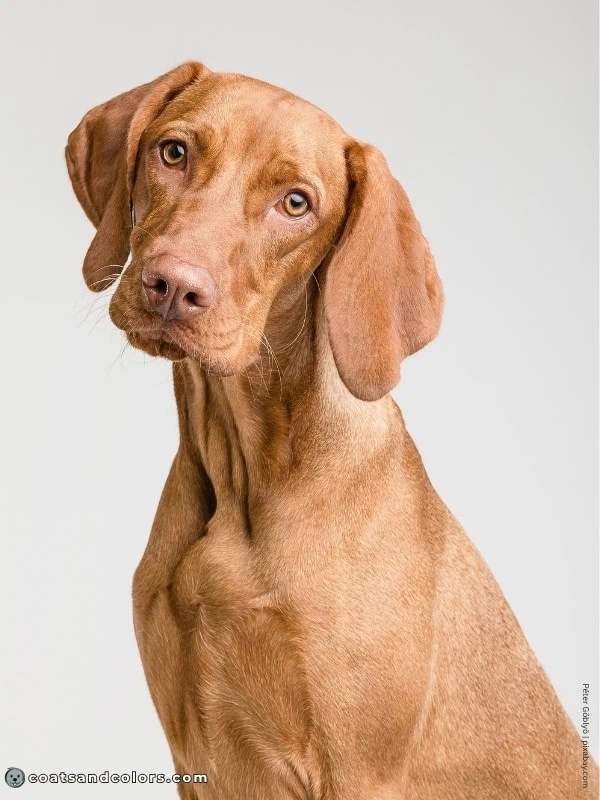
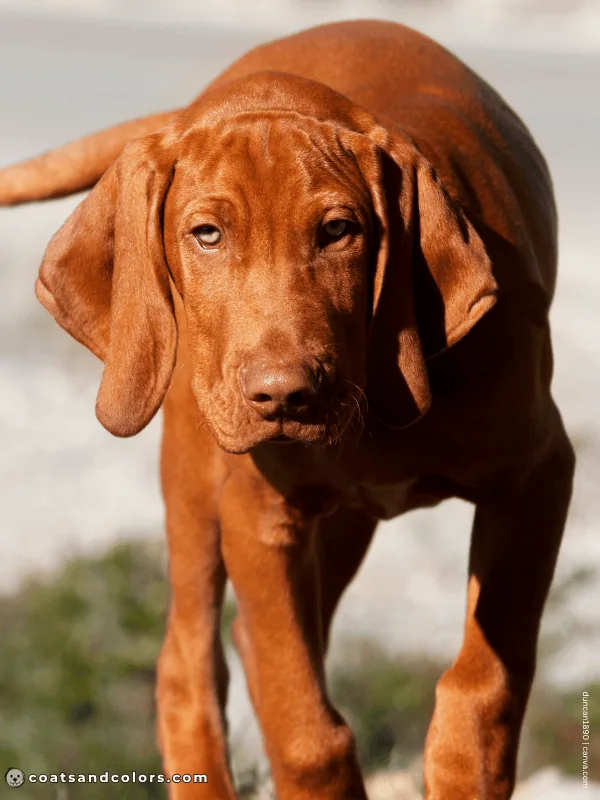
In summary, breed standards do not favor dogs that are too pale or too intense in color.
“Solid dark mahogany and pale yellow are faulty.”
AKC Breed Standard[1]
“Red, brownish or lightened colour is undesirable.”
FCI Breed Standard[2]
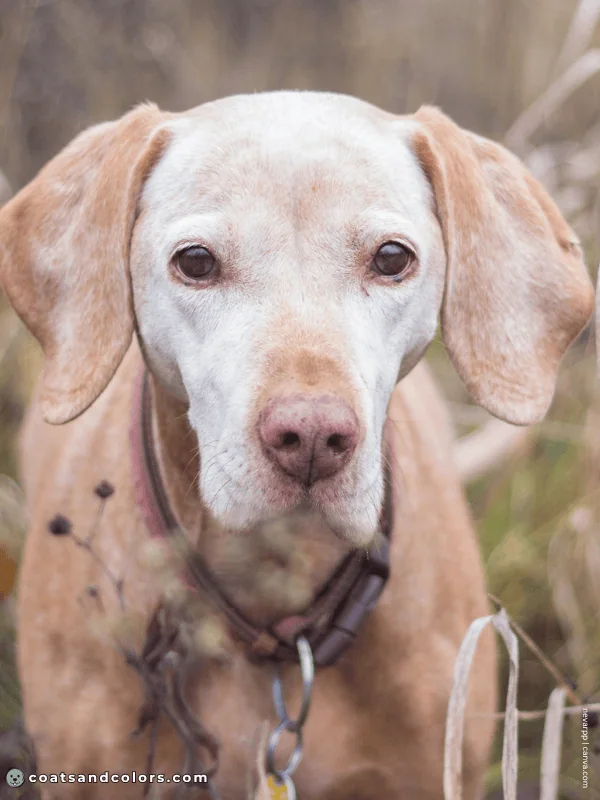
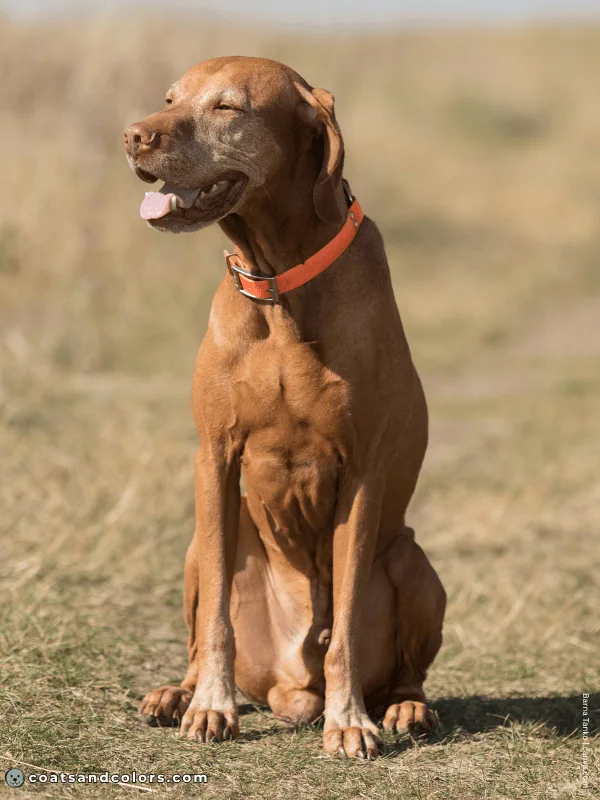
Old age graying can be quite extensive in these dogs and typically starts on the chin, muzzle, and toes. Additionally, some dogs show premature graying.
White Markings
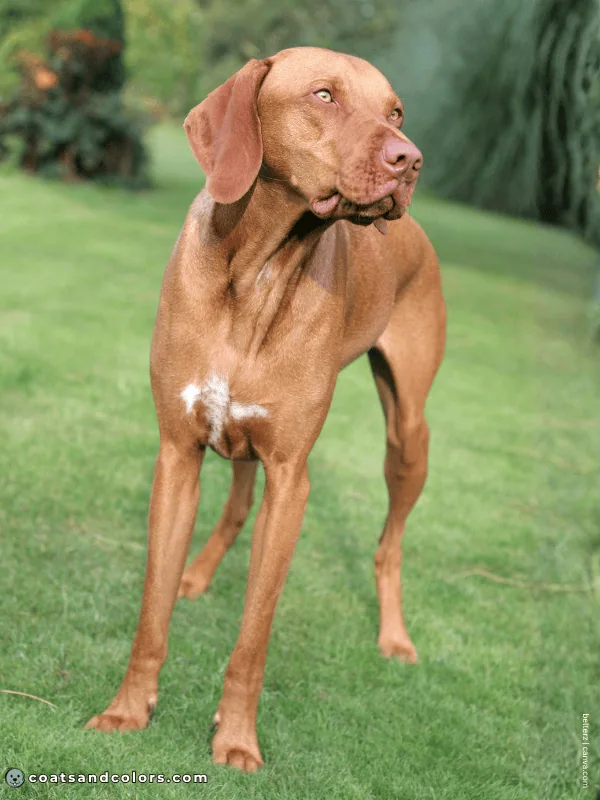
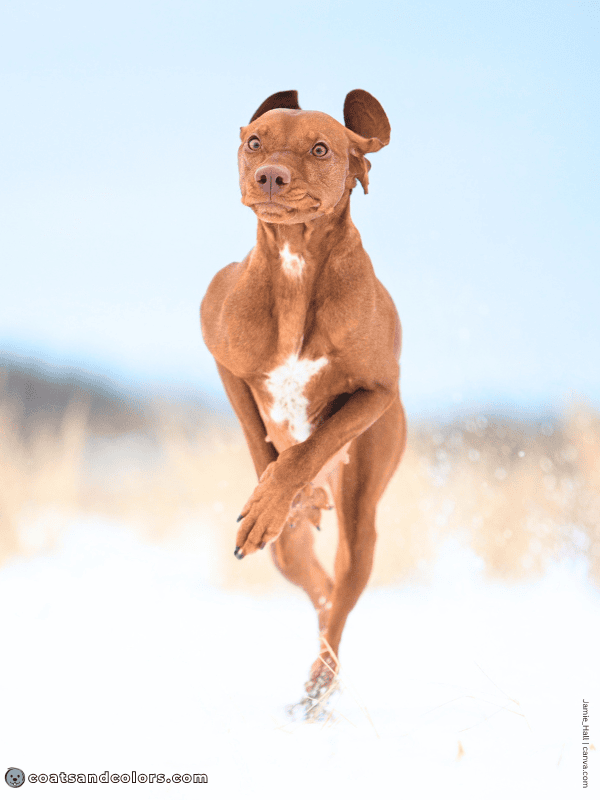
Some residual white on the paws and chest is tolerated but not desirable. And anything beyond a small patch on the chest and white reaching beyond the pasterns is a disqualifying fault.
The AKC standard clarifies that only chest white in an area from the top of the sternum to a point between the elbows is acceptable. The white must also not grow laterally beyond the points of the shoulders and can never actually extend to the shoulder or neck area (like a white collar).
“White on the forechest, preferably as small as possible, and white on the toes are permissible.”
“DQ: Solid white extending above the toes or white anywhere else on the dog except the forechest. White extending on the shoulders or neck.“
AKC Breed Standard[1]
“A little white patch on the chest or at the throat, not more than 5 cm in diameter, as well as white markings on the toes are not considered faulty.”
“DQ: White chest patch larger than 5 cm. White feet.”
FCI Breed Standard[2]
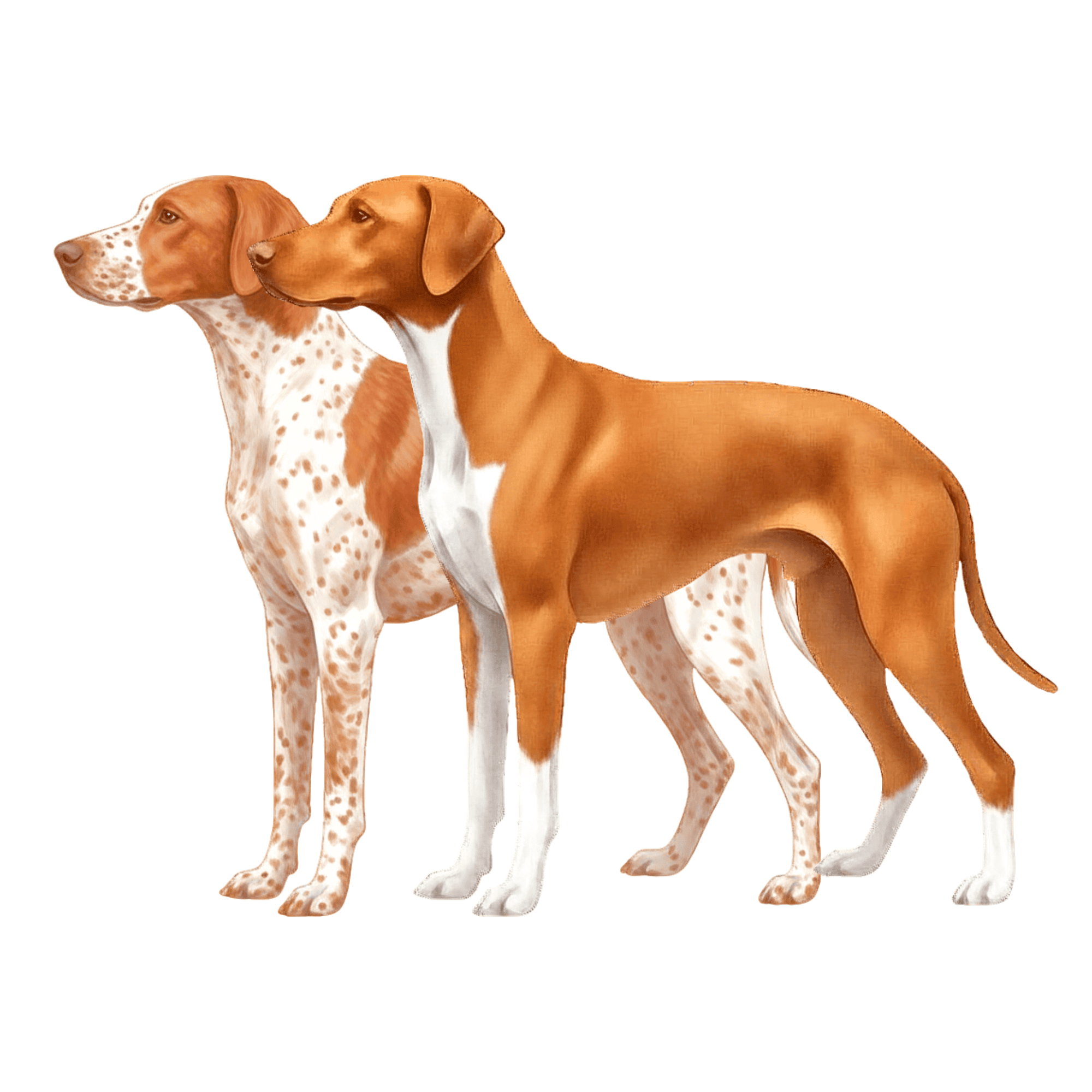
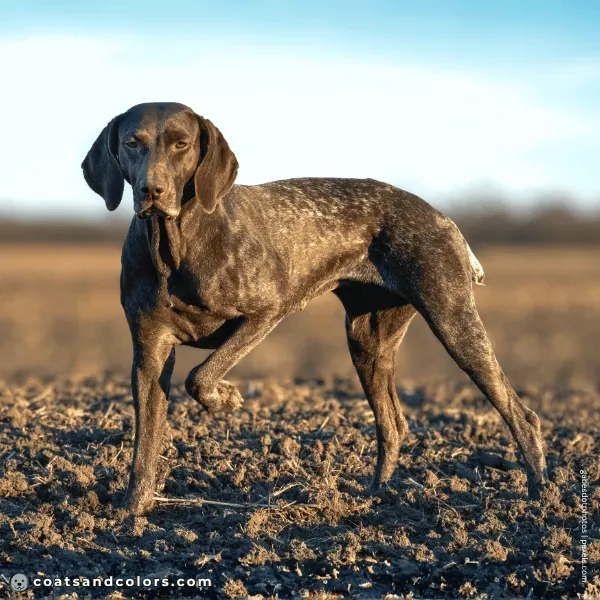
Some Vizlas may have one or two copies of piebald (sP). And the FCI standard mentions parti as a problem. Piebald is super common in related Pointer breeds like the German Short-Haired Pointer.
Most Vizlas likely also have ticking, another trait that is super common in hunting dogs. Mottles may help fill in white patches and can help make any white appear smaller than it is.
Vizsla Eye Colors
Dogs with brown pigment typically produce eye colors from light brown to light yellow. Puppies can have very light greenish eyes that will darken over time.
However, both the FCI and AKC standards do not accept yellow eyes in adult Vizlas.
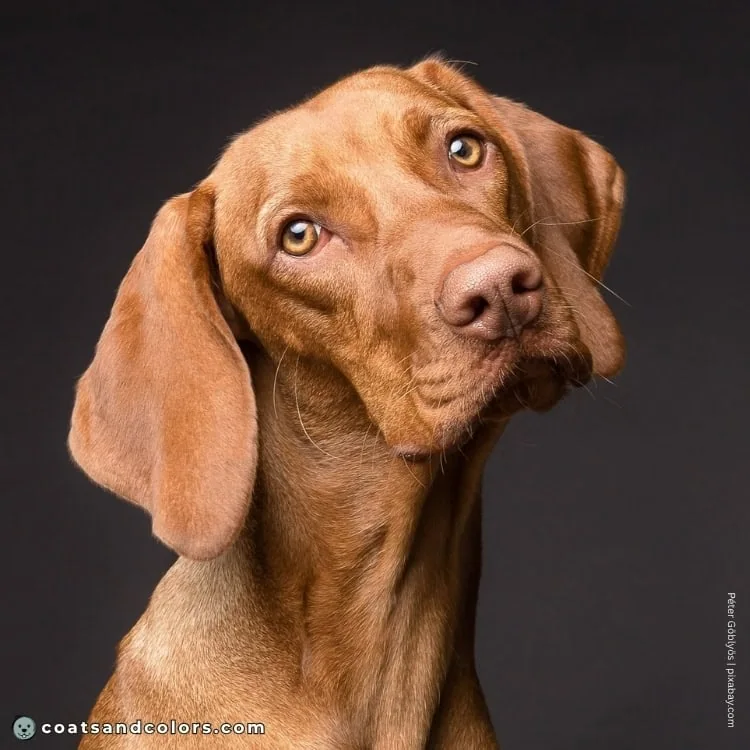
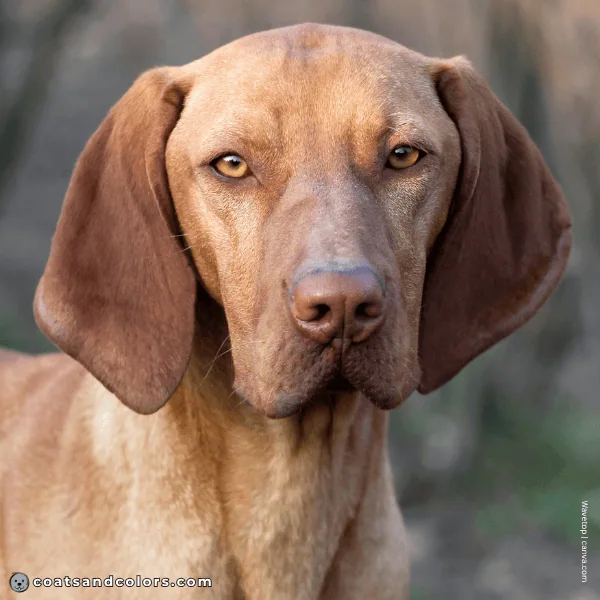
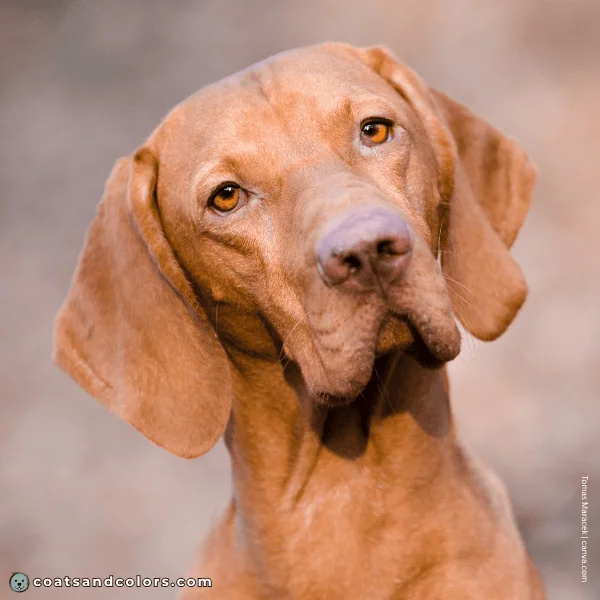
“Color of the iris should blend with the color of the coat. Yellow or any other color is faulty.“
AKC Breed Standard[1]
“The brown eye harmonising with the coat colour, as dark as possible preferred.”
“DQ: Light yellow eyes.“
FCI Breed Standard[2]
Vizsla Nose Colors
Many e/e dogs have a faded nose color.
Their puppy nose can still look solid brown. But adult dogs show varying degrees of pigment fading in adults. The AKC defines the nose color as “a brownish red or brownish-pink color“.
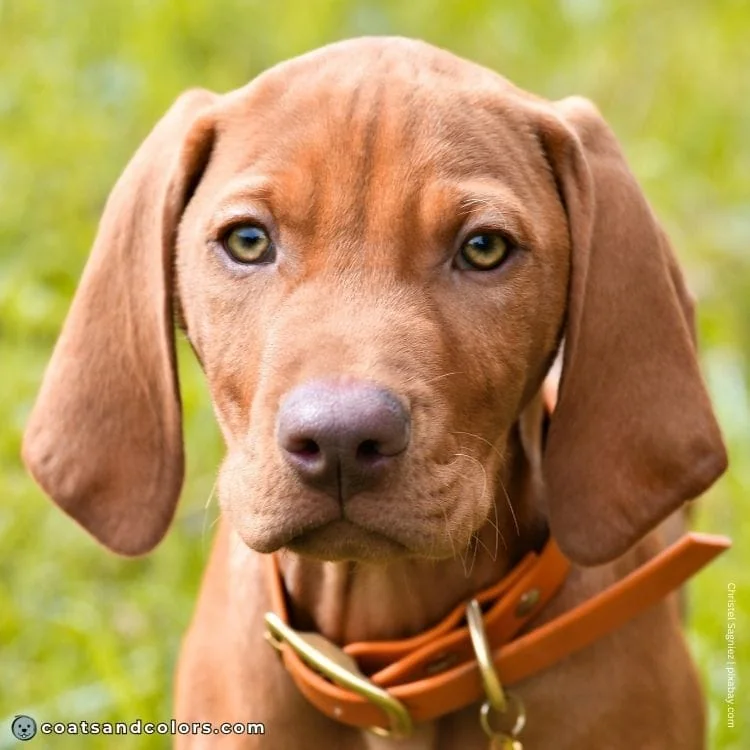
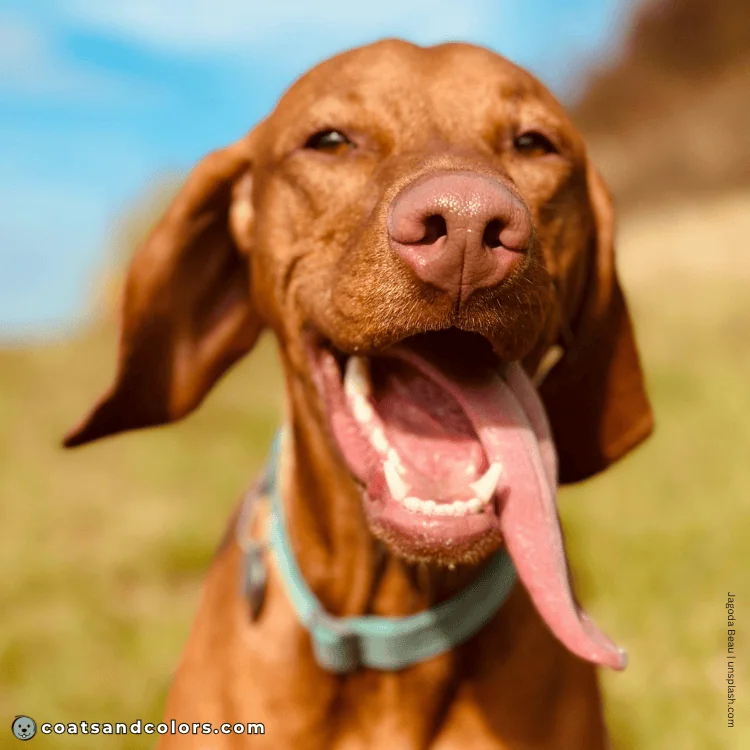
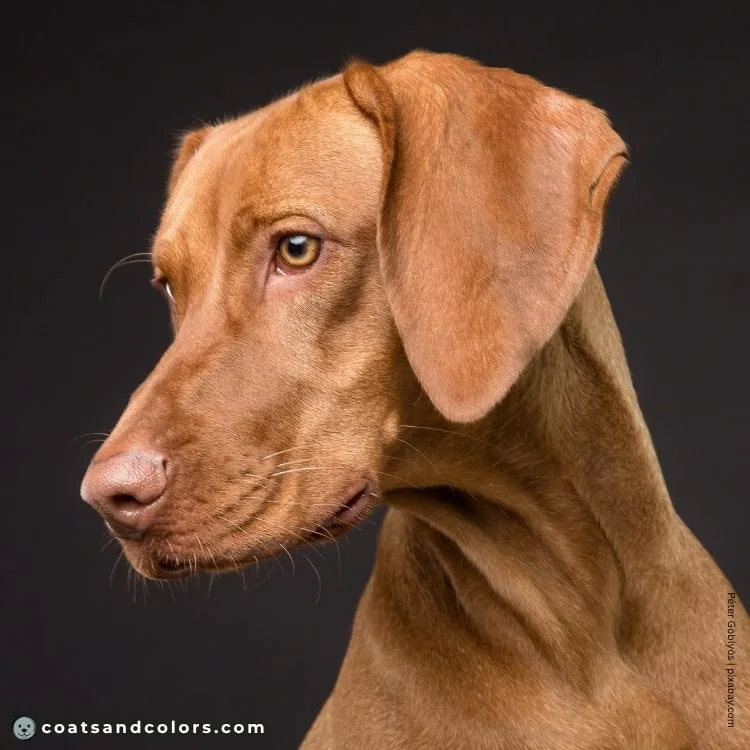
“Nose self-colored. Any other color is faulty. A partially or completely black nose is a disqualification. Freckles due to aging or sun exposure are not to be faulted.“
AKC Breed Standard[1]
“The colour of the nose harmonises in a dark shading with the coat colour.”
“DQ: Spotted (butterfly) nose”
FCI Breed Standard[2]
Vizsla Coat Type
The Vizsla is short-haired without an undercoat.

“Short, smooth, dense and close-lying, without woolly undercoat.“
AKC Breed Standard[1]
“Short and dense, should be coarse and hard at the touch. […] No undercoat.”
FCI Breed Standard[2]
Most Vizlas have two short coat alleles (L/L). However, some long coat carriers (L/l) can produce a long-haired coat in their homozygous recessive puppies (l/l)[4].
“A distinctly long coat is a disqualification.“
AKC Breed Standard[1]
“Disqualifying Faults: […] Atypical coat.”
FCI Breed Standard[2]
Related Breeds
Most breed fanciers try to attribute a history stretching back thousands of years to their dogs. The FCI says that modern Vizsla breeding started around 1920 and does not deny that other gundog breeds were used to develop the current type. The Vizsla was also used to create the Wire-Haired Vizsla.


Learn More

Links
[1] American Kennel Club (AKC): Vizsla
[2] Fédération Cynologique Internationale (FCI): Hungarian Short-Haired Pointer
[3] Royal Kennel Club (RKC): Hungarian Vizsla
[4] Canadian Kennel Club (CKC): Smooth Vizsla
[5] Dreger et al. (2019). True Colors: Commercially-acquired morphological genotypes reveal hidden allele variation among dog breeds, informing both trait ancestry and breed potential. PLoS ONE 14(10): e0223995. https://doi.org/10.1371/journal.pone.0223995
[6] Vizsla Club of America: Vizsla Illustrated Standard
Image Credits
Andreas Schnabl/pexels.com
Anna Pozzi/canva.com
Barna Tanko/canva.com
belterz/canva.com
Christel Sagniez/pixabay.com
Drago_Nika/depositphotos.com
Eirik Raudi/pixabay.com
gabesdotphotos/pexels.com
Jagoda Beau/unsplash.com
Jamie_Hall/canva.com
Jozef Fehér/pexels.com
Kurt Pas/canva.com
Laura Fay/canva.com
LexiTheMonster/canva.com
MartinFredy/canva.com
maxsol/yayimages.com
Moritz Dammann/pixabay.com
nevarpp/canva.com
Péter Göblyös/pixabay.com
Rebecca Scholz/pixabay.com
stokkete/yayimages.com
Tomas Maracek/canva.com
vauvau/canva.com
Wavetop/canva.com
Wirestock/canva.com
Hi! I’m Steffi. I am a biologist and a big time dog nerd. You are curious about coat color genetics? You’ve come to the right place! Read more.