

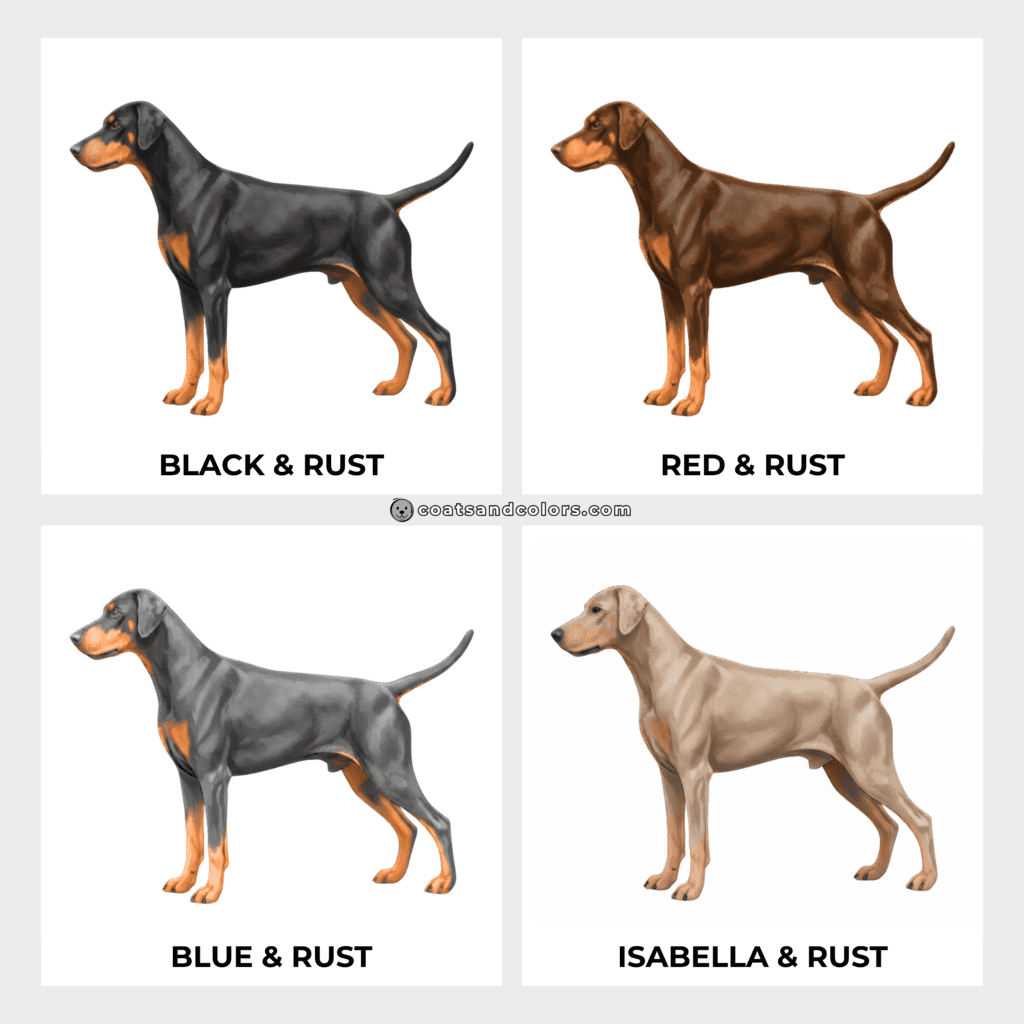
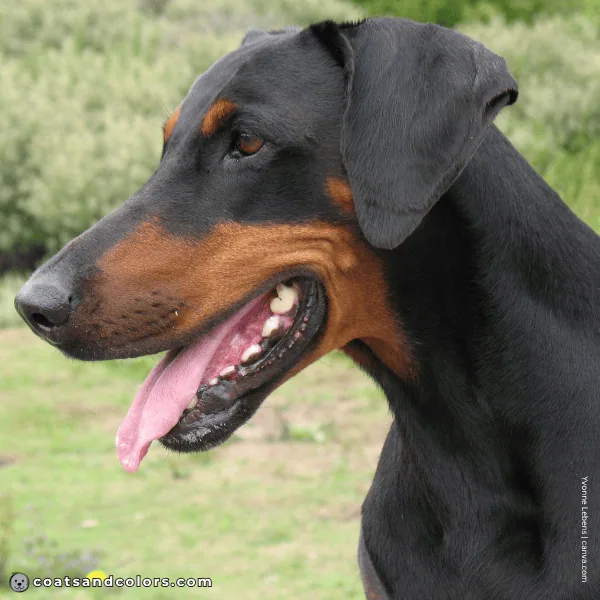
The Doberman is a working dog from Germany. Its sleek coat can be black or brown, both with rust markings. Some clubs also accept the diluted colors blue and fawn, also with rust markings.
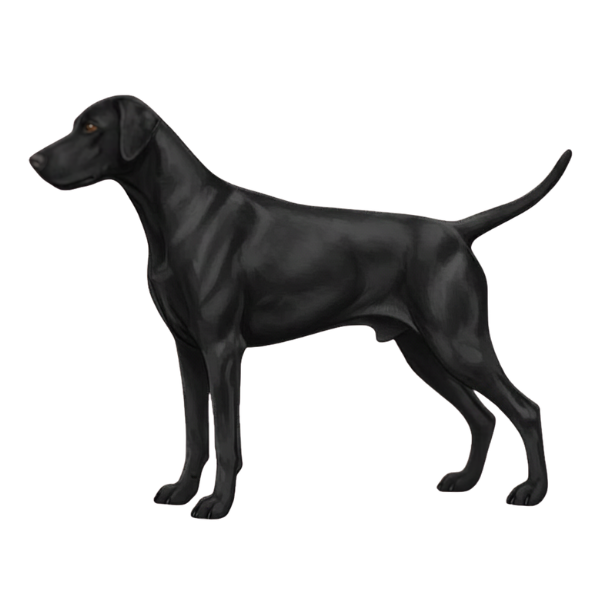
Black & Rust
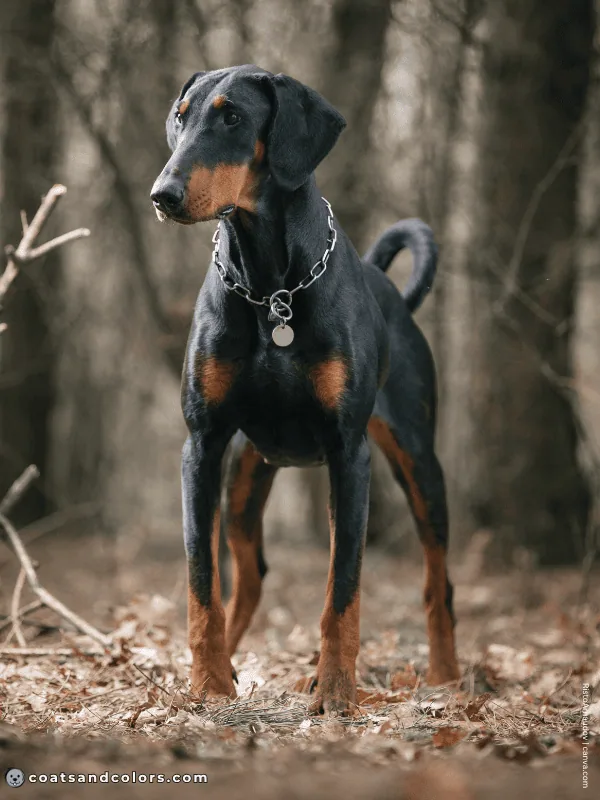
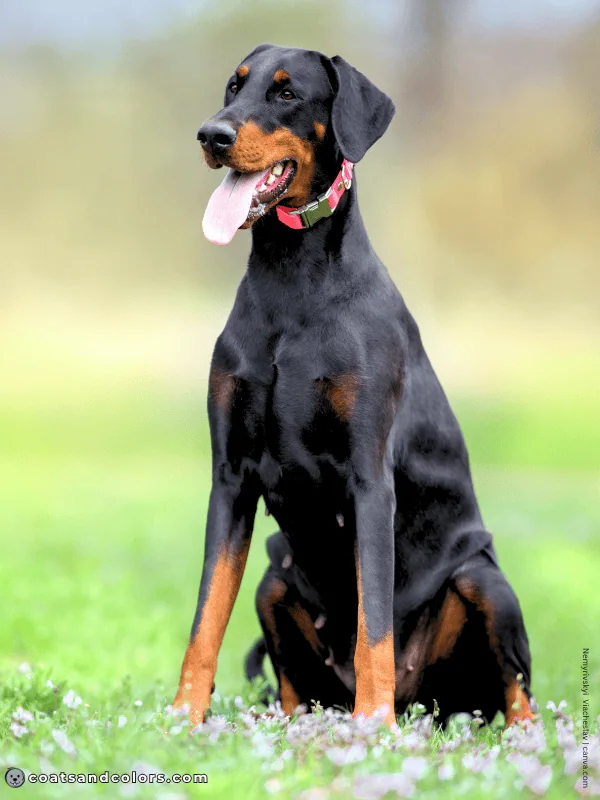
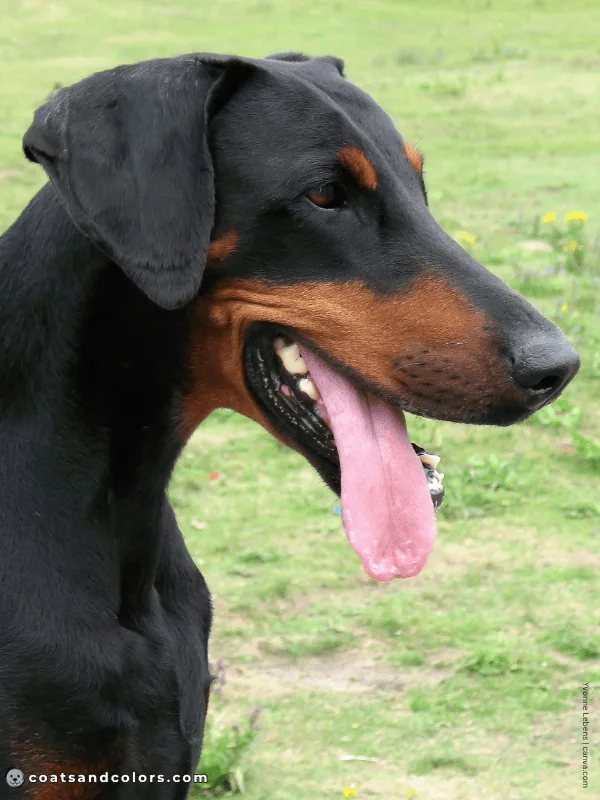
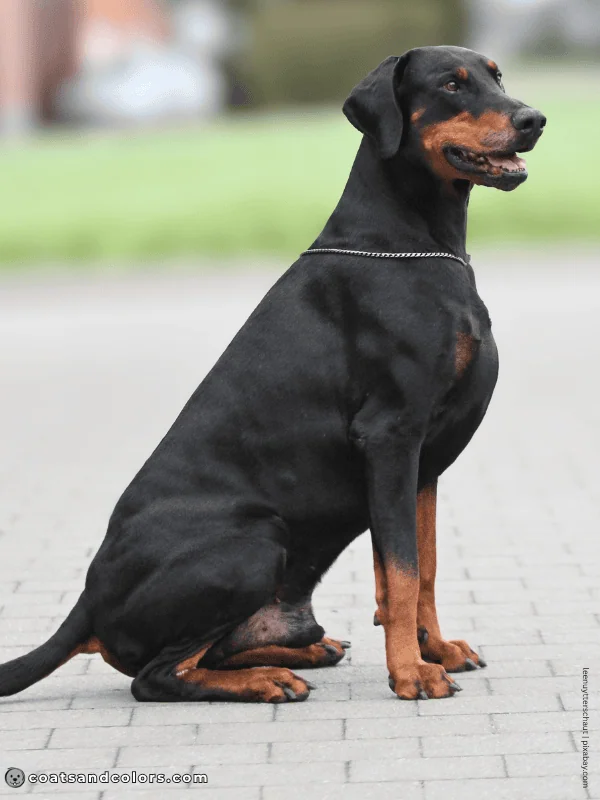
A black and rust Doberman has a black-based tan point pattern.
The “rust markings” are normal tan markings, just with a high red intensity.
BASE PATTERN
tan point
MERLE
–
OTHER
–
EUMELANIN
black
INTENSITY
rust
WHITE
solid
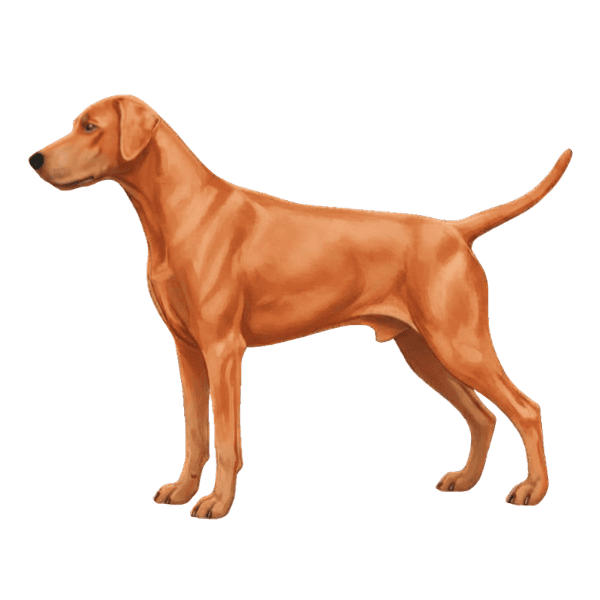
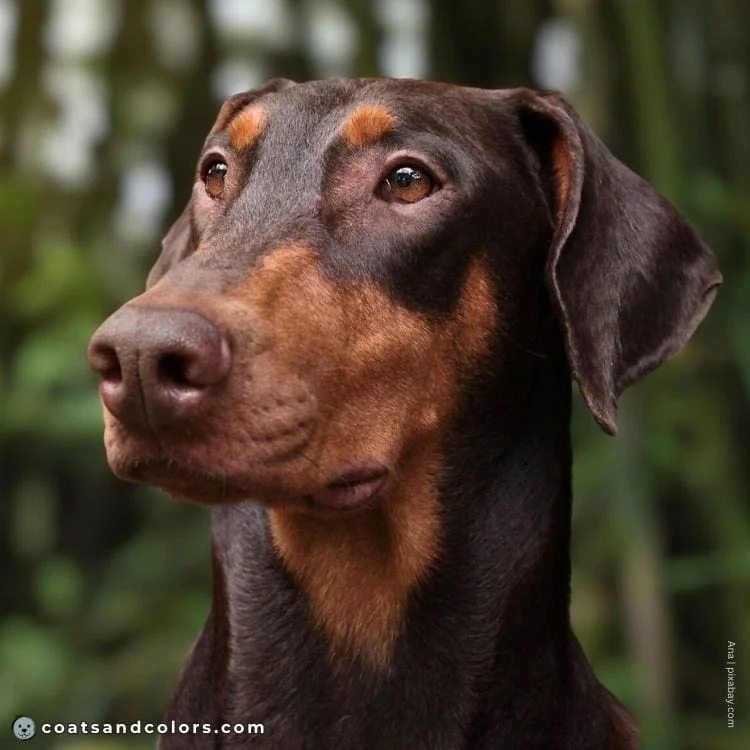
Red & Rust
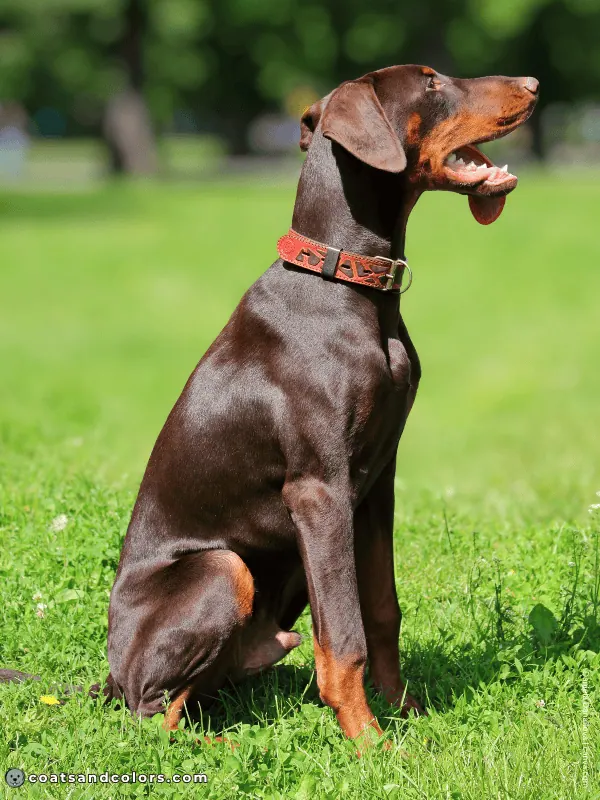
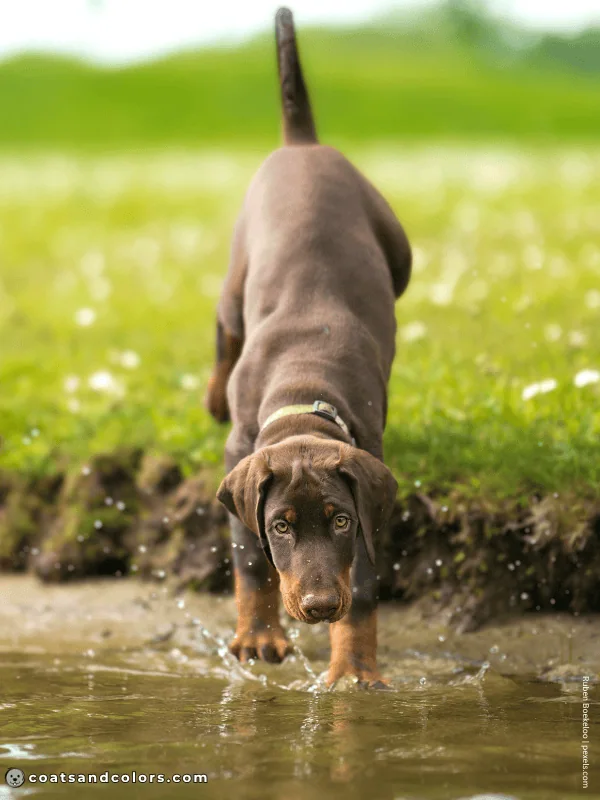
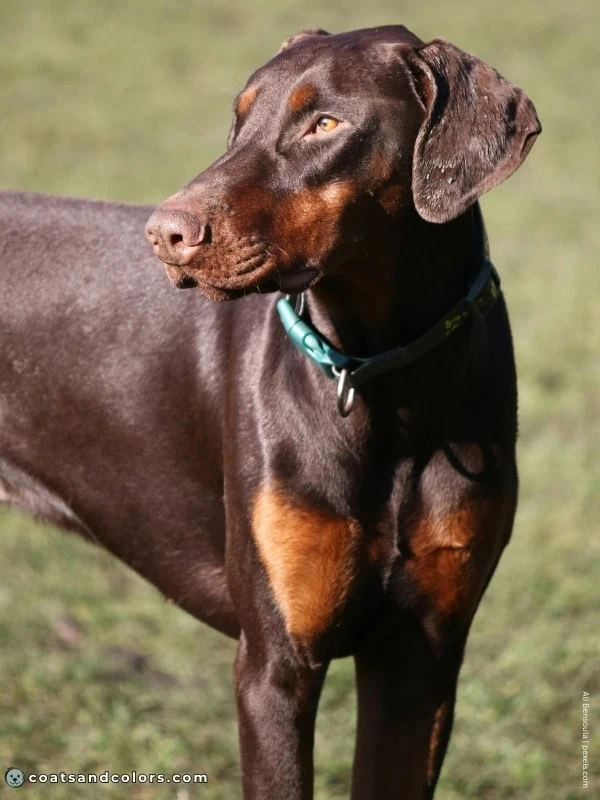
A red and rust Doberman has a brown-based tan point pattern.
This is one of the breeds that uses “red” as a breed term for brown pigment. Other breeds would call the same pattern brown & tan, chocolate & tan, or liver & tan.
BASE PATTERN
tan point
MERLE
–
OTHER
–
EUMELANIN
brown
INTENSITY
rust
WHITE
solid
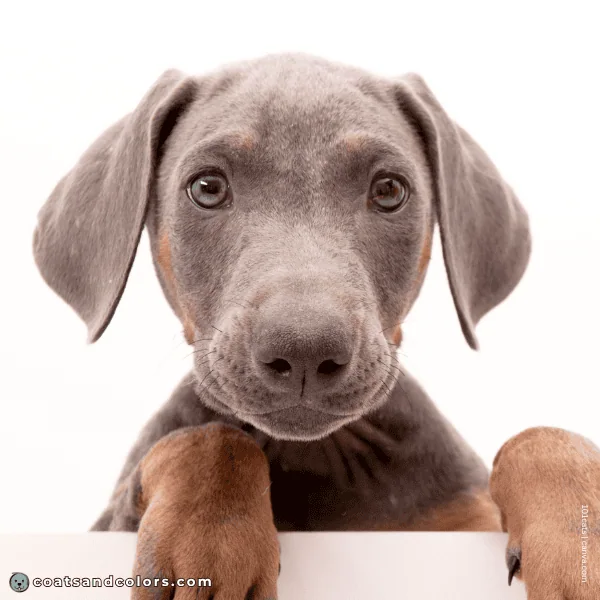
Blue & Rust
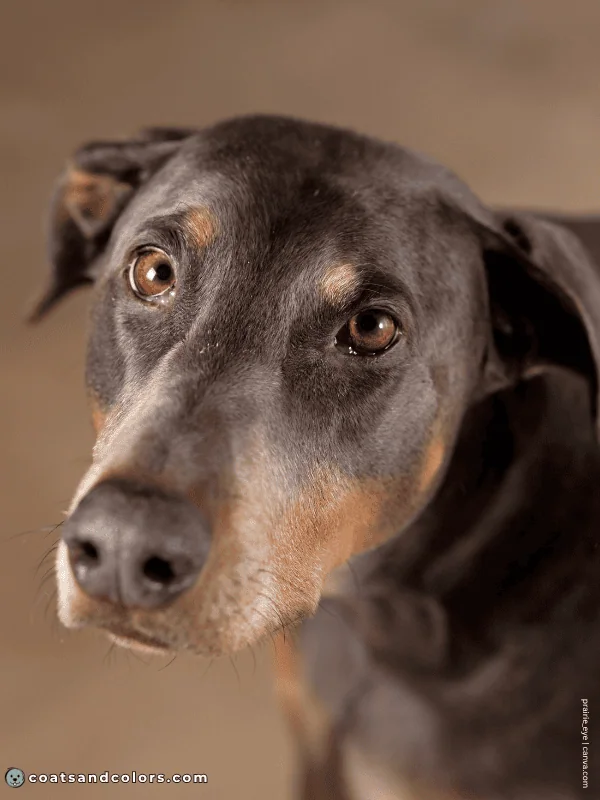
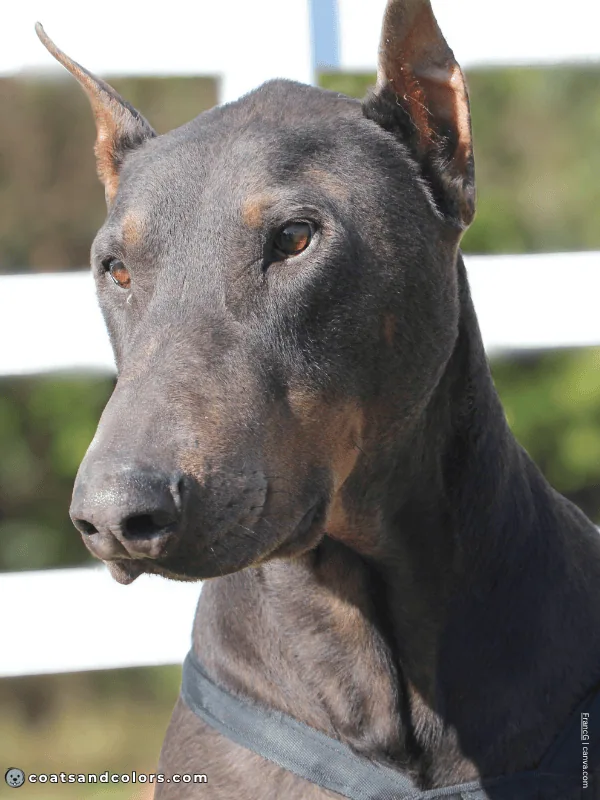
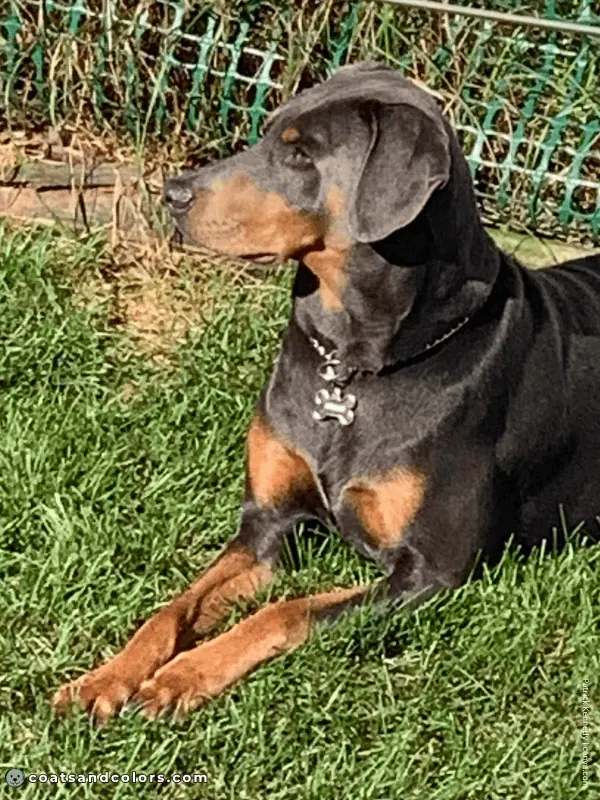
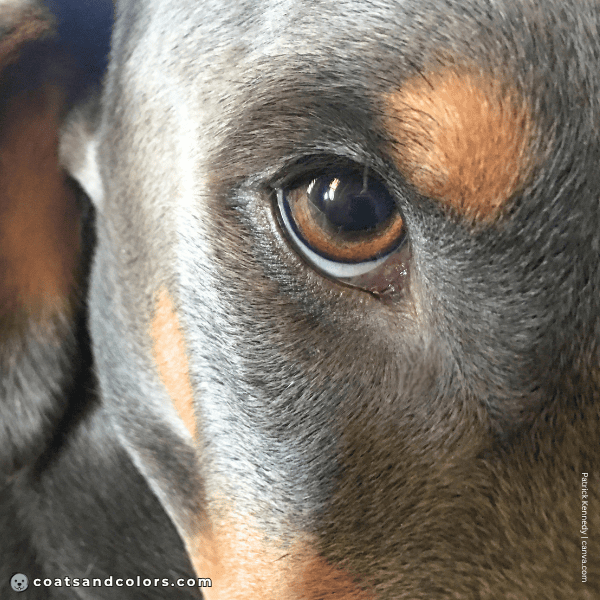
A blue and rust Doberman has a blue-based tan point pattern.
This is a black and tan dog with color dilution. They have a gray nose and lighter eyes. Dobermans with diluted black are also predisposed to have color dilution alopecia.
BASE PATTERN
tan point
MERLE
–
OTHER
–
EUMELANIN
diluted black
INTENSITY
rust
WHITE
solid
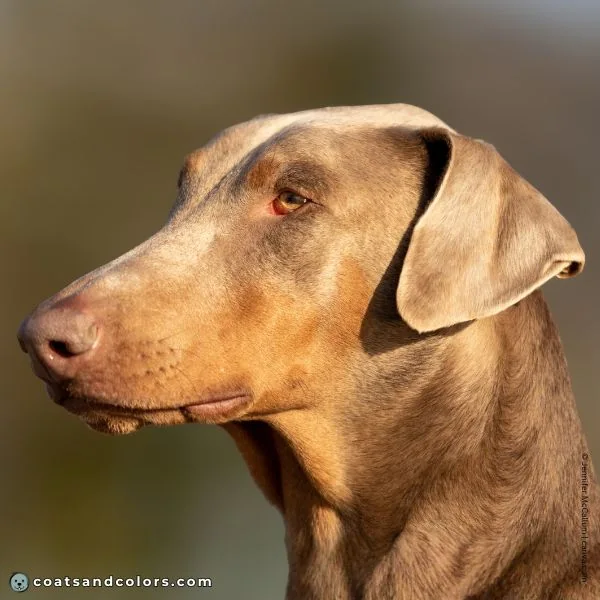
Isabella & Rust
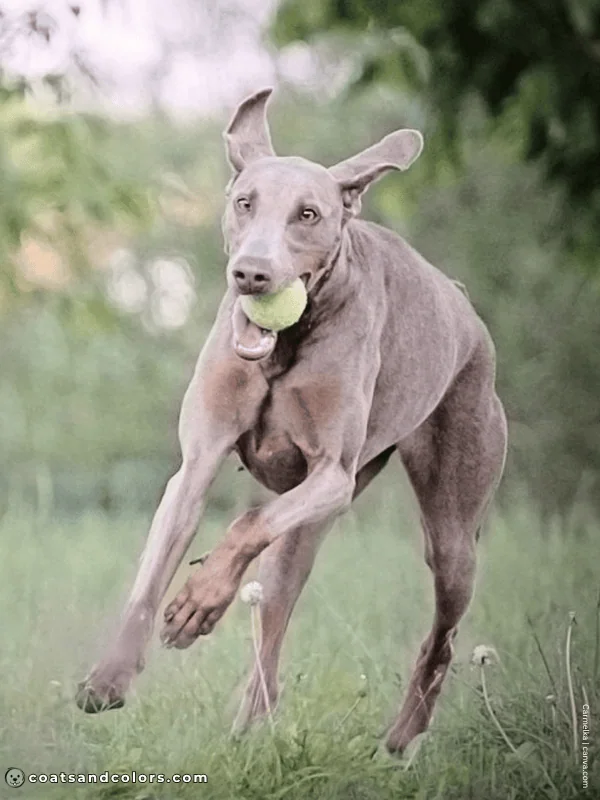
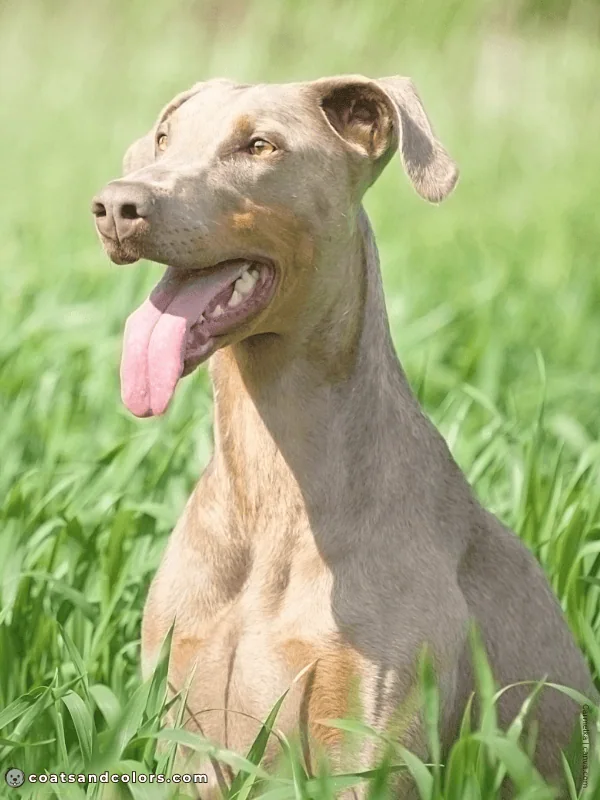
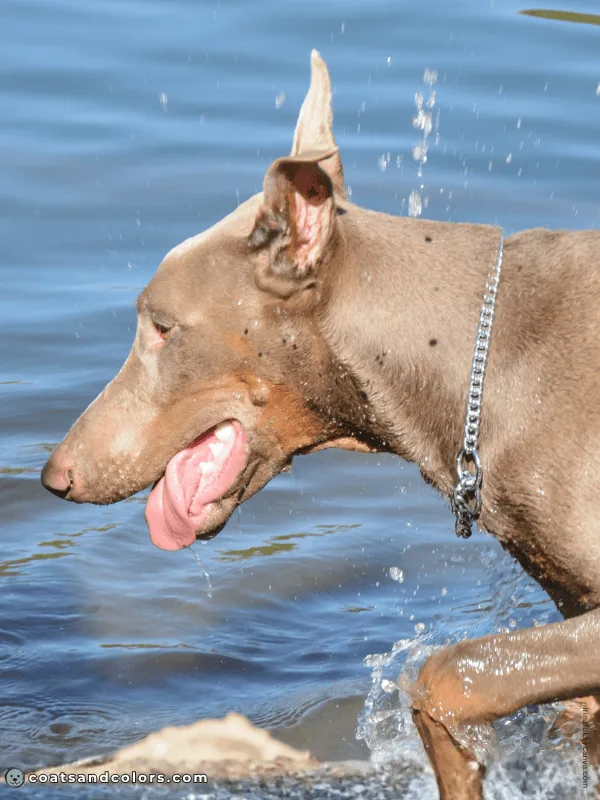
An isabella and rust Doberman has a lilac-based tan point pattern.
This is a brown and tan dog with color dilution. They have a taupe nose and amber eyes. Dobermans with diluted brown are also predisposed to have color dilution alopecia.
The Doberman breed also uses “fawn” as a breed term for diluted brown. So you might stumble about “fawn & rust” for this Dobie color. Keep in mind that most breeds (Boxer, Borzoi, Chihuahua, etc.) use “fawn” for a solid tan or yellow dog and not for diluted chocolate colors.
BASE PATTERN
tan point
MERLE
–
OTHER
–
EUMELANIN
diluted brown
INTENSITY
rust
WHITE
solid
Doberman Markings
Doberman tan markings have a reddish rust color.
“Rust, sharply defined, appearing above each eye and on muzzle, throat and forechest, on all legs and feet, and below tail.“
AKC Breed Standard[1]
“[…] clearly defined and clear markings (tan markings). Tan markings are on the muzzle as a spot on the cheeks and the top of the eyebrow; on the throat; two spots on the forechest; on the metacarpus, metatarsus and feet; on the inner side of the hind thigh; on the forearms and under the tail.“
FCI Breed Standard[2]
Their placement is always the same in all dogs with a tan point pattern. However, markings can vary slightly in size. And they can be clear or smutty with more or less defined edges.
“Sharply defined markings are preferable, as they enhance the characteristic look of the Doberman. The markings on the chest should be two small triangles, as opposed to a large unbroken banner.”
“Deviations to the standard include: large splashy markings, light-colored markings, lack of markings, indistinct markings (melanism), markings that bleed into the solid color […].“
Doberman Pinscher Club of America – Illustrated Standard
“Faults: […] smudged markings […], mask too dark; big black spot on the legs, chest markings hardly visible or too large, …”
FCI Breed Standard[2]

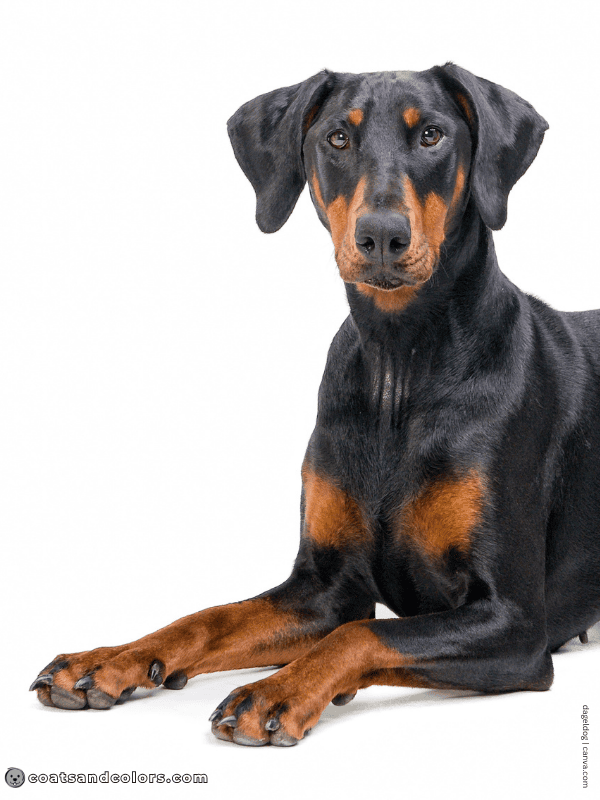
Typical face markings are found on the eyebrows, on the cheeks, and sides of the muzzle (leaving a dark nose bar on top of the muzzle), extending down to the throat. Body markings include two tan triangles on the chest, tan on the inner thighs, lower legs, and paws. And a tan spot under the tail.
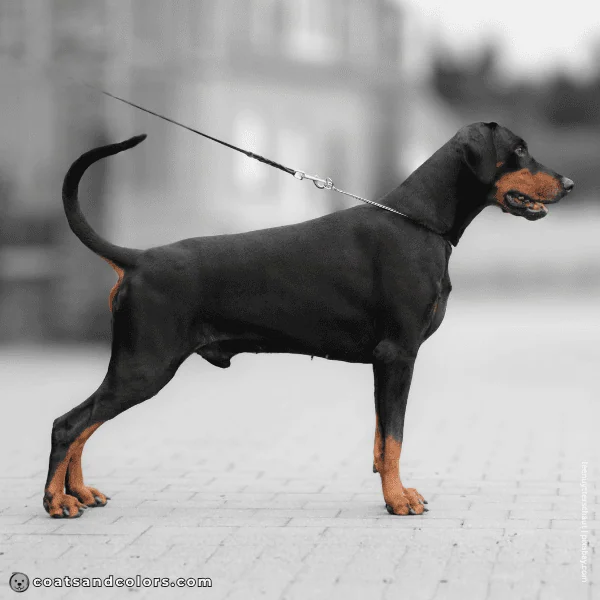
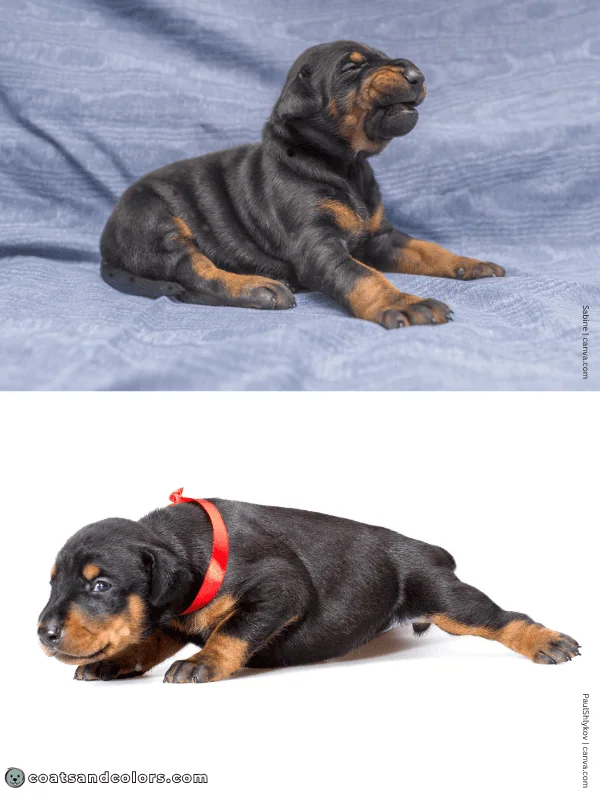
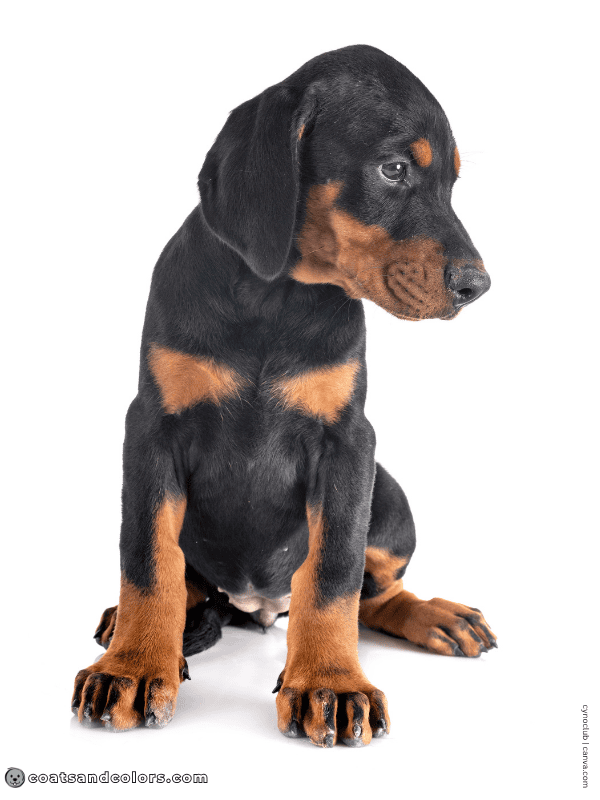
It’s normal for patterned puppies to have a dark overlay. Newborn Doberman puppies can look almost black (or brown, blue, isabella) before the first hints of their tan pigment become visible.
Color Dilution Alopecia
The Doberman Pinscher Club of America admits that “blues and fawns also have a higher incidence of coat and skin problems“. They say that “the hair itself is softer and has a difficult time coming through the follicle and emerging through the skin“. They’re talking about CDA.
Dobies with normal black or brown pigment are not affected.
But it actually is not the diluted color itself that causes health problems.
What happens is that diluted colors predispose a dog to color dilution alopecia. CDA is a skin condition that can only manifest in portions of the coat that grow hairs with diluted eumelanin.
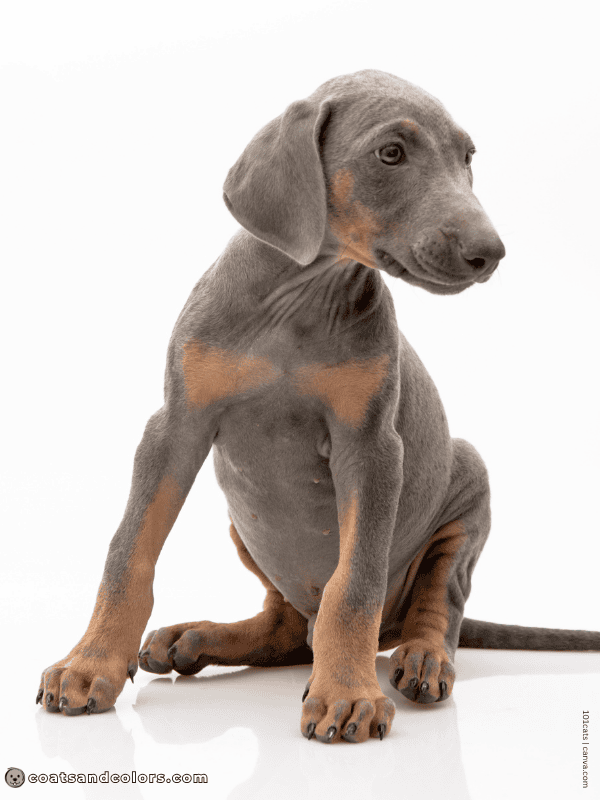
The diluted colors happen when pigment granules clump together. And CDA can then affect these areas and cause anything from mild hair loss to more severe skin problems.
The FCI stopped breeding dilute colors altogether because so many blue and isabella dogs were affected by what they called “Blue Doberman Syndrome“.
Faulty Colors
“Disqualifying Fault – Dogs not of an allowed color.“
AKC Breed Standard[1]
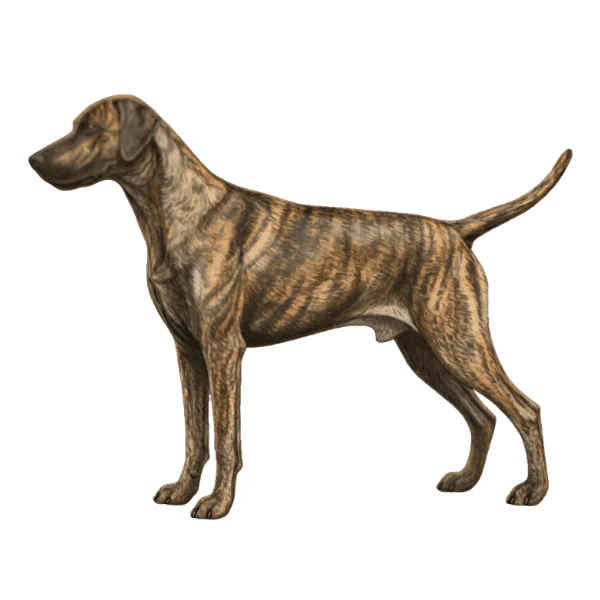
All Dobermans are fixed for a tan point pattern without much wiggle room. Color breeders advertise solid tan and solid black dogs (the latter are sold as “melanistic“). And the Doberman has also been merlified (I saw a post on Facebook, where the byb openly admitted that he crossbred with Catathoulas).
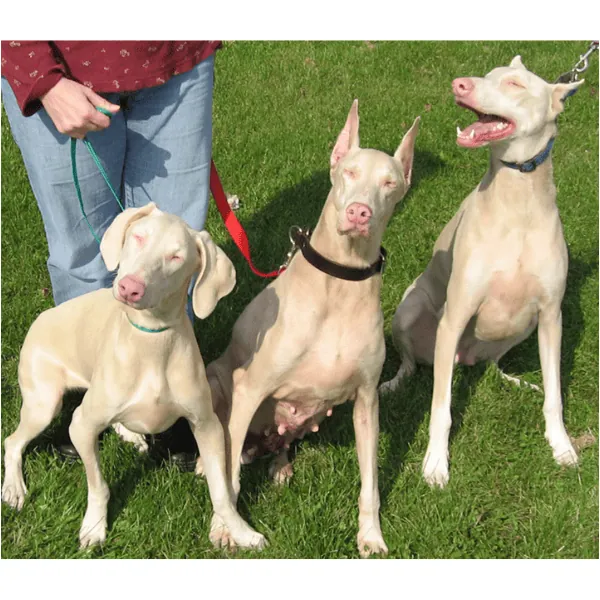
And then there is the case of white Dobermans, all of which can be traced back to the same ancestor with oculocutaneous albinism (OCA4). The birth of Padula’s Queen Sheba in 1976 sparked a white Doberman craze back in the day. Her novelty color quickly gained attention, and so began the extensive line breeding of this dog and her offspring to produce more and more white Dobes.
All purebred albino Dobermans descend directly from Sheba. The major registries have agreed to ban albino as an accepted color. Since 1982, white Dobes can not be shown in AKC conformation events.
“If there is any white ancestry in a Dobermann’s pedigree, any progeny will be registered with (WHITE ANCESTRY) at the end of the selected colour.”
Royal Kennel Club
Color breeders still produce albino Dobes. Dogs appear satin white with very faint blondish patches in place of black or brown. They are light-sensitive and often the product of very poor breeding choices (because greeders tend to forget that health testing and sound temperament are a thing).

Base Patterns
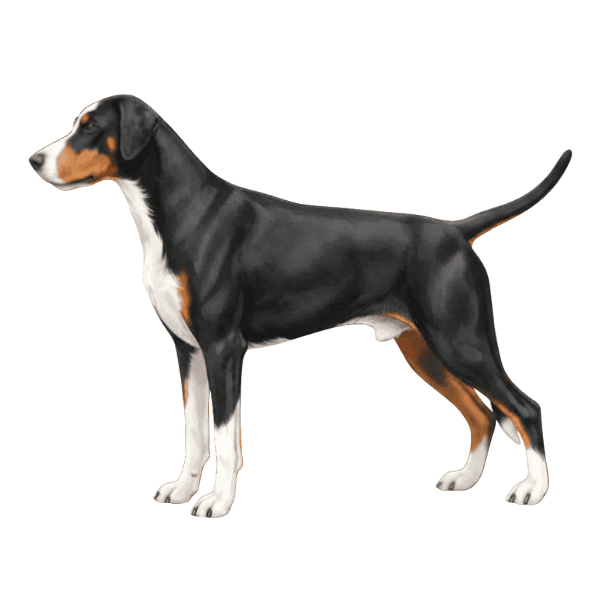
The base pattern describes the placement of phaeomelanin and eumelanin in the coat. There is an epistatic hierarchy between these genes: A locus < K locus < E locus.
- The A locus controls the basic distribution of both pigment types.
- Next, the K locus can add black to the A locus pattern.
- Finally, the E locus regulates the general ability to produce black pigment.
A Locus
| at | tan point |
The whole breed is fixed for tan points (at/at).
Markings can slightly vary in size. Some dogs are very dark with small sooty rust markings to the point where they have no visible chest markings. Many Dobes have toe pencilling.
The Doberman breed selects for solid black hair in the black areas. But it’s normal for dogs with this pattern to have tan hair roots. And this sometimes crops up in purebred Dobes, too.
K Locus
| ky | wild-type |
All purebred Dobies have normal pattern expression (ky/ky).
Some of the solid black “melanistic Dobermans” you can buy on the internet have ghost tan points. So breeders seem to have introduced dominant black (KB) into their dogs.
E Locus
| Em | black mask |
| E | wild-type |
| e | recessive red |
All Dobes should be fixed for normal pattern expression (E/E).
Some dogs have a dark mask (Em/-), which covers some of the tan on the muzzle and cheeks.
And recessive red (e/e) causes solid tan puppies.
Doberman Base Patterns
Purebred Dobes have exactly one accepted base pattern:
| A LOCUS | K LOCUS | E LOCUS | PATTERN |
|---|---|---|---|
| at/at | ky/ky | E/E | tan point |
Base Colors
The base color is determined by the B locus and D locus.
B Locus
| B | black |
| b | brown |
Dobermans can have black (B/-) or brown (b/b) pigment.
“Red is really reddish brown, and the most desirable shade is the rich brown with a reddish glow.“
Doberman Pinscher Club of America – Illustrated Standard
D Locus
| D | normal |
| d | diluted |
Dobermans can have normal (D/-) or diluted (d/d) pigment.
The FCI does not accept blue and tan and isabella and tan (anymore). They banned diluted colors a while ago due to the high rate of CDA (or “Blue Doberman Syndrome“) in these dogs.
“Fawn (also referred to as Isabella, a dilution of red) is a silvery beige color.“
Doberman Pinscher Club of America – Illustrated Standard
“Blue (a dilution of black) is a bluish gray color. It is actually a medium-to-dark shade of gray and ideally has a definitely bluish cast.“
Doberman Pinscher Club of America – Illustrated Standard
Red Intensity
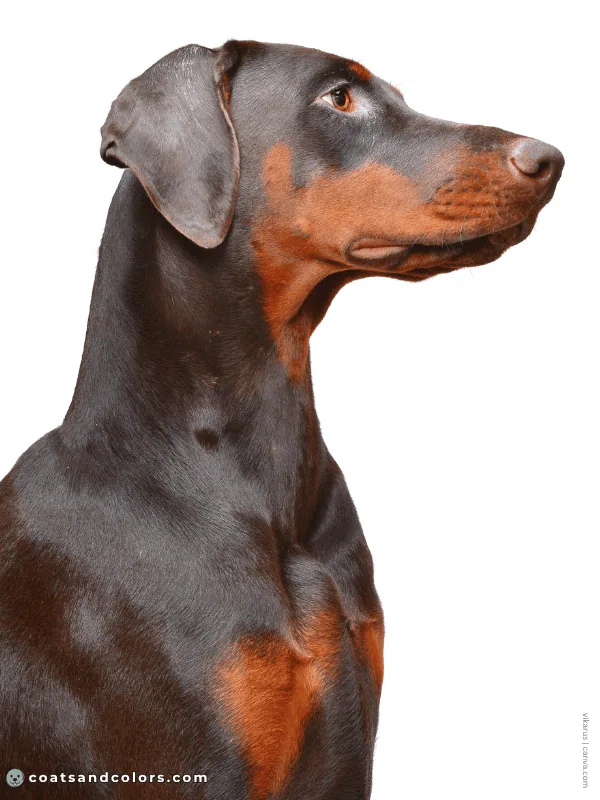
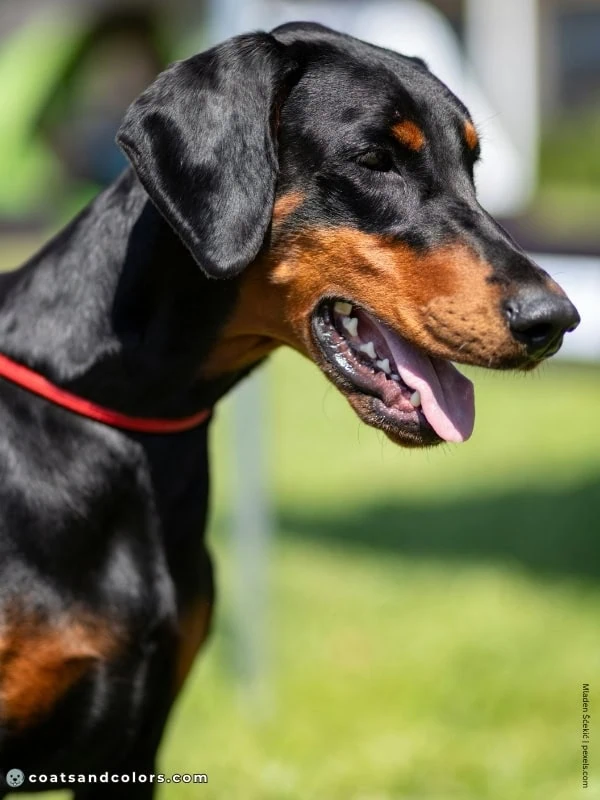
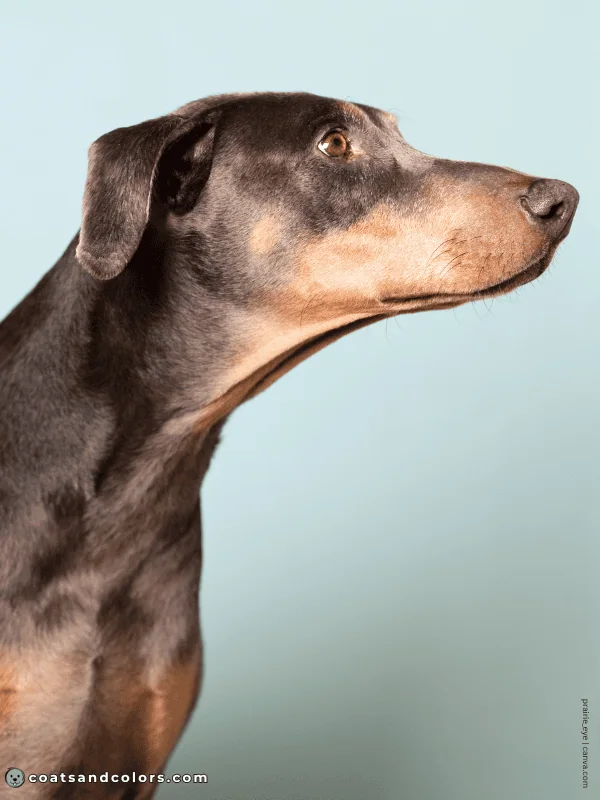
Dobermans call the red color in their tan markings “rust“. The color can be a reddish orange. But lighter yellow markings are not desired. Dilution typically should not affect the red pigment (phaeomelanin). However, quite some dogs with blue (or isabella) colors also show paler than expected tan markings.
“The desired color of markings is a deep rust-red but it may be somewhat lighter or darker.“
Doberman Pinscher Club – Illustrated Standard
White Markings
The FCI and RKC do not tolerate white markings.
The AKC says a very small white chest patch is ok.
There are some Dobes that test positive for a piebald variant (sP) while having no actual white. This is because the test for white spotting is a linkage test and not entirely accurate across breeds.
The minimal white in Dobermans is likely caused by residual white.
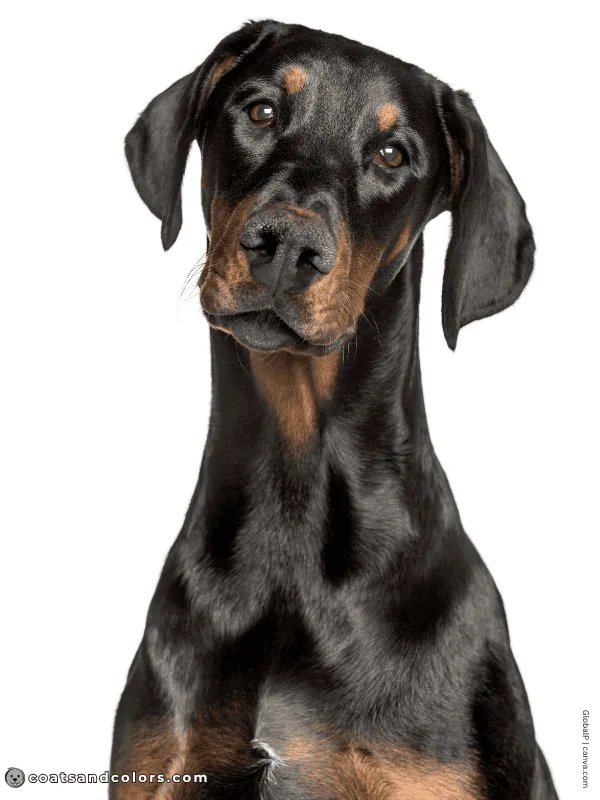
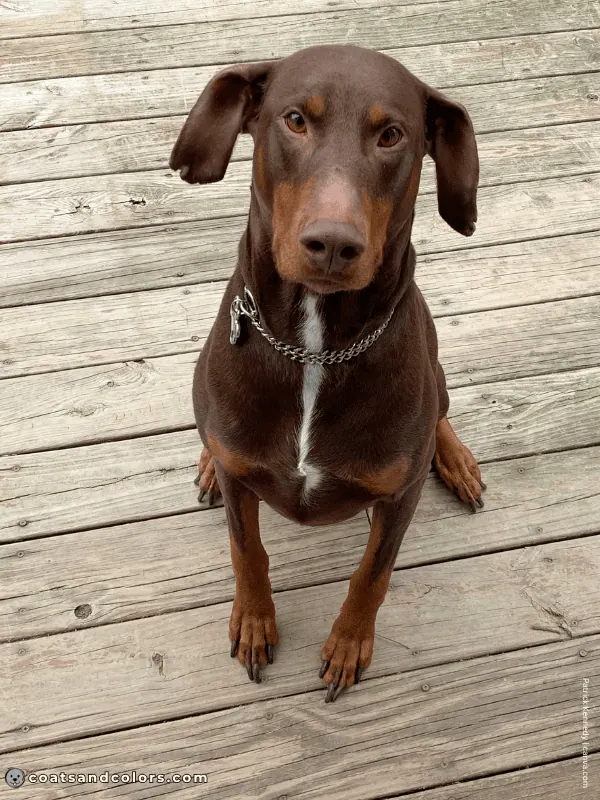
“White patch on chest, not exceeding ½ square inch, permissible.“
AKC Breed Standard[1]
“Deviations to the standard include: […] white chest patches larger than 1/2-inch square or white elsewhere on the dog.“
Doberman Pinscher Club – Illustrated Standard
“Disqualifying Faults: […] White spots.“
FCI Breed Standard[2]
Doberman Eye Colors
Doberman folks have a preference for brown eyes.
However, pigment color and the amount of pigment in the iris cause a range of possible eye colors. Overall, dogs with lighter pigment tend to have lighter eyes.
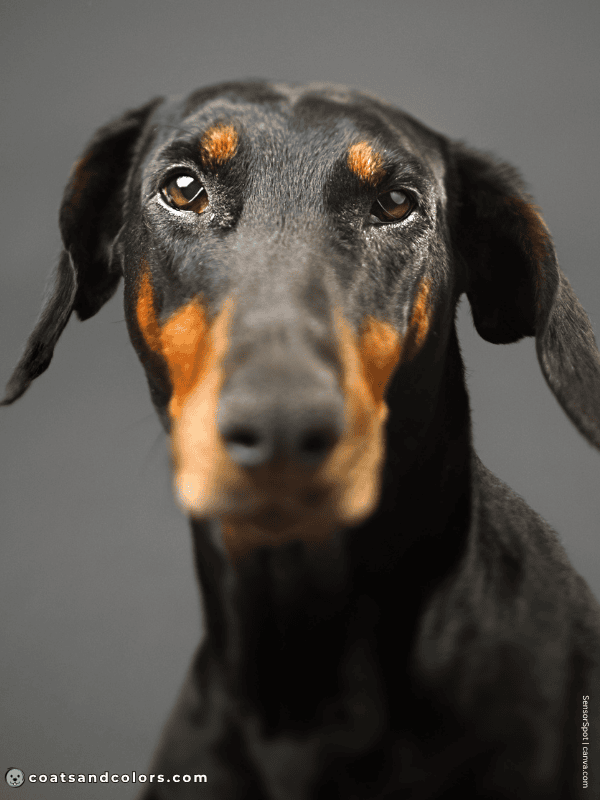
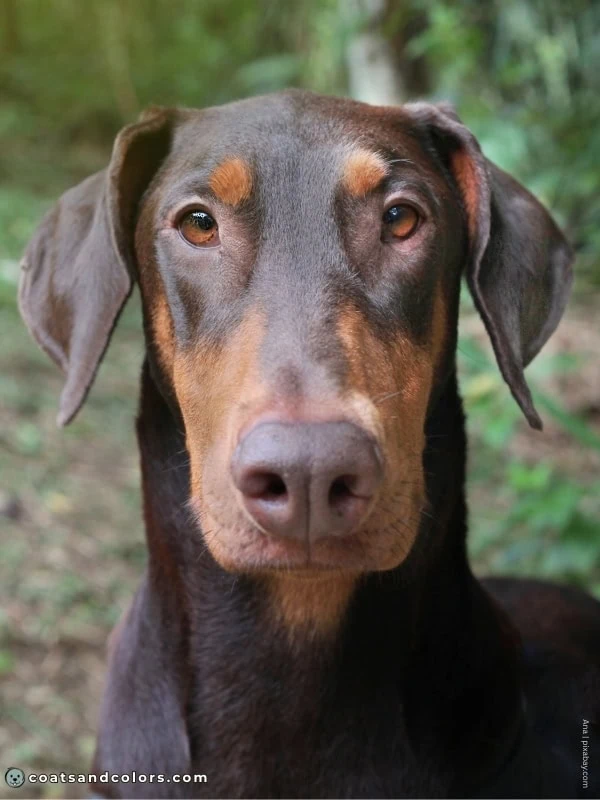
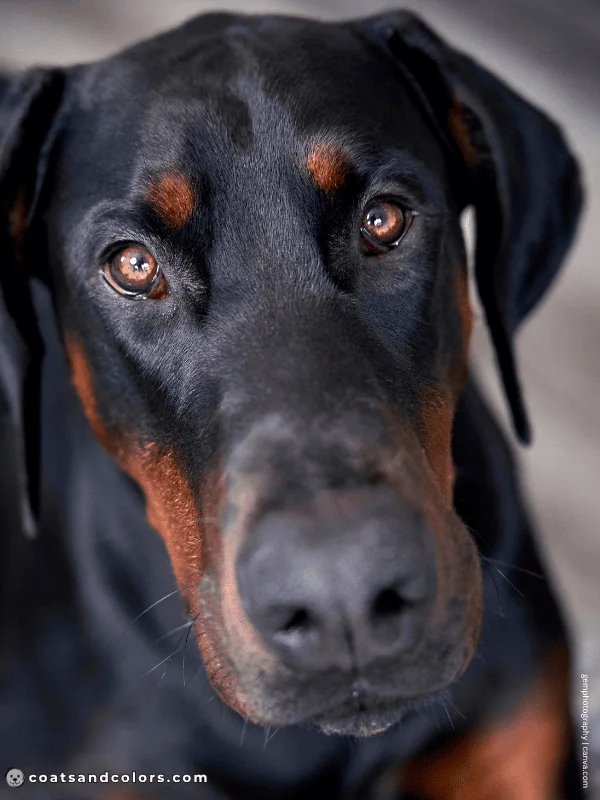
This is especially pronounced in puppy eye colors. Puppies with brown or diluted pigment often show very pale greenish or light yellow colors. It can take months for their eyes to darken.
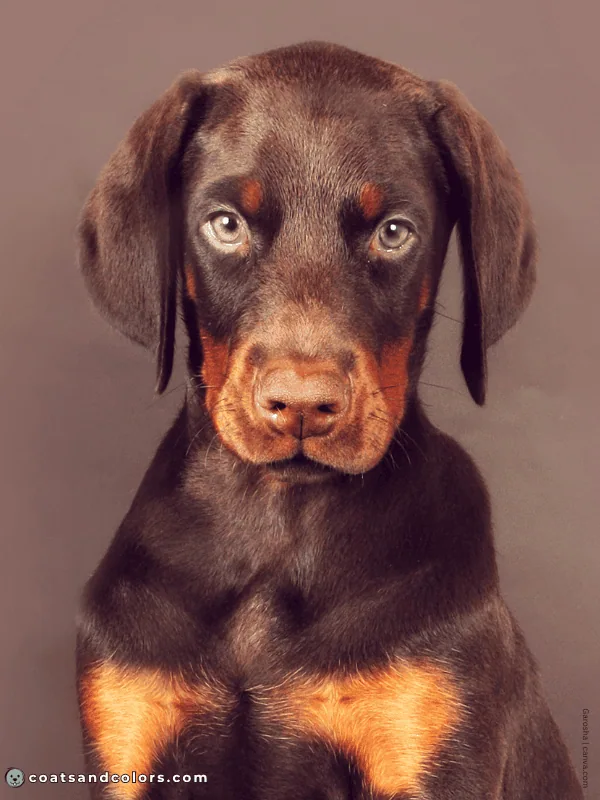
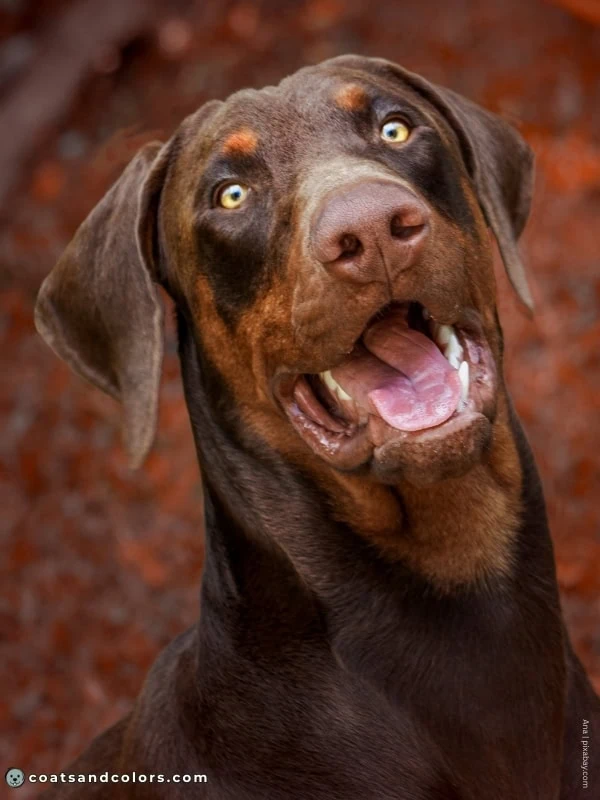
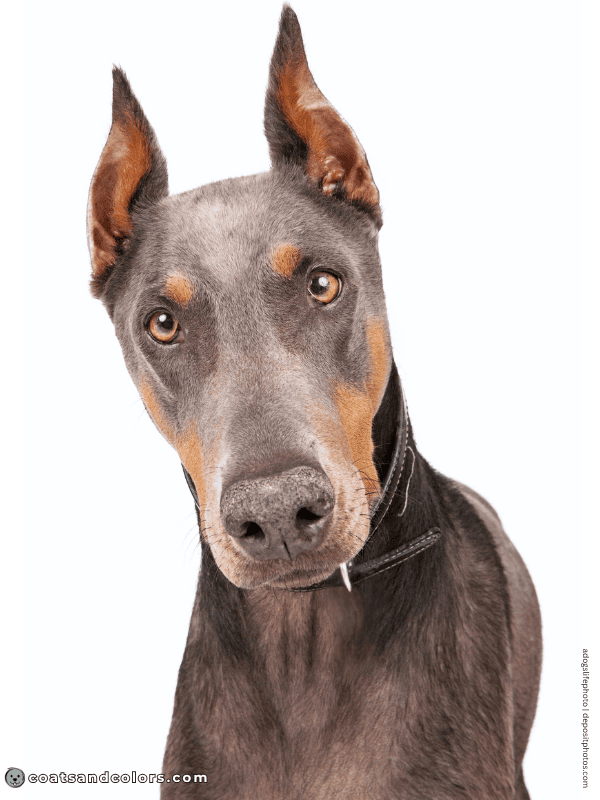
“Iris, of uniform color, ranging from medium to darkest brown in black dogs; in reds, blues, and fawns the color of the iris blends with that of the markings, the darkest shade being preferable in every case.“
AKC Breed Standard[1]
“Disqualifying Faults: […] Yellow eyes (bird of prey eye); different coloured eyes.“
FCI Breed Standard[2]
Doberman Nose Colors
Dogs with black pigment have a black nose, dogs with brown pigment have a brown nose.
Dobermans with diluted black will have a gray nose. And fawn Dobermans have a taupe-colored nose.
Some black and tan dogs can have weak nose pigment.

“Nose solid black on black dogs, dark brown on red ones, dark gray on blue ones, dark tan on fawns.“
AKC Breed Standard[1]
“Black – in black dogs; in brown dogs, corresponding lighter shades.”
FCI Breed Standard[2]
Doberman Coat Type
Dobies are short-haired with a glossy layer of guard hairs.
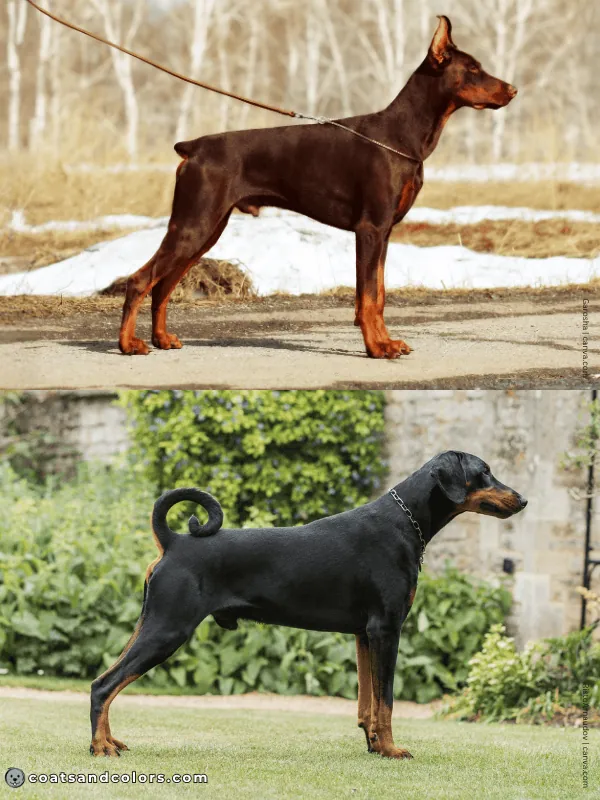
“Smooth-haired, short, hard, thick and close lying. Invisible gray undercoat on neck permissible.”
AKC Breed Standard[1]
“The hair is short, hard and dense. It lies tight and smooth and is equally distributed over the whole surface. Undercoat is not allowed.”
FCI Breed Standard[2]
The blue and fawn Dobes can suffer from color dilution alopecia. And Dobes of any color can have a very thin coat on their chest and throat (this kind of pattern baldness affects some breeds).
“Deviations to the standard include: Thin sparse coat […]“
AKC Breed Standard[1]
“Faults: […] hair long, soft, curly or dull. Thin coat; bald patches.“
FCI Breed Standard[2]
Related Breeds#
The Dobermann was originally developed as a protection dog in the 1880s by Karl Friedrich Louis Dobermann from a population of various unknown foundation dogs of mixed heritage.
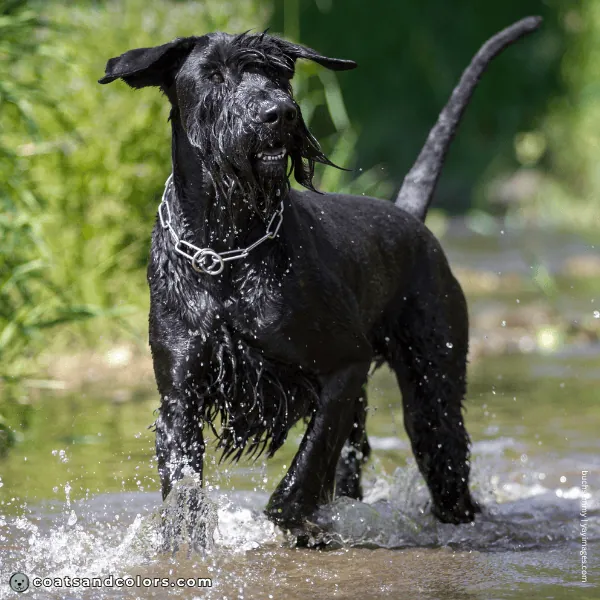
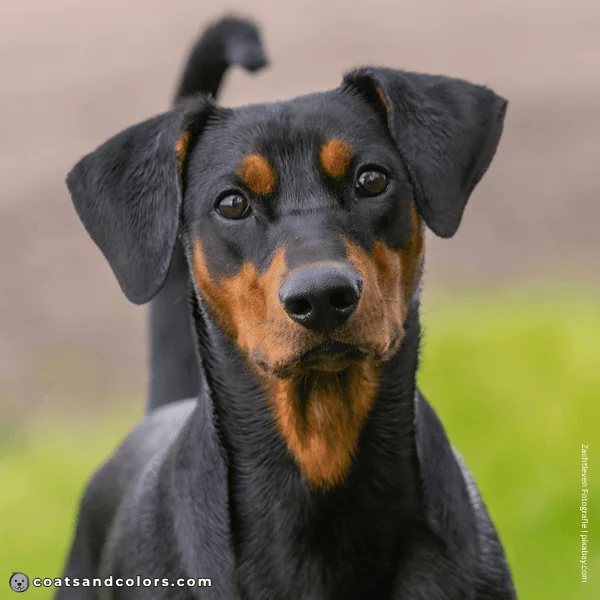
You can bet that there was some influx of similar German working dogs in the early days of the Doberman. While not sharing a direct bloodline, Dobes might be distantly related to Giant Schnauzers, Rottweilers, old types of German Shepherds, and German Pinschers.
The Doberman Pinscher Club of America also mentions Weimaraners (likely to explain from where these dogs got color dilution), Manchester Terriers, and black Greyhounds.

Learn More


Links
[1] American Kennel Club (AKC): Doberman Pinscher
[2] Fédération Cynologique Internationale (FCI): Dobermann
[3] Royal Kennel Club (RKC): Dobermann
[4] Canadian Kennel Club (CKC): Doberman Pinscher
[5] Dreger et al. (2019). True Colors: Commercially-acquired morphological genotypes reveal hidden allele variation among dog breeds, informing both trait ancestry and breed potential. PLoS ONE 14(10): e0223995. https://doi.org/10.1371/journal.pone.0223995
[6] Doberman Pinscher Club of America – Illustrated AKC Standard
[7] The Doberman Diversity Project
[8] Winkler et al. (2014): A Partial Gene Deletion of SLC45A2 Causes Oculocutaneous Albinism in Doberman Pinscher Dogs. PLoS ONE 9(3). https://doi.org/10.1371/journal.pone.0092127
[9] Philipp et al. (2005): Polymorphisms within the canine MLPH gene are associated with dilute coat color in dogs. BMC Genet 6. https://doi.org/10.1186/1471-2156-6-34
Image Credits
101cats/canva.com
adogslifephoto/depositphotos.com
ahavelaar/canva.com
Ali Bensoula/pexels.com
Ana/pixabay.com
buchsammy/yayimages.com
Carmelka/canva.com
cynoclub/canva.com
Daniela Danailova/canva.com
FrancG/ccanva.com
Garosha/canva.com
gemphotography/canva.com
GlobalP/canva.com
irinafuks/canva.com
Jennifer McCallum/canva.com
julieheath5/pixabay.com
leenuytterschaut/pixabay.com
Mladen Šćekić/pexels.com
Patrick Kennedy/canva.com
PaulShlykov/canva.com
prairie_eye/canva.com
RistoArnaudov/anva.com
RistoArnaudov/canva.com
Ruben Boekeloo/pexels.com
Sabine/canva.com
SensorSpot/canva.com
vikarus/canva.com
Yama Zsuzsanna Márkus/pixabay.com
Yvonne Lebens/canva.com
Zachtleven Fotografie/pixabay.com
Нина Игнатенко/pixabay.com
Hi! I’m Steffi. I am a biologist and a big time dog nerd. You are curious about coat color genetics? You’ve come to the right place! Read more.
1 thought on “Doberman Colors”
Comments are closed.