
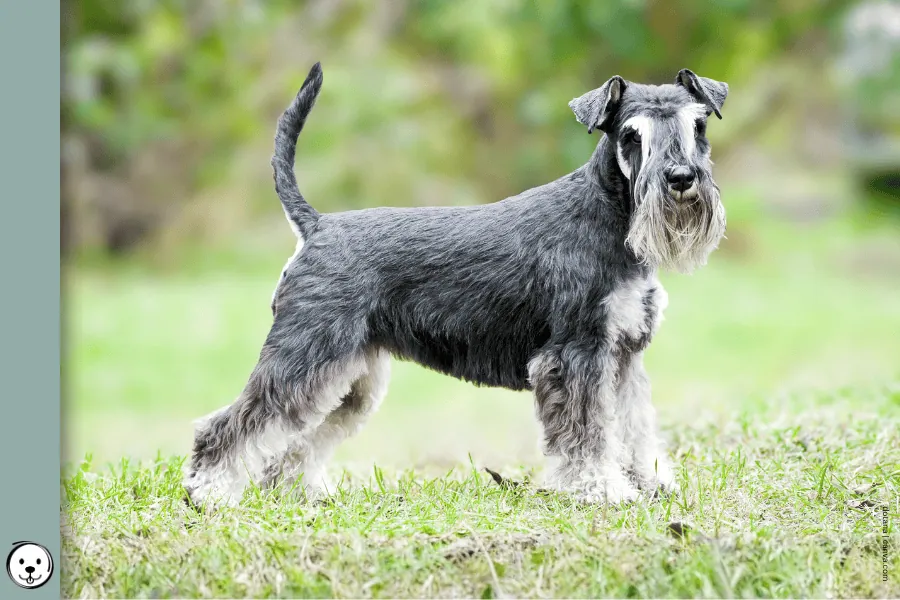
The Miniature Schnauzer is a spunky companion dog from Germany. The standard colors include salt‑and‑pepper, black, and black and silver. The FCI also accepts solid white dogs.
Black


Black Miniature Schnauzers are most often dominant black (KB/-). But recessive black (ky/ky a/a) was also found in this breed. Both patterns a solid black coat.
BASE PATTERN
dominant black
recessive black
MERLE
–
OTHER
–
EUMELANIN
black
INTENSITY
–
WHITE
solid
Black & Silver


The breed term for tan points is “black & silver“. These are essentially black-and-tan dogs, only that their tan markings have a very pale whitish color.
It’s normal for dogs with this pattern to grow some light hair roots in their black mantle. But many breeds, like Miniature Schnauzers, select for solid black hairs in the black areas of the pattern.
BASE PATTERN
tan point
MERLE
–
OTHER
–
EUMELANIN
black
INTENSITY
white
WHITE
solid
Salt & Pepper


The breed term “salt & pepper” refers to a black-based agouti pattern with a very light red intensity. The banded dorsal hairs create the illusion of black and white peppering.
The agouti pattern also produces ventral tan markings, which will appear white.
Dogs can have lighter or darker agouti patterns (the latter often indictaes that the dog carries tan points). The FCI says that permitted shades range from “dark iron grey to silver grey“.

BASE PATTERN
agouti
MERLE
–
OTHER
–
EUMELANIN
black
INTENSITY
white
WHITE
solid
White


A white Miniature Schnauzer (only accepted by the FCI) has a recessive red pattern with a super pale red intensity. This makes them appear solid white.
The AKC does not recognize this color. Their breed club states that Standard Schnauzers are never white, so Miniature Schnauzers should not be either. It is their belief that the white color is the result of crossbreeding, possibly with Westies[6].
BASE PATTERN
recessive red
MERLE
–
OTHER
–
EUMELANIN
black
INTENSITY
white
WHITE
solid
Faulty Colors
Miniature Schnauzers are popular pet dogs. There are a bunch of traits that have been introduced by color breeders. Pet Schnauzers have been bred for liver-based pattern or parti markings for a while now. Fewer people produce merle and brindle Schanuzers. Crossbreeding with other dogs also introduced more intense reddish pigment colors (replacing the trademark silver colors in purebred Schnauzers with shades of wheaten, tan, or red), pigment fading (“platinum”), and softer coat types.
“White, parti-color, liver, and merle are specifically disqualified and are typically mixed with another breed to achieve those colors.”
The American Miniature Schnauzer Club[6]


Base Patterns
The base pattern describes the placement of phaeomelanin and eumelanin in the coat. There is an epistatic hierarchy between these genes: A locus < K locus < E locus.
- The A locus controls the basic distribution of both pigment types.
- Next, the K locus can add black to the A locus pattern.
- Finally, the E locus regulates the general ability to produce black pigment.
A Locus
| Ay | sable |
| aw | agouti |
| at | tan point |
| a | recessive black |
Most Schnauzers are agouti (salt + pepper) or tan point (black + silver). Dogs with either pattern tend to have a dark overlay in their puppy coat. Dogs with a/a will express recessive black.
There is some incomplete dominance between alleles. For example, aw/at is likely to produce darker agouti than aw/aw. And at/a is more likely to produce small tan points compared to at/at.
Patterned Schnauzers are supposed to have very crisp silver markings with clearly separated light triangles on the chest.


The sable allele (Ay) is present mainly in some dominant black dogs, since KB hides the presence of Ay. Dogs that express sable will have a mainly tan coat with some sabling on their upper body.
Here is a link to an article about sable Schnauzers in the German breed club magazine.
K Locus
| KB | dominant black |
| kbr | brindle |
| ky | wild-type |
A KB/- dog will be solid black. Only dogs with ky/ky can express their agouti or tan point pattern. The brindle allele kbr has been introduced by color breeders, it did not exist in purebred Schnauzers.

(E/- ky/ky at/at)

(E/- KB/- at/at)
E Locus
| Em | black mask |
| E | wild-type |
| e | recessive red |
Mini Schnauzers can have a black mask (Em/-). My guess is that this mainly concerns solid black dogs, where it simply does not matter if that dog has a mask or not. Most patterned Schnauzers are maskless (E/-). Being e/e produces recessive red, which will appear solid white in this breed.
The FCI breed standard, very unfortunately, uses the term “dark mask” to refer to the dark face markings in salt-pepper and black-and-silver dogs. These markings include dark pigment around the eyes and a dark nose bar with lighter silver markings on the cheeks and over the eyes. A real black mask (like a Boxer or German Shepherd) would cover all of these face markings under a layer of black.

(E/- ky/ky at/at)

(e/e)
Mini Schnauzer Base Patterns
| A LOCUS | K LOCUS | E LOCUS | PATTERN |
|---|---|---|---|
| aw/- | ky/ky | E/- | agouti “salt & pepper” |
| at/at | ky/ky | E/- | tan point “black & silver“ |
| KB/- | E/- | dominant black “black” | |
| e/e | recessive red “white” |
Here are some Miniature Schnauzer color charts:


Base Colors
The base color is determined by the B locus and D locus.

B Locus
| B | black |
| b | brown |
Miniature Schnauzers should have black pigment (B/B).
However, liver brown (b/b) is popular in color breeding.
D Locus
| D | normal |
Miniature Schnauzers are fixed for normal pigment (D/D).
Graying
The progressive graying trait causes the fading of pigment colors over time. This is not present in European Schnauzers, but has been introduced into US breeding.
The whitish tan on these dogs can not lighten any further. But any black pigment will fade to a dark gray or silvery color. For example, salt and pepper with heavy graying is advertised as “platinum silver“.
Graying makes the dog look “less peppered” and gradually blends the formerly black areas with the silver markings. So you get an even shiny gray color with less distinct ventral silver markings.
“As the dogs age and are clippered, blacks and black and silvers may fade from black to dark gray while salt and peppers may fade to a lighter shade of gray.“
American Miniature Schnauzer Club[6]


Red Intensity
The phaeomelanin in Miniature Schnauzers is incredibly light. So pale, in fact, that it looks white or silver. Many adult dogs have some red beard staining (but this is not a pigment color).
“The body coat color in salt and pepper and black and silver dogs fades out to light gray or silver white under the throat and across the chest. Between them there exists a natural body coat color.”
AKC Breed Standard[1]
“Fault: Brown undercoat.”
FCI Breed Standard[2]
Black Schnauzers do not express phaeomelanin, so you can’t control if they produce the desired silver color. This can lead to a surprise puppy that expresses more intense cream, wheaten, tan, or red colors.


Miniature Schnauzer puppies often show hints of tan or gold colors in their coat.


White Markings
Miniature Schnauzers are meant to have a solid coat color.

Their tan markings have a very bright cream color. Sure, this makes them look “white”. But real white markings only happen in areas that don’t have any pigment at all.
Also, only the skin underneath real white is pink. The skin underneath light silver colors will still be dark.
Whoever wrote the FCI breed standard made the poor choice to call for “white markings” in the black and silver variety. What they actually mean are the very light tan points in these dogs, of course.

Any breed of dog can have minor spots of residual white.


But quite many color breeders produce “parti” Miniature Schnauzers with white piebald markings (sP). A lot of missing pigment can also cause blue eyes or pink-spotted nose or eye rims in some dogs.

“A small white spot on the chest is permitted, as is an occasional single white hair elsewhere on the body.”
“All colors have uniform skin pigmentation, i.e. no white or pink skin patches shall appear anywhere on the dog.“
AKC Breed Standard[1]
“Distinct light markings on head, chest and limbs are undesirable.”
FCI Breed Standard[2]
Merle
This is NOT a merle breed! But color breeders in the US have merlified the Miniature Schnauzer to sell what they call “confetti“. Merle did not occur in the Schnauzer population before someone introduced it.
Miniature Schnauzer Eye Colors
Miniature Schnauzers will mostly have dark brown eyes.


If the dog has liver pigment, its eyes might be a lighter honey or amber. And there is also a unique trait (genetics unknown) in color-bred lines that causes blue eyes in dogs that are neither parti nor merle.
“Small, dark brown and deep-set. They are oval in appearance and keen in expression.”
“Faults – Eyes light and/or large and prominent in appearance.”
AKC Breed Standard[1]
“Eyes […] dark with lively expression.”
FCI Breed Standard[2]
Miniature Schnauzer Nose Colors
Dogs that produce black eumelanin have a black nose.


The white Miniature Schnauzers have a recessive red pattern. This is often linked to weak nose pigment, so they may have a faded black nose that can look gray or pinkish.


“The nose must be solid black.”
AKC Breed Standard[1]
“Well developed nose leather, always black.”
FCI Breed Standard[2]
Miniature Schnauzer Coat Type
This is very obviously a bearded breed of dog. They are also wire-haired.

“Double, with hard, wiry, outer coat and close undercoat. The head, neck, ears, chest, tail, and body coat must be plucked. When in show condition, the body coat should be of sufficient length to determine texture. Close covering on neck, ears and skull. Furnishings are fairly thick but not silky.”
AKC Breed Standard[1]
“The coat should be wiry, harsh, and dense. It consists of a dense undercoat and a not too short top coat, lying close to the body. The top coat is rough and sufficiently long to allow the checking of its texture; it is neither bristly nor wavy. The hair on the limbs tends to be less harsh. Coat short on forehead and ears. Typical characteristics are the not too soft beard on the muzzle and the bushy eyebrows which slightly shade the eyes.”
FCI Breed Standard[2]
Schnauzers should be wire-haired with a harsh jacket. But modern Schnauzers are mainly selected for show coat quality with a finer texture and bushier leg furnishings.
Many dogs, including Schnauzers, have longer and darker hackles. This can lead to a “black trace” down the back in freshly groomed dogs. It’s perfectly normal, but a faulty coat for show dogs.
“Faults – Coat too soft or too smooth and slick in appearance.”
AKC Breed Standard[1]
“Faults: A black trace on the back or a black saddle. Too short, too long, soft, wavy, shaggy, silky coat.”
FCI Breed Standard[2]

Some pet Schnauzers in the US seem to be long-haired and have very fine and soft shaggy coats that need clipping (they often do this weird “skirt clip” with a shaved back and long leg and belly hairs).


Furnished dogs always tend to be low shedders and appear slightly wavy, regardless of their testing results. Still, some pet Schnauzers seem to have an improper curly coat.


Related Breeds
The Miniature Schnauzer was bred as a smaller variety of the Schnauzer. The FCI breed standard claims that this was the rough-haired variety of the Miniature Pinscher. But the Miniature Schnauzer seems to be more closely related to Pugs, Papillons, and Pomeranians than to the MinPin (link).


Learn More

Links
[1] American Kennel Club (AKC): Miniature Schnauzer
[2] Fédération Cynologique Internationale (FCI): Miniature Schnauzer
[3] Royal Kennel Club (RKC): Miniature Schnauzer
[4] Canadian Kennel Club (CKC): Miniature Schnauzer
[5] Dreger et al. (2019). True Colors: Commercially-acquired morphological genotypes reveal hidden allele variation among dog breeds, informing both trait ancestry and breed potential. PLoS ONE 14(10): e0223995. https://doi.org/10.1371/journal.pone.0223995
[6] The American Miniature Schnauzer Club: Gallery Of Colors
Image Credits
Andrés Carlo/pixabay.com
Antonio_Gravante/yayimages.com
baiajaku/canva.com
Becka H/pexels.com
Beto Prestes/pexels.com
Brett Sayles/pexels.com
Capuski/canva.com
CelsoDiniz/canva.com
cynoclub/yayimages.com
Da Silva Emmanuelle/canva.com
Daniela Sánchez/pexels.com
Dorena Beckendorf/pixabay.com
dotana/canva.com
Edophoto/yayimages.com
f8grapher/yayimages.com
George Orta/pexels.com
Ibbo39/canva.com
IgorSokolov/canva.com
Ihalavach/canva.com
Izabela/pixabay.com
Judithdz/depositphotos.com
katamount/yayimages.com
Magone/canva.com
Mladen Šćekić/pexels.com
PublicDomainPictures/pixabay.com
Ratikova/canva.com
Ray Bilcliff/pexels.com
RosaJay/yayimgaes.com
sssss1gmel/canva.com
Tomasz Brengos/unsplash.com
Viktor Plazzeriano/canva.com
Wirestock/canva.com
Ziviani/canva.com
Hi! I’m Steffi. I am a biologist and a big time dog nerd. You are curious about coat color genetics? You’ve come to the right place! Read more.