

The English Springer Spaniel is a sporting dog with a black or liver coat and white markings, some dogs have a tricolor pattern or ticking. Read on, and let me show you some pictures.
Black & White

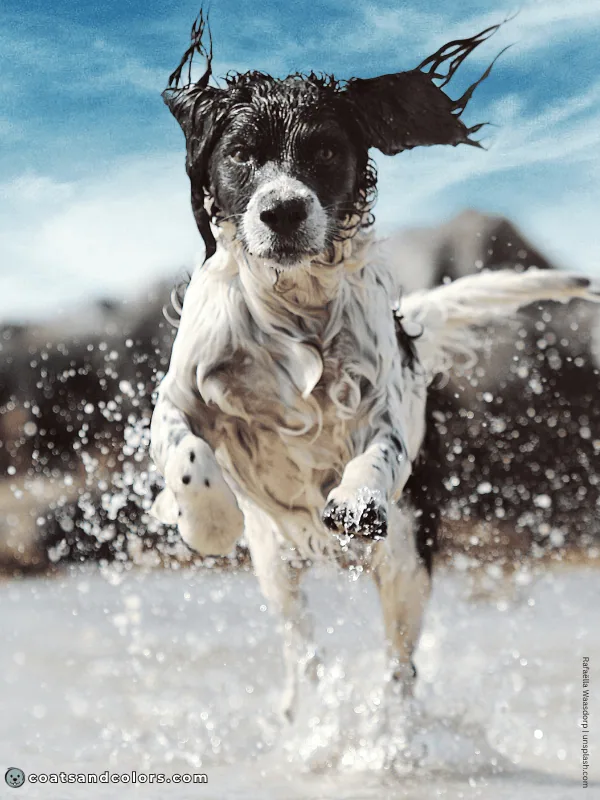
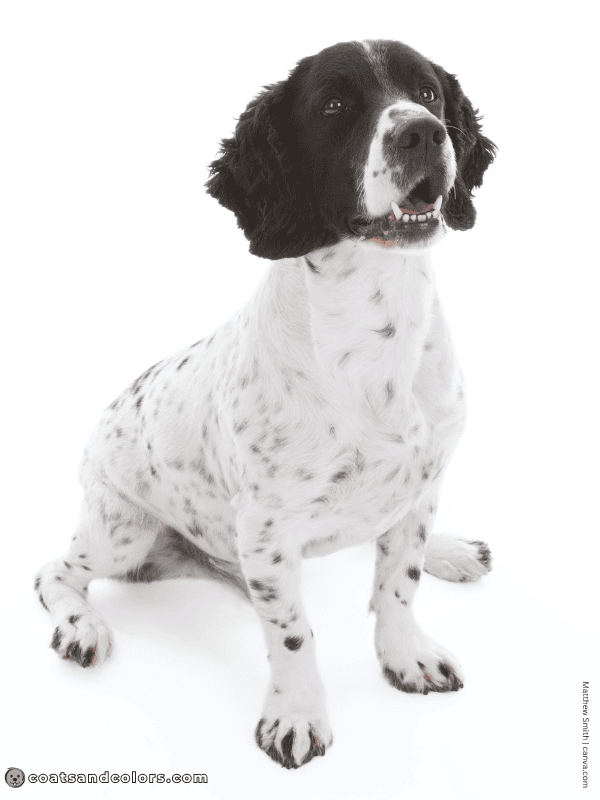
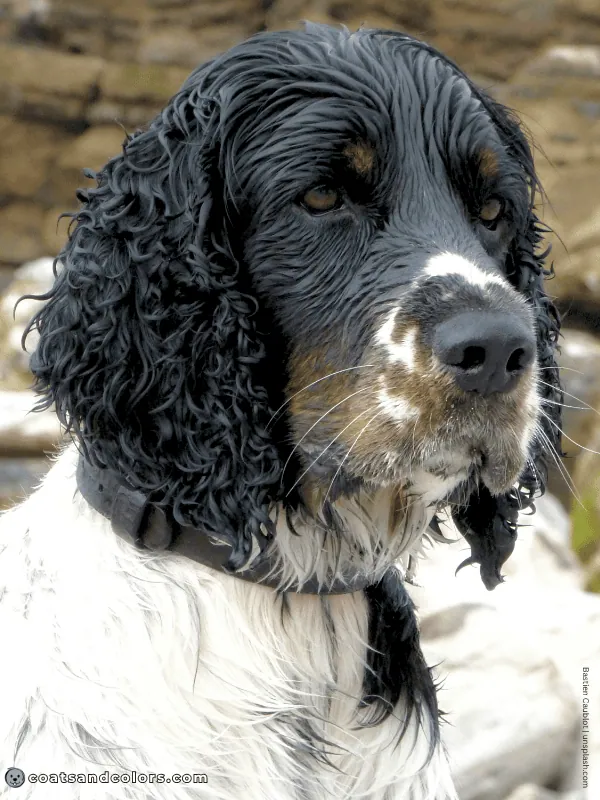
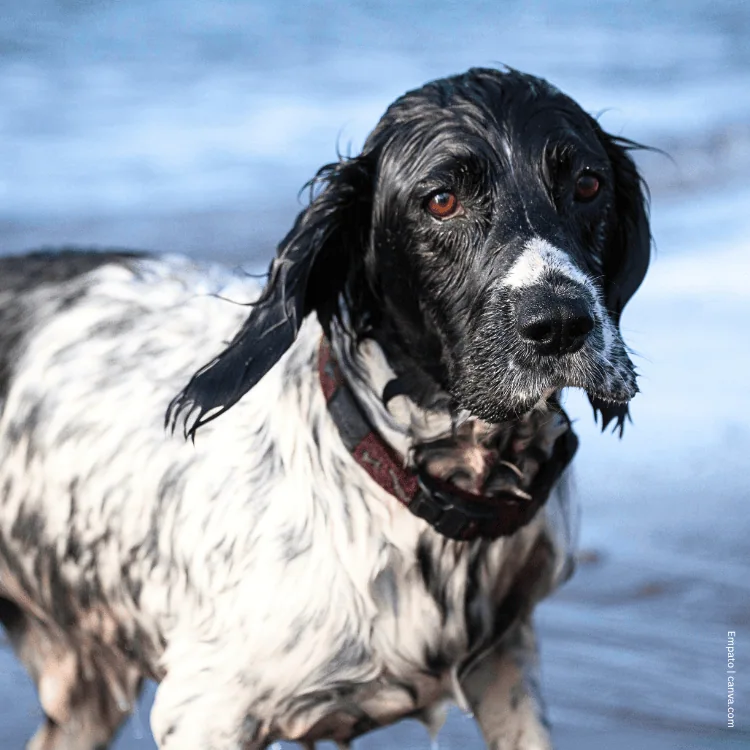
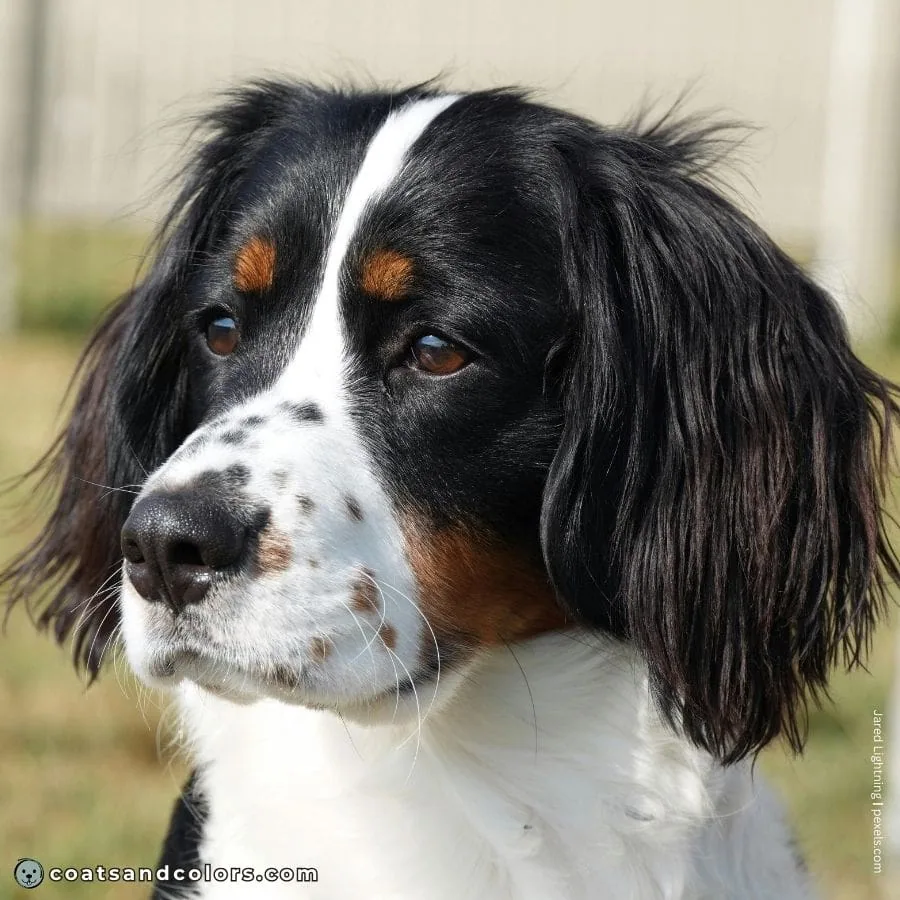
A black & white English Springer Spaniel is a solid black dog with white markings. If the dog appears mainly white with patches of color, then it’s called a white & black ESS.
Most black & white English Springers express a dominant black pattern (KB/-).
This means their tan point pattern (at/at) will be hidden by a solid coat. Black ESS can be E/- (wild type) or Em/- (dark mask), you just can’t see a black mask on an already solid black dog.
Some KB/- dogs might have ghost tan. An unknown modifier makes their dominant black incomplete, allowing the underlying tan points to show through. Ghost tan is often only visible in direct sunlight and can result in subtle dark reddish face markings.
The recessive black allele has also been confirmed, mostly in UK show line Springers[4].
Dogs with ky/ky a/a will also have a solid black coat. This is rare but makes it possible to get a black & white puppy from two tricolor parents if both were recessive black carriers (ky/ky at/a).
The amount of white on a black ESS can vary from moderate to extended piebald. It is not defined when “black & white” turns into “white & black“. Any white can stay solid white, but many Springer Spaniels express some degree of a ticking or even some roan.
BASE PATTERN
dominant black (KB/-)
recessive black (a/a ky/ky)
MERLE
no
OTHER
ticking
ghost tan
EUMELANIN
black
INTENSITY
–
WHITE
piebald
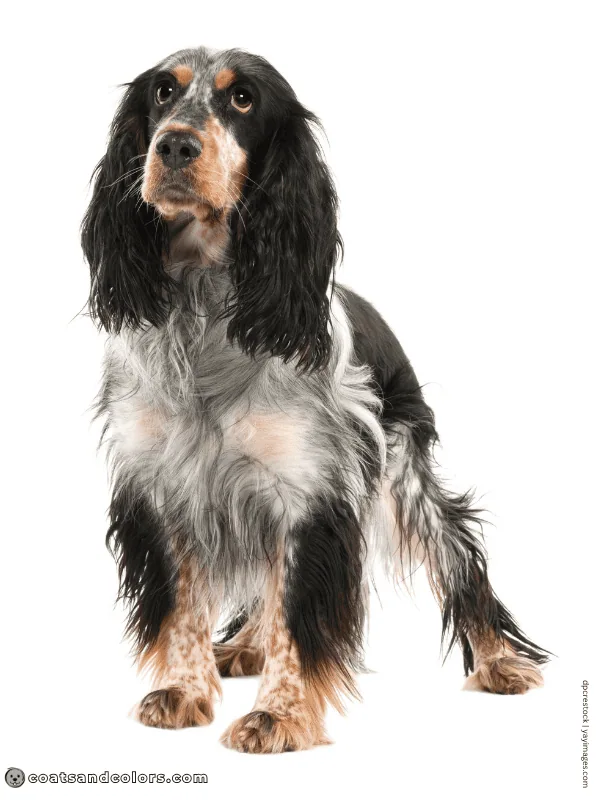
Black White & Tan
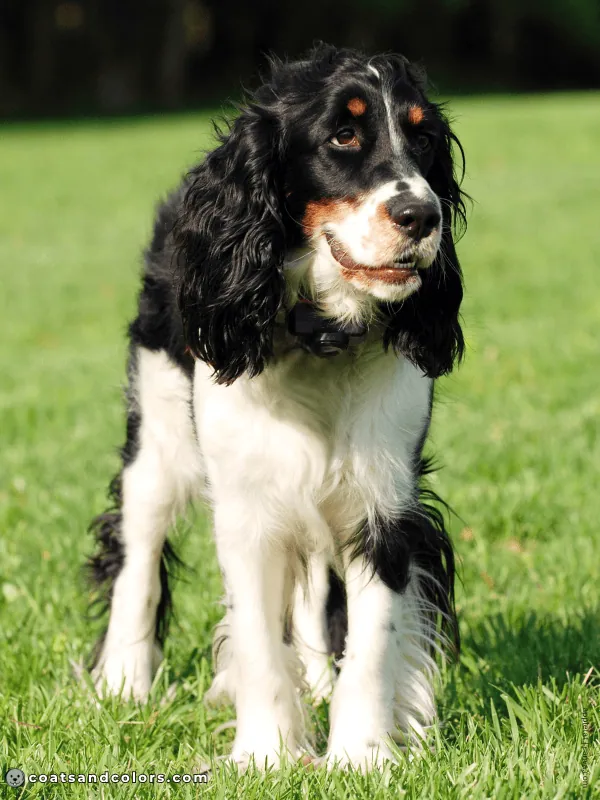
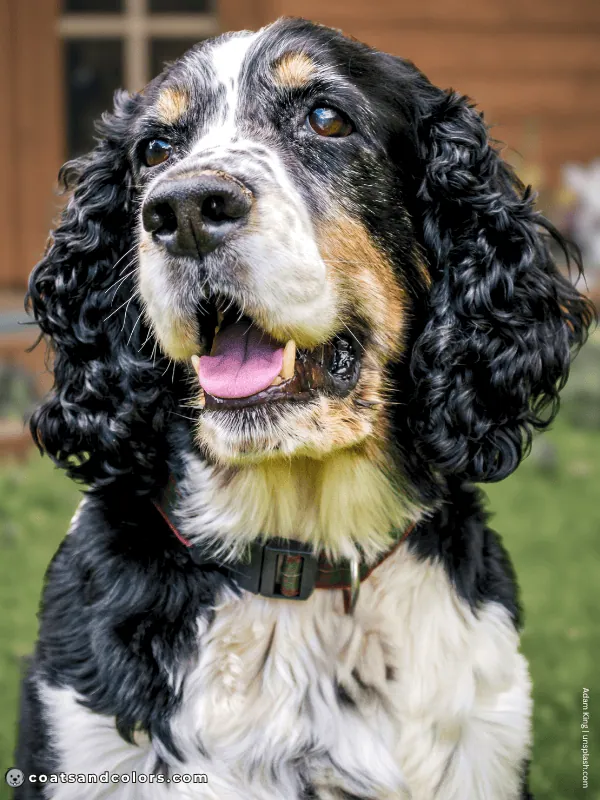
A black tri English Springer Spaniel is a black & tan dog with white markings (the ‘three colors’ of a tricolor dog). Without the white, they would look similar to a Gordon Setter.
Most ESS are homozygous tan point (at/at). Dogs that can express their pattern (ky/ky) will have tan markings on eyebrows, cheeks, inside of ears, lower legs, and under the tail.
The red intensity of the tan markings can vary from orange tan to red.
Dogs with Em/- might have a black mask that covers some of the tan markings on their muzzle and cheeks. But masks often go unnoticed in this breed because most ESS have white markings on their muzzle, which deletes much of their face tan markings anyway.
A black & tan dog that carries recessive black (at/a) might express smaller tan points compared to a homozygous tan point (at/at) dog. This is rare, but it can happen. It often causes the tan eye pips to get so small and smutty that they very much blend into the surrounding black.
The amount of white on a black ESS varies from moderate to extended piebald. The common term for a black & tan pattern with some amount of white is black tricolor.
BASE PATTERN
tan point
MERLE
no
OTHER
ticking
EUMELANIN
black
INTENSITY
tan
WHITE
piebald
Liver & White
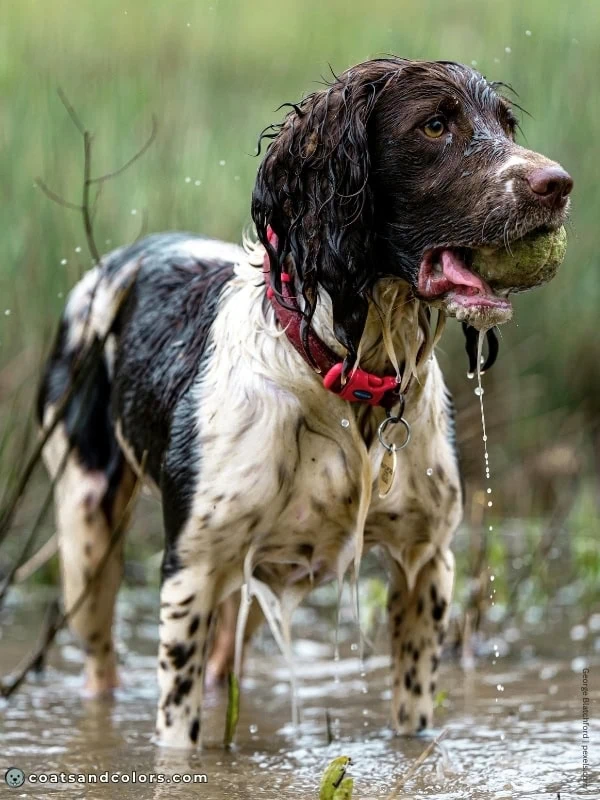
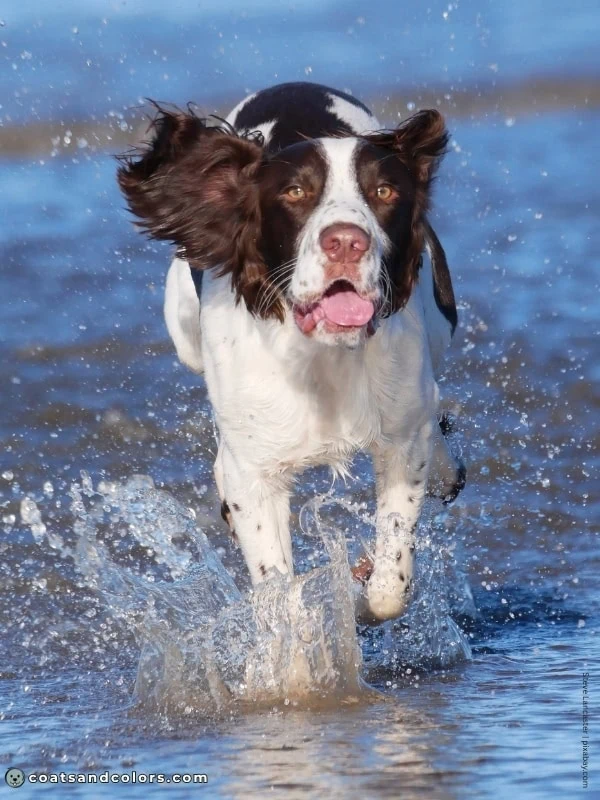
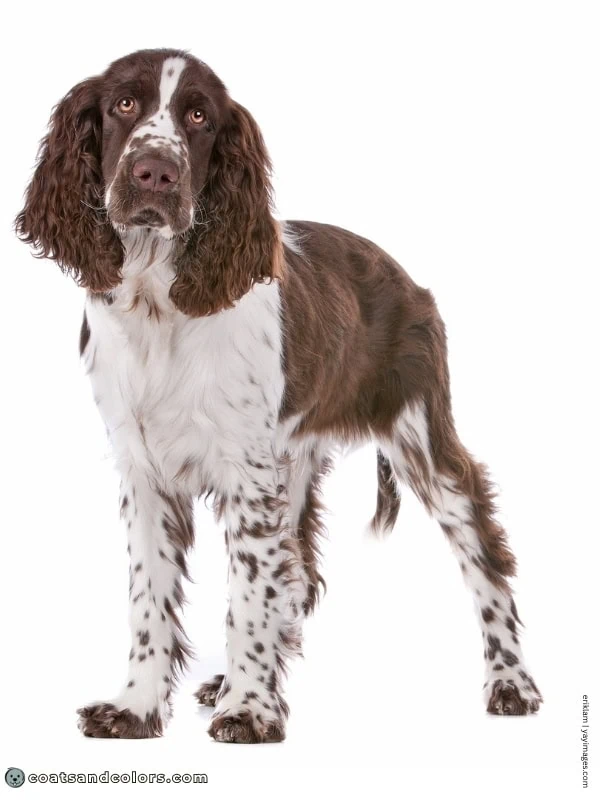
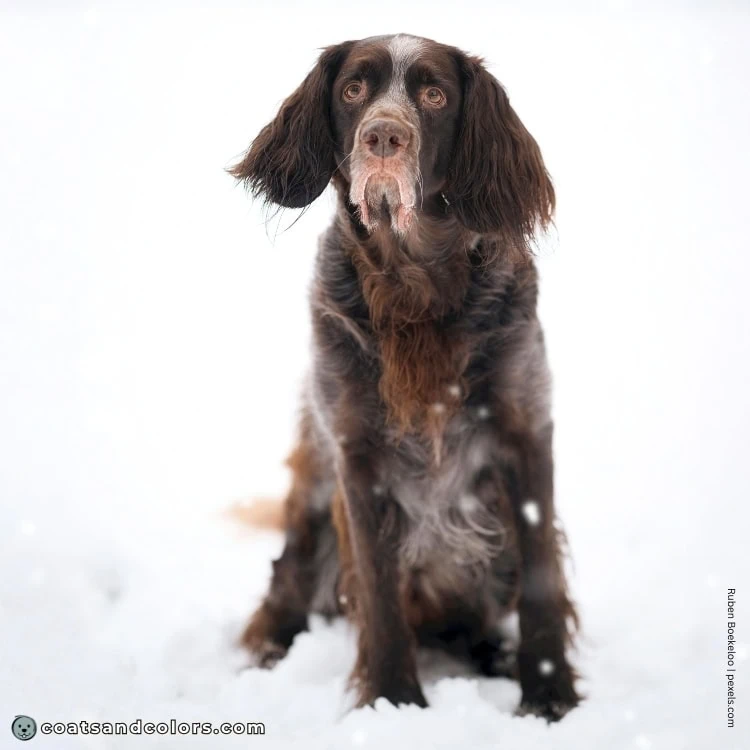
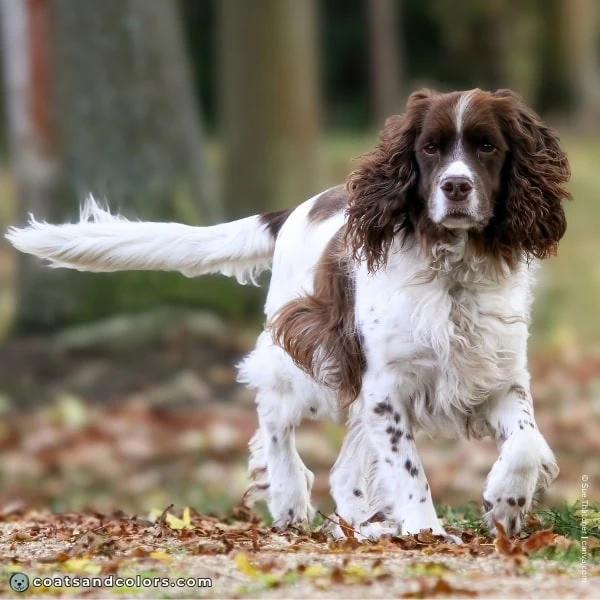
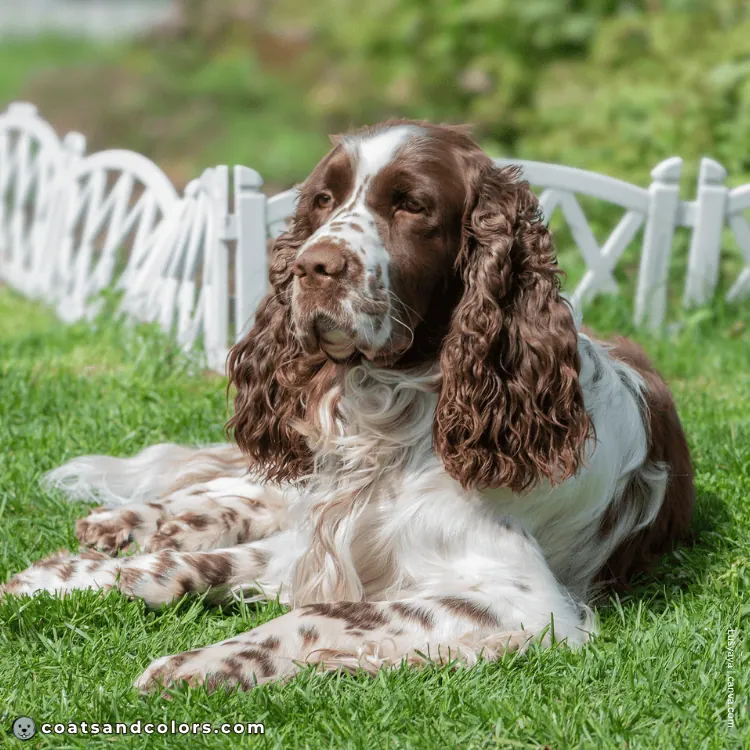
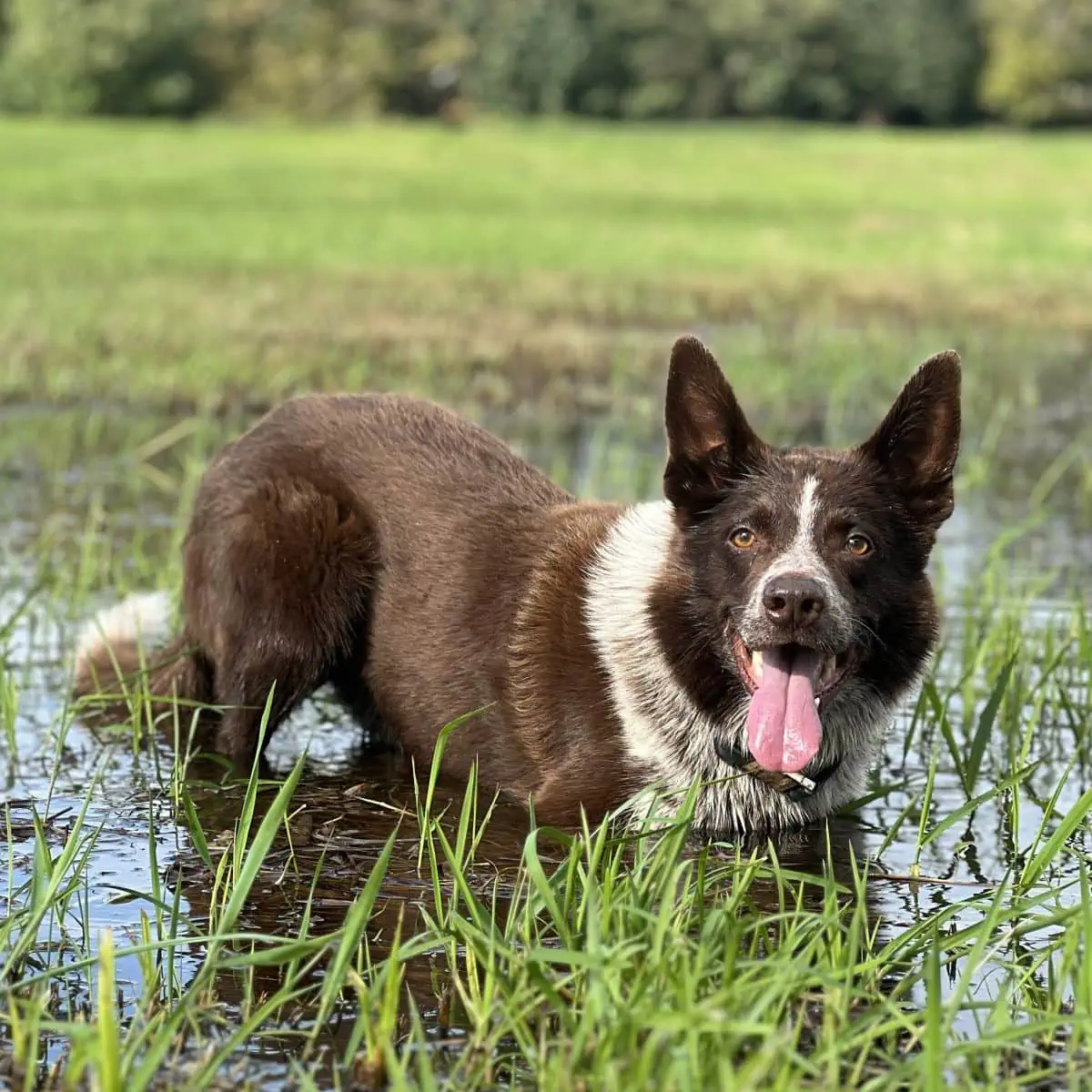
A liver & white English Springer has the same pattern as a black & white. But all its eumelanin has been modified from black to liver brown. That’s the only difference.
Most liver ESS are brown-based (b/b) dominant black (KB/-). Their solid brown coat hides their tan point pattern (at/at). They can be E/- (wild type) or Em/- (dark mask) at the E locus.
A small number of solid liver & white dogs might be brown-based recessive black (ky/ky a/a).
The color of brown pigment is known to vary from dog to dog. Different shades of liver color can give anything from a light chocolate to a dark brown Springer Spaniel. And old sun-bleached coat on the ears can look more yellow than liver before it grows back.
The amount of white on a liver ESS can range from moderate “liver & white” to extended “white & liver”. All liver & white dogs can have some ticking.
BASE PATTERN
dominant black
recessive black
MERLE
no
OTHER
ghost tan
ticking
EUMELANIN
liver
INTENSITY
–
WHITE
piebald
Liver White & Tan
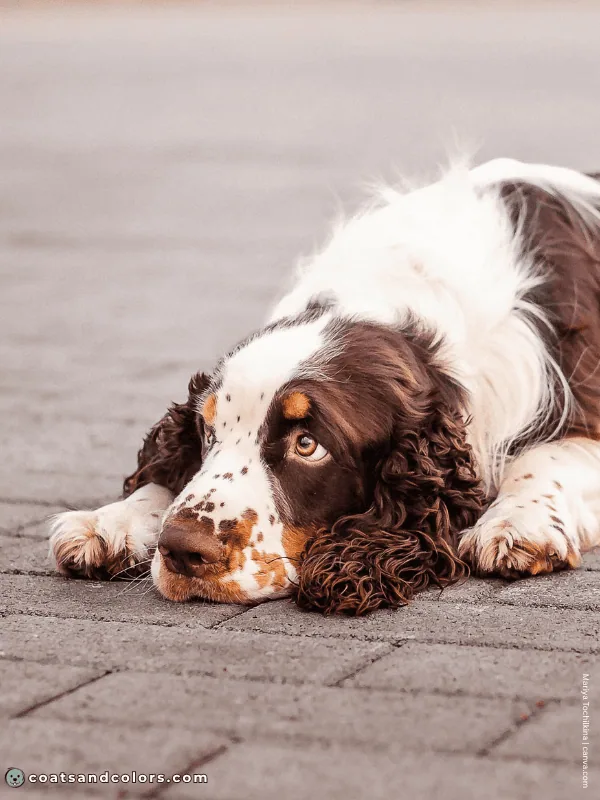
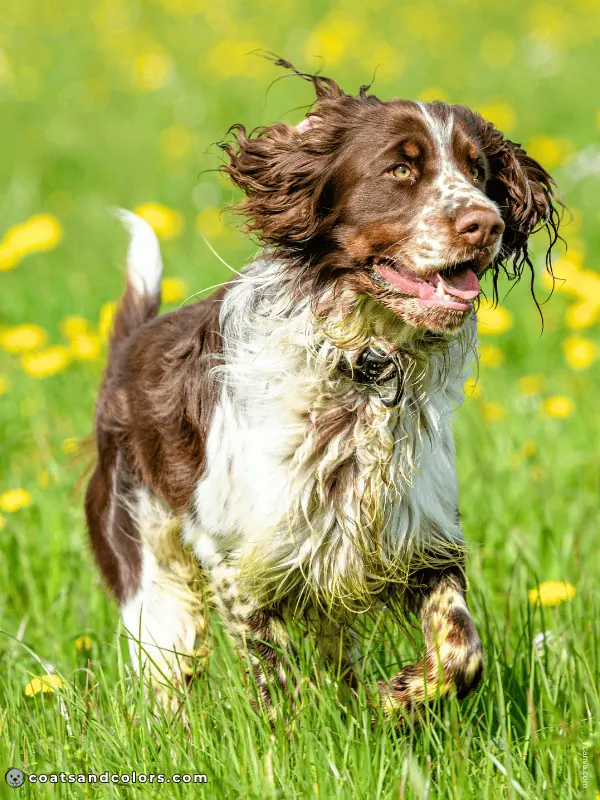
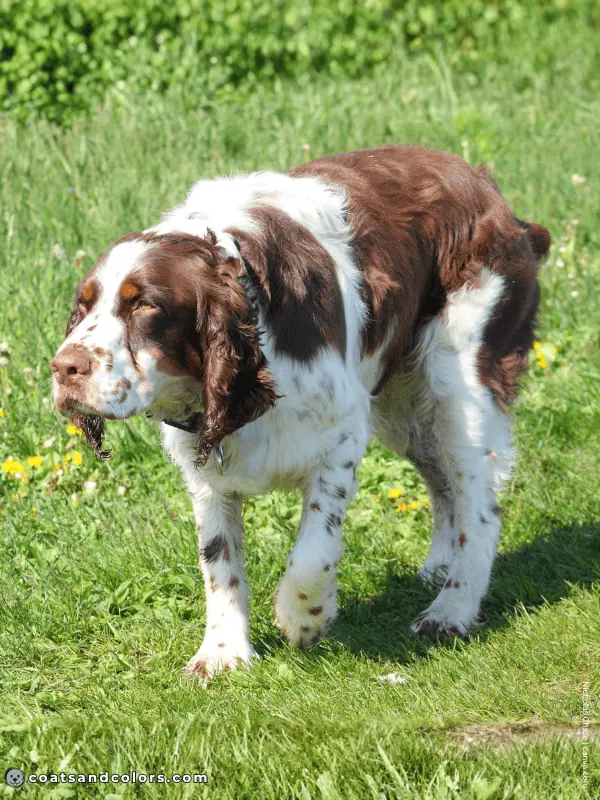
A liver tri English Springer Spaniel is a chocolate & tan dog with white markings.
A brown tan point pattern will cause a predominantly solid liver brown coat with yellow-reddish tan markings on the eyebrows, cheeks, inside of ears, lower legs, and below the tail.
The breed term for a liver & tan pattern with white is liver tricolor. Some liver tricolor ESS can have a liver mask (Em/-), which may hide some of the tan on their faces.
BASE PATTERN
tan point
MERLE
no
OTHER
ticking
EUMELANIN
liver
INTENSITY
tan
WHITE
piebald
Faulty Colors
“Off colors such as lemon, red or orange are not to place.”
AKC Breed Standard[1]
“Liver and white, black and white, or either of these colours with tan markings. Any other colour or combination of colours unacceptable.”
RKC Breed Standard[3]
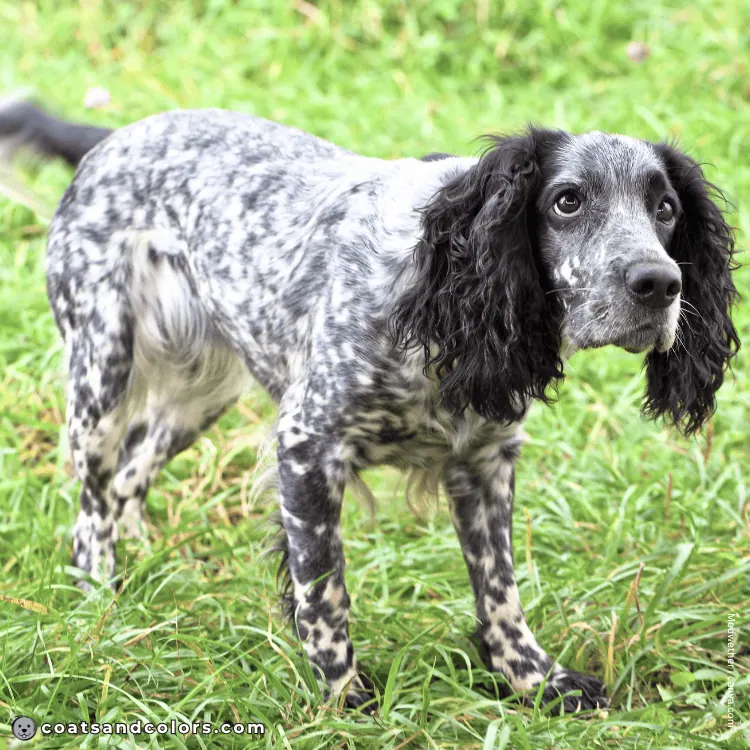
The AKC and CKC list “blue or liver roan” as accepted colors in their breed standards. But really heavy roan patterns are rare in the breed. And the RKC or FCI standards do not mention roan at all.
It is my understanding that too heavy roan and ticking patterns are not desired in this breed (less they look like big Cocker Spaniels … which they technically somehow were at some point in the past).
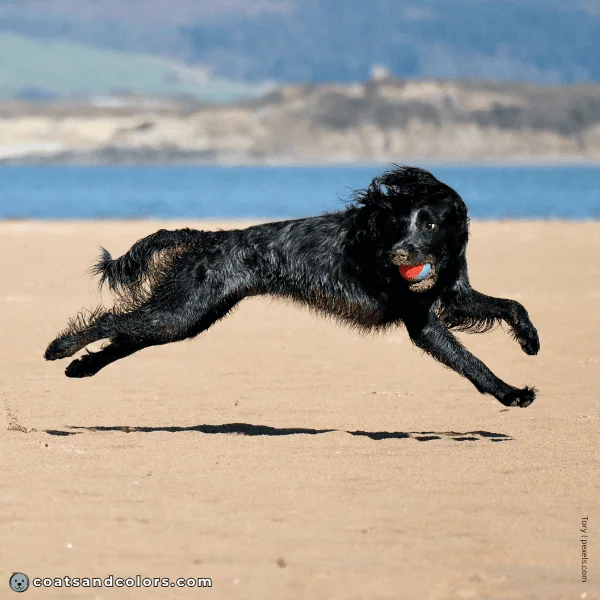
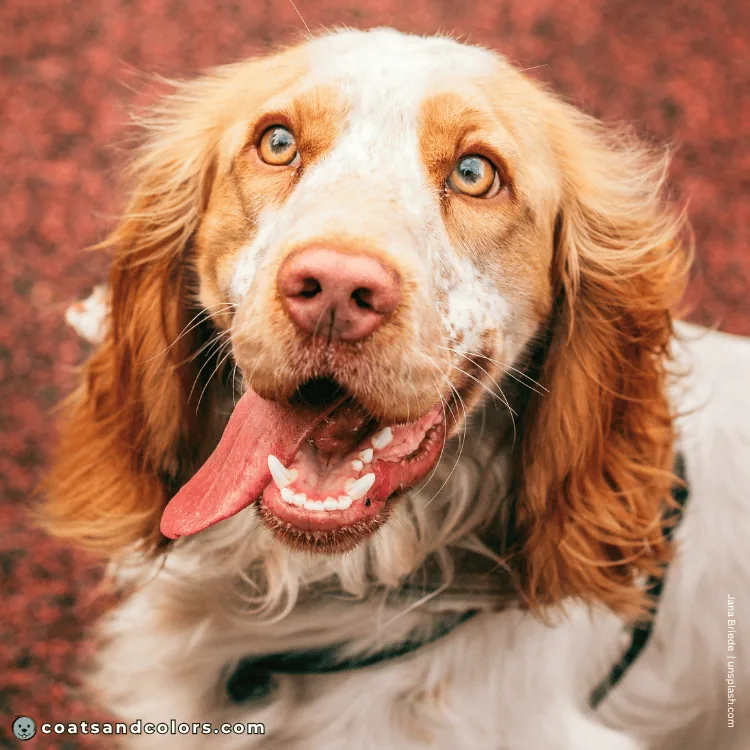
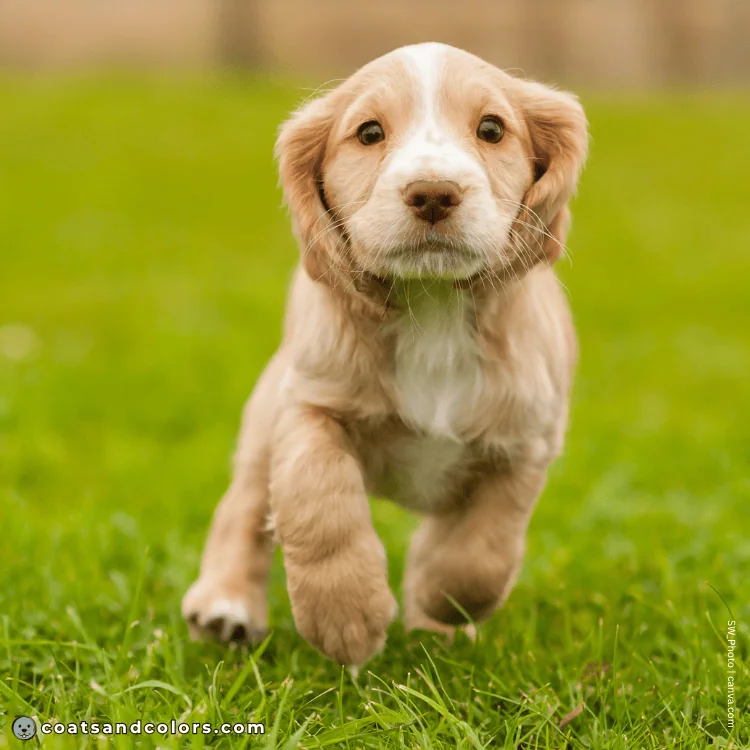
The white markings from their piebald pattern can also not extend into the extreme, e.g. dogs should not have white faces, split faces, blue eyes, or pink noses and eye rims.
Noteworthy mismarks are called sable, red, or lemon. This hints at either recessive red (e) or maybe fawn (Ay) patterns. I don’t think they have real cocker “sable” (eH).
Base Patterns
The base pattern describes the placement of phaeomelanin and eumelanin in the coat. There is an epistatic hierarchy between the A locus < K locus < E locus.
- The A locus controls the basic distribution of both pigment types.
- Next, the K locus can add black to the A locus pattern.
- Finally, the E locus regulates the general ability to produce black pigment.
A Locus
| at | tan point |
| a | recessive black |
The English Springer Spaniel breed is almost fixed for tan points (at) at this locus.
But recessive black (a) has also been confirmed.
K Locus
| KB | dominant black |
| ky | wild-type |
Only dogs with ky/ky have normal pattern expression.
Being KB/- replaces the A locus pattern with a solid dark coat.
E Locus
| Em | black mask |
| E | wild-type |
The ESS can have a dark mask (Em/-). The wild-type (E/-) does not affect coat color. I don’t know if recessive red (e) is a thing in ESS. If so, it could cause the faulty “lemon” color seen in some dogs.
ESS Base Patterns
| A LOCUS | K LOCUS | E LOCUS | PATTERN |
|---|---|---|---|
| at/at | ky/ky | Em/- | tan point, mask |
| at/at | ky/ky | E/- | tan point |
| a/a | ky/ky | Em/-, E/- | recessive black |
| KB/- | Em/-, E/- | dominant black |
Base Colors
The eumelanin base color is determined by the B locus and D locus.
B Locus
| B | black |
| b | liver |
English Springer Spaniels can have black (B/-) or brown (b/b) pigment.
D Locus
| D | normal |
The D locus controls color dilution, which does not occur in English Springer Spaniels.
Red Intensity
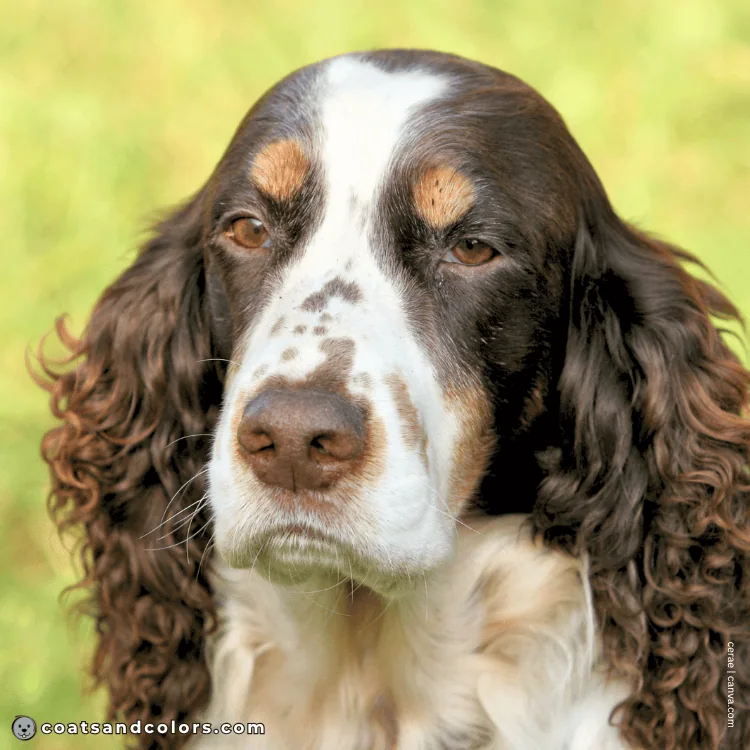
The shades seen in ESS are described as red, lemon, or simply as tan. The color can only be observed in tricolors, which tend to have very vibrant orangey tan or reddish tan markings.
White Markings
The white in English Springer Spaniels is typically caused by piebald.
“Black or liver with white markings or predominantly white with black or liver markings.”
AKC Breed Standard[1]
“Black or liver with white markings or white with black or liver markings.“
CKC Breed Standard[4]
All Springers express white markings. Almost all of them are homozygous sP/sP at the S locus.
But the wild-type allele S (solid) has also been confirmed, at least in UK field lines[4]. Dogs with S/sP will, on average, have less white on their body compared to sP/sP.
White is caused by a lack of pigment in some areas of the coat and deletes some of the dog’s original pattern. Any pattern (in this breed, we have solid dark and tan point) can show white markings.
White turns a solid black into a black & white dog. And a tan point into a tricolor.
The amount of white in homozygous sP/sP dogs depends on some untestable modifiers and is never fully predictable. Both moderate to extended white are accepted.
Most Springer Spaniels have some white on their legs and body, some white on the muzzle and blaze, a white collar, and a white tail tip. More extended white starts to cut into the blanket on the dog’s back. Even more extreme piebald can cause a white dog with pigment in its head only.
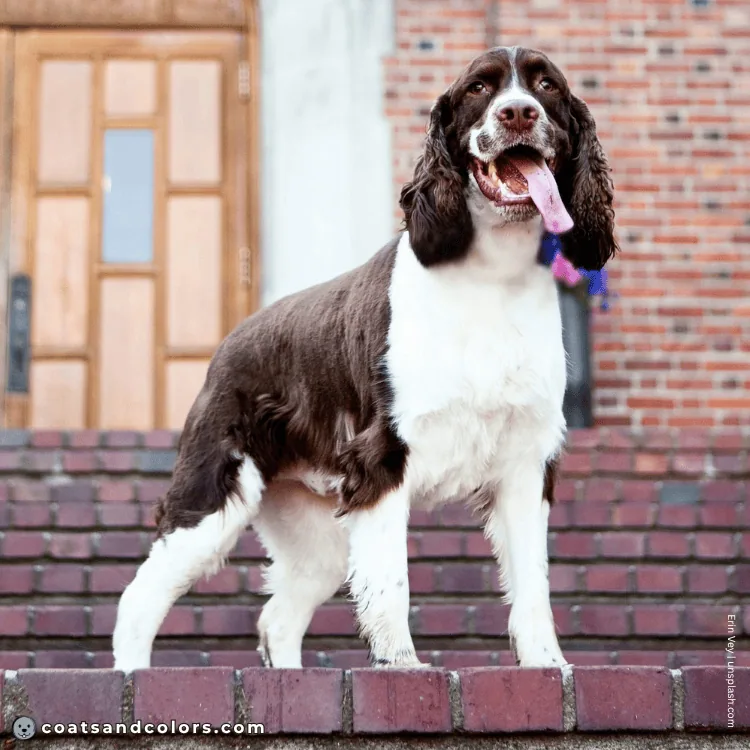
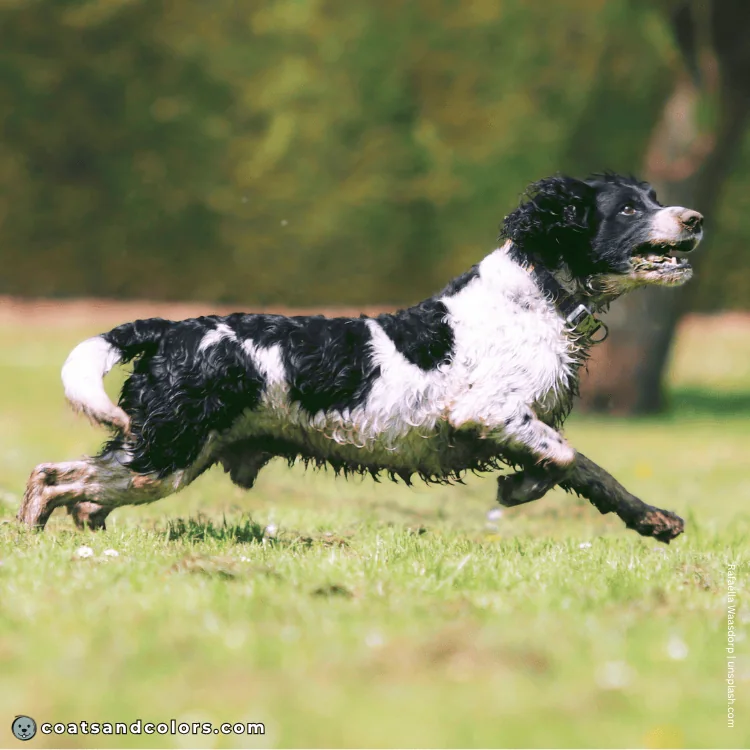
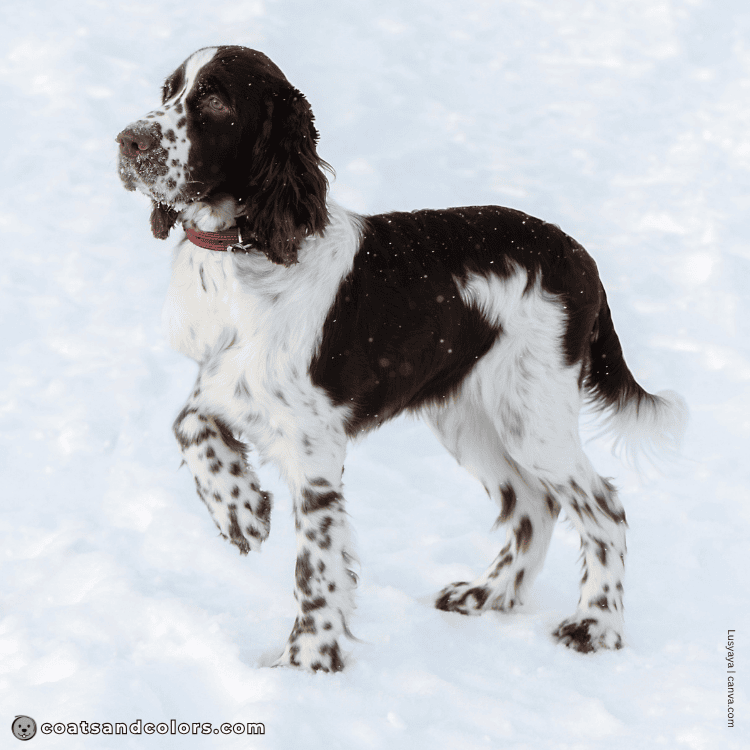
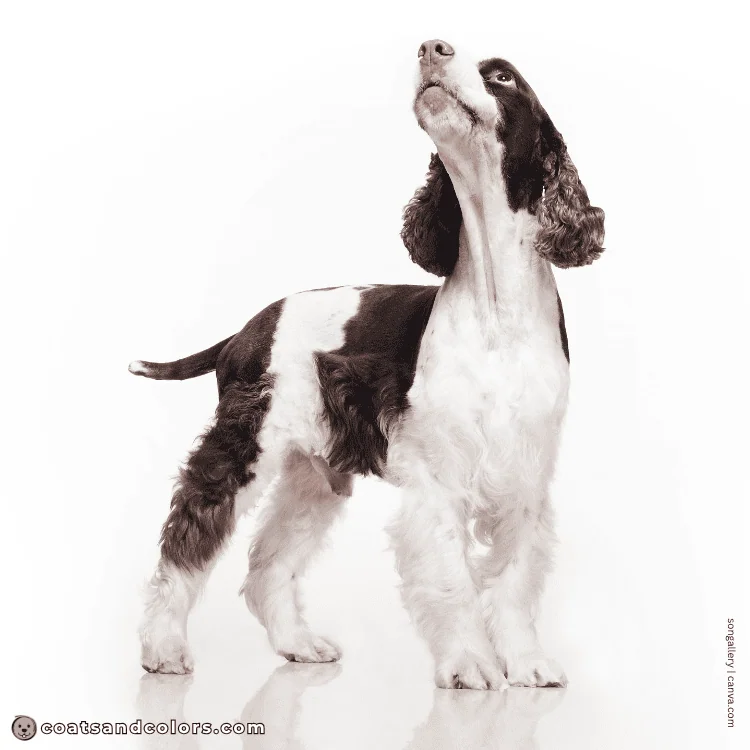
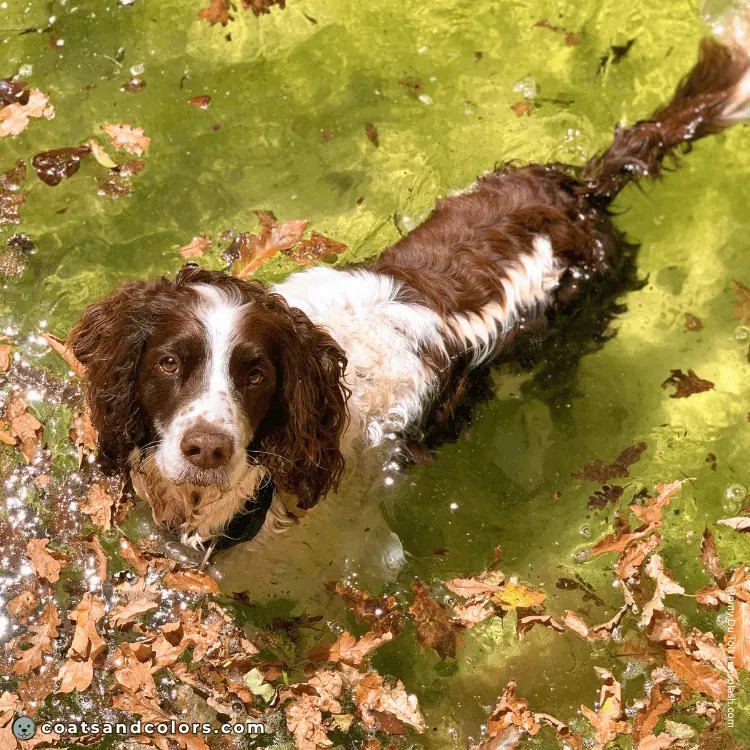
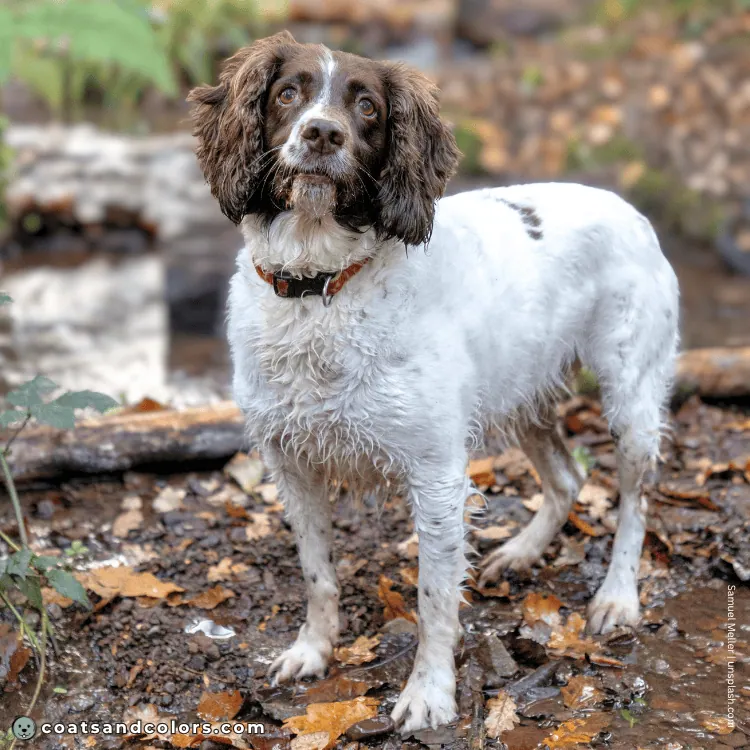
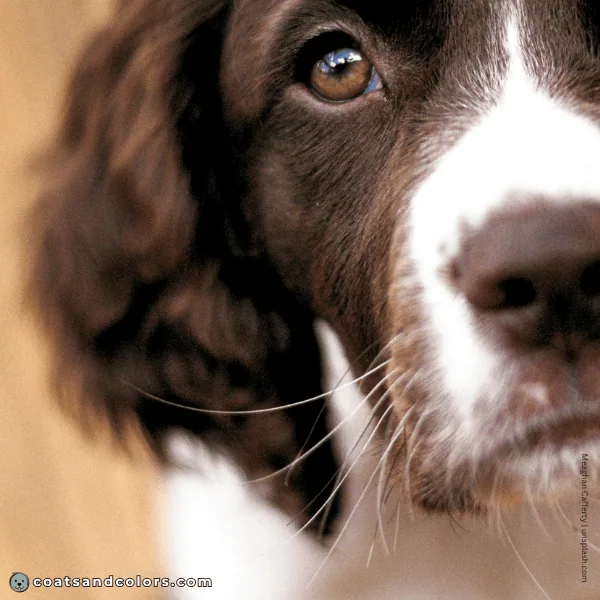
The white on the muzzle will often cause the whiskers to also be white. But you might catch some single whiskers on top of some dark mottles that have kept their black or liver color.
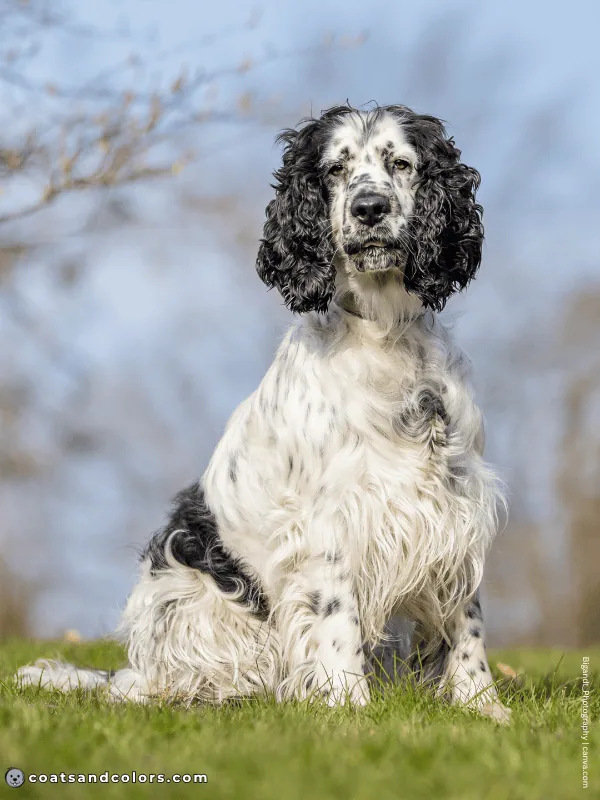
A moderate piebald pattern often gives just some white on the face. But extended piebald can delete more color from the head and cause very wide blazes, split faces, clown faces, or white ears.
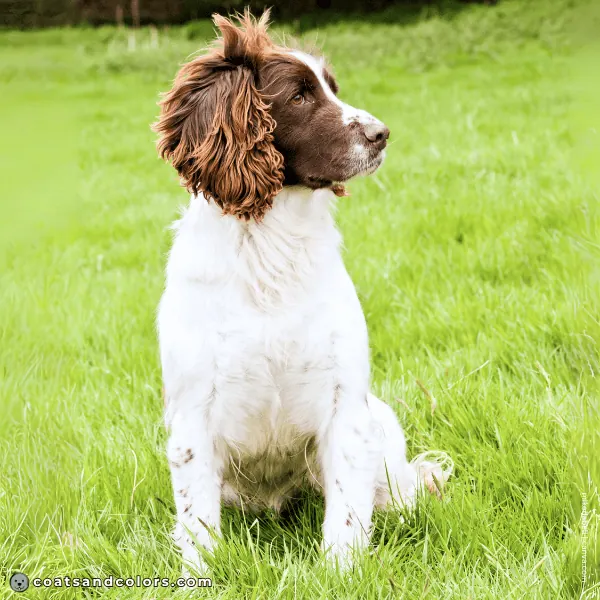
Any dog with too much white on the head has a small risk to also have blue eyes or being born deaf in one or both ears. While traditional hunting breeds with piebald don’t breed for large white face markings, ESS with blue eyes or hearing loss caused by face white can still happen.
Ticking
The AKC breed website lists both ticking and roan as possible markings. And the text version of the AKC standard says that “blue roan” or “liver roan” and “white flecked with ticking” are accepted colors.
All white areas will be solid white at birth. Both roan and ticking develop only after some time. Heavy ticking patterns tend to come in earlier and faster than minimal ticking.
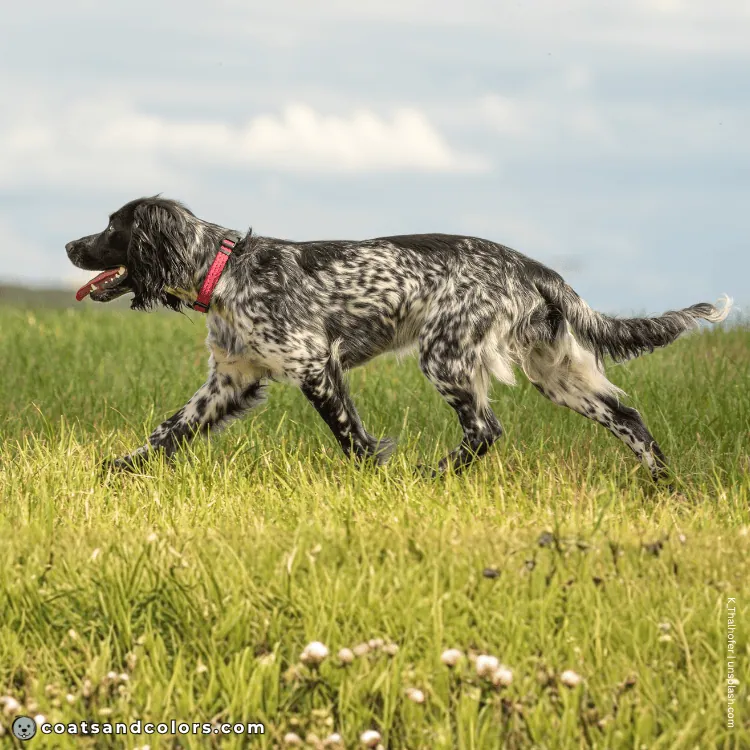
You’ll find lots of dogs with ticking in this breed. True roaning is less common.
Ticking refers to roundish mottles. Minor ticking only causes some mottles on the muzzle and lower legs. More heavy ticking can cover all of the white on a dog with dense mottles.
Dogs with roan don’t have these well-defined dots but rather a dense mixture of dark hairs and white hairs. Heavy roaning can reintroduce a lot of pigment back into white areas.
It is not fully understood if roan and ticked are fully separate traits or if roan can be put in the ticking series (TR > T > t). For Spaniels, ticking (T) shows complete dominance over clear white (t). Dogs with one copy of roan (TR/t) show less of a pattern than dogs with two copies (TR/TR).
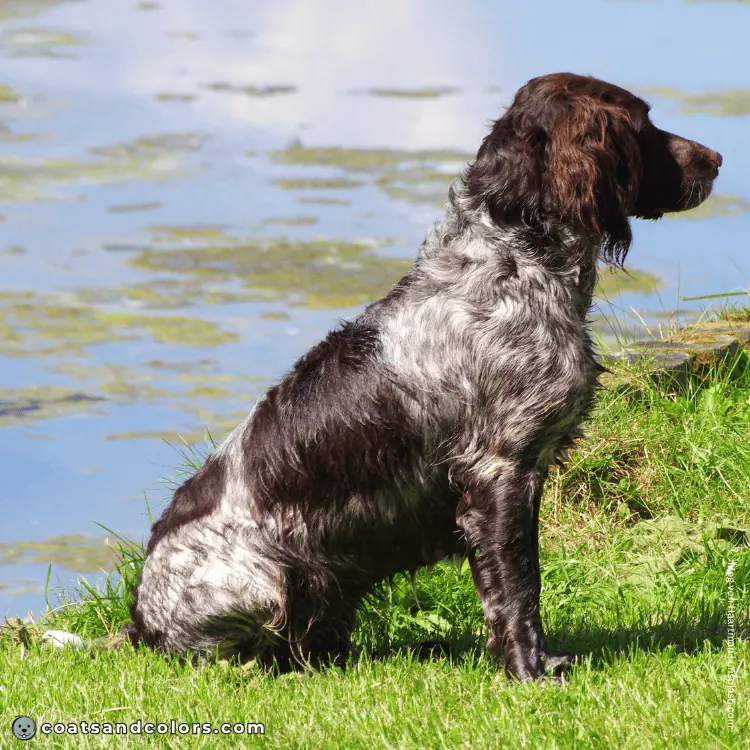
English Springer Spaniel Eye Colors
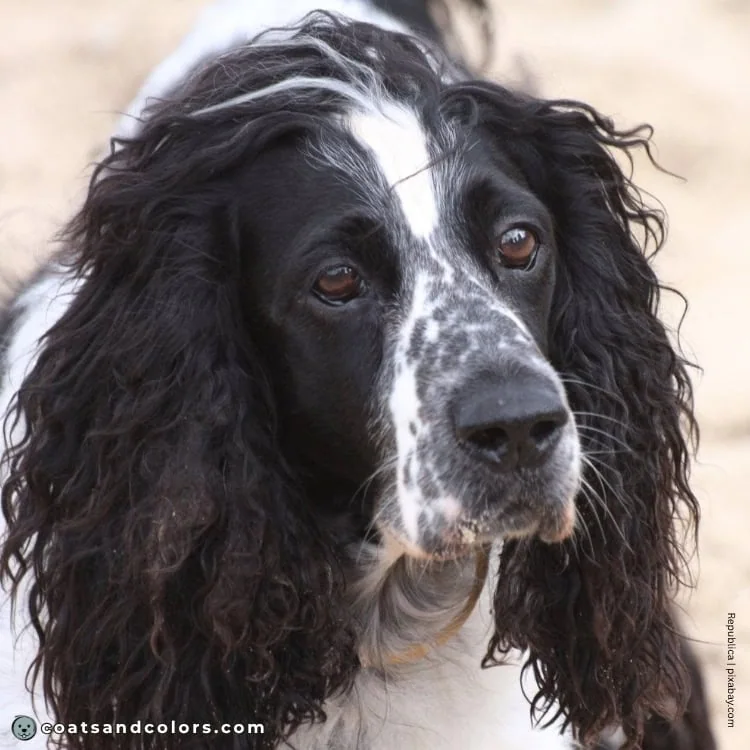
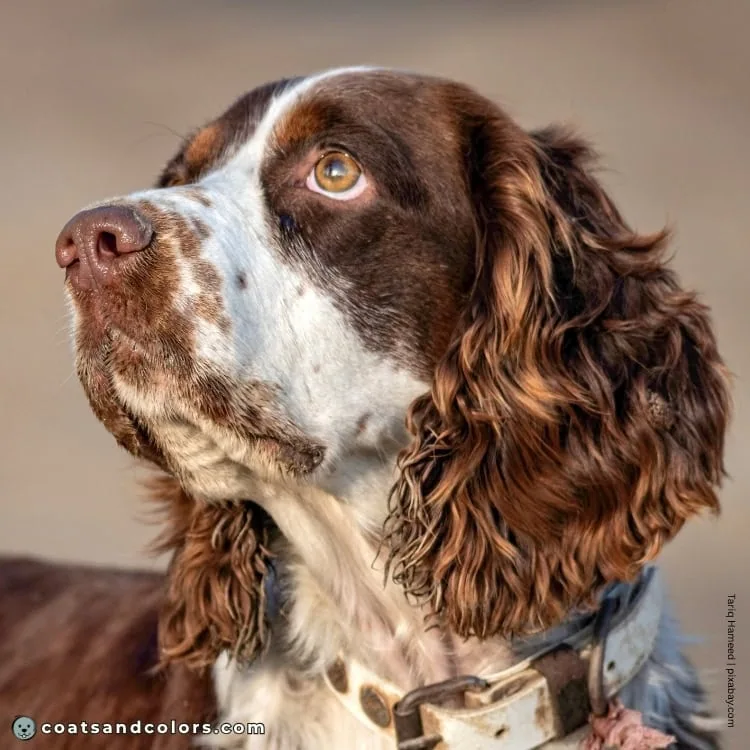
The ESS breed standards favor dogs with darker eye colors. So breeders tend to select away from yellow eye colors, which can be harder in liver dogs since these naturally come with lighter eyes.
Some young liver puppies might still have very pale greenish or bluish eyes. This is very normal for young dogs, and their eye color will darken over time as more pigment fills in.
“The color of the iris harmonizes with the color of the coat, preferably dark hazel in the liver and white dogs and black or deep brown in the black and white dogs. Eye rims are fully pigmented and match the coat in color.“
“[…] eyes that are yellow or brassy in color, are highly undesirable.”
AKC Breed Standard[1]
“Dark hazel. Light eyes undesirable.”
FCI Breed Standard[2]
English Springer Spaniel Nose Colors
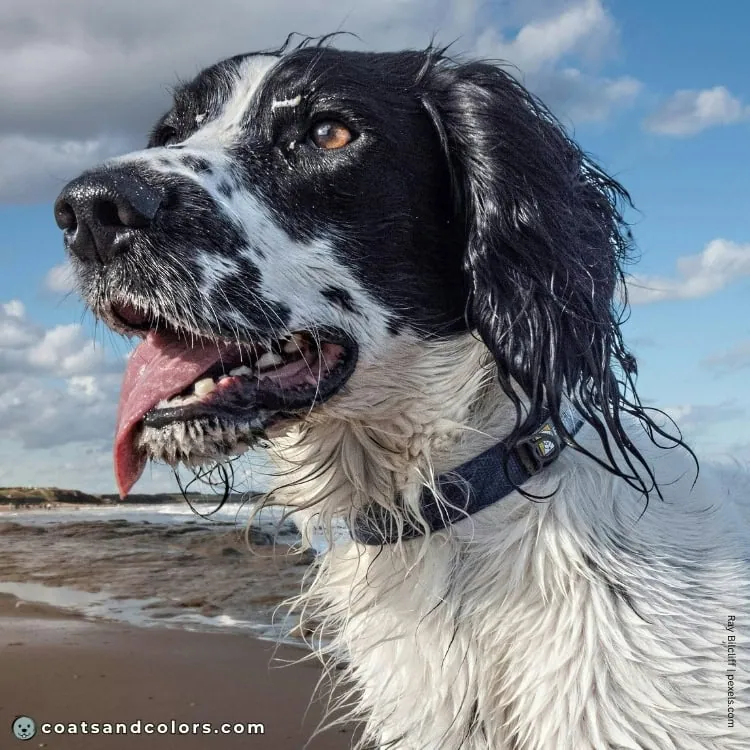
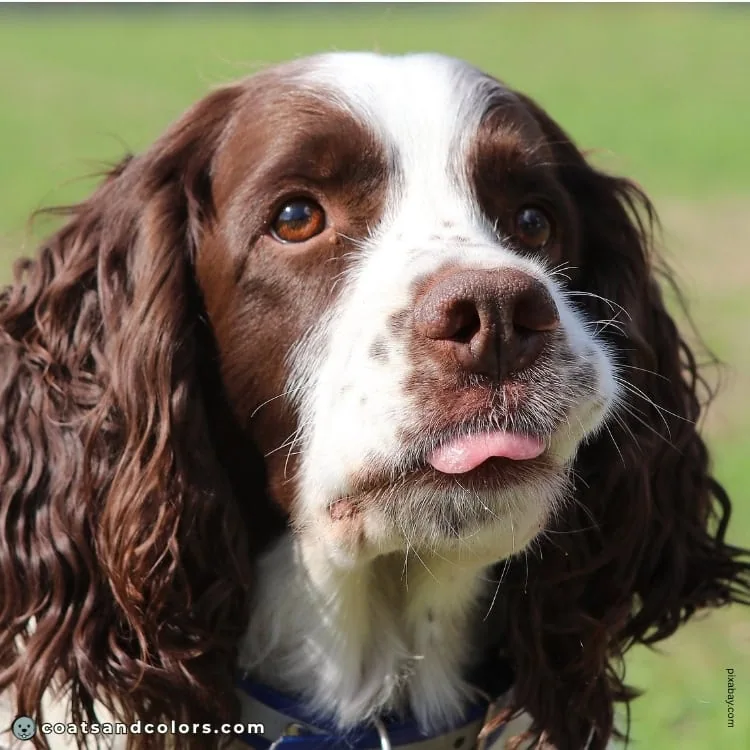
Springer Spaniels either have a black or a brown nose. Their color of eumelanin will also affect the color of their eye rims, lips, paw pads, nails, or whiskers, etc.
“The nose is fully-pigmented, liver or black in color, depending on the color of the coat.”
AKC Breed Standard[1]
English Springer Spaniel Coat Type
The English Springer Spaniel is a long-haired (l/l) breed with a “flat or wavy coat“.
Some Springers have one or two curly alleles, which means that any longer coat may be wavy (Cu/N) or curly (Cu/Cu). The coat on their face and legs is smooth.
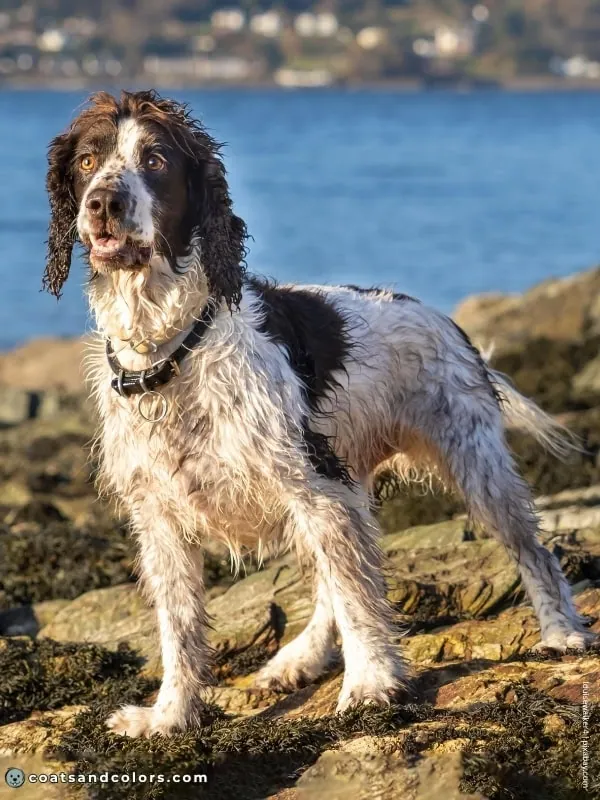
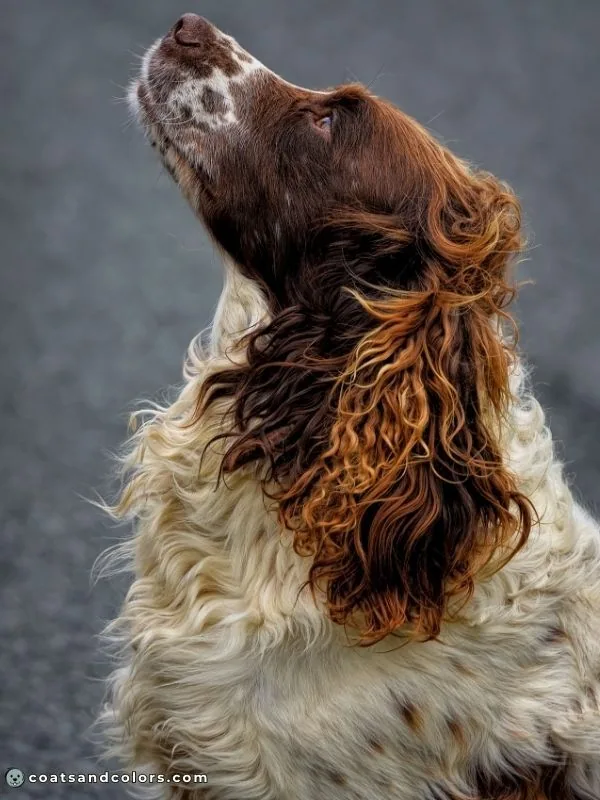
“The Springer has an outer coat and an undercoat. On the body, the outer coat is of medium length, flat or wavy, and is easily distinguishable from the undercoat, which is short, soft and dense.”
AKC Breed Standard[1]
“Close, straight and weather resisting, never coarse. Moderate feathering on ears, forelegs, body and hinquarters.”
FCI Breed Standard[2]
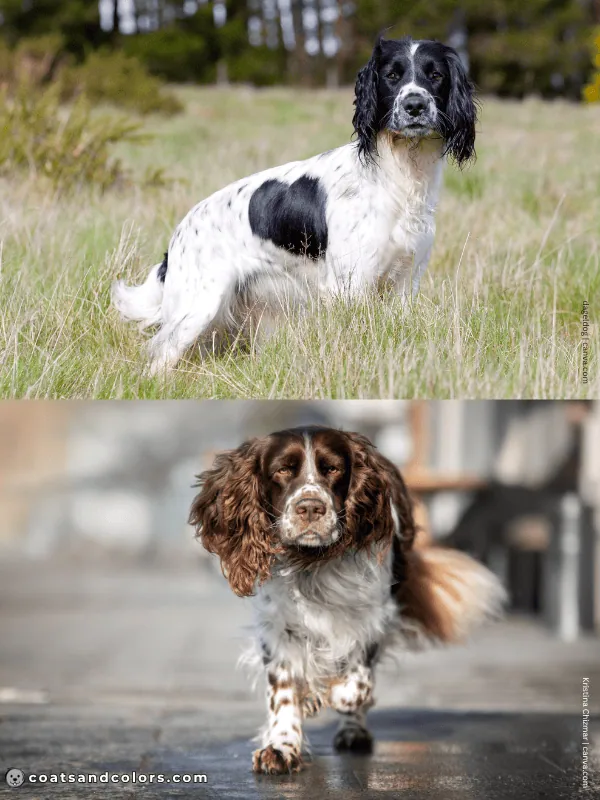
Some untestable modifiers control how long a long coat will actually be. Or how much feathering exactly a dog has. The show-type Springers have a longer and more luxurious coat with longer ear feathering compared to working Springers.
Related Breeds
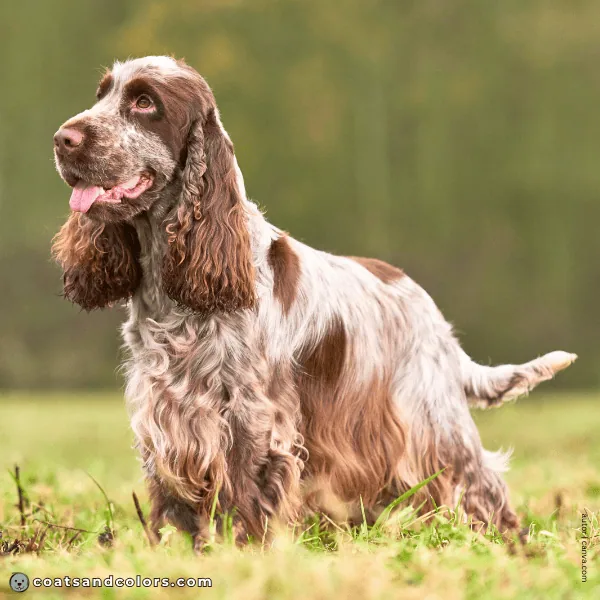
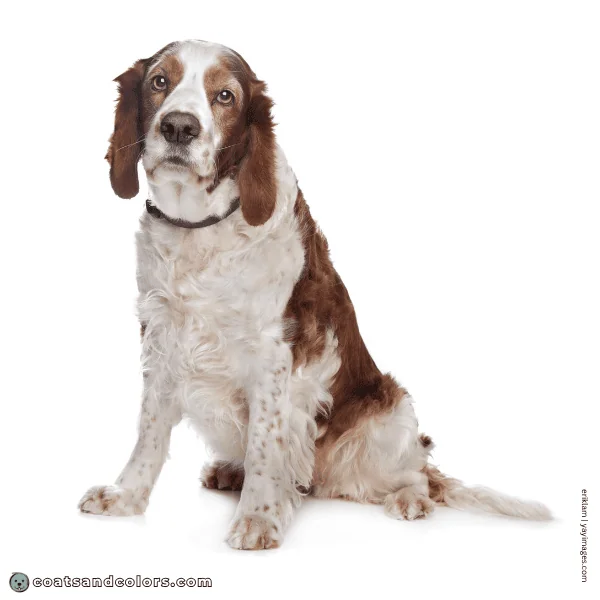
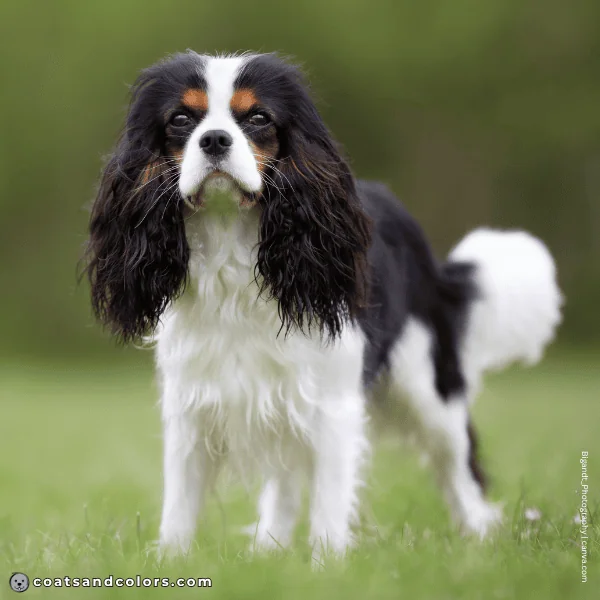
Learn More

Links
[1] American Kennel Club (AKC): English Springer Spaniel
[2] Fédération Cynologique Internationale (FCI): English Springer Spaniel
[3] Royal Kennel Club (RKC): English Springer Spaniel
[4] Canadian Kennel Club (CKC): English Springer Spaniel
[5] Dreger et al. (2019). True Colors: Commercially-acquired morphological genotypes reveal hidden allele variation among dog breeds, informing both trait ancestry and breed potential. PLoS ONE 14(10): e0223995. https://doi.org/10.1371/journal.pone.0223995
Image Credits
Adam King/unsplash.com
Alyssa li/unsplash.com
Angela/pixabay.com
appletat/canva.com
bastien caublot/unsplash.com
beinder/canva.com
Bigandt_Photography/canva.com
BrankoPhoto/canva.com
dageldog/canva.com
Dan/unsplash.com
Darren Wordley/canva.com
DevidDoO/canva.com
Dom Heartley/unsplash.com
dpcrestock/yayimages.com
Empato/canva.com
eriklam/yayimages.com
Erin Vey/unsplash.com
Eva :)/unsplash.com
Fi Dogs/unsplash.com
FoYu/pixabay.com
George Blatchford/pexels.com
glebchik/canva.com
Jana Briede/unsplash.com
Jared Lightning/pexels.com
John Debrey/unsplash.com
K_Thalhofer/canva.com
Kemter/canva.com
Kristina Chizmar/canva.com
Kurt Pas/canva.com
louisewalker4/pixabay.com
Lusyaya/canva.com
Mariya Tochilkina/canva.com
Matthew Smith/canva.com
Meaghan Cafferty/unsplash.com
Nicholas Chase/canva.com
Rafaëlla Waasdorp/unsplash.com
Raoul Croes/unsplash.com
Ray Bilcliff/pexels.com
Republica/pixabay.com
Robjem/canva.com
Romy Du Toit/unsplash.com
Ruben Boekeloo/pexels.com
Samuel Meller/unsplash.com
songallery/canva.com
Steve Lancaster/pixabay.com
steved_np3/canva.com
Stockjohnw/canva.com
Sue Thatcher/canva.com
SW_Photo/canva.com
Tariq Hameed/pixabay.com
Tim Riesner/unsplash.com
Tory/pexels.com
Hi! I’m Steffi. I am a biologist and a big time dog nerd. You are curious about coat color genetics? You’ve come to the right place! Read more.