

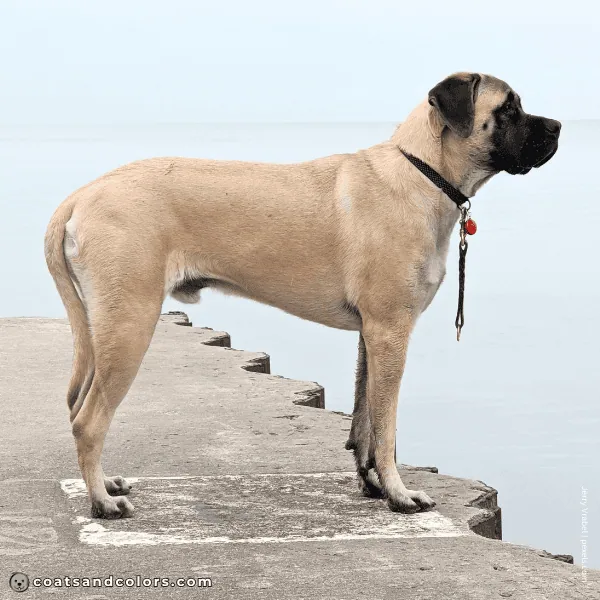
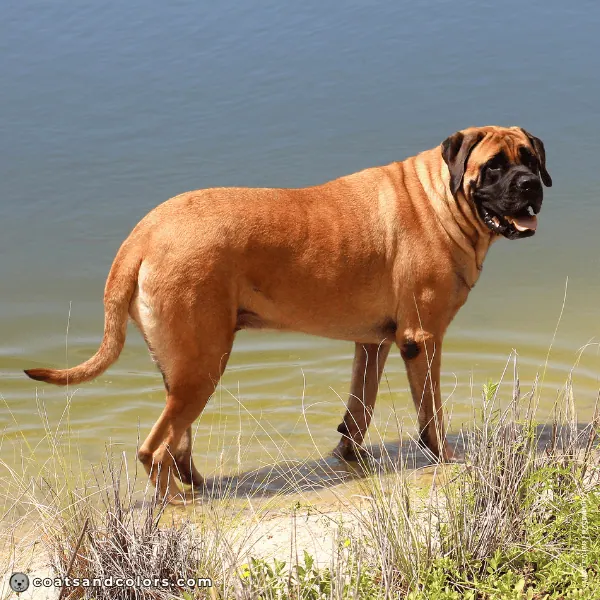
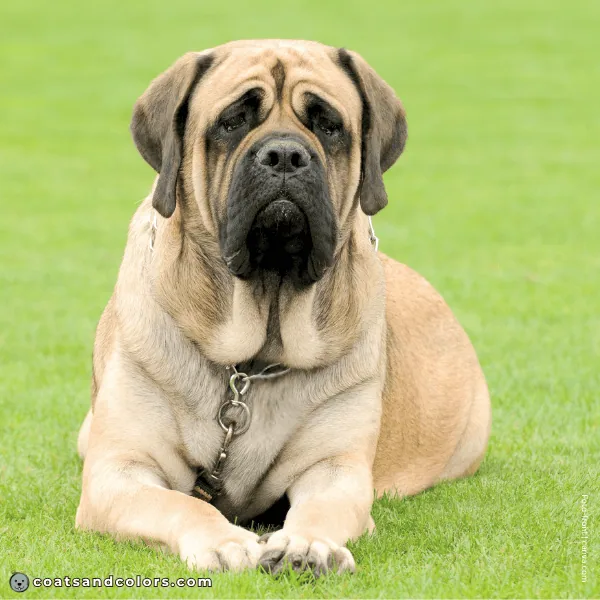
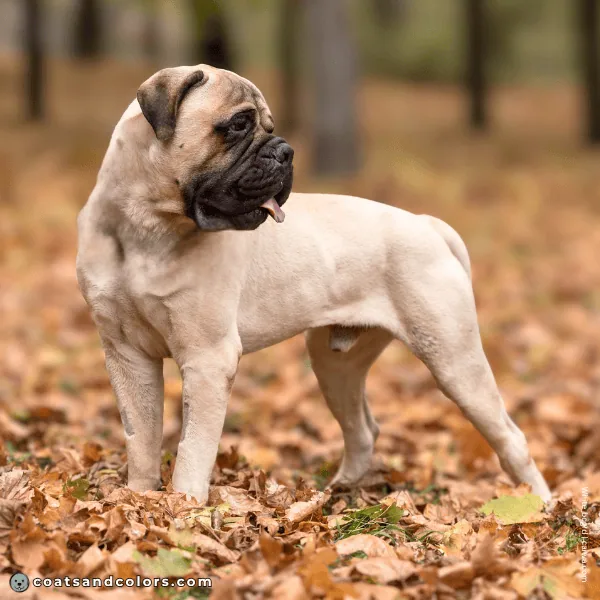
The Mastiff is a giant breed from England. The accepted English Mastiff colors are fawn, apricot, and dark brindle. Each of these patterns also has a black mask.
Fawn
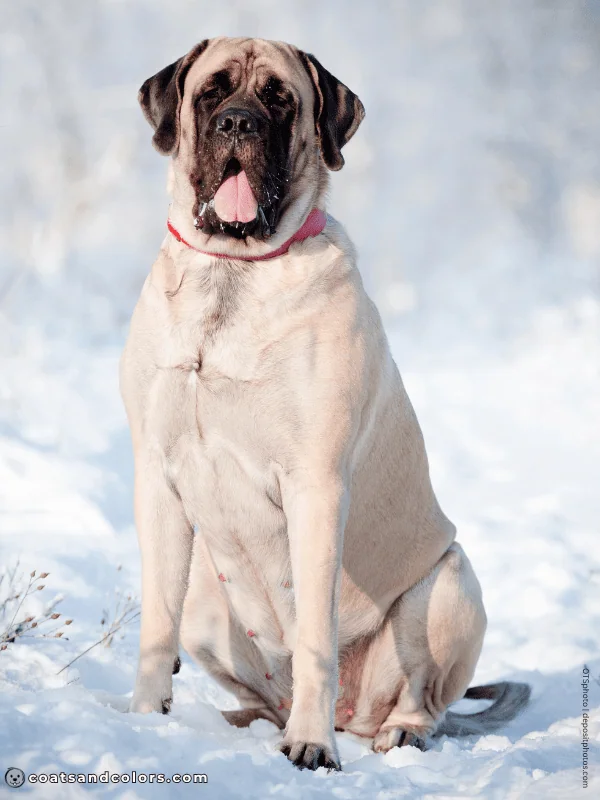
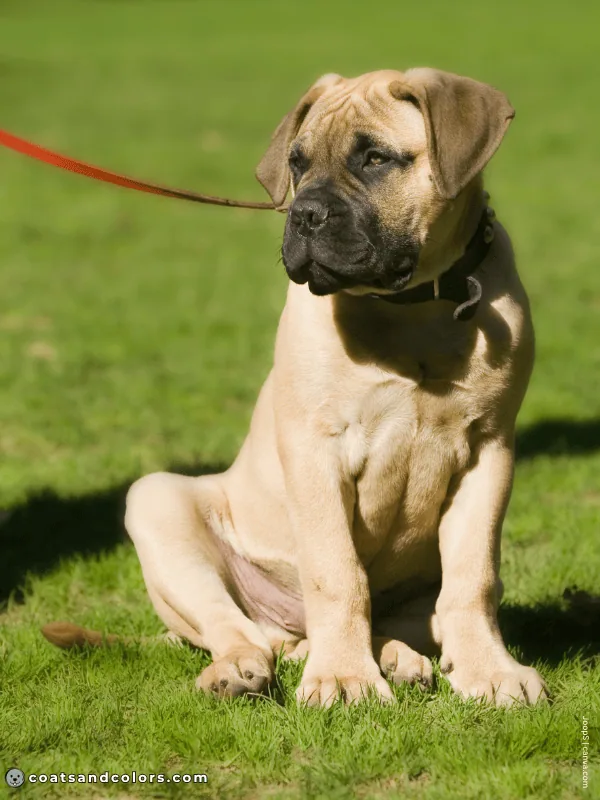
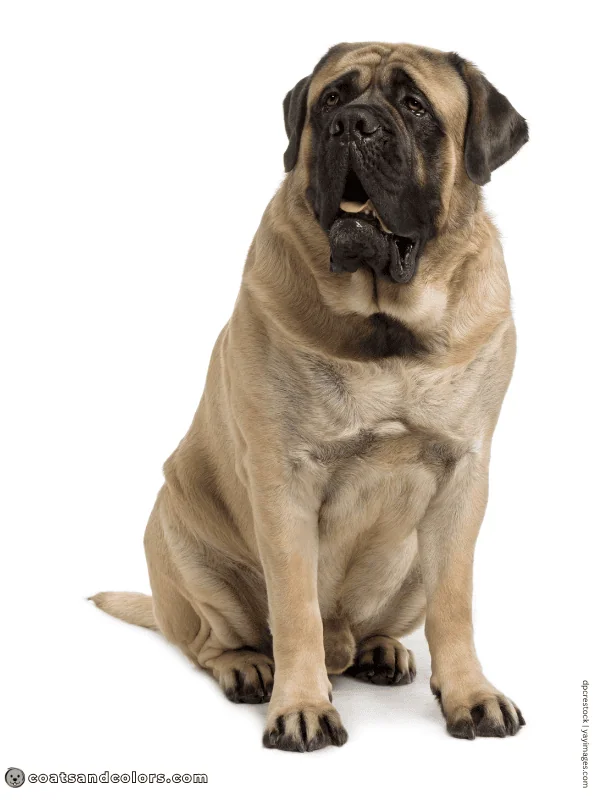
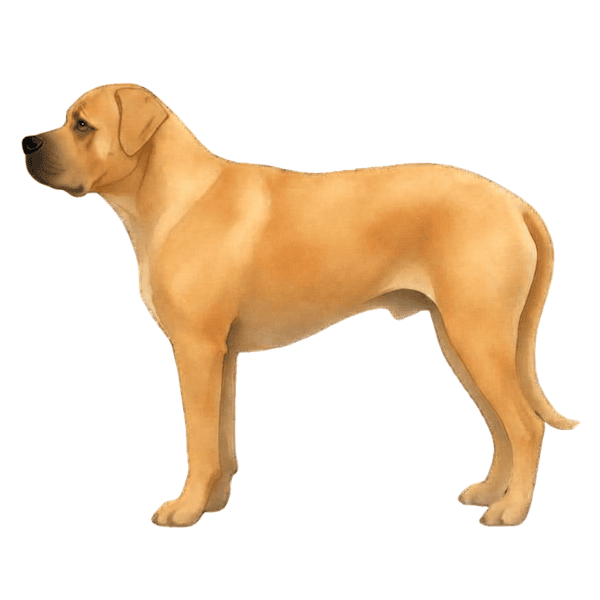
A fawn Mastiff has a clear sable pattern with a light tan color. They always have a black mask.
BASE PATTERN
sable, black mask
MERLE
–
OTHER
–
EUMELANIN
black
INTENSITY
fawn
WHITE
solid
Apricot
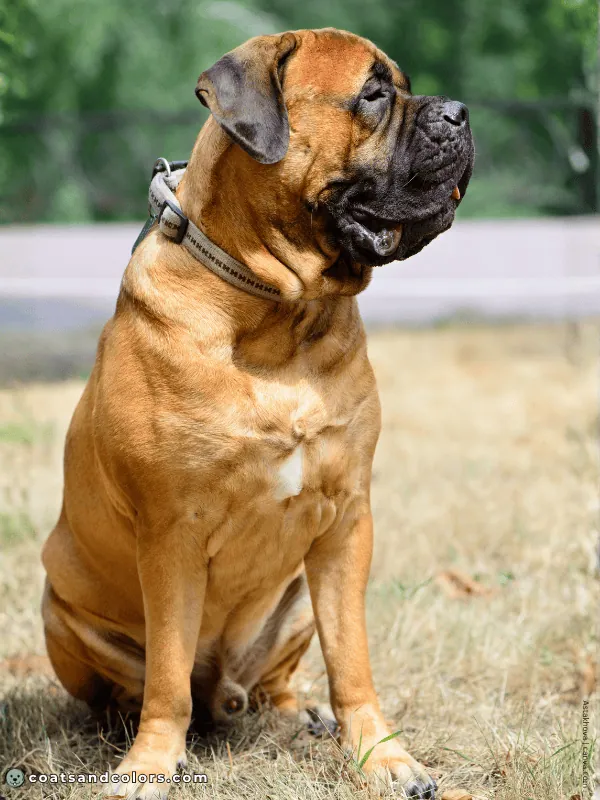
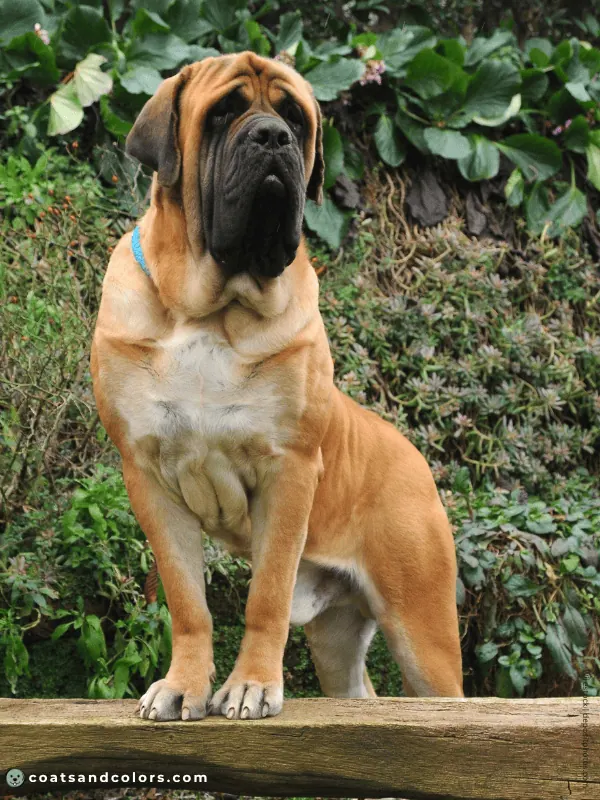
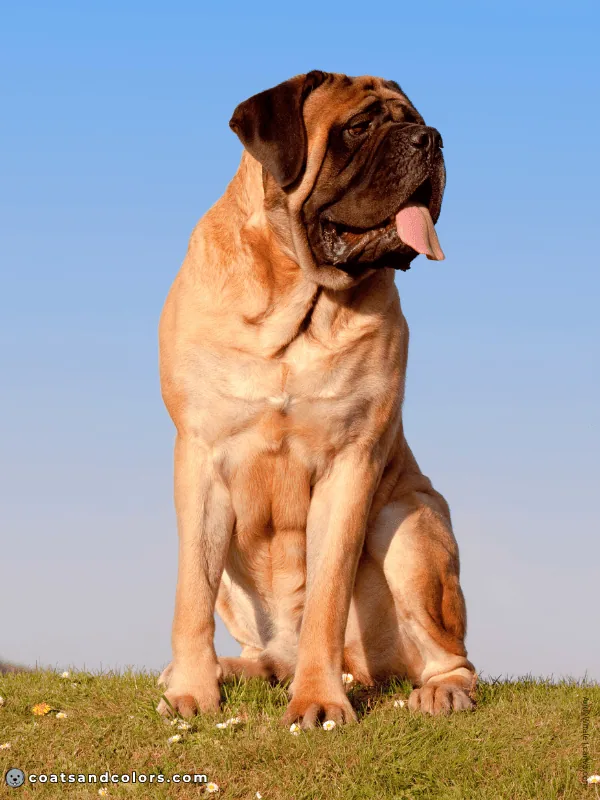
The apricot Mastiff is clear sable with a reddish fawn color. They always have a black mask.
BASE PATTERN
sable, black mask
MERLE
–
OTHER
–
EUMELANIN
black
INTENSITY
apricot
WHITE
solid
Brindle
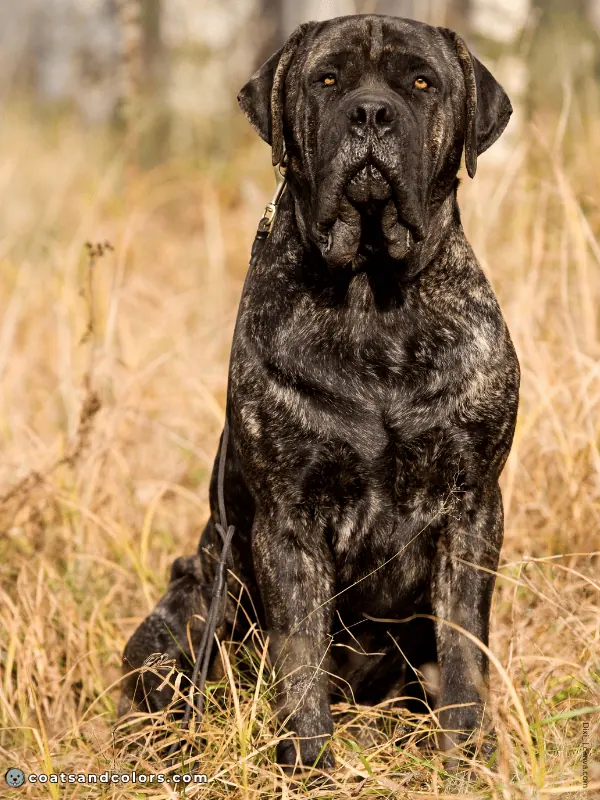
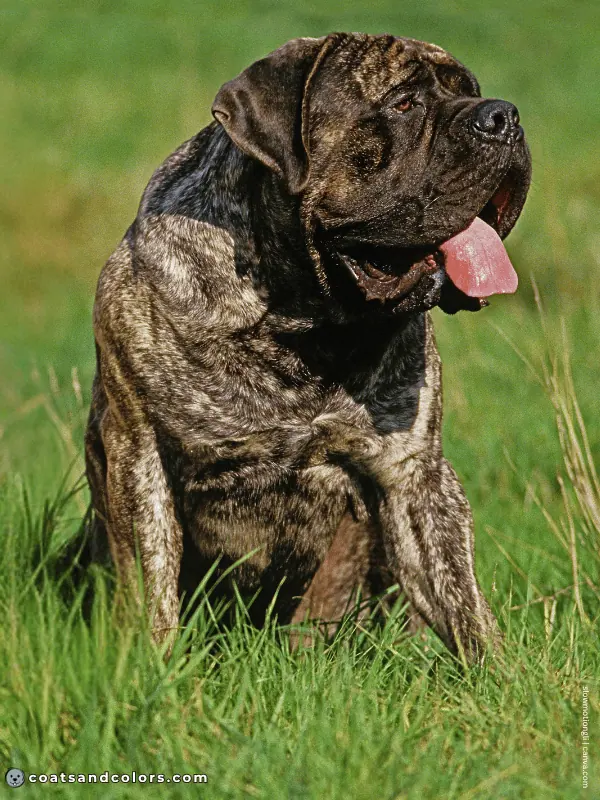
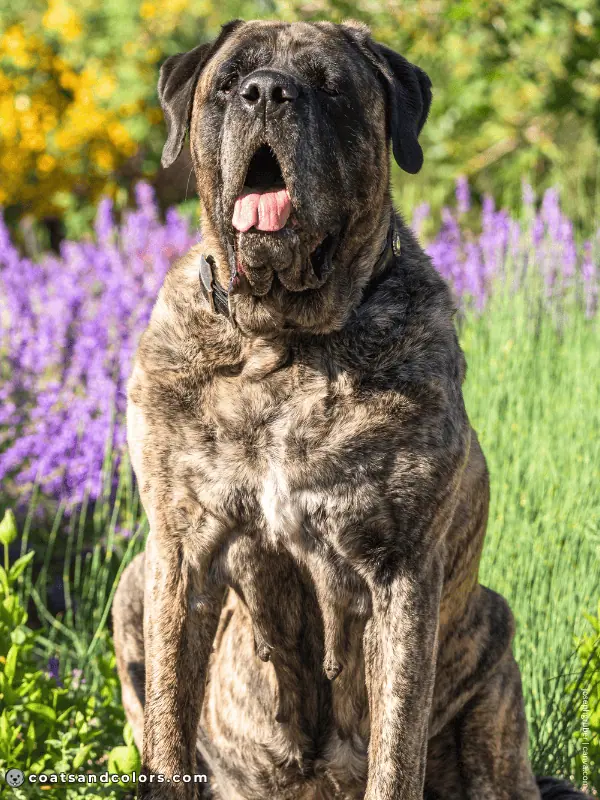
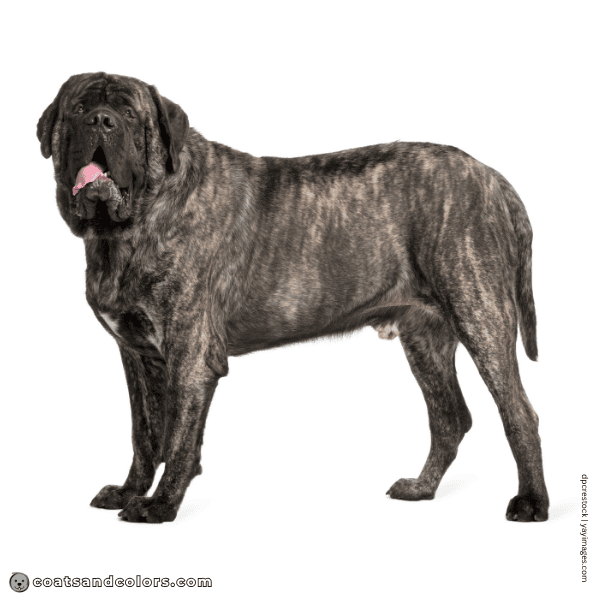
A brindle Mastiff is sable brindle (they have brindle stripes on top of a sable pattern) with a black mask. Brindle density can vary. The color underneath the black stripes can also vary, dogs can be either fawn brindle or apricot brindle.
Interestingly, the AKC standard requires that a Mastiff be “completely covered with very dark stripes,” suggesting that medium or even sparse brindle markings are not preferred.
BASE PATTERN
sable brindle, black mask
MERLE
–
OTHER
–
EUMELANIN
black
INTENSITY
fawn, apricot
WHITE
solid
Faulty Colors
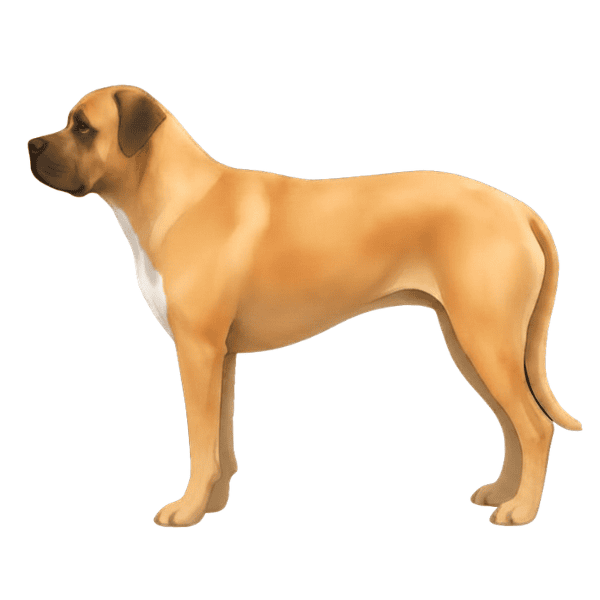
Any pattern other than sable and sable brindle (each with a black mask) is faulty. Any base color other than black, too. The black mask should not be too small, but should also not extend too far. The breed has a solid coat color, any white beyond a small patch on the chest is “too excessive”.

Base Patterns
The base pattern describes the placement of phaeomelanin and eumelanin in the coat. There is an epistatic hierarchy between these genes: A locus < K locus < E locus.
- The A locus controls the basic distribution of both pigment types.
- Next, the K locus can add black to the A locus pattern.
- Finally, the E locus regulates the general ability to produce black pigment.
A Locus
| Ay | clear sable |
| Ays | shaded sable |
Mastiffs typically have a clear sable pattern (Ay/Ay). All sable puppies can have some darker overlay at birth, but this will start to clear after a few days until dogs are solid fawn or apricot.
Some Mastiffs keep a little bit of darker shading in their adult coat, which hints at them having shaded sable (Ays). Dogs with Ay/Ays will be clear, dogs with Ays/Ays are predicted to show some sabling.
K Locus
| kbr | brindle |
| ky | wild-type |
Dogs with ky/ky express a normal sable pattern. Dogs with kbr/- will be brindle.
E Locus
| Em | black mask |
| E | wild-type |
Mastiffs should always have a black mask (Em/Em).
Puppies with two copies of normal pattern expression (E/E) will not have a melanistic mask. However, due to the very low frequency, it’s highly unlikely to match two carriers (Em/E) by accident. The recessive red variant (e) has likely also been present in the past, but has since been eliminated.
Ideally, the mask should be richly pigmented and cover the muzzle and eyes. Black masks also tend to cause black hairs on the ears, which is even part of the Mastiff breed standards. Some Mastiffs express a slightly extended mask. This can cause some dark shading to creep onto the chest and lower legs.
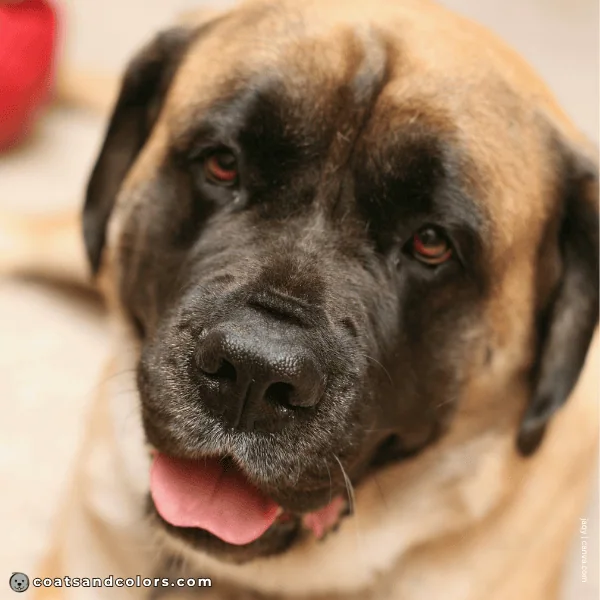
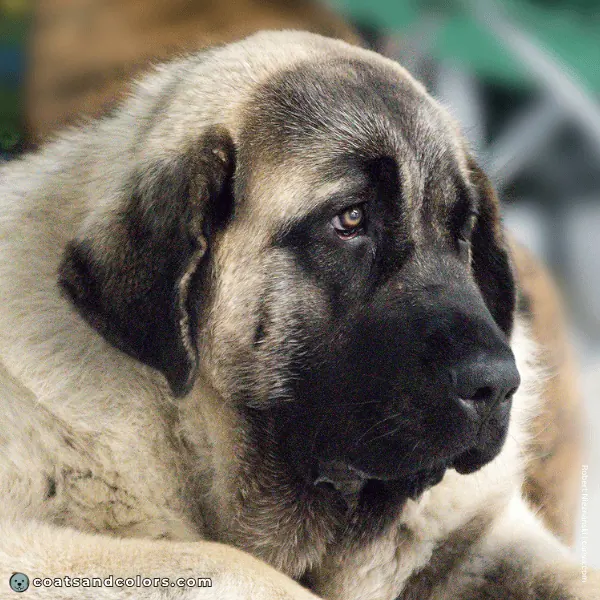
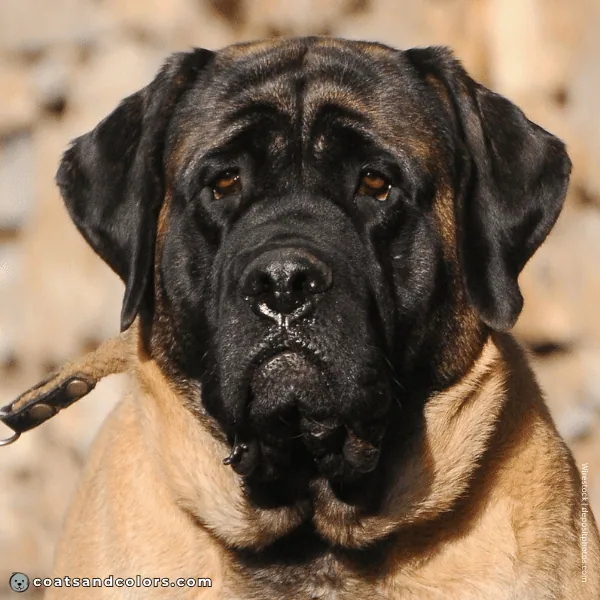
“Muzzle, ears, and nose must be dark in color, the blacker the better, with similar color tone around the eye orbits and extending upward between them.”
“Fault – Mask, ears, or nose lacking dark pigment.”
AKC Breed Standard[1]
“In any case, muzzle, ears and nose should be black with black around eye rims, and extending upwards between them.”
FCI Breed Standard[2]
Mastiff Base Patterns
| A LOCUS | K LOCUS | E LOCUS | PATTERN |
|---|---|---|---|
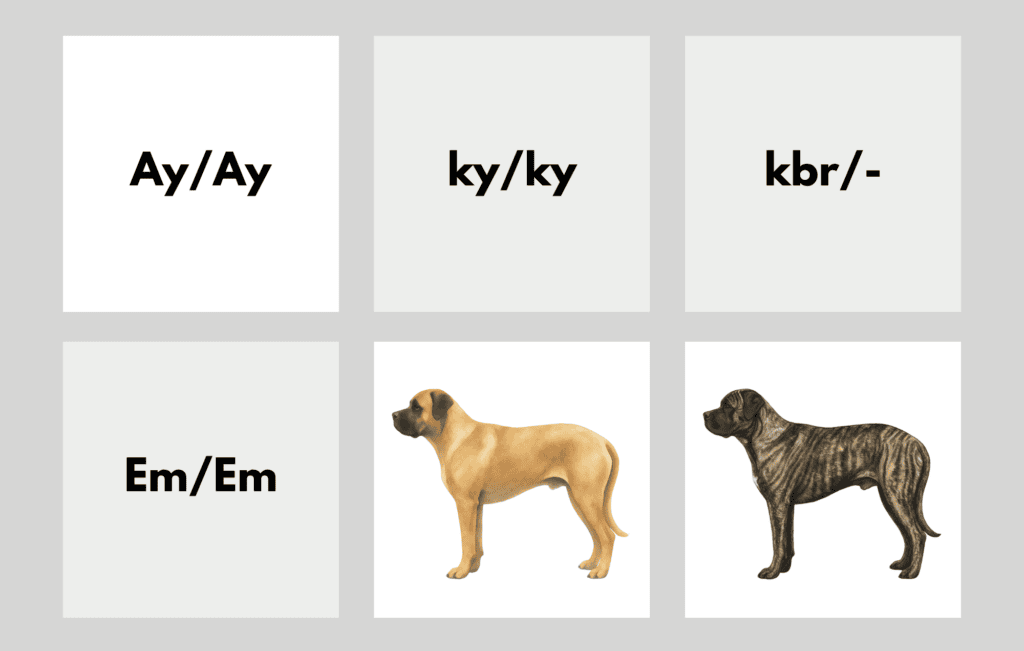
| Ay/Ay | ky/ky | Em/Em | sable, mask “fawn, apricot” |
| Ay/Ay | kbr/- | Em/Em | sable brindle, mask “brindle” |
And here is the English Mastiff color chart:
Base Colors
The base color is determined by the B locus and D locus.

B Locus
| B | black |
Mastiffs should all have black pigment (B/B). This automatically means that their mask, any brindle striping, their nose, eye rims, nails, whiskers, and lips will be black.
Some decades ago, there were some dogs with a chocolate fawn (b/b) pattern. Some people of that time called them “Dudley,” a term that often refers to lighter-than-typical nose pigment.
D Locus
| D | normal |
Mastiffs should all have normal pigment (D/D).
Red Intensity
The red colors divide Mastiffs into lighter yellow fawn dogs and darker orangey apricot dogs. Apricot resembles a reddish fawn color, the Royal Kennel Club even calls it apricot fawn.
But there is no strict definition, when exactly a darker fawn would be called an apricot and vice versa.

White Markings
Some residual white can happen in any breed. This is a hiccup during early development and can cause some white on the chest or the odd white toe. These minor spots will often fill in after a while.
Any white that goes beyond a small white patch on the chest is considered a mismark in this breed. The Mastiff Club of America already labels a broader white bib as “excessive white“.
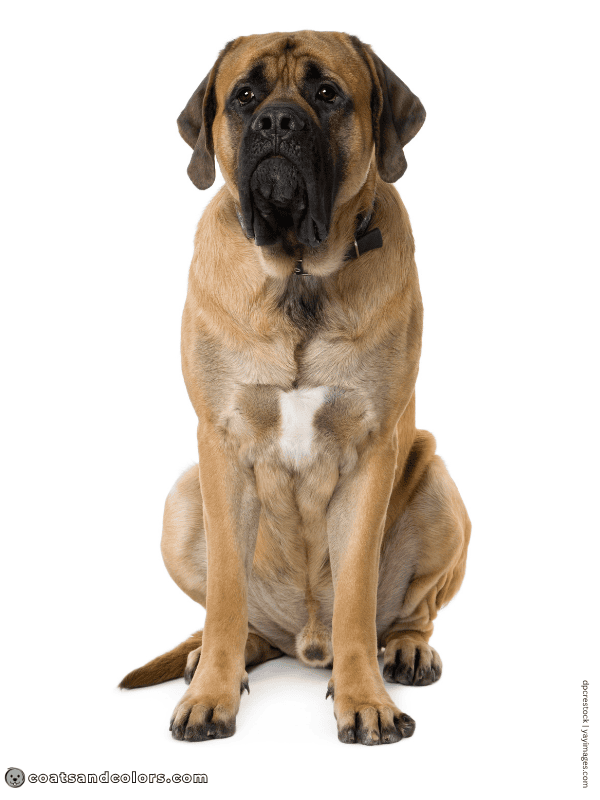
The piebald variant (sP) was found at a low frequency in Mastiffs[5]. But this is a linkage test and can not always reliably predict white markings in all breeds. And minimal whitehead expression can also not be ruled out as responsible for large white ties or white socks in some of these “excessively” marked dogs.
“A small patch of white on the chest is permitted.“
“Faults – Excessive white on the chest or white on any other part of the body.”
AKC Breed Standard[1]
“Excessive white on body, chest or feet is unacceptable.”
FCI Breed Standard[2]
Mastiff Eye Colors
The ideal Mastiff should have dark brown eyes.
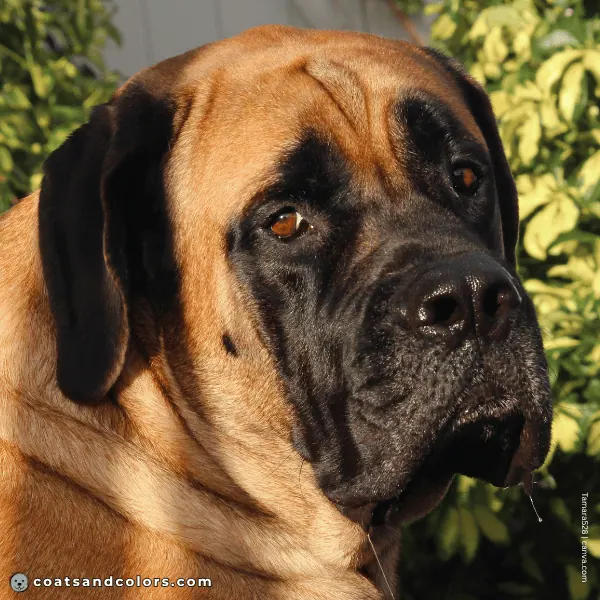
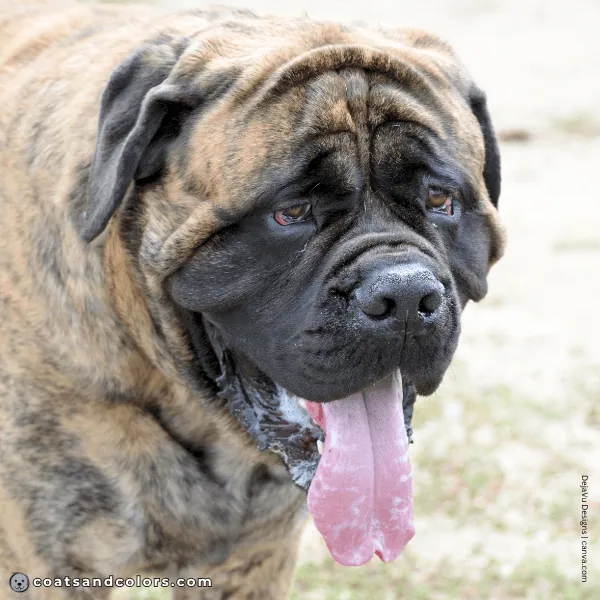
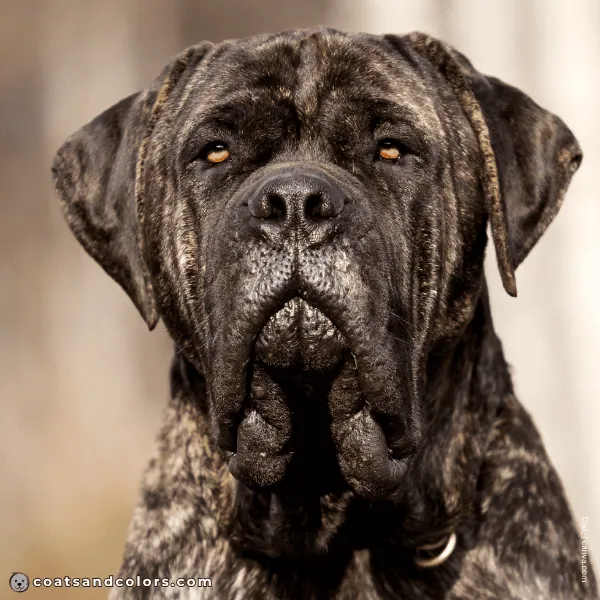
“Color of eyes brown, the darker the better, and showing no haw.“
“Light eyes or a predatory expression is undesirable.”
AKC Breed Standard[1]
“Colour hazel brown, darker the better, […]”
FCI Breed Standard[2]
Mastiff Nose Colors
All English Mastiffs produce black eumelanin, which always gives a black nose. According to the AKC standard, “…the blacker the better…“.
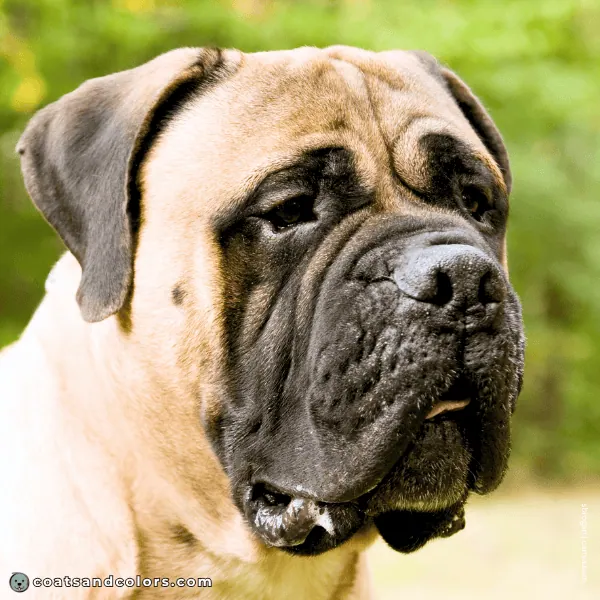

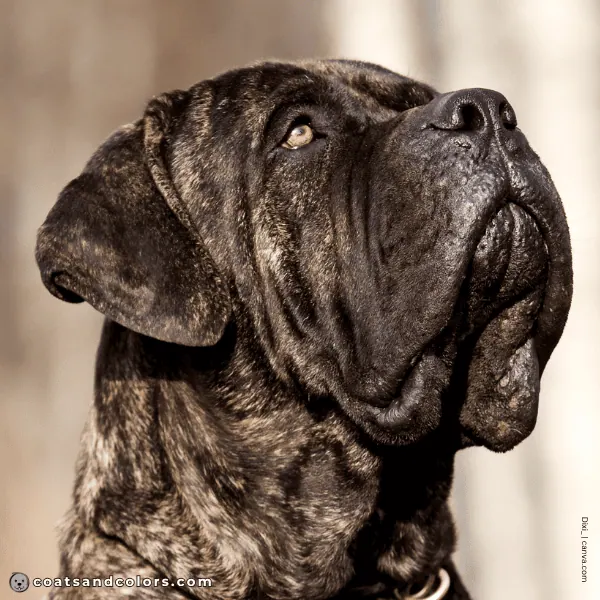
“Nose broad and always dark in color, the blacker the better…”
AKC Breed Standard[1]
“Nose black.”
FCI Breed Standard[2]
Mastiff Coat Type
Mastiffs should be short-haired, but with some undercoat.
“Outer coat straight, coarse, and of moderately short length. Undercoat dense, short, and close lying. Coat should not be so long as to produce “fringe” on the belly, tail, or hind legs.”
AKC Breed Standard[1]
“Short and close-lying, but coarse over neck and shoulders.”
FCI Breed Standard[2]
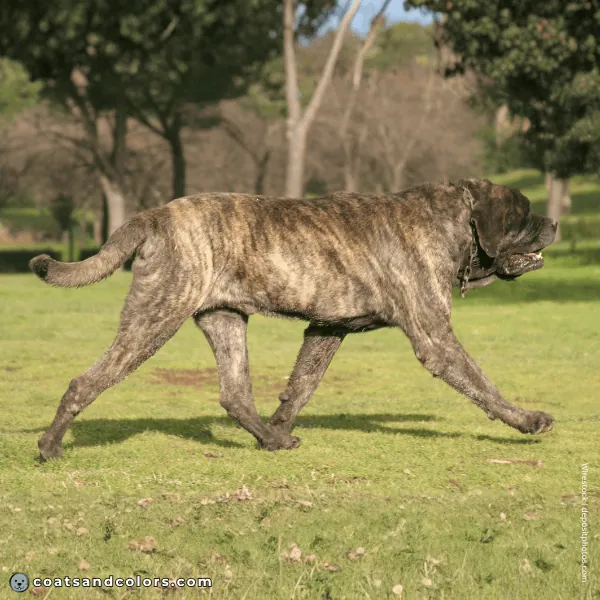
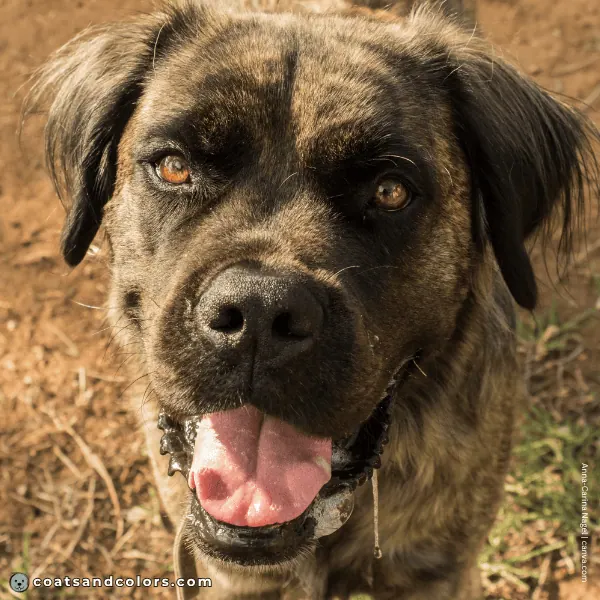
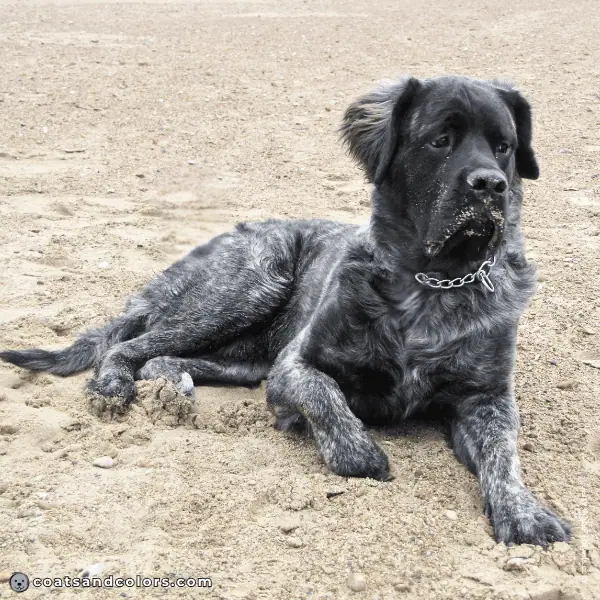
Some Mastiffs carry a recessive variant for long hair (N/l). Dogs that end up with two such alleles (l/l) will produce a fluffy phenotype (bully types often produce a very short long coat).
“Fault – Long or wavy coat.”
AKC Breed Standard[1]
Related Breeds
Old types of Mastiffs have historically been used as guard dogs. The modern English Mastiff was reinvented as a show dog with a shorter muzzle and a more massive build. It was among the first breeds to be recognized by the newly founded Kennel Club in the late 19th century.
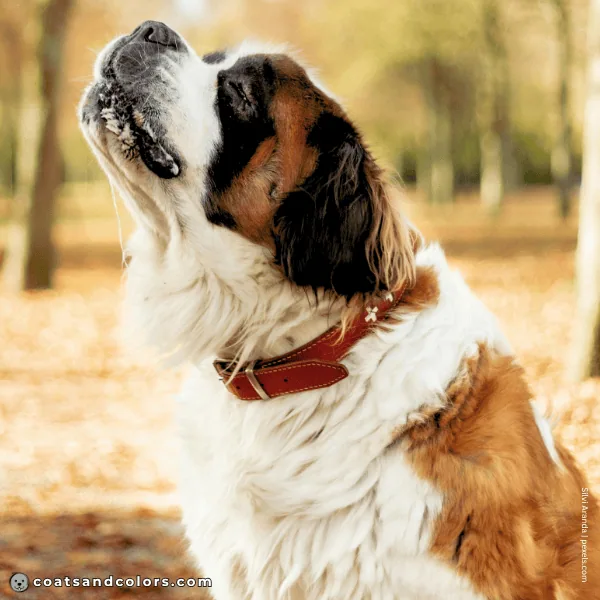
The breed declined in numbers and was restored in the post-war era (when only a single breeding female was left in Britain) by using similar breeds like St. Bernards and Dogue de Bordeaux.
Learn More

Links
[1] American Kennel Club (AKC): Mastiff
[2] Fédération Cynologique Internationale (FCI): Mastiff
[3] Royal Kennel Club (RKC): Mastiff
[4] Canadian Kennel Club (CKC): Mastiff
[5] Dreger et al. (2019). True Colors: Commercially-acquired morphological genotypes reveal hidden allele variation among dog breeds, informing both trait ancestry and breed potential. PLoS ONE 14(10): e0223995. https://doi.org/10.1371/journal.pone.0223995
[6] The Mastiff Club Of America: The Illustrated Mastiff Standard
Image Credits
AndyWhale/canva.com
Anna-Carina Nagel/canva.com
Astakhova/canva.com
DejaVu Designs/canva.com
Dixi_/canva.com
dpcrestock/yayimages.com
Foto-front/canva.com
Good Focused/canva.com
jaqy/canva.com
Jerry Vrabel/pexels.com
JoopS/canva.com
josephgruber/canva.com
OTSphoto/depositphotos.com
Robert Nieznanski/canva.com
sbrogan/canva.com
SergeyTikhomirov/canva.com
Silvi Aranda/pexels.com
slowmotiongli/canva.com
Tamara528/canva.com
White_bcgrd/canva.com
Wirestock/depositphotos.com
Hi! I’m Steffi. I am a biologist and a big time dog nerd. You are curious about coat color genetics? You’ve come to the right place! Read more.
1 thought on “English Mastiff Colors”
Comments are closed.