
Wondering what colors a litter could have? Enter the coat color genotypes of the sire and dam below, and this calculator predicts the odds for each puppy to have this color or that.
How To Use This Calculator
- Use the dropdowns to pick two alleles per gene for the sire and dam.
- Use the small ? next to each gene to read more about it.
- You can Lock a parent genotype to protect it from accidental changes.
- You can use Swap Sire/Dam to exchange the genotypes of unlocked parents.
- You can use Reset to wipe the genotype input for unlocked parents.
- Click Calculate Puppy Colors. This shows the odds for a puppy to have a specific color.
- Scroll further down to see the Punnett squares for each gene.
- If you make changes to the parents, any prior calculations will disappear.
- Click Share These Results to copy a link that opens your exact cross.
Genetic Testing
Don’t know your dog’s genotype? A DNA test is the most reliable way to find out.
Read the list of color genes to see which letters to look for in a test report.
Which Genes & Alleles Are Included?
The puppy color calculator includes all the main color genes:
- A locus: sable (Ay, Ays), agouti (aw), saddle (asa), tan point (at), recessive black (a)
- K locus: dominant black (KB), brindle (kbr), wild-type (ky)
- E locus: masks (Em), normal extension (E), domino (eA, eG), recessive red (e)
- B locus: black (B), brown (b)
- D locus: normal base color (D), diluted base color(d)
- S locus: solid (S), white markings, piebald (sP)
- M locus: advanced merle genetics (Mh, M, Ma+, Ma, Mc+, Mc, m)
What It Does Not Include
The calculator does not include coat type (furnishings, coat length, curly, hairless, etc.).
There are some traits that are not testable or that genetic testing can not predict reliably. This includes red intensity, whitehead, graying, countershading, seal, or ticking.
The calculator also leaves out some very breed-specific traits such as cocoa in French Bulldogs and harlequin in Great Danes or eH domino in Spaniels.
Keep in mind that parents and puppies can look different from the prediction because of these traits.
How to Read Your Results
Odds are per puppy!
The results show the chance that any one puppy gets a certain coat color. They do not predict how many puppies of each color a litter will have. A 25% chance does not mean exactly one puppy in four.
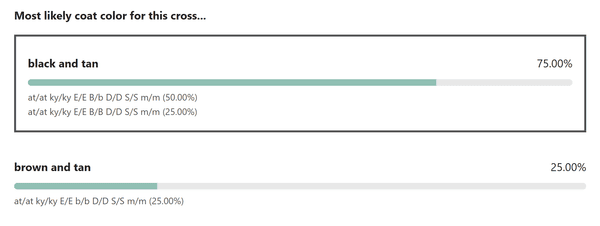
Most likely colors.
When one or a few outcomes are clearly more likely than the rest, they appear in a box at the top.
Matching genotypes.
Under each phenotype outcome you can see every genotype that produces it, with its own odds.
Punnett squares.
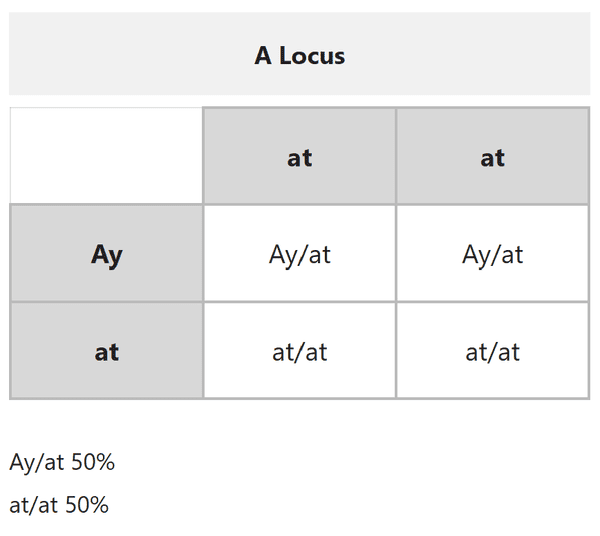
Each gene gets its own Punnett square with the odds of all possible outcomes.
Want a refresher? Read our guide to Punnett squares and coat color inheritance.
A Note on Merle
The merle alleles in this calculator use the scale developed by Mary Langevin.
| Allele | Name | Length |
|---|---|---|
| m | non-merle | – |
| Mc | cryptic merle | 200-230 bp |
| Mc+ | cryptic merle + | 231-246 bp |
| Ma | atypical merle | 247-254 bp |
| Ma+ | atypical merle + | 255-264 bp |
| M | classic merle | 265-268 bp |
| Mh | harlequin merle | 269-280 bp |
To know which merle allele your dog has, you need to test at a company that offers high-resolution testing and has a proven track record of providing reliable results. Some companies like Embark can determine the presence of merle, but not the actual allele (instead, they report M* as placeholder).
It’s common knowledge that breeding with merle parents can produce health issues.
Puppies that inherit two longer merle alleles (such as M/M or Mh/Ma+) are at risk for a “double merle” phenotype, where extended pigment loss causes vision or hearing problems.
Not every homozygous merle puppy is at risk, there are safe combinations such as M/Mc.
Merle issues very easily be avoided if breeders do proper testing and make safe breeding choices to avoid risky combinations. To help with this, merle results in my calculator show a risk label.
The calculator marks high risk combinations in red and lower-risk combinations in orange so you can avoid risky combinations. But: This calculator is not a substitute for advice from a health professional.
What Is Merle Mosaicism?
Longer merle alleles can shorten during cell division early in development.
This causes a mosaic genotype where some cells have the original allele and some cells have a shortened allele. This often affects the germline, so a dog can potentially pass on either allele.
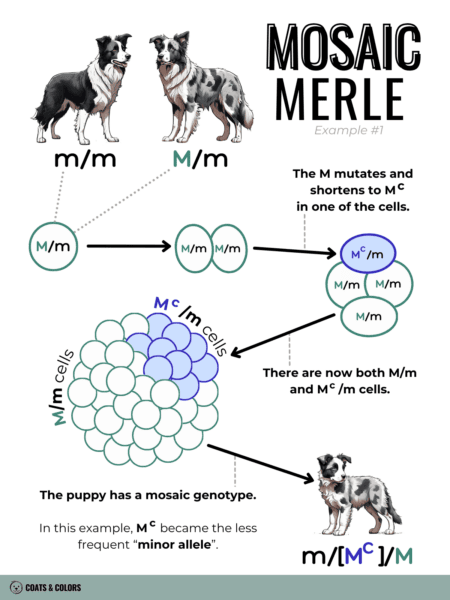
If your dog tested with a mosaic result, click Show Mosaicism Dropdowns under the M locus.
You can then unlock up to three extra rows, one for each shortened allele (e.g. a m/M[Mc] result translates to the dog having both an M/m and Mc/m genotype, so you need one extra row).
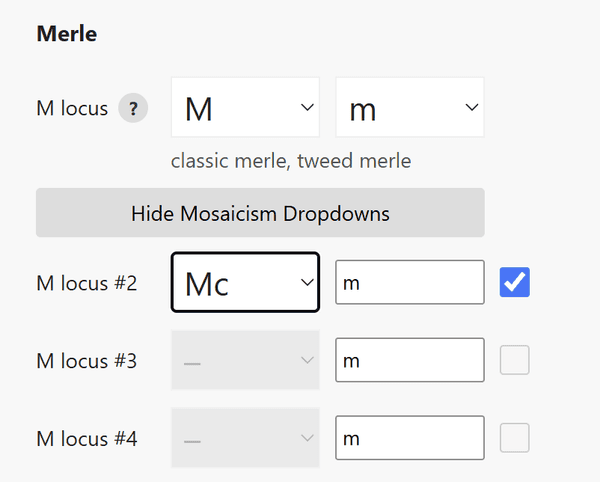
The calculator makes two assumptions here:
Only the longer of the two original merle alleles is assumed to have shortened. The longer allele and all of its shorter variants share a chance of 50%, which this calculator distributes equally among original and shortened alleles (25% for 2 alleles, 16.7% for 3 alleles, 12.5% for 4 alleles).
| Parent Genotype | Possible Parent Cells | Possible Gametes (%) | Calculator Assumptions |
|---|---|---|---|
| m/Mh/Ma | Mh/m, Ma/m | Mh, Ma (50%) — m (50%) | Mh (25%) Ma (25%) — m (50%) |
| m/Mh/Ma/Mc | Mh/m, Ma/m, Mc | Mh, Ma, Mc (50%) — m (50%) | Mh (16.7%) Ma (16.7%) Mc (16.7%) — m (50%) |
| m/Mh/M/Ma/Mc | Mh/m, M/m, Ma/m, Mc/m | Mh, M, Ma, Mc (50%) — m (50%) | Mh (12.5%) M (12.5%) Ma (12.5%) Mc (12.5%) — m (50%) |
Real inheritance in mosaic dogs is generally much more uneven and less predictable.
Dogs typically have less frequent minor alleles and more frequent major alleles indicated int heir mosaicism result, e.g. m/M[Mc] means there are more M/m than there are Mc/m cells.
But we should treat puppy calculation numbers as estimates anyway, so there’s no point in making the “puppy math” more complicated than it already is. For merle breeders, a good rule of thumb is to always base breeding decisions on the longest possible allele that a parent can pass on, even if it is the less frequent allele (e.g a m/Mc[Mh] dog can potentially pass on Mh, even if Mc or m are more likely).
Frequently Asked Questions
Getting familiar with coat color genetics in dogs can take some time. I created this calculator to make your life easier and help you predict puppy coat colors with ease.
Can I use this puppy coat color calculator for mixed breeds?
The only thing that matters is that you know the genotypes of the parents. DNA testing for coat color does not care about breed, color genetics are the same for all dogs.
Why doesn’t my puppy match the prediction?
Some untestable color genes and modifiers, coat type, and rare breed-specific variants can change the final look. The tool covers the main color genes, not every trait.
Why does my dog’s color look different from what its genotype says?
Some genes can hide the effect of other genes. For example, dominant black (KB) hides the A locus pattern. The calculator interprets your input according to current knowledge.
Can I share my results?
Yes. Click Share These Results to copy a link that you can share. Anyone who opens it sees the same parent genoytpes and puppy predictions.
Disclaimer
This calculator is intended for informational purposes.
I can obviously make no guarantee as to the accuracy of the results. Confirm genotypes with a DNA test before making breeding decisions. And consult with an expert if you have questions about the health risks associated with certain coat colors, particularly merle, color dilution, and extreme white.
Learn More


Image Credits
Ruben Boekeloo/pexels.com
Hi! I’m Steffi. I am a biologist and a big time dog nerd. You are curious about coat color genetics? You’ve come to the right place! Read more.