
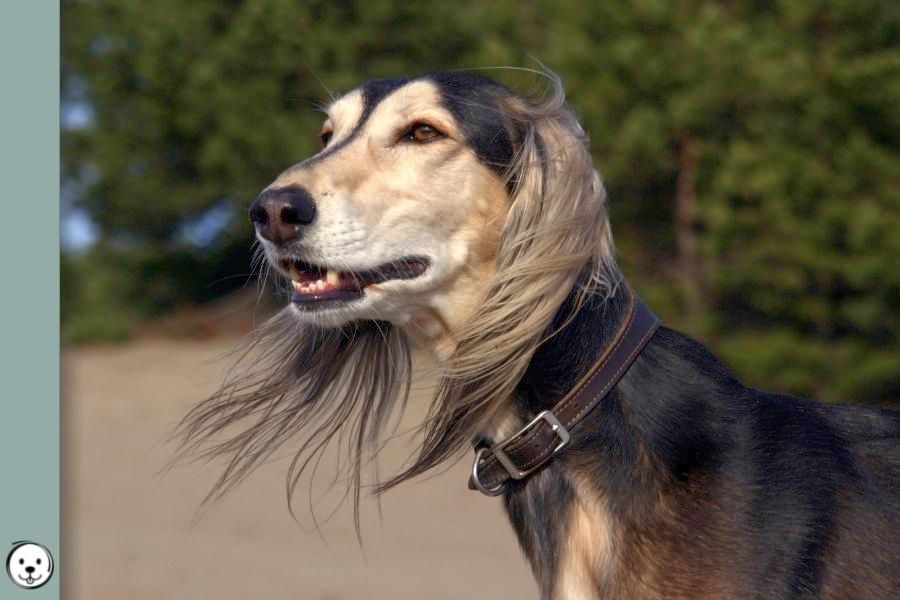
The eG allele at the E locus is mainly found in sighthound breeds. It modifies any other pattern by reducing eumelanin and increasing phaeomelanin.
What is Grizzle?
Domino changes any base pattern by decreasing eumelanin expression.
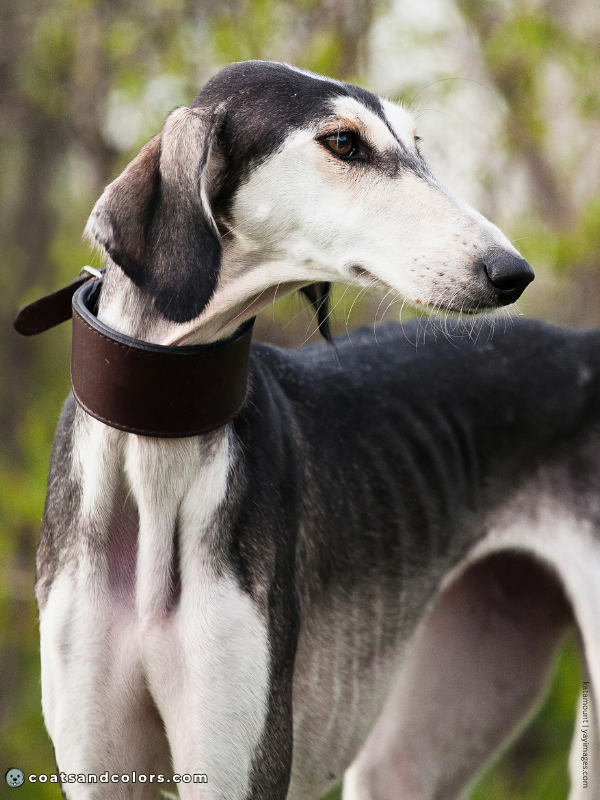
In Afghan Hounds, the tan point domino pattern was named after show dog “Tanjores Domino” in the 1950s. Other breed have their own terms for various grizzle patterns, e.g. chinchilla or grizzle.
Grizzle is a type of domino (partial recessive red).
And domino can modify any pattern to show less black. But the resulting phenotypes vary greatly, depending on the original K locus and A locus pattern (e.g. agouti domino vs black domino).
Grizzle patterns can be hard to pinpoint since the effect of eG/- can vary so much.
Similar to Northern domino, grizzle reduces dark hair banding in the dorsal coat. It makes all the areas with eumelanin smaller. So the ventral tan surface gets larger and is often light in color.
Domino also typically causes pale undercoat, pale whiskers, and pale hair roots.
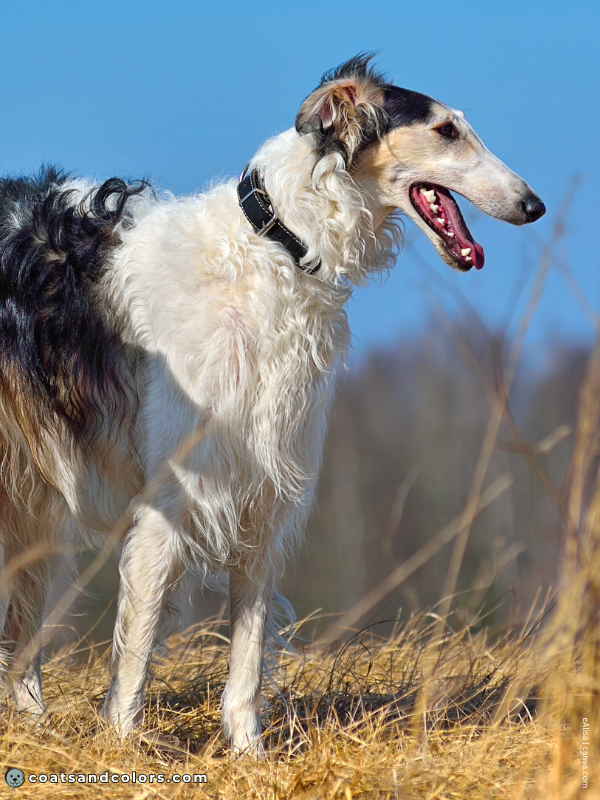
The eG Allele
The E locus is part of the mechanism that tells pigment cells what pigment type they should produce. The K locus and A locus depend on a functional E locus to be expressed.
But grizzle domino is caused by the eGrizzle allele, which essentially represents a reduced-function variant of the E locus. It’s also called partial recessive red.
Grizzle domino eG does not inhibit all eumelanin synthesis (only recessive red e/e fully removes all the eumelanin from the coat). But eG/- still greatly reduces the amount of eumelanin.
The eG allele has an (incomplete) recessive relationship to melanistic mask (Em) and wild type (E), but is (incomplete) dominant over recessive yellow (e).
The authors of the original study describing this new allele put “EG“ over E in the dominance theory of the E locus series (“Em>EG>E>e”). They also came to the false conclusion that grizzle might only affect tan points [1]. Both of these statements have been proven untrue many times over by now. But unfortunately, they are still repeated all over the internet.
This is the true hierarchy at the E locus:
Since eG is recessive to mask Em and wild type E, some dogs can carry grizzle without expressing it (Em/eG, E/eG). However, there likely is some weak incomplete dominance.
Some grizzle domino carriers produce slightly less eumelanin compared to non-carrier siblings (things like faded masks in Em/eG dogs or large tan points in E/eG dogs).
A grizzle pattern is only expressed in dogs that are either eG/eG or eG/e.
Some breeders think that maybe eG/e might cause an even paler coat than eG/eG, again implying a semi-dominant relationship between E locus alleles.
Combinations of domino alleles such as eG/eA are extremely rare, so there is hardly any information on the interaction between different domino alleles[3].
Sighthound Domino Phenotypes
Since eG affects many sighthound breeds, we have a good basic understanding of the effect of grizzle on typical sighthound colors such as sable, sable brindle, or tan points.
Many base colors (e.g. liver) or patterns (e.g. merle) are less common or simply don’t exist in sighthounds. So some combinations like grizzle merle or liver grizzle are very rare.
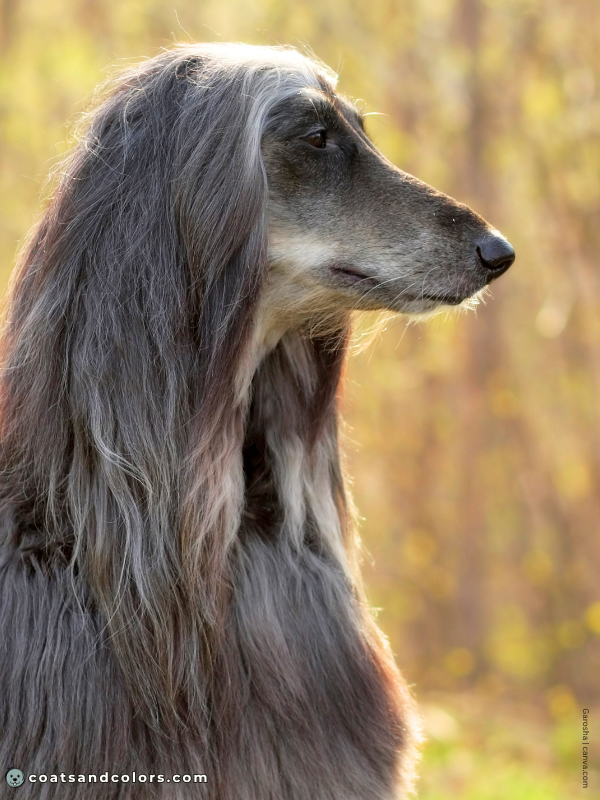
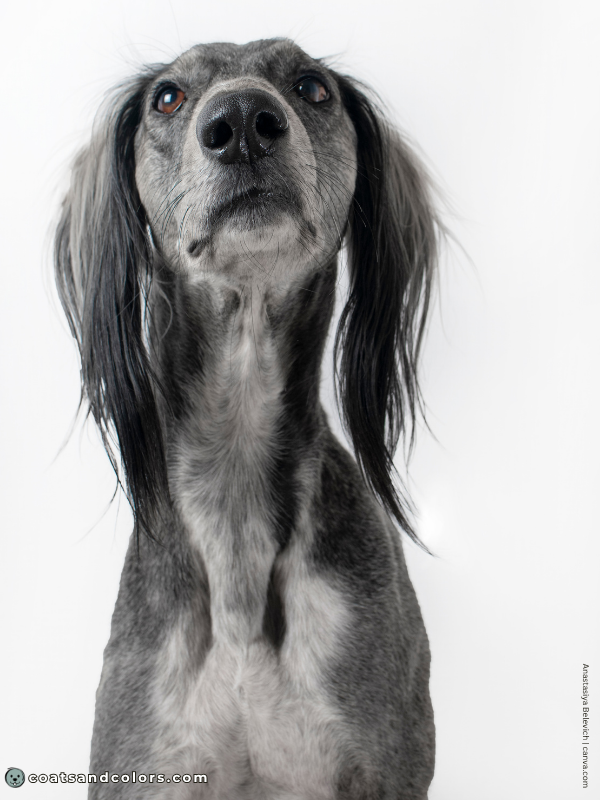
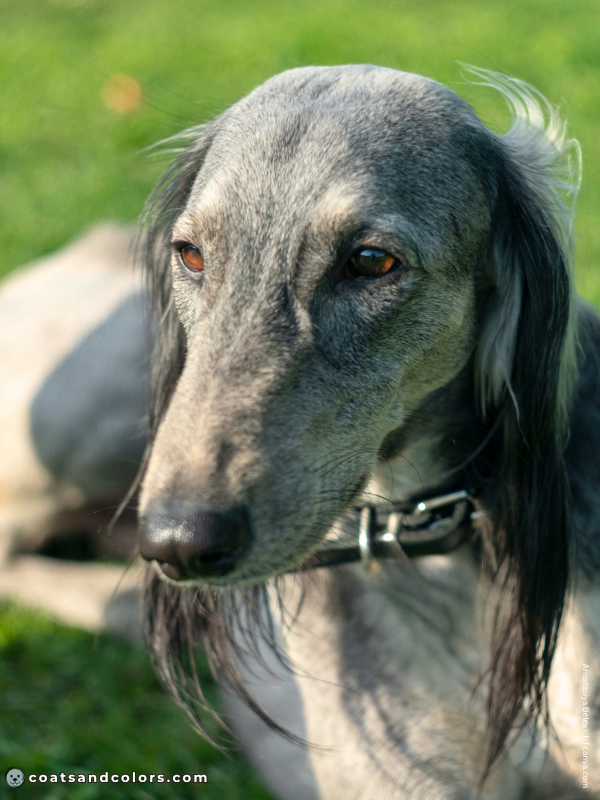
Dominant Black Grizzle
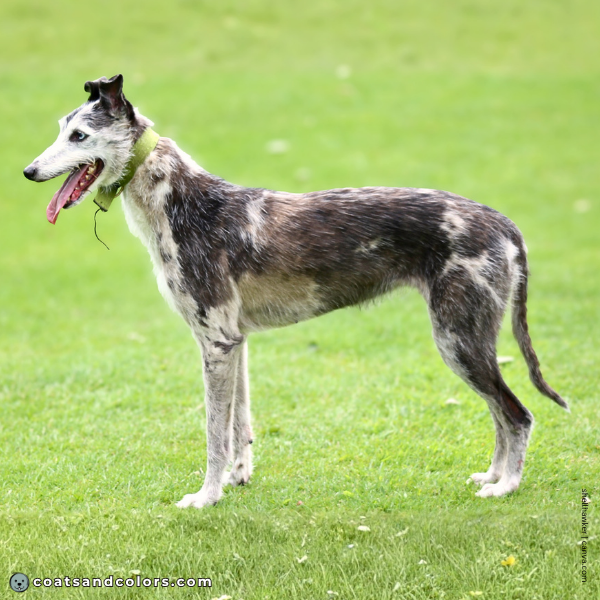
A dominant black KB variant would normally inhibit the A locus and replace it with a solid dark coat. But KB/-eG/- can somehow still cause residual expression of the A locus.
On a KB domino dog with hidden tan points (KB/- eG/- at/-), this often causes a shaded grizzle phenotype with an almost patterned look, e.g. a dark top and a lighter underside.
On a KB domino dog with hidden sable (KB/- eG/- Ay/-), it often causes a more even grayish coat called chinchilla, bronze, blue domino, blue grizzle, or simply gray.
Brindle Grizzle
Brindle adds dark stripes of eumelanin on top of areas with phaeomelanin.
But on a sable brindle domino dog (kbr/- Ay/- eG/-), the striping is often reduced to some washed-out “phantom brindling“. Striping can sometimes fully vanish from the muzzle or legs.

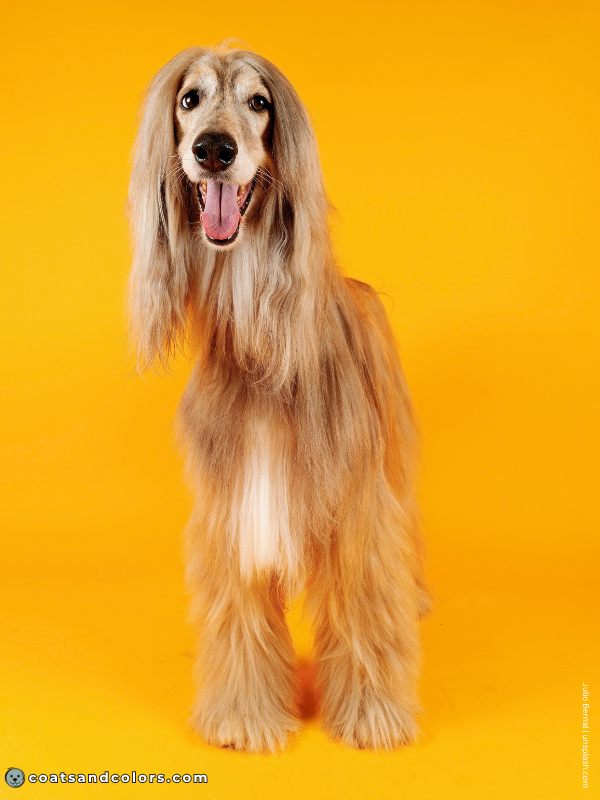
On tan point brindle domino (kbr/- at/- eG/-), some faint brindle striping can be visible on the faded black back and flanks. Simultaneously, eG often deletes striping from the face and leg tan markings!
Sable Grizzle
Grizzle removes eumelanin, so it can remove dark shading from a sable coat.
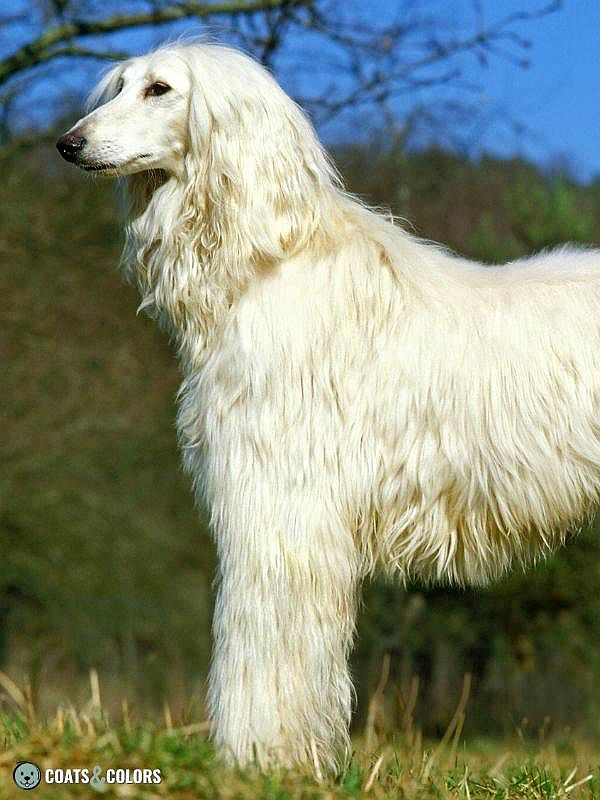
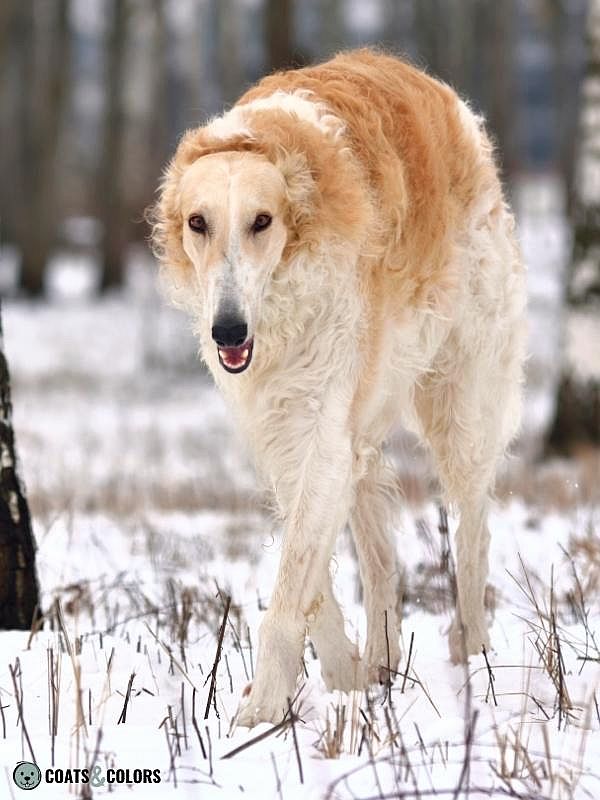
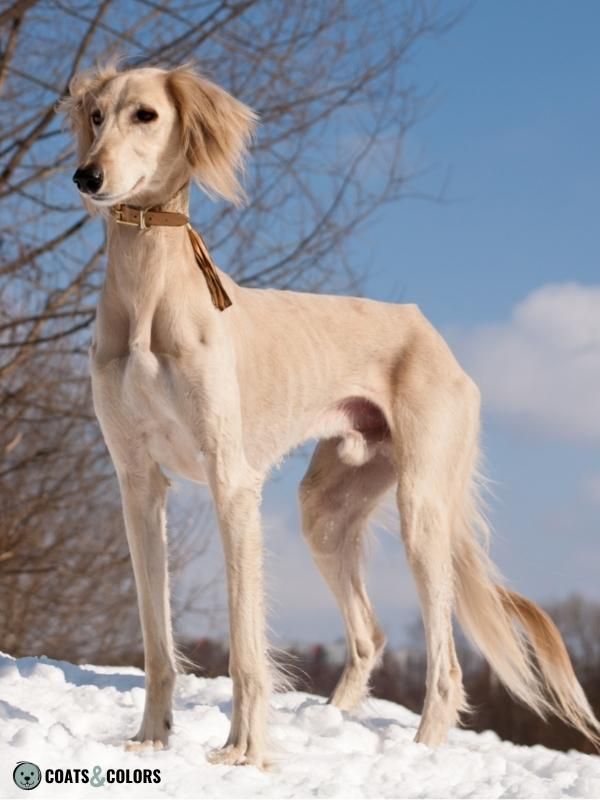
In combination with lighter phaeomelanin and pale undercoat, this can add up to create a very light and purely cream or yellow coat.
A golden domino or cream domino puppy is sometimes called newsprint cream (due to some faint residual puppy shading in their dorsal coat). Adults can hardly be distinguished from recessive red dogs.
Agouti Grizzle
Not many sighthounds come in agouti.
While Northern domino is often combined with aw, this is less common in sighthounds. Some of the few breeds that I can think of with agouti grizzle are Chart Polski or Taigan.
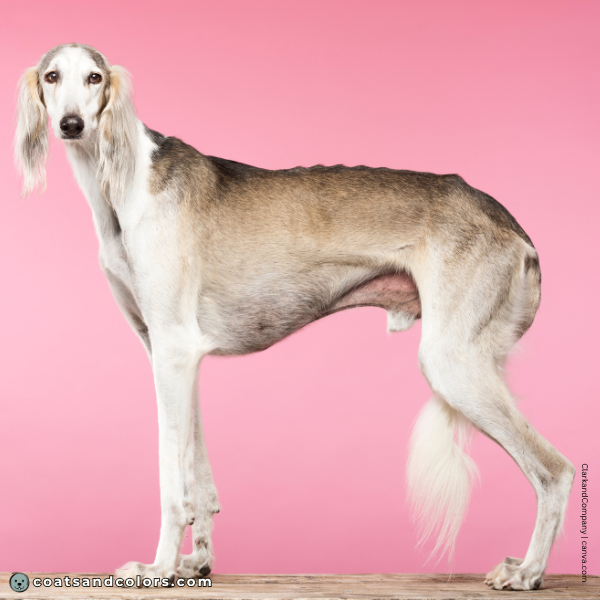
It often causes a widow’s peak and reduced dark hair banding, which can mimic shaded sable. Affected dogs have light open-face markings, maybe with some hints of residual black banding.
A darker agouti grizzle can easily mimic a lighter tan point grizzle.
Saddle Grizzle
In dogs with a saddle pattern, the dark saddle can get very small or even be reduced to only some darker hairs on the back of the dog. Not many sighthounds have saddles, so this is rare.
Tan Point Grizzle
This is one of the most common grizzle domino phenotypes. Typically, it is expressed as a pale face with a widow’s peak or residual dark nose bar. Affected dogs often have a pale red intensity.
A tan point pattern with grizzle will cause lighter and bigger tan points and create large pale “open” face markings. This is characteristic of the tan point grizzle phenotype.
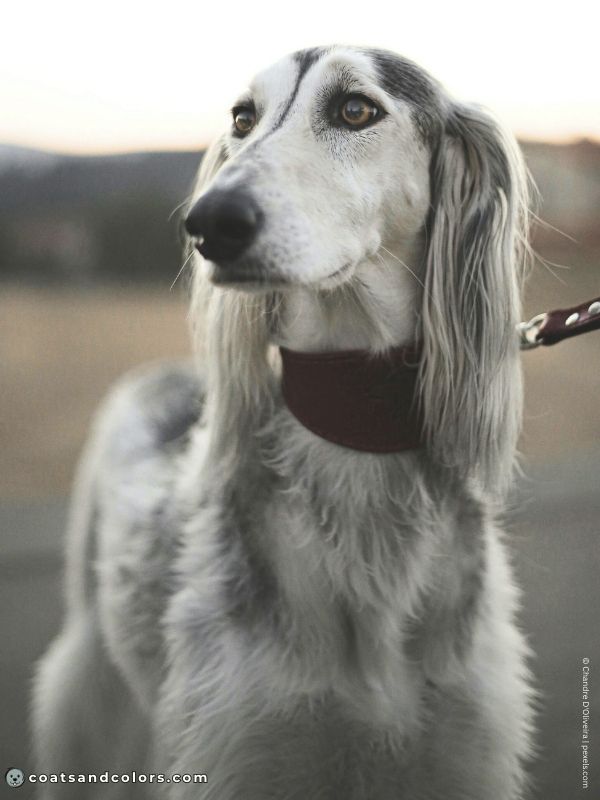
This pattern can sometimes remove lots of eumelanin from the back and resemble shaded sable. In some dogs, this phenotype is even called silver sable, golden sable, etc.
But most dogs stay quite dark with only some lighter undercoat and light hair roots. In most dogs, pointed grizzle creates a very shaded look with a dark overlay on paler than average phaeomelanin.
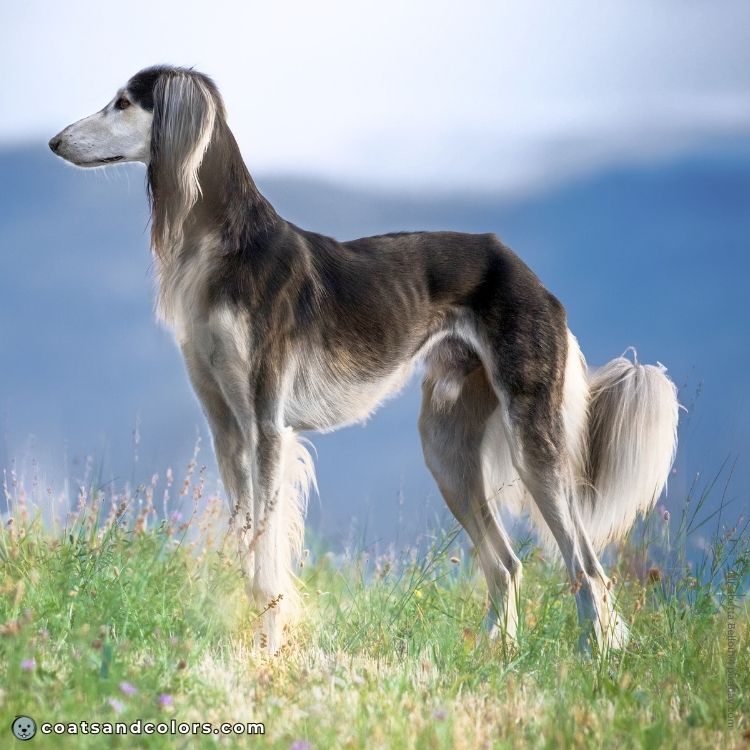
There are many different names for different patterns of this type.
Depending on the background color, different color combinations are called ivory grizzle, cream grizzle, silver grizzle, yellow grizzle, or cream domino, golden domino, cream domino, silver domino, etc.
But in some dogs, phaeomelanin will not fade to cream or yellow. Grizzle with normal reddish phaeomelanin expression is sometimes called red domino, red grizzle, or deer grizzle.

Breeds with Grizzle
Grizzle domino is common in some closely related sighthound breeds. It was also confirmed in some other dog breeds that mostly originate from Asia or the Middle East[2].
A 2024 study found an allele frequency of 40.9% in Salukis, 36.8% in Afghan Hounds, 50.0% in Borzois, and 33.3% in Polish Greyhounds. The allele frequency in a large dataset of breeds was only 0.37%. So the eG variant is rare in dogs, but common in sighthounds[4].
- Afghan Hound
- Borzoi
- Chart Polski
- Saluki
- Taigan
- Tazy
- Hortaya Borzaya
- Silken Windhound
- Silken Windsprite
- Xigou
- Caravan Hound
- Anatolian Shepherd Dog
- Tibetan Mastiff
- Canaan Dog
- Central Asian Shepherd Dog
- Kritikos Lagonikos
In some other breeds, the eG variant occurs at a very low frequency. So, dogs actually expressing a domino pattern should be very rare[2]. But it shows how much this allele got around, eh?
- Akita
- Alaskan Husky
- American Foxhound
- Black Russian Terrier
- Caucasian Shepherd Dog
- Dachshund
- Greyhound
- Large Munsterlander
- Maltese
- Manchester Terrier
- Mi-ki
- Norwegian Buhund
- Norwegian Lundehund
- Pembroke Welsh Corgi
- Pomeranian
- Poodle
- Puli
- Tibetan Mastiff
- Treeing Walker Coonhound
- Yorkshire Terrier
Learn More
Links
[1] Dayna L. Dreger, Sheila M. Schmutz. A New Mutation in MC1R Explains a Coat Color Phenotype in 2 “Old” Breeds: Saluki and Afghan Hound. Journal of Heredity, Volume 101, Issue 5, September-October 2010, Pages 644–649. https://doi.org/10.1093/jhered/esq061
[2] Dreger DL, Hooser BN, Hughes AM, Ganesan B, Donner J, Anderson H, et al. (2019). True Colors: Commercially-acquired morphological genotypes reveal hidden allele variation among dog breeds, informing both trait ancestry and breed potential. PLoS ONE 14(10): e0223995. https://doi.org/10.1371/journal.pone.0223995
[3] Anderson, H., Honkanen, L., Ruotanen, P. et al. Comprehensive genetic testing combined with citizen science reveals a recently characterized ancient MC1R mutation associated with partial recessive red phenotypes in dog. Canine Genet Epidemiol 7, 16 (2020). https://doi.org/10.1186/s40575-020-00095-7
[4] Honkanen et al. (2024). Canine coat color E locus updates: Identification of a new MC1R variant causing’sable’coat color in English Cocker Spaniels and a proposed update to the E locus dominance hierarchy. Animal Genetics. https://doi.org/10.1111/age.13398
Image Credits
Chandre D’Oliveira/pexels.com
Julio Bernal/unsplash.com
Anastasiya Belevich/canva.com
katamount/yayimages.com
shellhawker/canva.com
ClarkandCompany/canva.com
cynoclub_1/yayimages.com
Garosha/canva.com
Elisabetta Bellomi/pixabay.com
eAlisa/canva.com
Hi! I’m Steffi. I am a biologist and a big time dog nerd. You are curious about coat color genetics? You’ve come to the right place! Read more.