

The Akita Inu is a spitz‑type dog from Japan. It has a dense, double coat with a red, brindle, or whitish cream coat. Read on to learn more about Akita patterns and look at some pictures.
Red
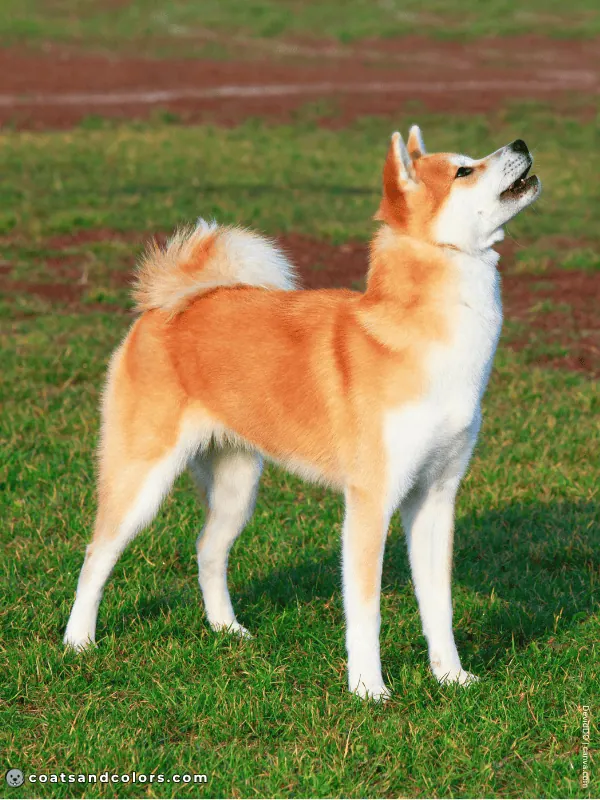
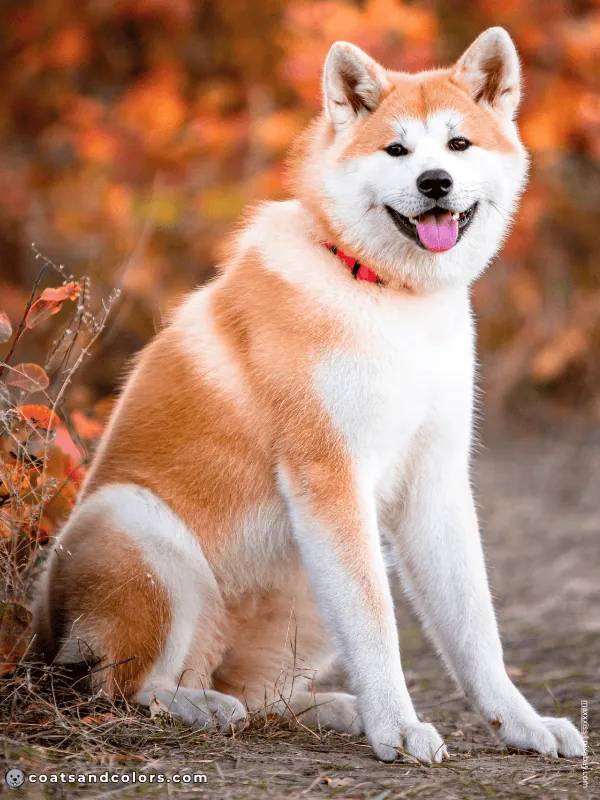
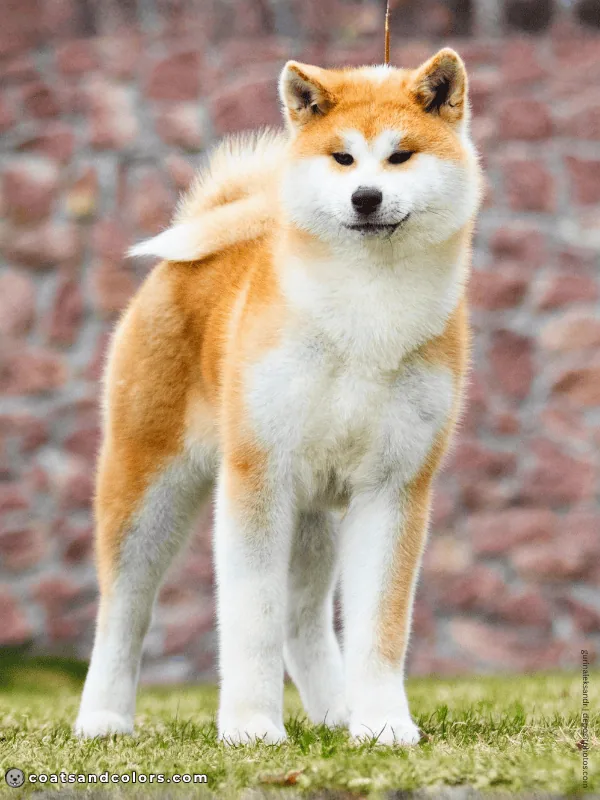
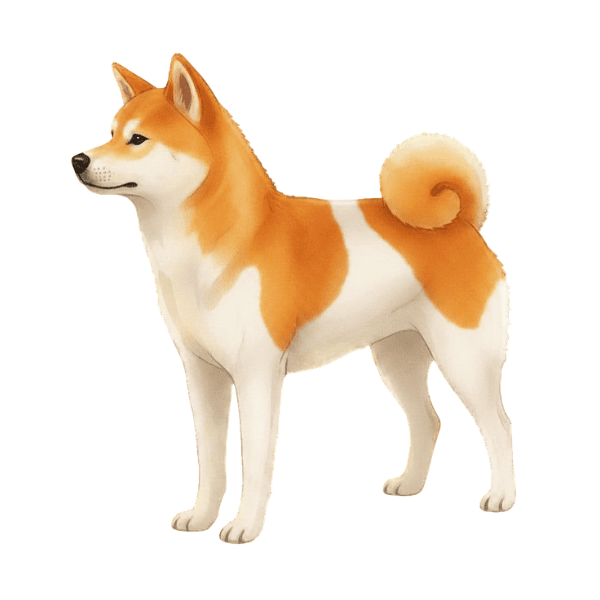
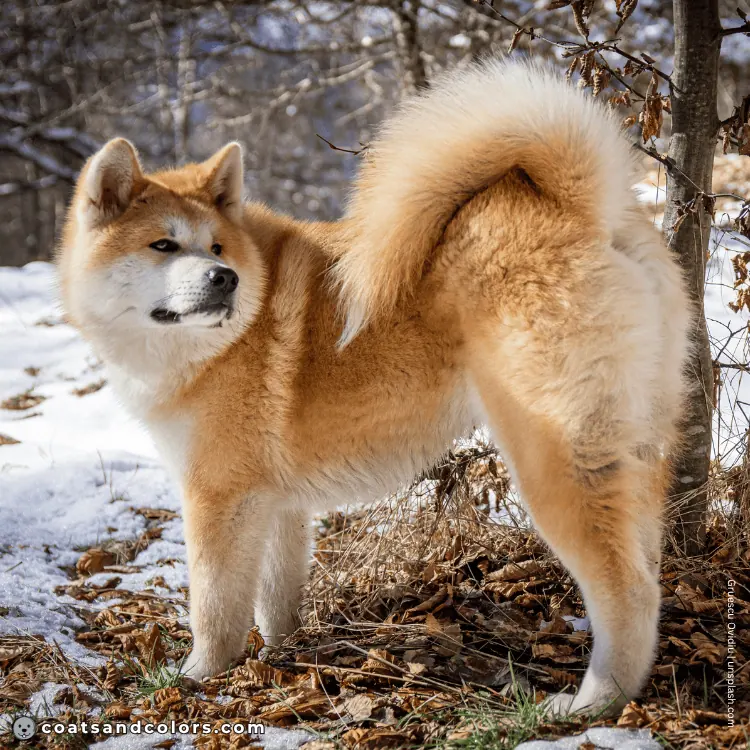
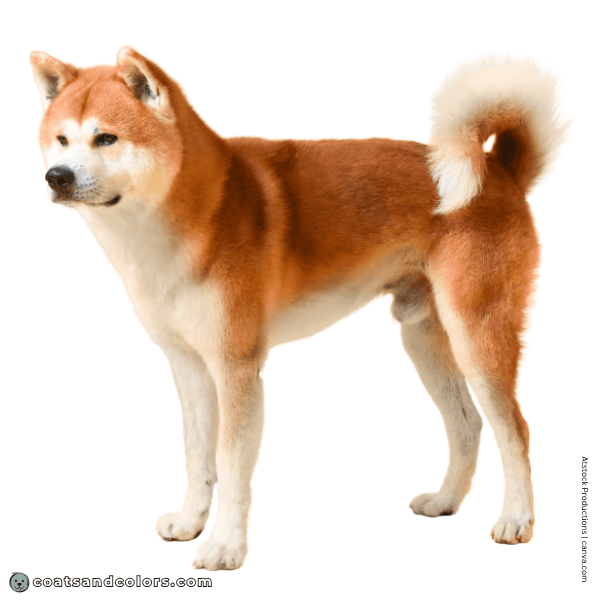
A red Akita Inu expresses clear sable with a vivid red intensity (red or red fawn) and without any black shading. They also have crisp countershading, called urajiro in Japanese dog breeds. This refers to the crisp cream or white Akita markings on the ventral body.
The Japanese term urajiro translates to “underside white“. Breeders also use the term omotejiro or “front white” specifically for the countershading on the muzzle and cheeks.
Some dogs seem to have white markings. They very often have a white tip on their curled tail.
BASE PATTERN
clear sable
MERLE
–
OTHER
urajiro
EUMELANIN
black
INTENSITY
red, red fawn
WHITE
possible
Sesame
The American Kennel Club does not list sabled red as a standard color. Their breed club even mentions black saddle-like shading on the back as a serious fault. But the FCI and the Kennel Club both accept sesame, describing it as “red fawn hairs with black tips“.
In genetic terms, this seems to refer to shaded sable (or maybe even to agouti).
But sesame, or goma in Japanese, seems to be incredibly rare in the modern Japanese Akita. Even the Japan Dog Preservation Society does not include sesame in its list of possible coat colors for this breed. Sesame can still be found in other Japanese breeds like the Shiba.
BASE PATTERN
sahded sable
agouti
MERLE
–
OTHER
urajiro
EUMELANIN
black
INTENSITY
red, red fawn
WHITE
possible
Brindle
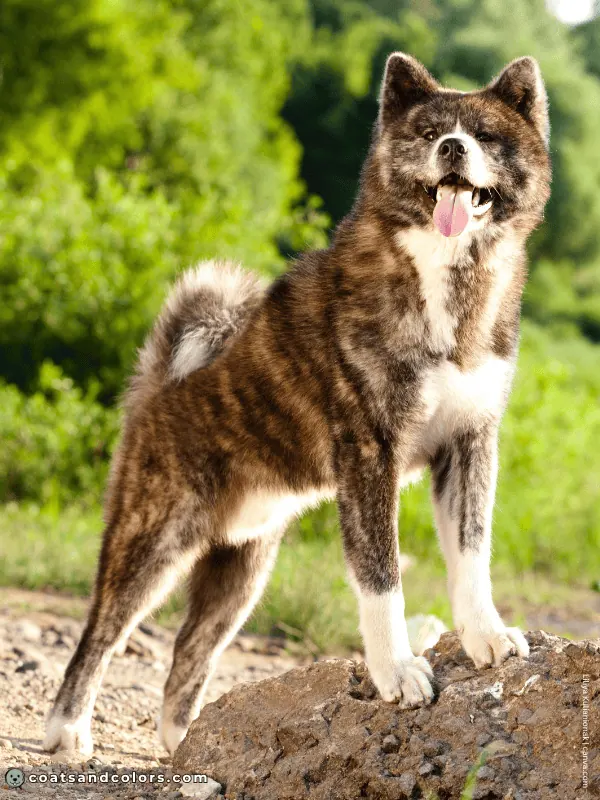
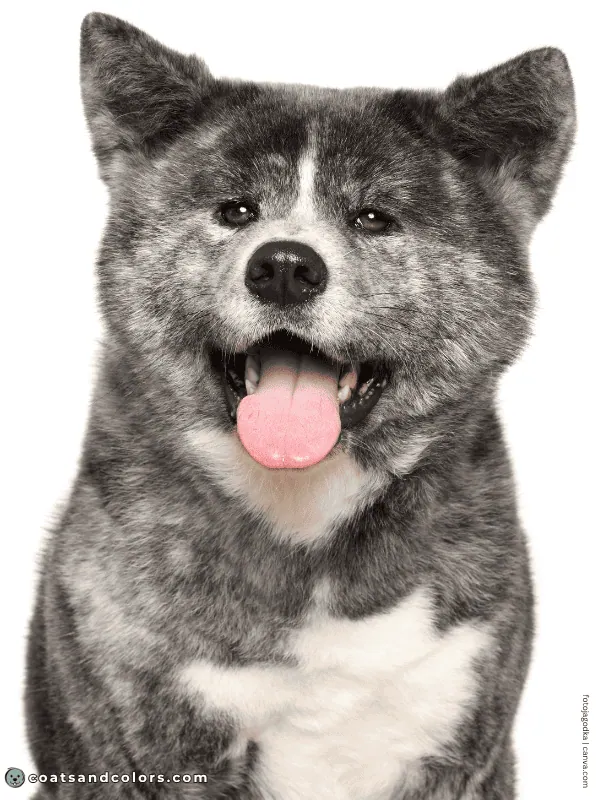
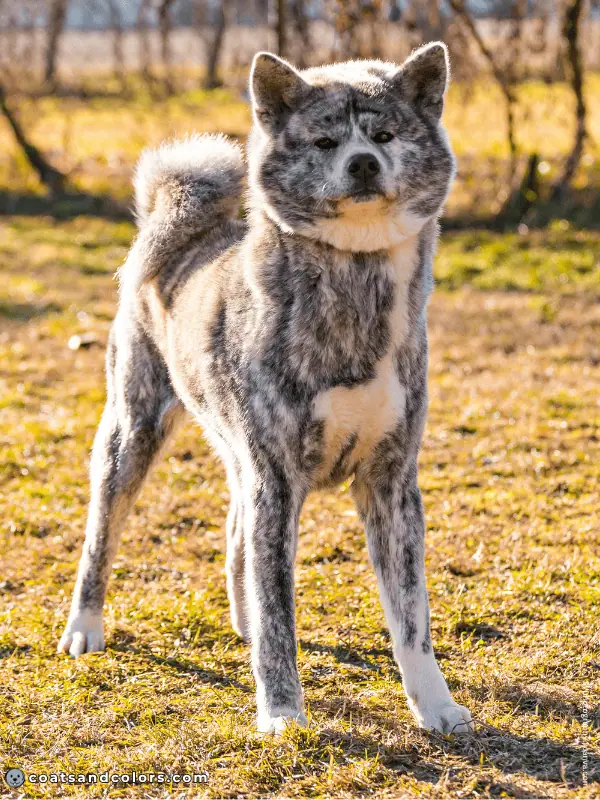
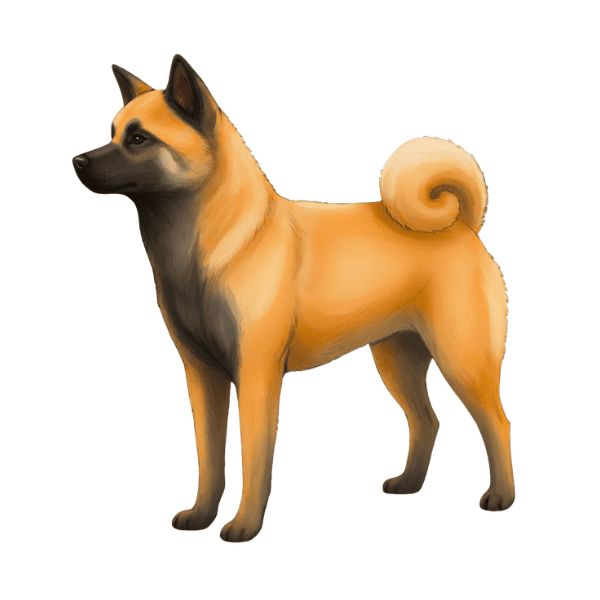
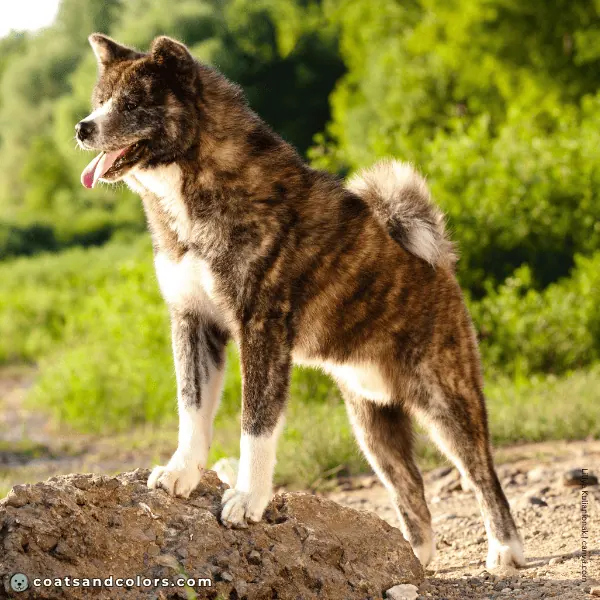
A brindle Akita (tora) is a clear sable dog with black stripes. They also express urajiro in the red areas of their pattern. The brindling should be even and not show any gaps.
But brindle density can be a lot denser in some dogs than others. And the red pigment underneath the striping can vary from silver to deep red.
- Dogs with more heavy black striping are called black brindle (kurotora).
- Dogs with moderate brindle on a red base are called red brindle (akatora).
- Dogs with a lighter cream base are called silver brindle (shimofuri).
- Dogs with a very light base are sometimes called white brindle (shirotora).
Brindle Japanese Akita often have white markings. The ideal amount of white covers the muzzle, the tip of the tail, and on each of its four paws.
BASE PATTERN
sable brindle
MERLE
–
OTHER
urajiro
EUMELANIN
black
INTENSITY
silver, cream, red
WHITE
white markings
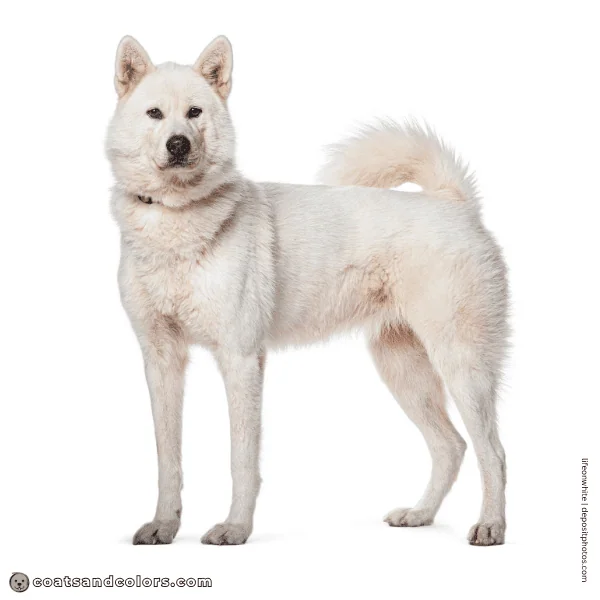
White
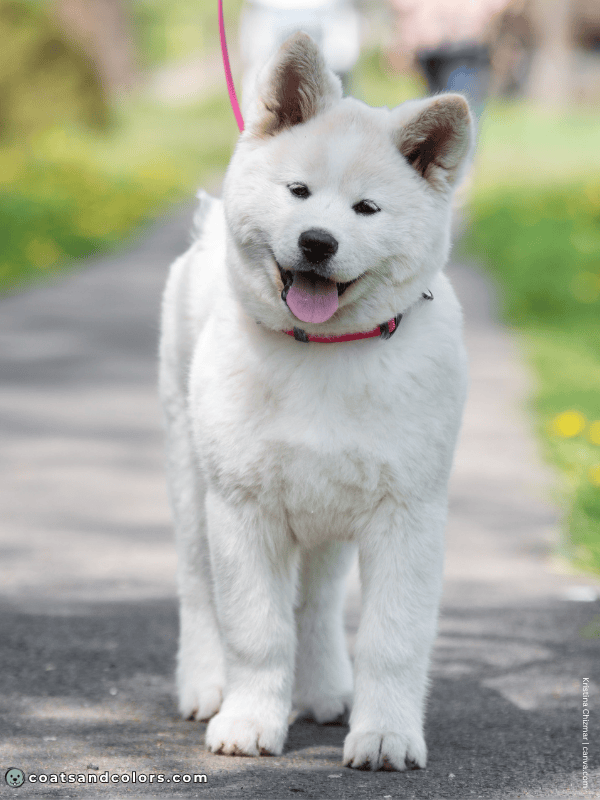
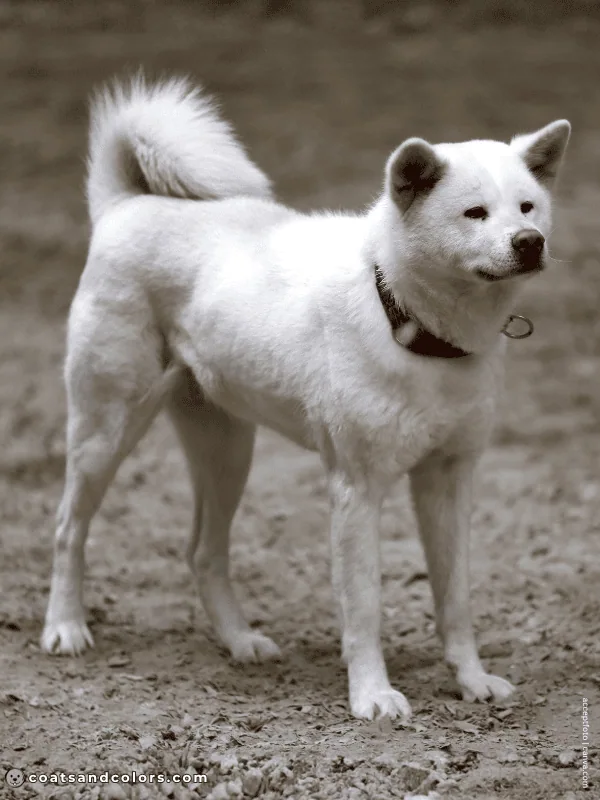

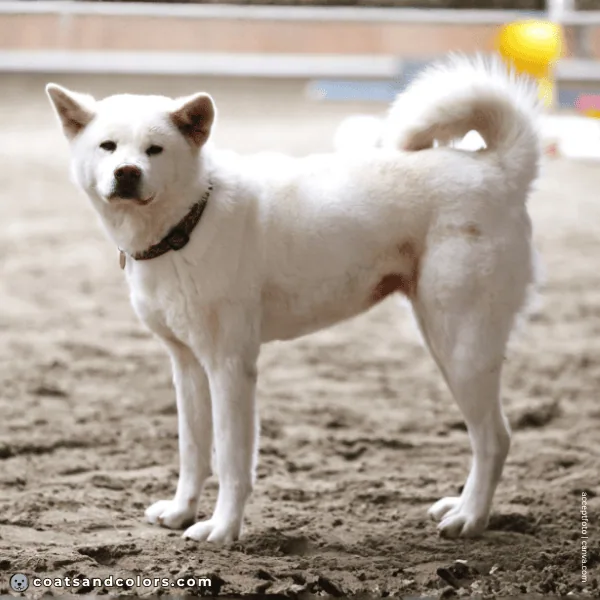
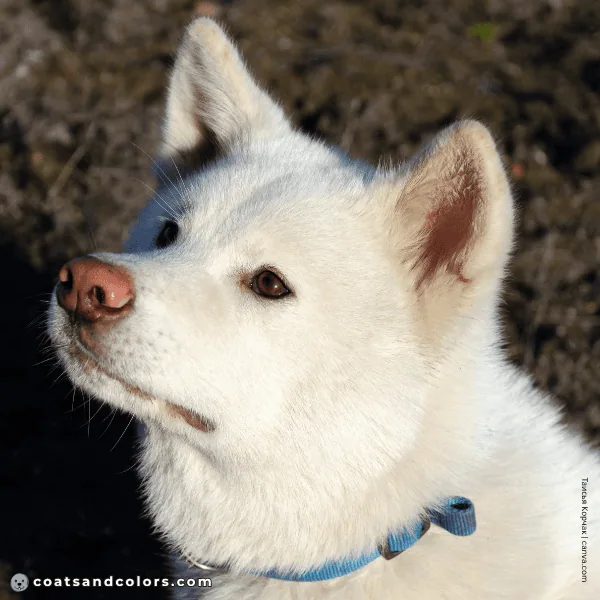
A white Akita Inu (shiro) is recessive red (e/e) with a very low phaeomelanin intensity. It’s actually a very pale cream color. According to the AKC, the white should be as bright as possible.
What makes this interesting is that the very pale cream color only happens in e/e dogs. The sable dogs in this breed have red pigment. There seems to be something that affects intensity depending on the pattern of the dog. Many of the solid white Japanese Akitas still have some biscuit coloring or red shades on their ears, shoulders, or tail.
“Fault – Biscuit coloring on the ears, rear legs, back, shoulders and tail on a white dog.”
AKC Breed Standard[1]
Pure white Japanese Akitas can not have black in their coat. But the lips, skin pigment, eye rims, or nose still show they have black pigment. However, it is quite common in all-white Akita dogs to have the fading nose pigment that is common in all dogs with an e/e pattern.
BASE PATTERN
recessive red
MERLE
–
OTHER
–
EUMELANIN
black
INTENSITY
white, cream
WHITE
possible
Faulty Colors
Akitas can have a moderate amount of white. But any excessive white on the head or body is considered a mismark and undesirable. Dense ticking in the white markings is not tolerated.
Several breed standards mention ticking or black masks as a faulty coloration.
Base Patterns
The base pattern describes the placement of phaeomelanin and eumelanin in the coat. There is an epistatic hierarchy between these genes: A locus < K locus < E locus.
- The A locus controls the basic distribution of both pigment types.
- Next, the K locus can add black to the A locus pattern.
- Finally, the E locus regulates the general ability to produce black pigment.
A Locus
| Ay | clear sable |
| Ays | shaded sable |
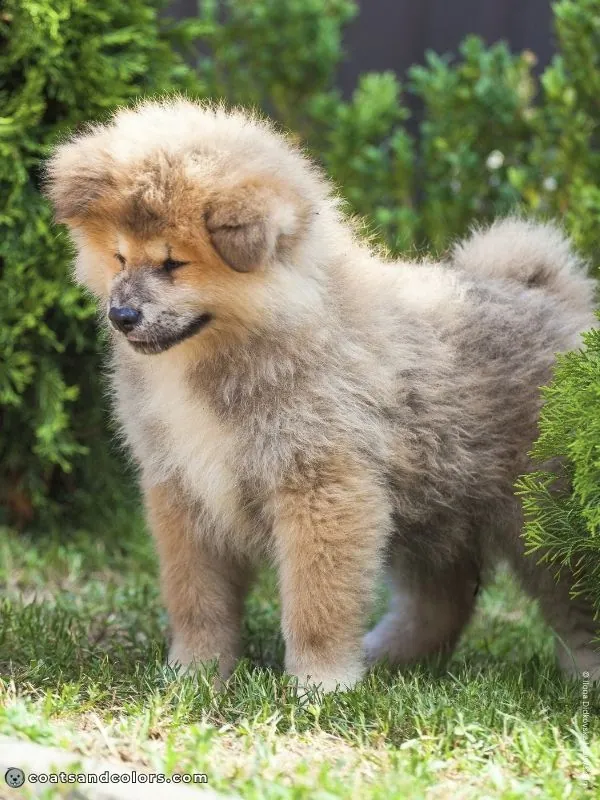
The modern Akita Inu breed is almost fixed for clear sable (Ay/Ay). The rare sesame color likely means shaded sable (Ays/Ays). Other patterns don’t seem to exist in this breed.
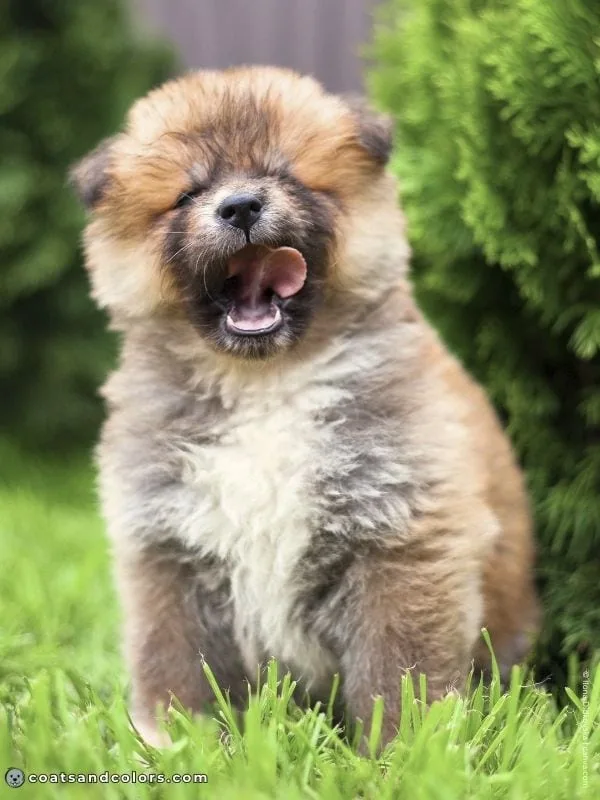
Many red Akitas have a dark puppy overlay before they clear.
K Locus
| kbr | brindle |
| ky | wild-type |
Akitas can be brindle (kbr/-) or have normal pattern expression (ky/ky).
E Locus
| E | wild-type |
| e | recessive red |
The red and brindle Akitas have normal pattern expression (E/-). Many of them show black puppy masking. The white Akitas are recessive red (e/e), which also causes pale whiskers.
Akita Inu Base Patterns
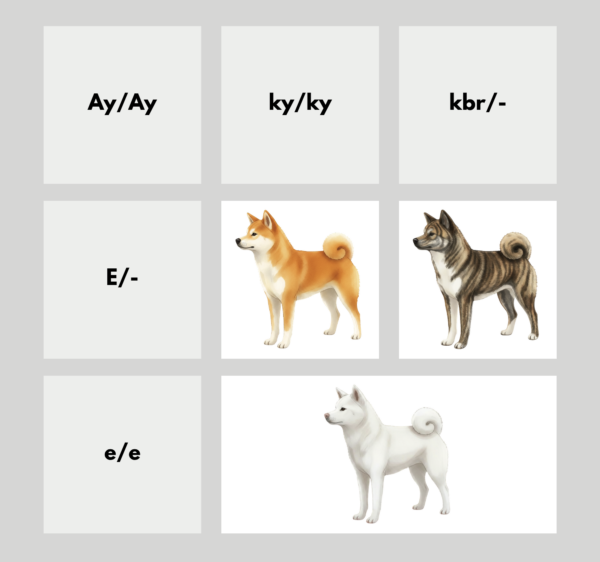
| A LOCUS | K LOCUS | E LOCUS | PATTERN |
|---|---|---|---|
| Ay/Ay | ky/ky | E/- | sable “red“ |
| Ay/Ay | kbr/- | E/- | sable brindle “brindle” |
| e/e | recessive red “white“ |
Here is the simplified Akita Inu color chart:
Base Colors
The base color is determined by the B locus and D locus.
B Locus
| B | black |
Akitas are fixed for black pigment (B/B)
D Locus
| D | normal |
Akitas are fixed for normal pigment (B/B)
Red Intensity
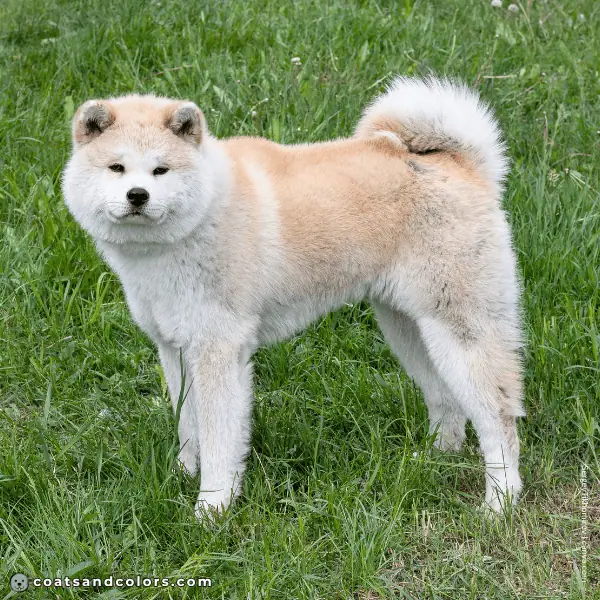
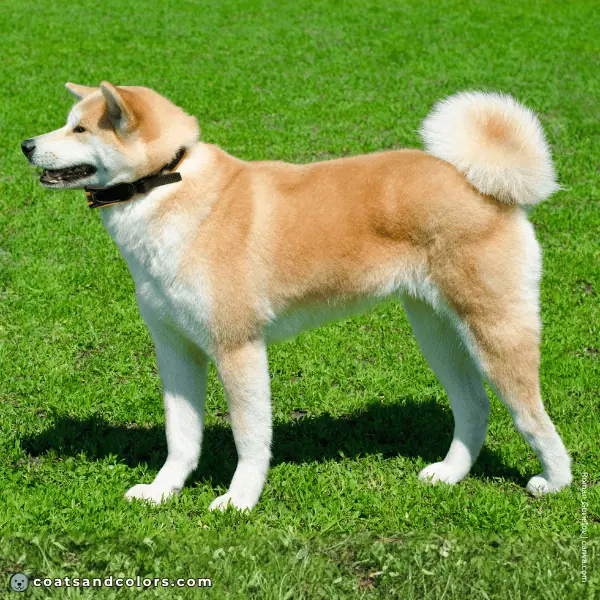
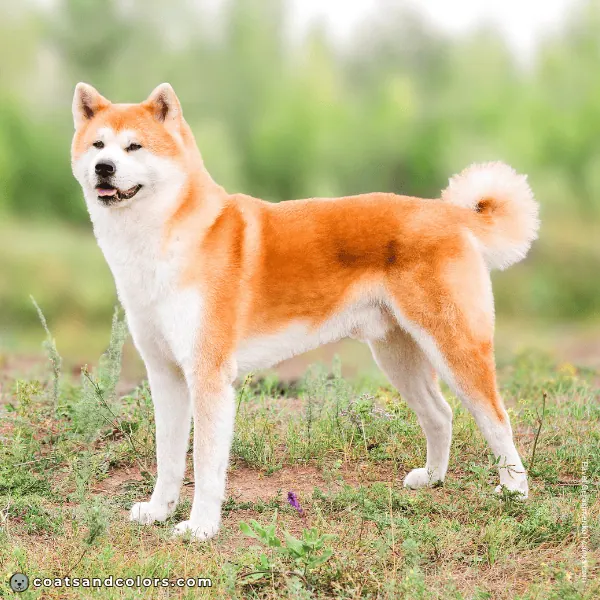
The red colors in Japanese Akita is meant to be a vivid red in the red fawn dogs. There are some light tan or blonde sable Akitas, but this is considered undesirable. In brindle Akitas, you’ll also find shades of reddish yellow to silvery cream. And e/e Akitas appear solid white, some with reddish shading.
Urajiro
All Akita Inus have countershading. Their urajiro causes the dilution of red intensity towards the ventral body surface, e.g. dogs have less intense red on their underbody, lower legs, front, and face.
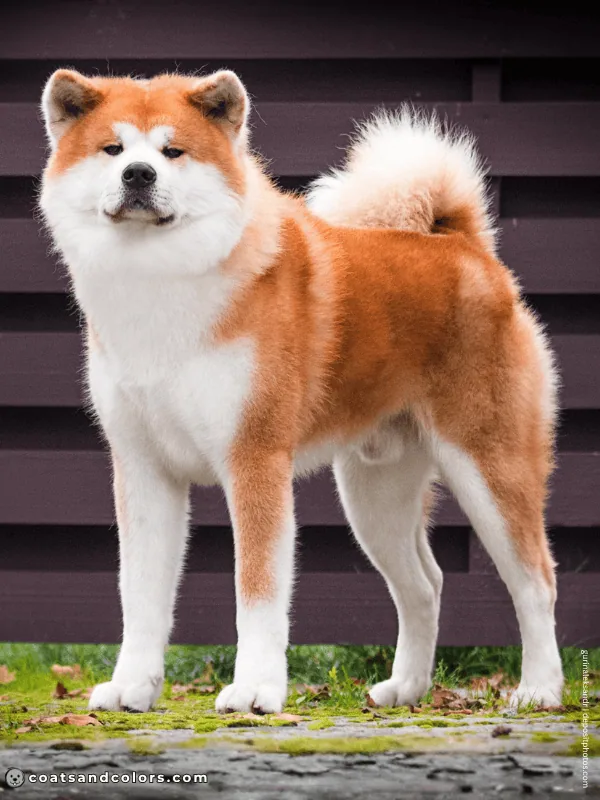
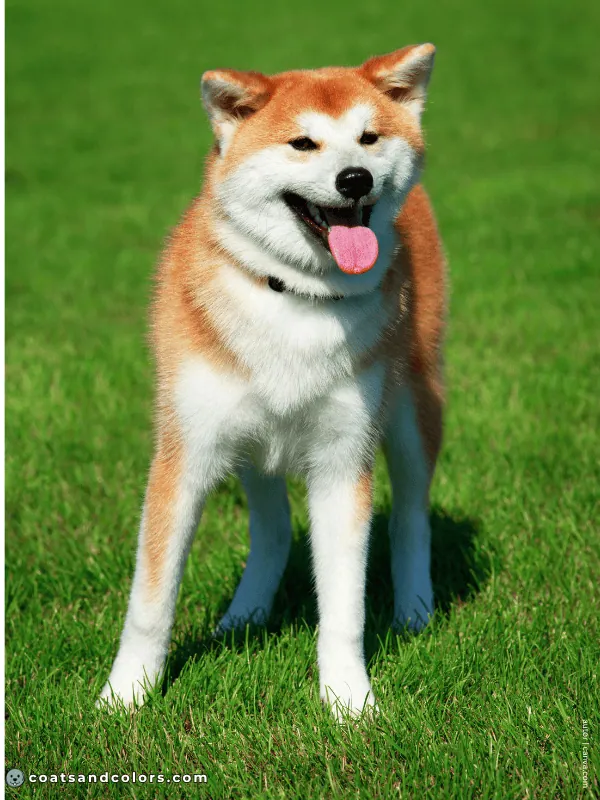
“Red and brindle coats must possess urajiro (light cream or white underside shading).”
AKC Breed Standard[1]
“Urajiro = whitish coat on the sides of the muzzle, on the cheeks, on the underside of jaw, neck, chest, body and tail and on the inside of the legs.”
FCI Breed Standard[2]
“The urajiro markings must blend in gradually with the main coat colour and not extend above the elbow or hock.”
RKC Breed Standard[3]
White Markings
“Brindles may be self-masked or possess a white blaze that extends up the muzzle. The preferred brindle possesses roppaku (six points of white markings) which may be of varying degrees, on the muzzle, four paws, and tip of the tail.”
AKC Breed Standard[1]
“White markings in the main body coat are undesirable.”
RKC Breed Standard[3]
The piebald allele (sP) seems to be present in this breed. In fact, many Japanese Akita test as sP/sP.
A moderate amount of white is not only accepted, but even encouraged in the case of brindles with their six white spots or “roppaku“ on the muzzle, paws, and tip of the tail.
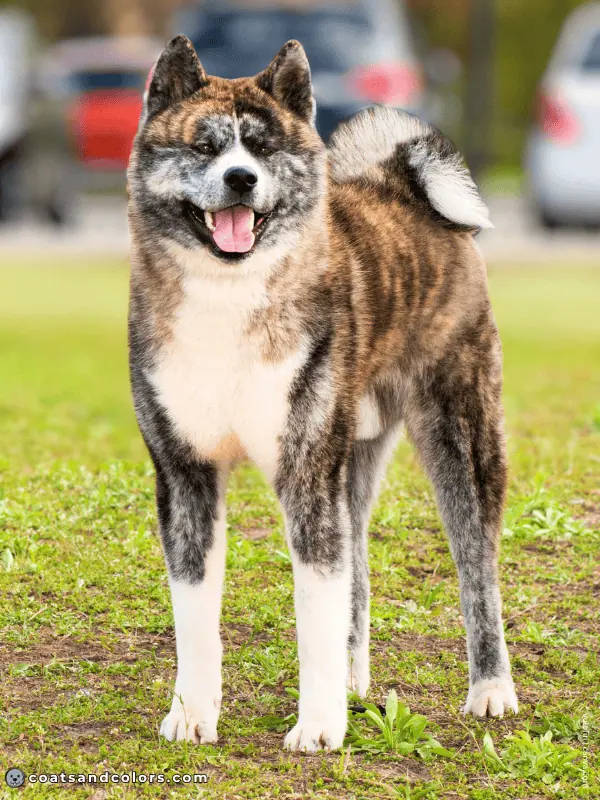
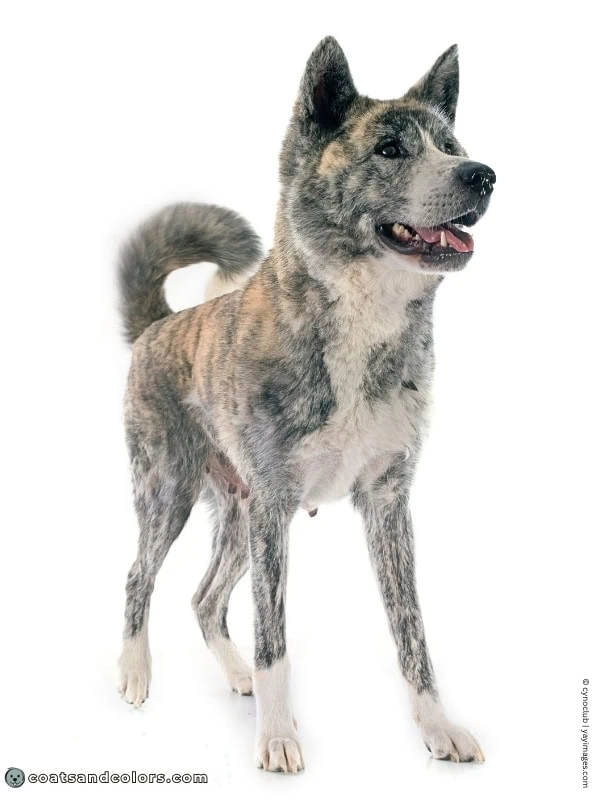

The red and white Akita Inus can also have some white markings. It is just harder to see truly white markings against the already very pale coat in their urajiro phenotype.
The countershading on red dogs can be so crisp that it might be confused with white markings.
The difference is that truly white areas (e.g. white paws, white chin, etc.) will already be visible at birth. But once the urajiro comes in, it will lighten all the red colors around the edge of the real white, so it’s hard to say whether an adult red Akita was born with markings or not.
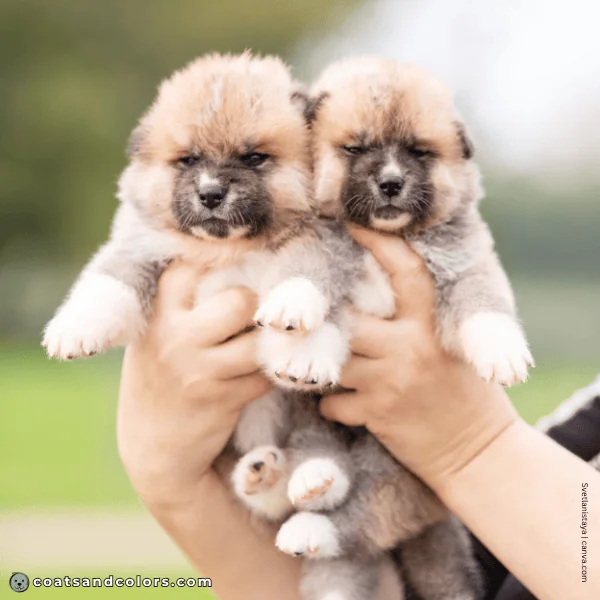
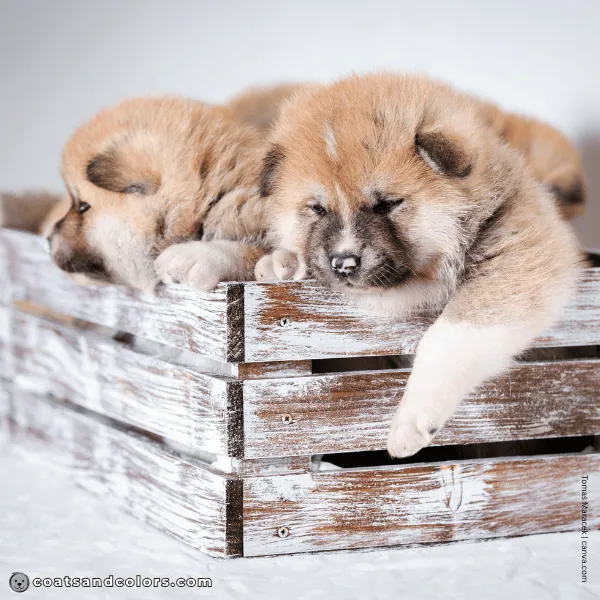
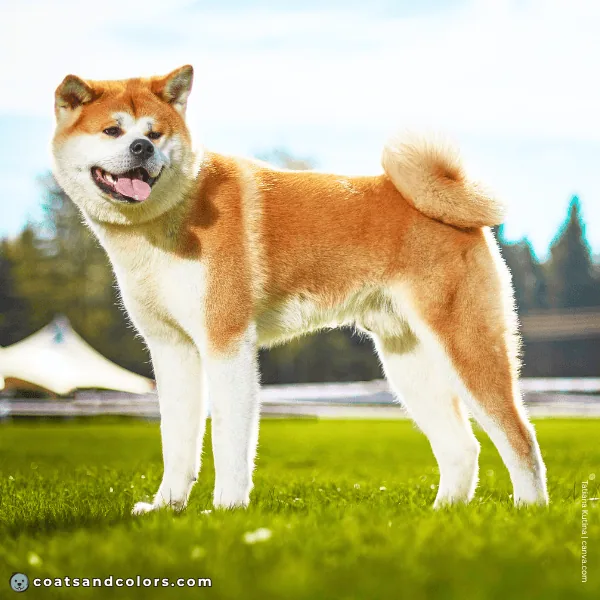
But Akitas should never have too extended white. Big markings on the chest, white boots, a pinto pattern, a full white collar around the neck, or a tuxedo blaze extending from the muzzle to the back of the neck and dividing the head pattern in the middle (“hachiware“) are faulty.
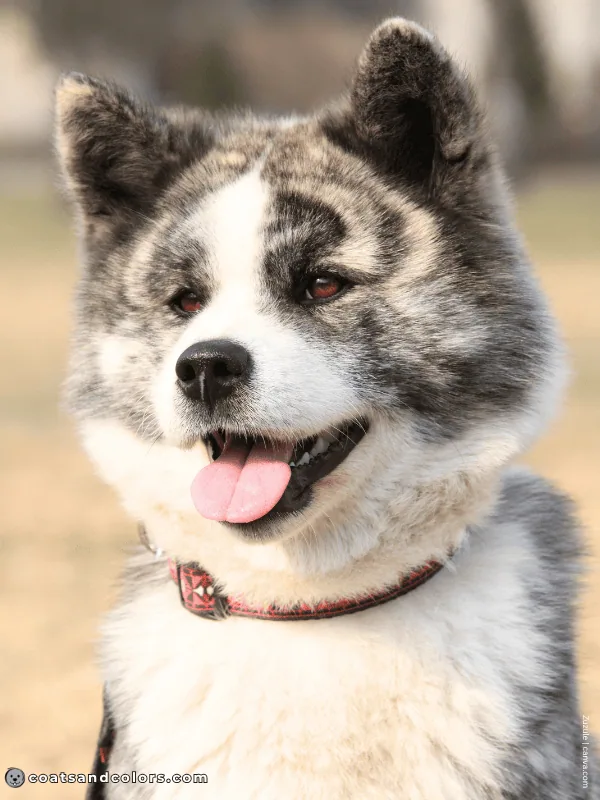
“Faults – White blaze that extends from the muzzle to the back of the head (hachiware).”
“Serious Fault – Wide white collar marking extending completely around the neck.”
“Disqualifications: Pinto markings, Hachiware blaze that connects to a complete white collar.”
AKC Breed Standard[1]
“Disqualifying Faults: Markings on white ground.”
FCI Breed Standard[2]
One last thing:
Dogs with white markings can have mottles. While the AKC states that some “slight ticking is permissible“, the FCI standard discourages any “markings on white ground“.
Akita Inu Eye Colors
Akitas have dark brown eyes.
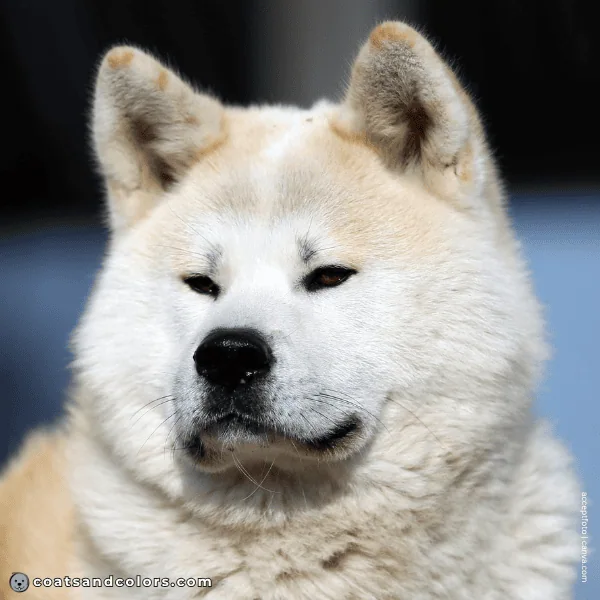
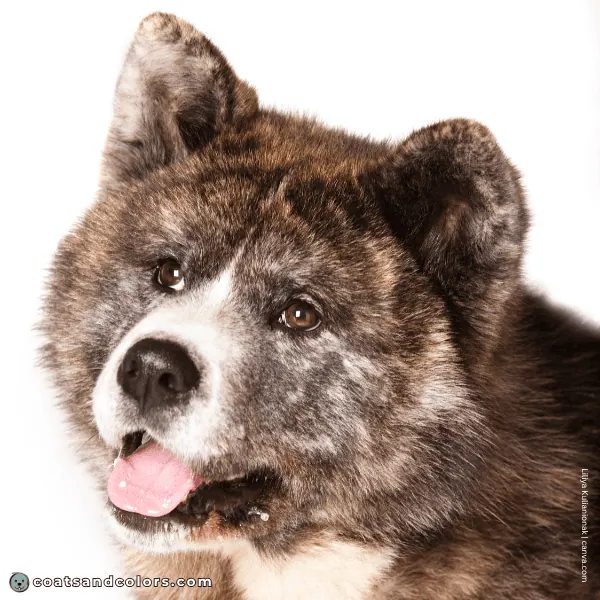
“Eyes are dark brown, deep-set, almond-shaped, relatively small, and slightly raised at the outside corners. Eye rims are thick and black.”
“Faults – Light colored irises”
AKC Breed Standard[1]
“Eyes […] dark brown; the darker, the better.”
FCI Breed Standard[2]
Akita Inu Nose Colors
Akitas have a black nose. The white Akitas are recessive red, which often causes their nose pigment fading to pink. So a flesh-colored nose is only accepted in white dogs.
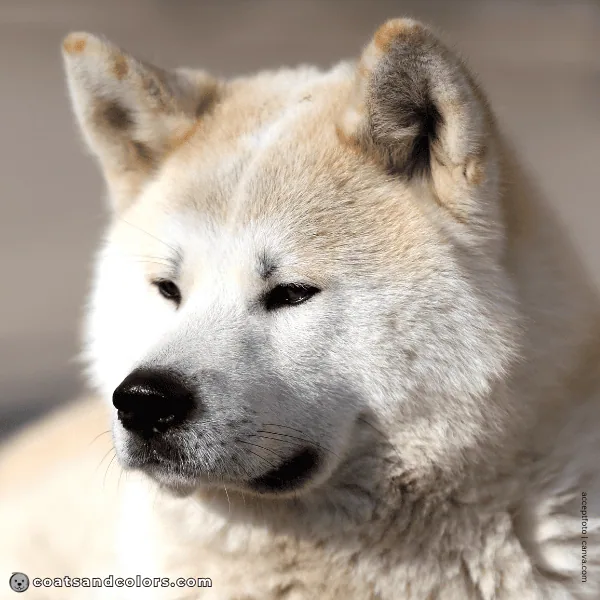
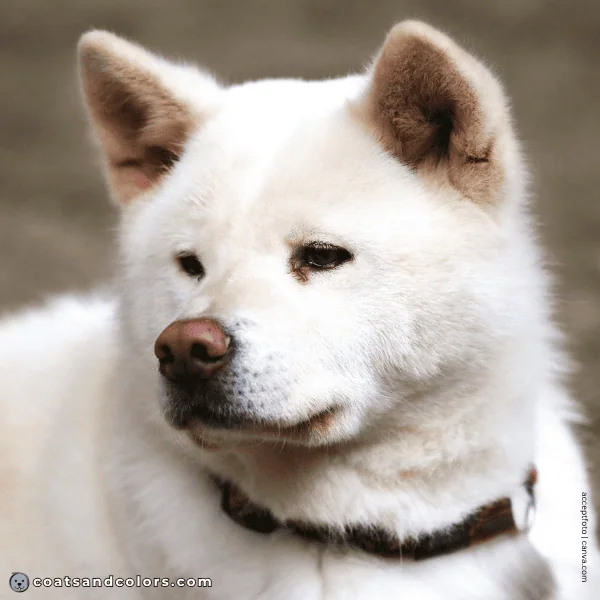
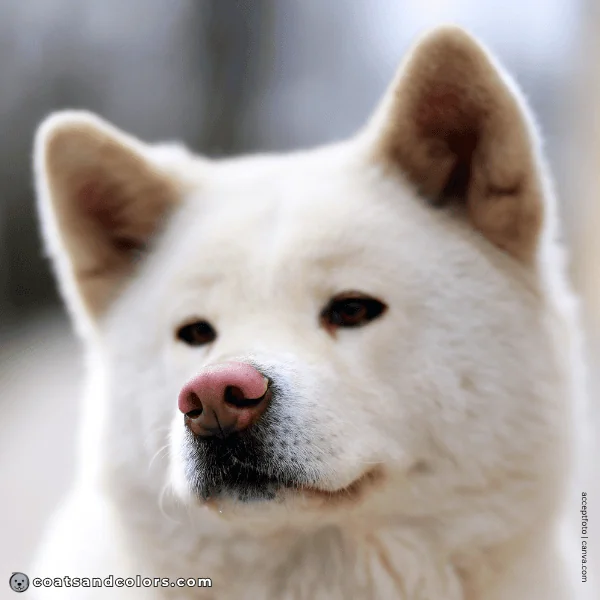
Some dogs with a lot of white on the face are born with a partially pigmented butterfly nose. The pink spots sometimes don’t fill in completely (called ‘hanakake‘). This is considered a fault.
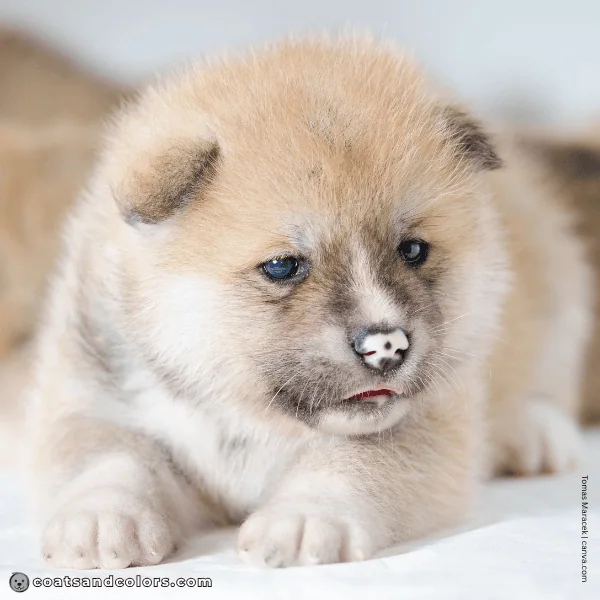
“Nose is black. For white dogs, faded black and snow noses are acceptable. Black is always preferred”
“Disqualifications: Butterfly nose.”
AKC Breed Standard[1]
“Nose large and black. Slight and diffuse lack of pigment accepted in white dogs only, but black is always preferred.”
FCI Breed Standard[2]
Akita Inu Coat Type
The Akita Inu is a spitz-type dog breed with a double coat (nijuuhimou) providing insulation in cold climates. The hairs on the withers, rump and tail can be slightly longer than on the rest of the body.
Genetically, the Japanese Akita is a smooth-coated dog breed, it should not have a ruff or feathering.
The AKC breed standard describes three types of hair:
- Long guard hairs standing out like needles from the body
- Coarse guard hairs that lie flat on the body
- Soft wooly undercoat, which can be lighter
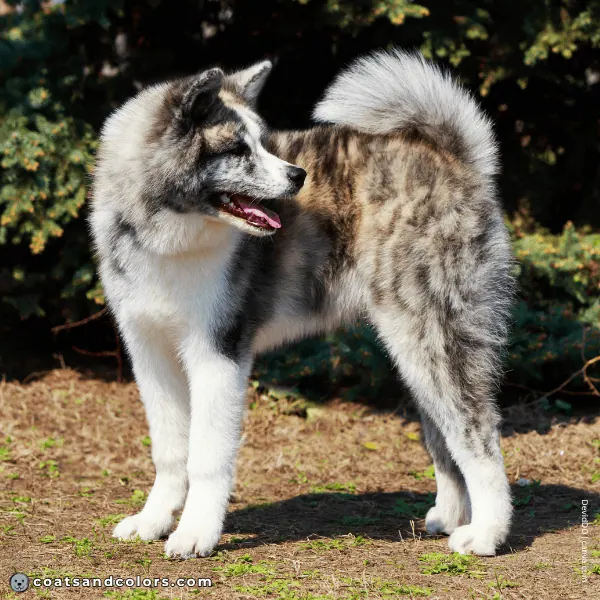
“Triple coated with the outer coat consisting of coarse, straight guard hairs that stand off the body. The two inner coats are under coats. One is thicker and somewhat soft, generally matching the coat color. The second is closest to the skin and is generally thicker and wool-like in texture and can be a different color than the guard coat.”
AKC Breed Standard[1]
“Outer coat harsh and straight, undercoat soft and dense; the withers and the rump are covered with slightly longer hair; the hair on tail is longer than on the rest of the body.”
FCI Breed Standard[2]
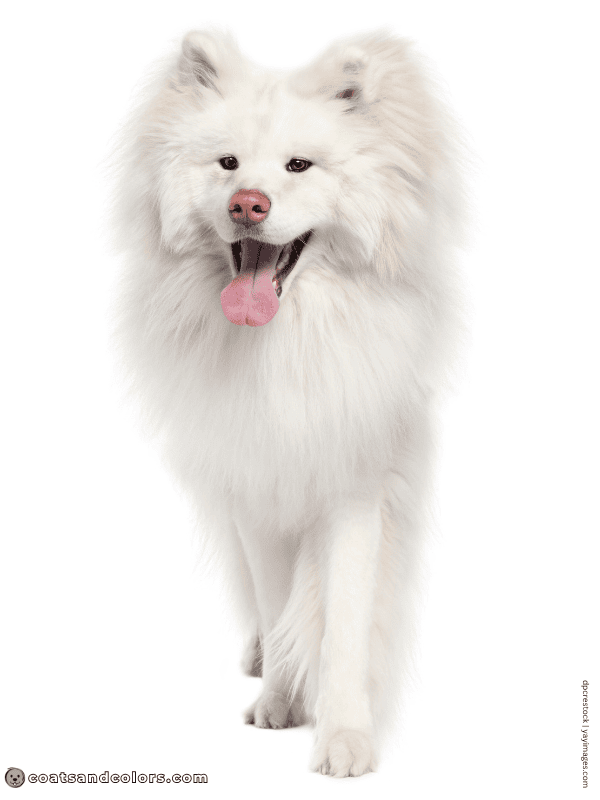
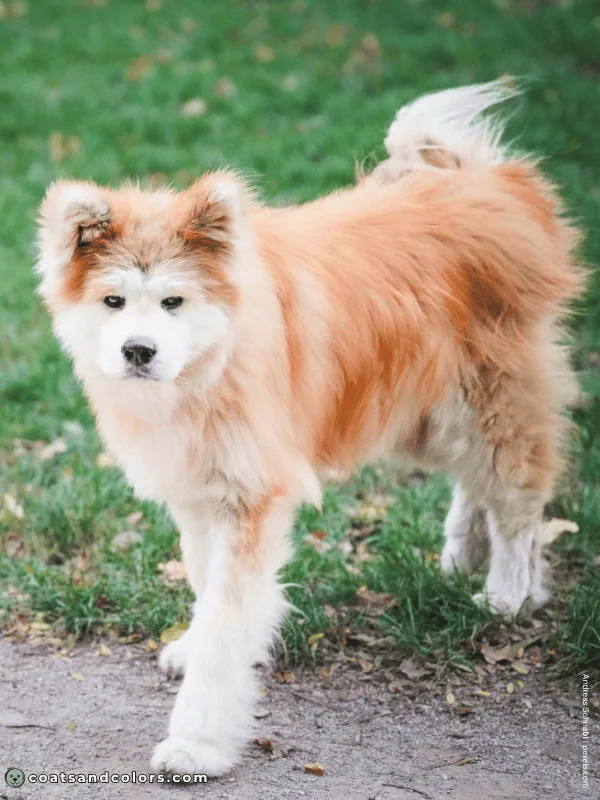
Some Akitas express a long coat with a much more plush look and obvious signs of fluffy ear, tail, and leg feathering. Long coat (l) is recessive and standard Akitas can be carriers of the wooly trait (N/l).
Related Breeds
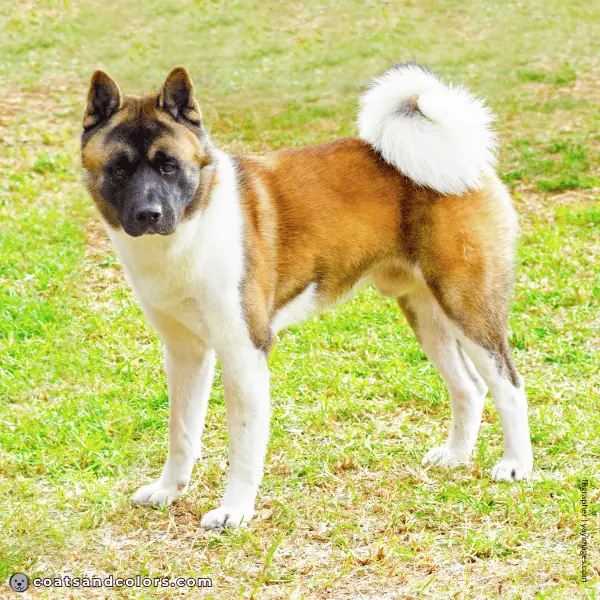
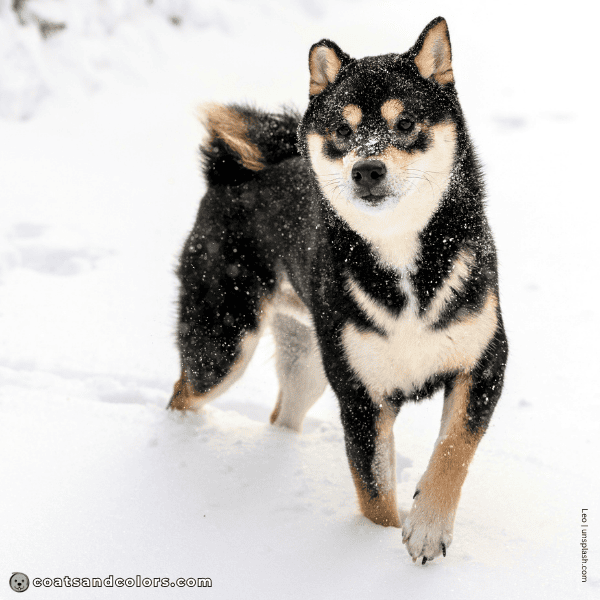
The Akita Inu shares ancestors with the American Akita. It’s also closely related to other basal Japanese spitz breeds, . i.e. the Shiba Inu, Kishu Ken, Hokkaido Ken, or Kai Ken.
Learn More


Links
[1] American Kennel Club (AKC): Japanese Akitainu
[2] Fédération Cynologique Internationale (FCI): Akita
[3] Royal Kennel Club (RKC): Japanese Akita Inu
[4] Canadian Kennel Club (CKC): Japanese Akita
[5] Dreger et al. (2019). True Colors: Commercially-acquired morphological genotypes reveal hidden allele variation among dog breeds, informing both trait ancestry and breed potential. PLoS ONE 14(10): e0223995. https://doi.org/10.1371/journal.pone.0223995
[6] Japanese Akitainu Club of America: AKC Color Guide (pdf)
[7] Oguro-Okano et al (2011). Mutations in the melanocortin 1 receptor, β-defensin103 and agouti signaling protein genes, and their association with coat color phenotypes in Akita-inu dogs. J Vet Med Sci. https://doi.org/10.1292/jvms.10-0439
Image Credits
acceptfoto/canva.com
Andreas Schnabl/pexels.com
Atstock Productions/canva.com
cynoclub/yayimages.com
DevidDO/canva.com
dpcrestock/yayimages.com
f8grapher/yayimages.com
fotojagodka/canva.com
Gruescu Ovidiu/unsplash.com
gurinaleksandr/depositphotos.com
Ilona Didkovska/canva.com
Kaelin/pexels.com
Kristina Chizmar/canva.com
Leo/unsplash.com
lifeonwhite/depositphotos.com
Liliya Kulianionak/canva.com
Lunja/canva.com
maxxxiss/pixabay.com
Pavel Gerasimenko/canva.com
Roman_Gorielov/canva.com
Svetlanistaya/canva.com
SVphotography/canva.com
Tatiana Kutina/canva.com
Tomas Maracek/anva.com
volofin/canva.com
Таисья Корчак/canva.com
Hi! I’m Steffi. I am a biologist and a big time dog nerd. You are curious about coat color genetics? You’ve come to the right place! Read more.