

Albinism causes a congenital lack of pigment in most parts of the body
This guide explains what albinism in dogs is, how it works, and how to identify it.
What Is Albinism?
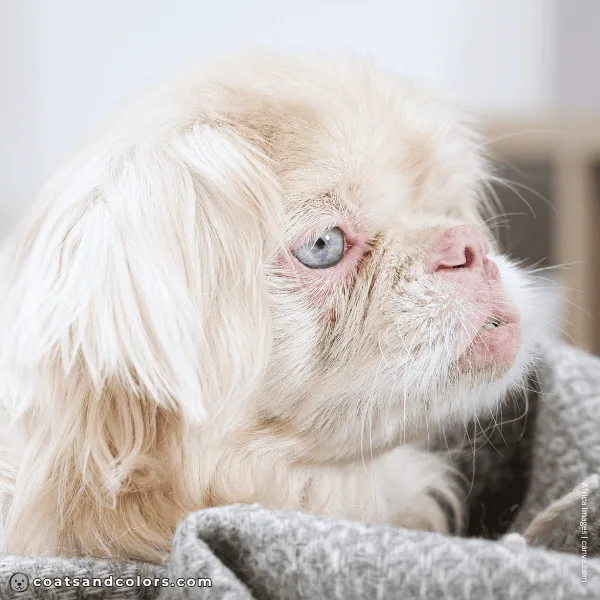
Albinism is a rare genetic disorder that prevents pigmentation.
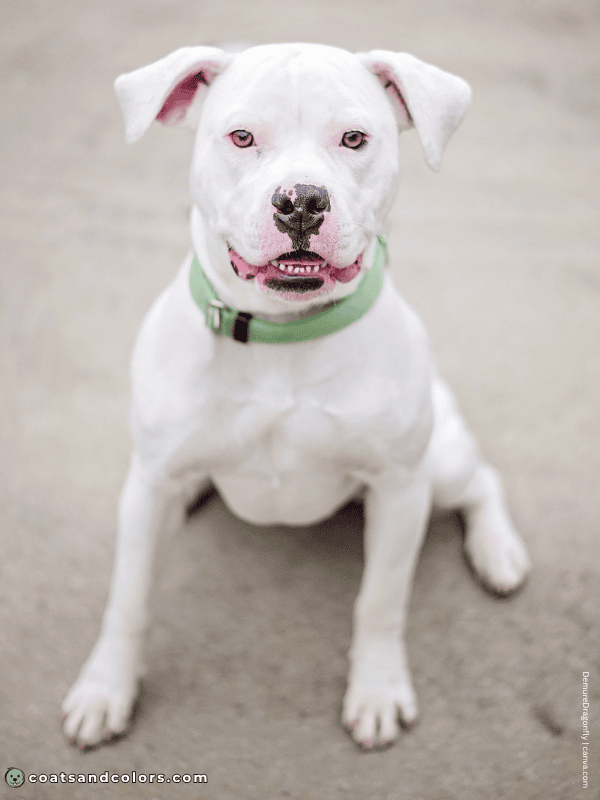
The pigment cells of an albino dog are switched off at the enzyme level. This affects the whole body, so pigment is missing everywhere. Even the nose is pink and eyes are blue or red-tinted.
How does albinism happen?
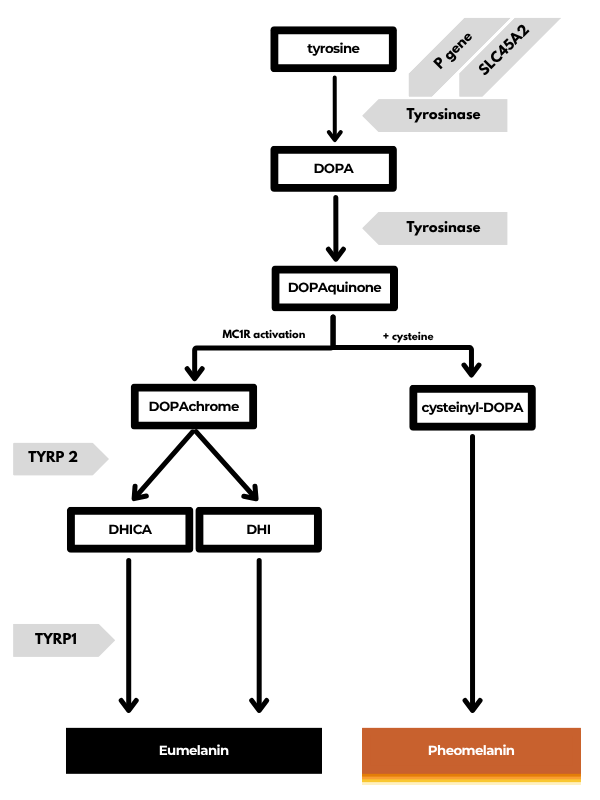
Normally, pigment cells use a whole assembly line of enzymes to build pigment from scratch.
Albinism happens due to mutations in any of the crucial steps of the assembly line, so that pigment synthesis gets interrupted. An albino dog still has pigment cells. They just don’t work properly.
What Albino Looks Like
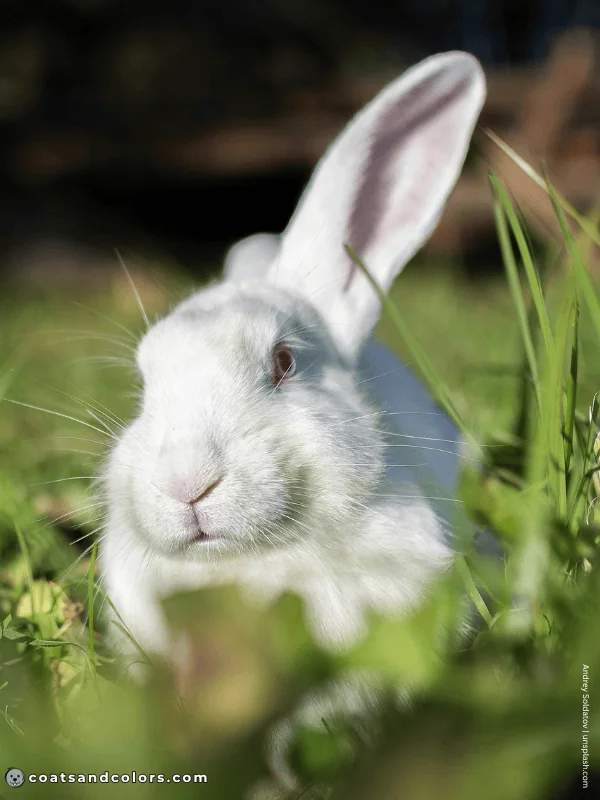
Most people think of white and red-eyed mice or rabbits when they think “albino”.
But the coat color on an albino dog isn’t necessarily pure white.
The most common OCA4 albinism often affects pheomelanin a little more than it affects eumelanin. So dogs can still show very faint hints of a pattern.
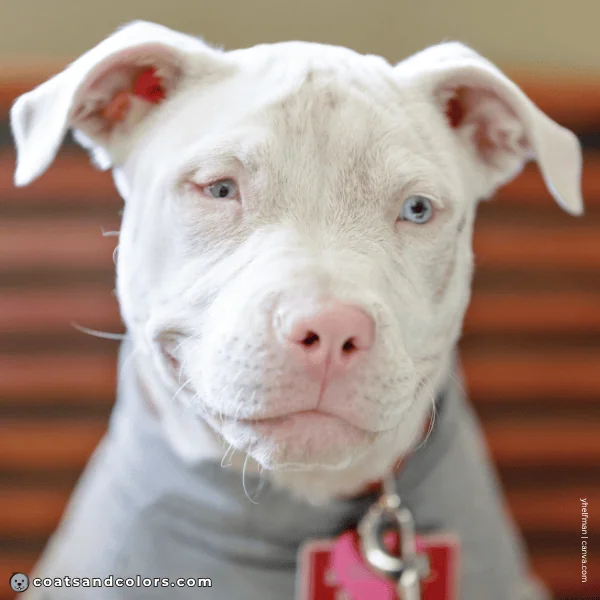
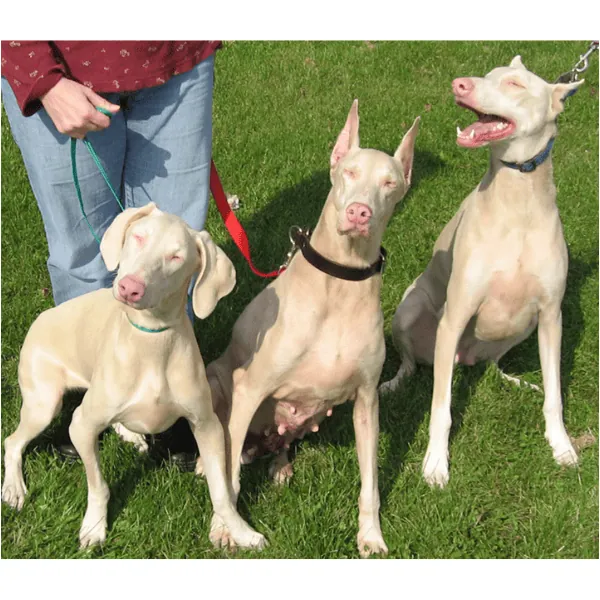
Many albino dogs have very pale beige markings, since a small amount of eumelanin can still leak through. For example, in many white Dobes, you can still see faint hints of their faded tan point pattern.
An albino dog also has pink skin, including a solid pink nose.
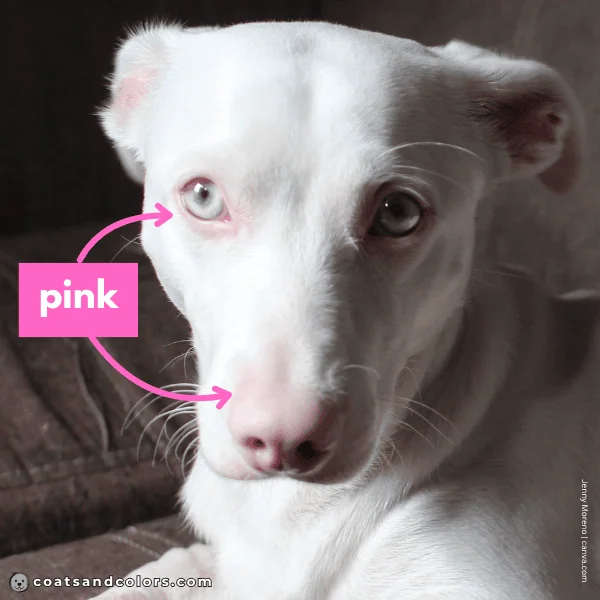
The iris color appears light blue, but can have touches of tan or green. The retinal pigment epithelium also lacks pigment, which can cause red eyes in certain images.
Types Of Albinism In Dogs
The albinism in dogs is called oculocutaneous albinism (OCA), a class of heritable conditions that severely reduces the amount of eumelanin and pheomelanin in the skin, hair, and eyes.
There are different types of OCA. Each type is caused by a different mutation in one of the many different genes that contribute to the synthesis of melanin within the pigment cells.
The most important enzyme in the pigment-building assembly line is called tyrosinase.
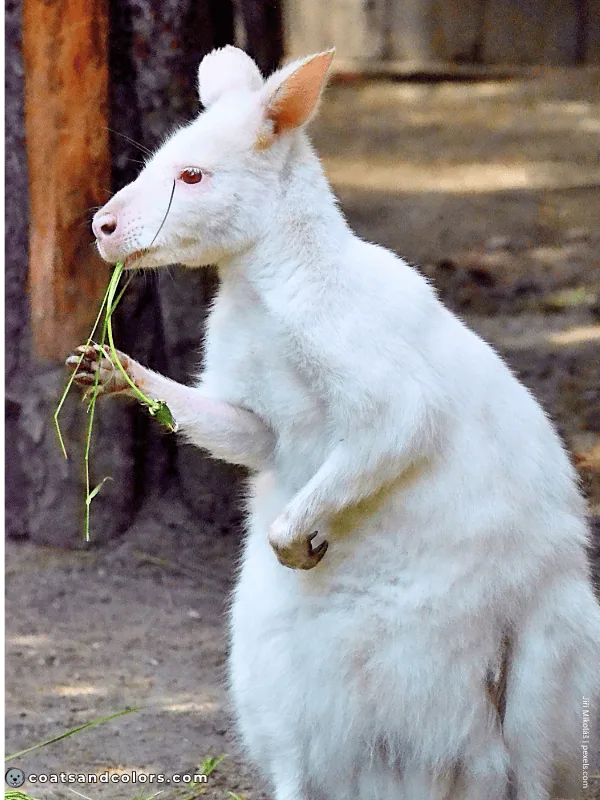
Animals without tyrosinase show the most severe types of albinism as they can not make any pigment whatsoever. This type of tyrosinase-deficient albinism happens in white red-eyed Wallabies, for example:
In dogs, we typically do not find mutations in the TYR gene itself, but in genes that help the tyrosinase enzyme to function. This causes types of albinism that still have limited melanin production.
All types of canine albinism are recessive disorders. This means a dog must inherit a mutated gene from both parents to be affected. Dogs with only one copy of the disorder are carriers, but not affected.
Mutations in three different genes are currently known to produce albinism in dogs:
| Gene | Gene Function | Type Of Albinism |
|---|---|---|
| TYR | This causes temperature-sensitive albinism, where the pigment-building enzyme tyrosinase can only function below a certain temperature. | OCA1b TS |
| P gene | A transporter protein in pigment cells and the retinal pigment epithelium that carries substrate to the pigment-building enzymes. | OCA2 |
| SLC45A2 | Another transporter protein that mediates melanin synthesis by regulating favorable pH levels for tyrosinase to function properly. | OCA4 |
Some people believe “chocolate” technically also fits the criteria for albinism, as it affects tyrosinase-related protein 1, resulting in impaired eumelanin synthesis throughout the body.
However, brown coat color is not a disorder, as it has no negative side effects in dogs. And it only changes pigment structure/color, but not the ability to make pigment!
OCA1
Dogs can have a type of OCA1, where the enzyme tyrosinase only functions in cooler body parts[5-6]. OCA1 was first identified in Rottweilers and Dachshunds, but has since popped up in unrelated dogs.
You can find images of colorpoint dogs on the Satin Points Facebook page or Instagram.
Reserch has identified several unique mutations in dogs with this phenotype.
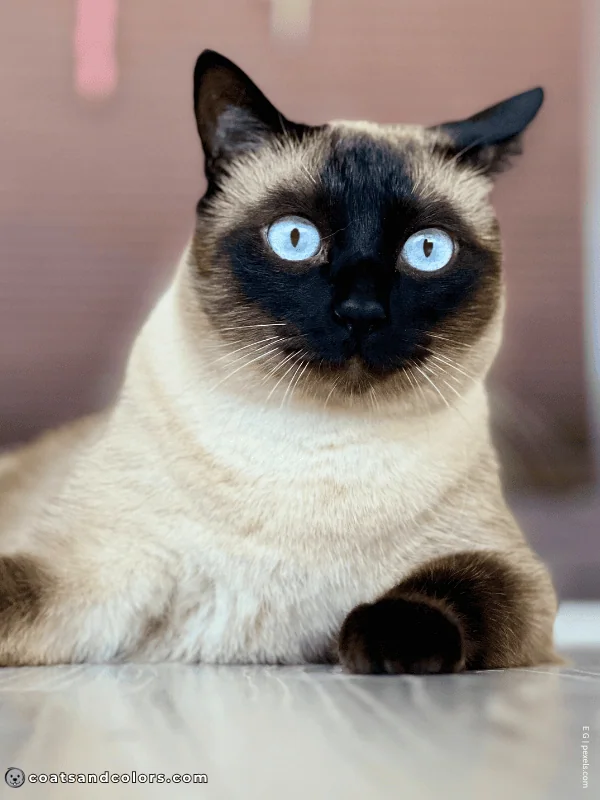
OCA1 in dogs causes acromelanism or “Himalayan” albinism. This type of temperature-sensitive albinism is similar to what you already know from some cats and their “colorpoint” pattern.
OCA2
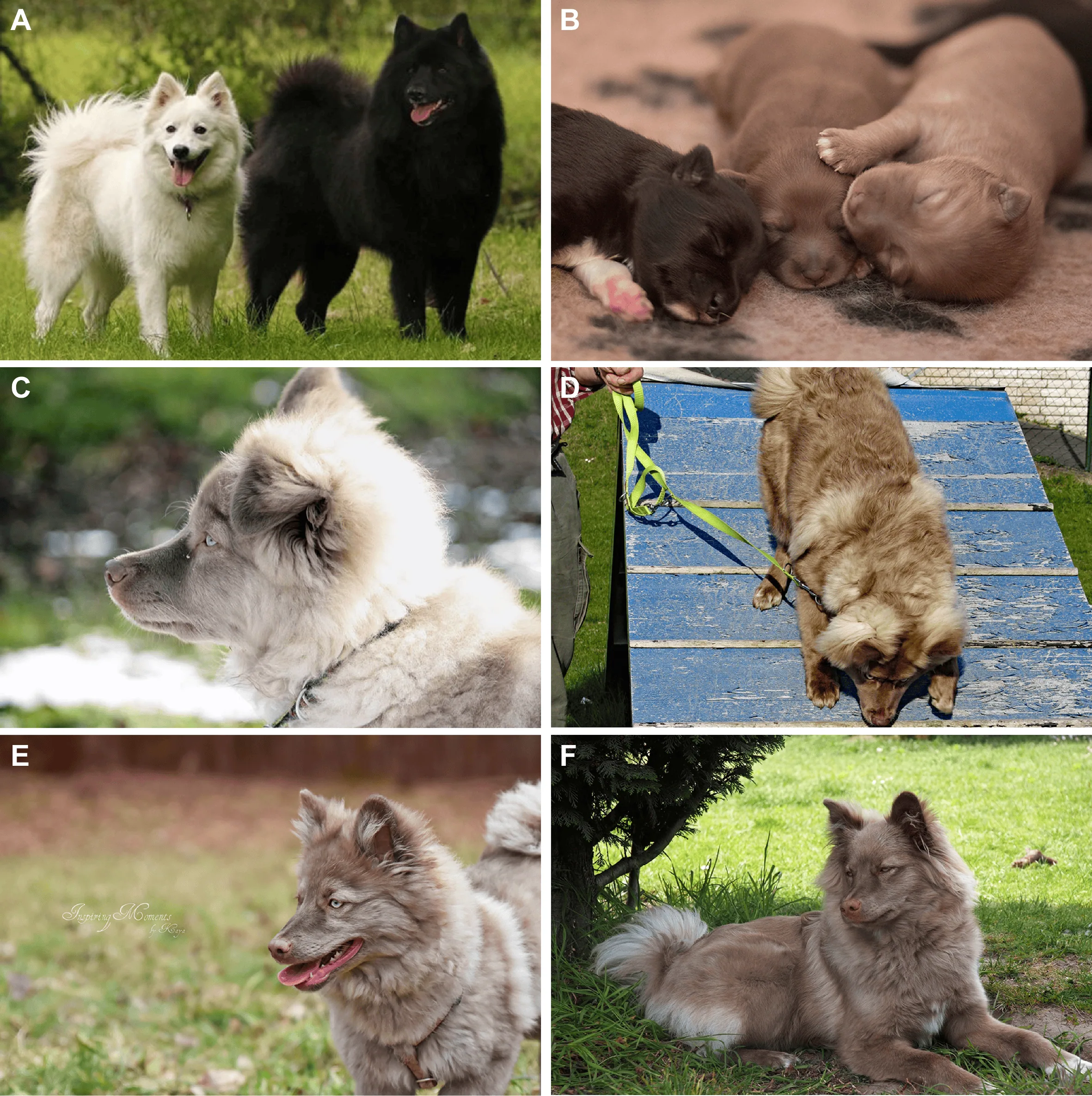
Another type of albinism, tyrosinase-positive OCA2, was confirmed in a litter of German Spitz puppies[7].
The puppies showed a washed-out coat color and pink eyes, but the coat and eyes became slightly darker with age. Affected puppies very light sensitive and had mild vision impairment.
OCA4
Almost every documented case of canine oculocutaneous albinism in dogs traces back to SLC45A2. This is the same gene responsible for white tigers or the “cremello” dilution in horses.
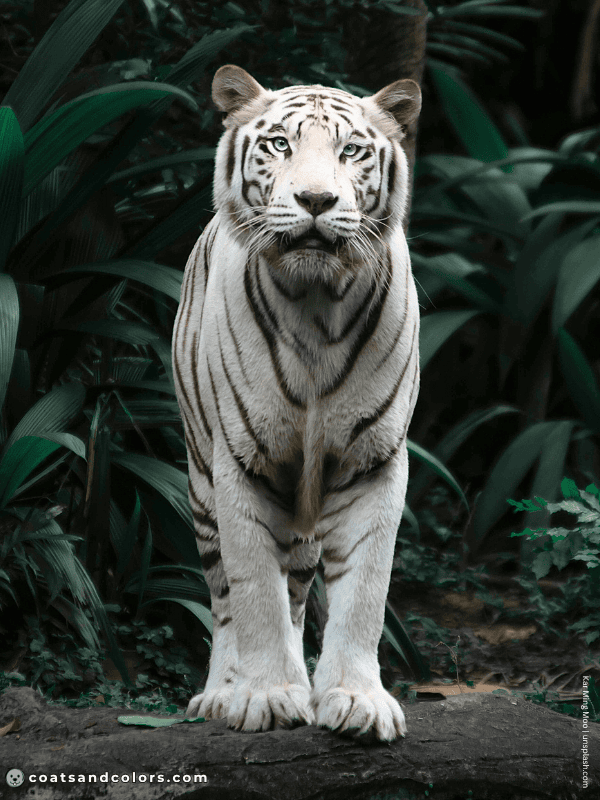
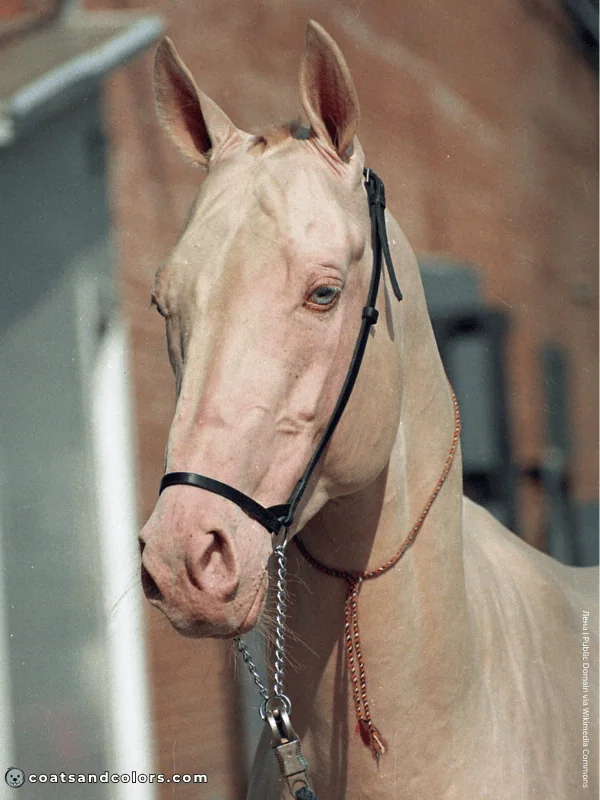
The best-documented case of OCA4 is the white Doberman Pinscher.
Every white Doberman today descends from a single dog registered in 1976. A 2014 study identified the cause as a large deletion in SLC45A2, classifying the phenotype as OCA4[3].
A second, distinct SLC45A2 mutation causes albinism in small breeds. This has been, documented in Lhasa Apsos, Pomeranians, Pekingese, French Bulldogs, or Pugs[4].
Some of these breeds purposely breed albino puppies and advertise them as “pink“.
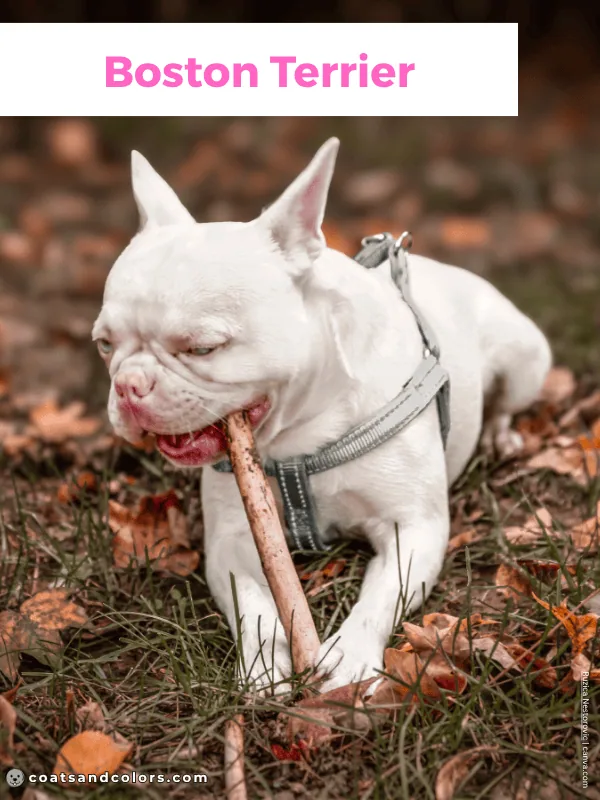
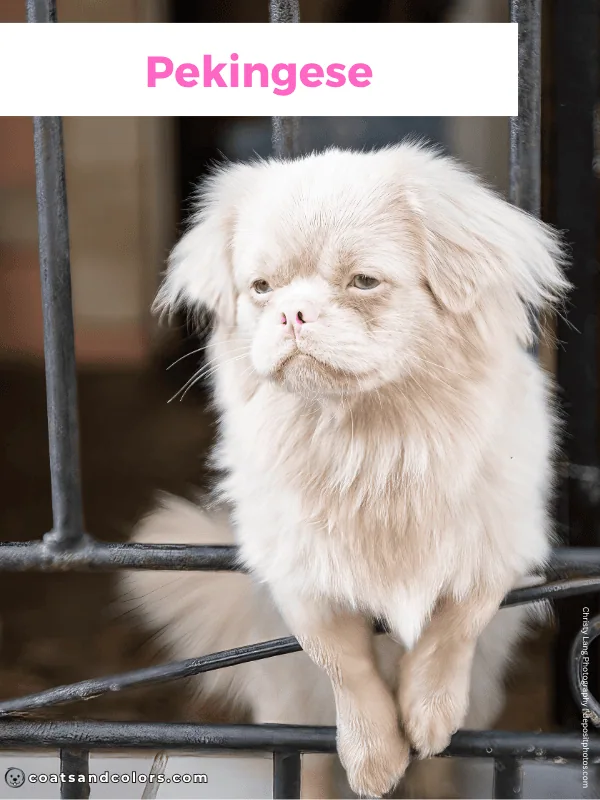
And lastly, yet another mutation of SLC45A2 was found in a Bullmastiff.
Health Considerations
Many albino dogs show behavioral symptoms. They are light sensitive, because the eyes may show abnormal development and lack the pigment that normally shields the retina.
So any animal with albinism can be uncomfortable in bright light.
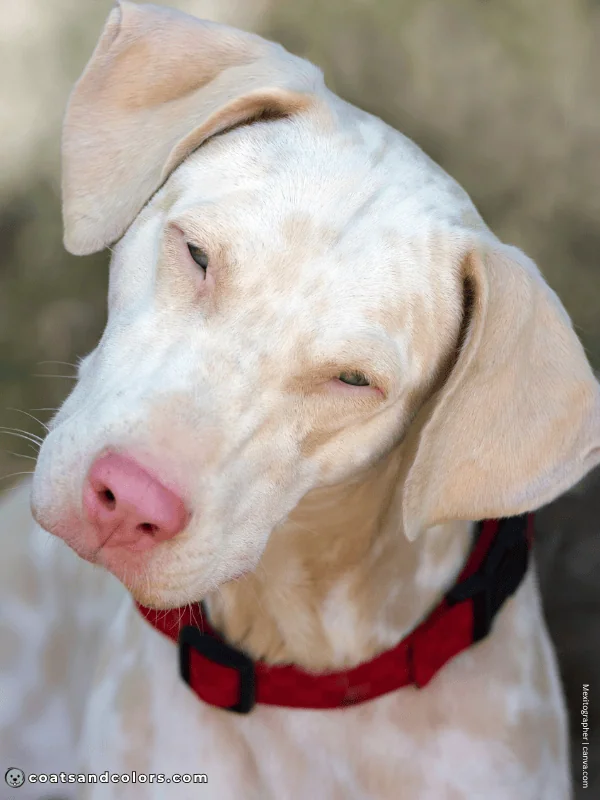
This can lead to a lot of squinting or even vision defects and photophobia.
Their hypopigmented skin is more sensitive to sunlight. Albino dogs have a meaningfully higher rate of skin cancer, since unpigmented skin has no protection from UV radiation.
Monitoring sun exposure matters more for these dogs than for a normally pigmented one.
Albino Dog Breeds
True albinism is genuinely rare in dogs, and ethical breeders generally avoid intentionally producing it, given the behavioral and health implications. Only backyard breeders produce albinos and sell them for their rare “pink” color. Which is not all that rare if you start breeding it on purpose…
Albinism is a recessive condition caused by various loss-of-function mutations. As a result, it may be present in the gene pool of many breeds without anyone realizing it. However, as long as two carriers are not bred together or tests are not conducted to detect it, this trait remains hidden.
Here are some breeds in which albinism has been identified to date:
- Boston Terrier (OCA4)
- Bullmastiff (OCA4)
- Dachshund (OCA1bts)
- Doberman (OCA4)
- French Bulldog (OCA4)
- German Spitz (OCA2)
- Lhasa Apso (OCA4)
- Maltese (?)
- Pekingese (OCA4)
- Pomeranian (?)
- Pug (OCA4)
- Rottweiler (OCA1bts)
- Yorkshire Terrier (OCA4)
Albino Look-Alikes
Just being solid white does not mean a dog is an albino!
True albinism is extremely rare in the general dog population and often misidentified.
It is often confused with other “leucistic” phenotypes.
Leucism can mean a dog shows a partial loss of pigmentation or looks lighter than expected. This typically refers to white markings due disrupted pigment cell migration.
Albinism results in the total loss of melanin synthesis. Albino dogs have pigment cells, but can not make pigment anywhere. This makes them genetically distinct from piebald or cream dogs.
If you see dark skin spotting or even just small irregular dark patches of coat color anywhere on the dog or dark eye or nose colors or black whiskers or nails, the dog is most certainly not albino.

These are all separate traits that could, in theory, all be present at the same time. But I hope there is no unlucky creature out there that is an “extreme white cream dog with double merle and albinism”.
Here are the most common look-alikes:
Cream vs Albino
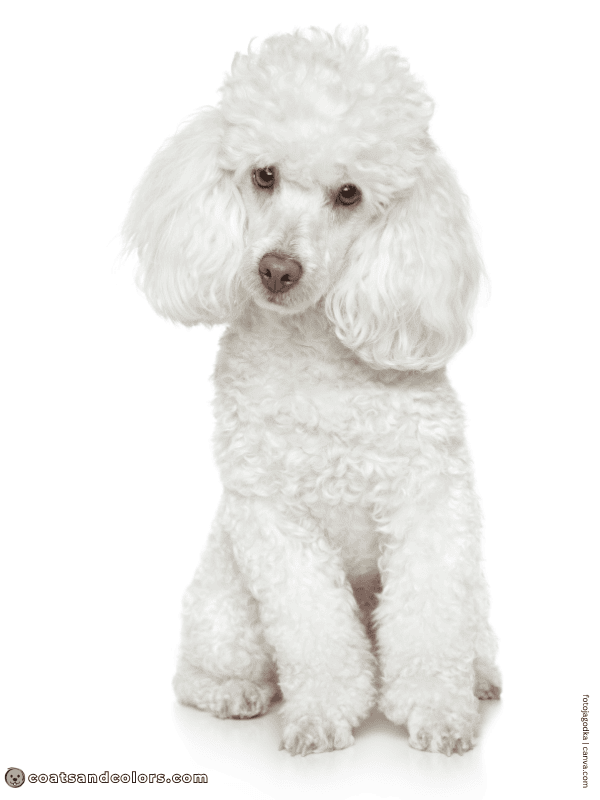
Solid white breeds like Samoyeds or Westies are actually solid red dogs, but with a very low red intensity. They appear cream, but have dark eyes and noses. This separates them from albino dogs.
Light cream is most often confused with albinism when combined with brown pigment (e/e b/b d/d). These dogs have a very light nose color, often hypopigmented, and light eyes.
Double Merle vs Albino
Double merle dogs can end up mostly white with blue eyes, but often still show minor patches of color. This condition comes from an overdose of merle in dogs with two longer merle alleles. This disturbs pigment cell function and survival. But affected dogs still have the theoretical ability to make pigment.
Extreme White vs Albino
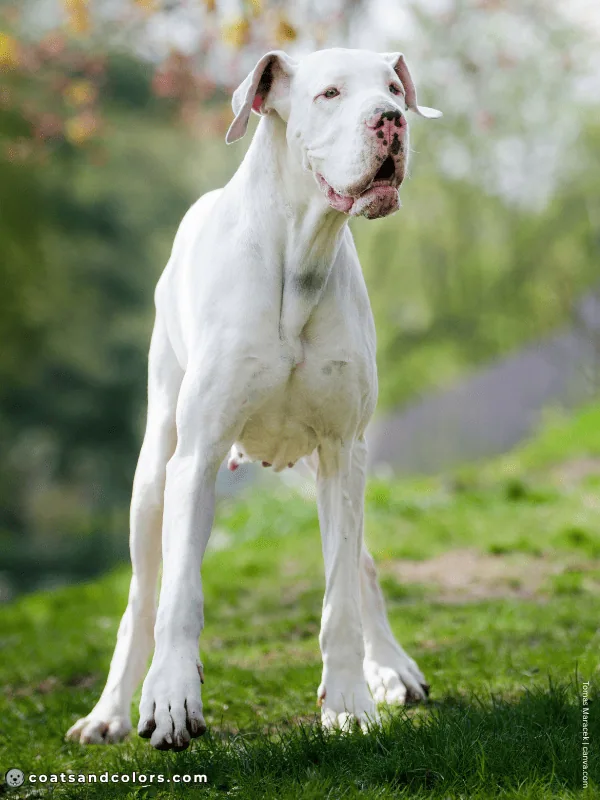
Extreme white from whitehead or piebald can look nearly all white, too. But this happens due to a loss of pigment cells rather than a pathway-wide enzyme failure. These dogs can still have nose and eye pigment and only very, very rarely turn out fully white with pink skin and two blue eyes.
Learn More

Links
[1] Online Mendelian Inheritance in Animals (OMIA). Sydney School of Veterinary Science, University of Sydney.OMIA:001821-9615 (07/2025): Oculocutaneous type IV Albinism. https://omia.org/OMIA001821/9615/
[2] Online Mendelian Inheritance in Animals (OMIA). Sydney School of Veterinary Science, University of Sydney.OMIA:001821-9615 (12/2024): Oculocutaneous type I Albinism. https://omia.org/OMIA000202/9615/
[3] Winkler et al (2014). A partial gene deletion of SLC45A2 causes oculocutaneous albinism in Doberman Pinscher dogs. PLoS One. doi.org/10.1371/journal.pone.0092127
[4] Hiruni R. Wijesena, Sheila M. Schmutz (2015). A Missense Mutation in SLC45A2 Is Associated with Albinism in Several Small Long Haired Dog Breeds. Journal of Heredity. https://doi.org/10.1093/jhered/esv008
[5] Bychkova et al (2021). Identification of a candidate genetic variant for the Himalayan color pattern in dogs. https://doi.org/10.1016/j.gene.2020.145212
[6] Van Buren et al (2025). A TYR-iffic discovery: Identification of a second TYR variant associated with acromelanism in dogs. Anim Genet. https://doi.org/10.1111/age.13496
[7] Caduff et al (2017). OCA2 splice site variant in German Spitz dogs with oculocutaneous albinism. PLoS ONE. https://doi.org/10.1371/journal.pone.0185944
[8] National Organization for Albinism and Hypopigmentation (2025). Information Bulletin – What is Albinism?. https://albinism.org/information-bulletin-what-is-albinism/
[9] Facebook: Albino Dogs
Image Credits
Africa Images/canva.com
Andrey Soldatov/unsplash.com
Christy Lang Photography/depositphotos.com
DemureDragonfly/canva.com
E G/pexels.com
Jenny Moreno/canva.com
Jiří Mikoláš/pexels.com
K/pexels.com
Kar Ming Moo/unsplash.com
Maria Argiroudaki/pexels.com
Mexitographer/canva.com
Ruzica Nestorovic/canva.com
Stuart Robinson/pexels.com
Tomas Maracek/canva.com
Ulrike Stein/canva.com
yhelfman/canva.com
Лена/Wikimedia Commons
Hi! I’m Steffi. I am a biologist and a big time dog nerd. You are curious about coat color genetics? You’ve come to the right place! Read more.